
Sell My Land in Mercer County PA - What Landowners Need to Know
Key Takeaways
- Mercer County's population has declined for well over a decade: The county fell from 116,638 in the 2010 Census to 110,652 in the 2020 Census, and the latest estimate places the count near 107,860 — a loss of nearly 8,800 residents since 2010, tied to the long contraction of the Shenango Valley's steel and manufacturing base, according to U.S. Census Bureau data reported by Wikipedia
- The effective property tax rate runs around 1.47% of market value: Mercer County collects, on average, approximately 1.47% of a property's fair market value in property tax, according to PropertyTax101 — above the Pennsylvania state average of about 1.33% and well above the national average near 1.08%, meaning carrying costs accumulate every year on parcels that produce no income
- Farmland and woodland are both substantial land uses: The 2022 USDA Census of Agriculture counts 1,023 farms across 146,865 acres in Mercer County, including 96,160 acres of cropland and 27,796 acres of woodland — a genuine mixed farm-and-woodlot land base rather than a purely recreational or purely industrial market
How Can You Sell Land in Mercer County Pennsylvania?
You can sell land in Mercer County through three primary paths: listing with a local real estate agent, selling by owner, or requesting a direct cash offer from a buyer — with all sales closing through a title company under Pennsylvania law, subject to a 2% combined transfer tax, and carrying costs around 1.47% annually.
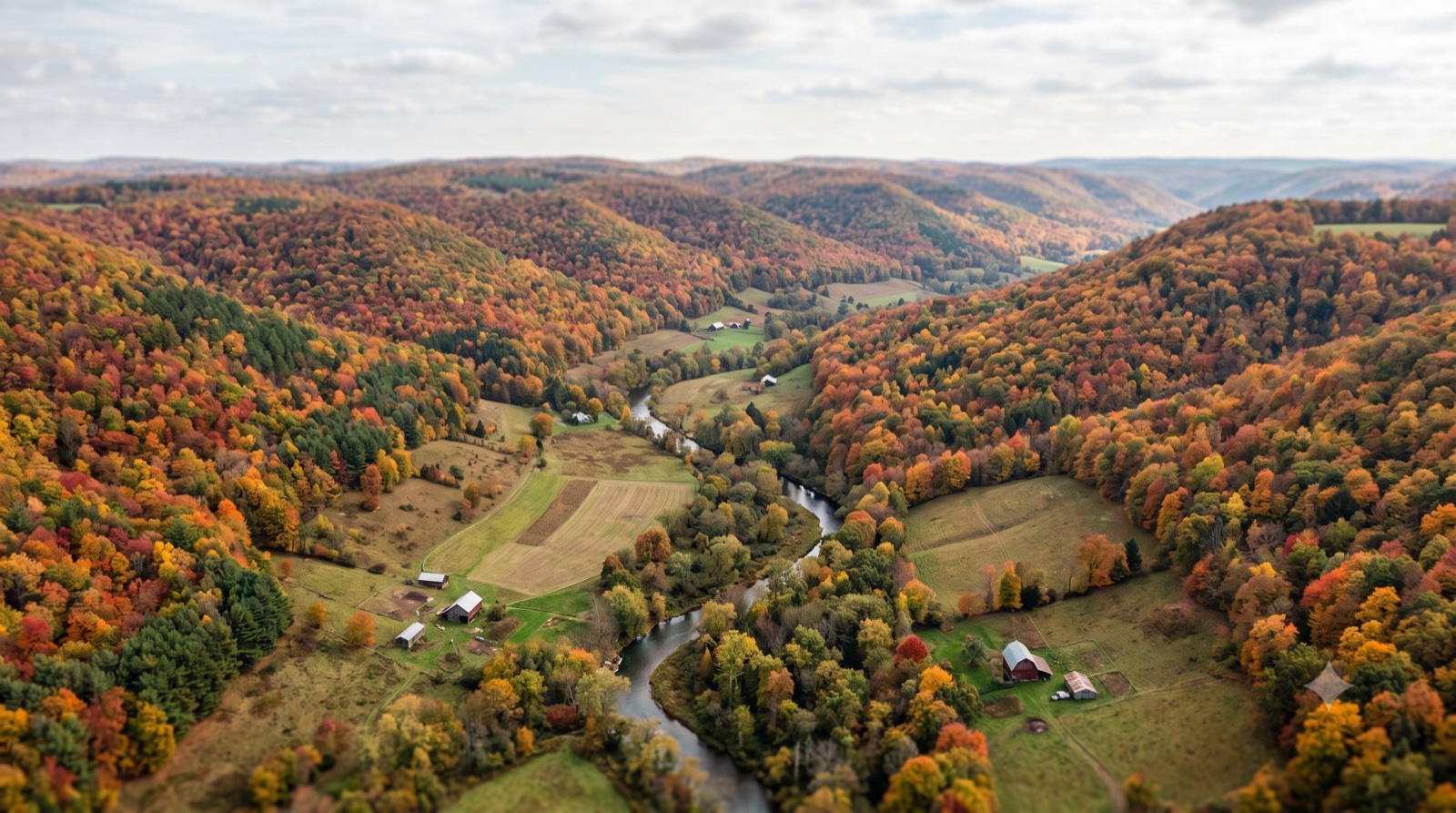
Selling land in Mercer County, Pennsylvania means navigating a northwestern market shaped by a decades-long population decline tied to the collapse of the Shenango Valley's steel and manufacturing economy, a title company-centered closing process, and a land base split between working farm ground and hardwood woodlots. Mercer County covers roughly 673 square miles anchored by the borough of Mercer as county seat, with Hermitage and Sharon forming the county's largest population centers around the old steel corridor, and Greenville and Grove City serving as its other principal boroughs. Unlike the oil-region counties immediately to its east, Mercer's land economy runs more on row crops, hay, and cattle interspersed with hardwood tracts than on legacy oil-and-gas holdings.
Understanding how Pennsylvania's property tax system, realty transfer tax, and title closing requirements interact — and how a declining population and a mixed agricultural base affect buyer demand — will help you set realistic expectations, whether you plan to list on the open market, sell by owner, or request a no-obligation cash offer from a direct buyer. For a statewide overview, start with our guide on how to sell land in Pennsylvania, and browse more county guides on our blog.
What Are the Tax Costs of Holding Land in Mercer County?
Pennsylvania does not use a uniform statewide assessment ratio the way some states do — each county maintains its own assessed values based on periodic reassessments, and Mercer County's assessed values are based on older base-year market data rather than a recent countywide reassessment. The Pennsylvania Department of Revenue publishes an annual Common Level Ratio (CLR) factor — the mathematical reciprocal of the actual common level ratio certified by the State Tax Equalization Board — that translates assessed values into current market-value terms for realty transfer tax purposes. Mercer County's CLR factor for documents accepted July 1, 2026 through June 30, 2027 is 9.52, according to the Pennsylvania Department of Revenue's current factor list — meaning the underlying common level ratio is roughly 10.5% (1 ÷ 9.52), or that assessed values in Mercer County average only about a tenth of current market value. The Department of Revenue's factor list carries no footnote or assessment-base adjustment for Mercer County in the current release, unlike the special adjustment applied to Philadelphia.
Mercer County's effective property tax rate is approximately 1.47% of fair market value, according to PropertyTax101 — above the Pennsylvania state average of roughly 1.33% and well above the national average near 1.08%. The median property tax bill in Mercer County runs about $1,492 on a median home value near $101,700. Total effective rates vary by municipality and school district, as each taxing authority applies its own millage on top of the county rate.
How Property Tax Bills Add Up for Vacant Land
Pennsylvania does not impose a separate higher assessment ratio on vacant land the way some states do — all real property is assessed under the same framework. However, vacant land that produces no income generates a recurring tax obligation with no offset. A parcel carrying a county market value of $50,000 at an effective rate of 1.47% produces an annual tax bill of roughly $735; properties in school districts with above-average millage will face higher combined bills. Over a decade of holding, those payments compound into thousands of dollars on land that may not appreciate fast enough to offset them.
Pennsylvania property tax payments are typically split into installments with deadlines set by each taxing authority — often with a discount period, a face period, and a penalty period. Delinquent taxes are collected by the Mercer County Tax Claim Bureau (125 S. Diamond Street, Suite 3, Mercer, PA 16137, 724-662-3800 ext. 2228/2229/2232/2233). Properties with two or more years of delinquent taxes become eligible for the county's annual Upset Tax Sale — the 2026 sale is scheduled for September 15 at the Penn State Extension County Office in Mercer — where the starting bid equals the total delinquent taxes, costs, and municipal liens, and the buyer takes title subject to any existing mortgages and judgments. A continued upset sale follows in October at the county courthouse for parcels that don't sell the first time, and unsold parcels can proceed toward a judicial sale where title passes free and clear of most tax and municipal claims, mortgages, and liens. If you've inherited land with an unclear title or unpaid taxes, our guide on selling land with back taxes explains your options before the Tax Claim Bureau schedules a sale.
Beyond taxes, vacant landowners in Mercer County face liability insurance costs, potential fence and boundary maintenance expenses, and the carrying cost of holding an illiquid asset in a rural market with a shrinking population base. Our guide on how much is my land worth explains the factors that drive valuation for rural parcels.
Clean and Green Act 319 Preferential Assessment
Landowners with parcels of at least 10 acres devoted to agricultural use, open space, or forest reserve can apply for Pennsylvania's Clean and Green program (Act 319), which taxes land based on use value rather than fair market value — ordinarily producing significant tax savings, according to the Pennsylvania Department of Agriculture. Given that the USDA counts more than 27,000 acres of woodland within Mercer County farms alone, alongside nearly 100,000 acres of cropland, both the agricultural-use and forest-reserve categories are relevant here. Enrolled parcels must remain in qualifying use; withdrawing from the program triggers a rollback tax equal to seven years of the difference between market-value taxes and use-value taxes, plus 6% interest per year. Applications and Clean and Green information run through the Mercer County Tax Assessment Office (125 S. Diamond Street, Suite 4, Mercer, PA 16137, 724-662-7551). If your parcel is enrolled, factor the rollback exposure into your net proceeds before agreeing to a sale price.
What Zoning and Closing Rules Apply to Mercer County Land?
Zoning in Mercer County is handled at the municipal level rather than countywide, so land use requirements vary depending on which township, borough, or city your parcel sits in. For zoning and permitting questions, contact the relevant municipal supervisors or the Mercer County planning staff directly, since ordinances differ significantly between the more built-up Hermitage/Sharon corridor and the county's rural townships.
For current deed information, legal descriptions, and recorded easements, contact the Mercer County Recorder's Office (125 S. Diamond Street, Suite 109, Mercer, PA 16137, 724-662-3800, Mon–Fri 8:30 a.m. – 4:30 p.m.). This office records deeds, mortgages, and other land instruments for the county.
Pennsylvania's Title Company Closing Process
Pennsylvania does not require a licensed attorney to conduct real estate closings. Most land transactions in the state are handled by a title company or settlement agent, which coordinates the title search, prepares closing documents, disburses funds, and records the deed with the county recorder. Attorneys are often involved but are not legally required for the closing itself.
The closing process for land in Mercer County typically works as follows:
- Title search: The title company searches public land records through the Mercer County Recorder's Office to verify clear title — no outstanding liens, unpaid taxes, or unresolved encumbrances
- Title insurance: A lender's or owner's title insurance policy protects against defects not found in the standard search
- Closing: Buyer, seller, and agents execute the deed and settlement statement; the title company or settlement agent oversees the signing
- Recording: After closing, the deed is recorded with the Mercer County Recorder's Office, making the transfer part of the public record
For more detail on what documents are needed to complete a Pennsylvania land sale, our guide on paperwork needed to sell land covers the full checklist.
Pennsylvania Realty Transfer Tax
Pennsylvania imposes a 1% state realty transfer tax on all real property transfers, according to the Pennsylvania Department of Revenue. In addition, a local realty transfer tax of typically 1% applies, split between the municipality and school district — bringing the combined total to 2% in most of Mercer County. Some municipalities may charge a slightly different local rate.
By custom and in most transactions, the tax is split equally between buyer and seller — each paying 1% of the sale price — though the allocation can be negotiated. Cash buyers who advertise "no closing costs to seller" typically absorb both sides of the transfer tax as part of the offer terms. For a fuller breakdown of how these costs are divided, see our guide on who pays closing costs when selling land. The deed must be recorded with the Recorder's Office in the county where the property is located.
How Does Mercer County Compare to Neighboring Pennsylvania Counties?
Mercer County's population of approximately 107,860 has declined steadily from the 2010 Census count of 116,638 and the 2020 count of 110,652, according to U.S. Census Bureau data reported by Wikipedia — a loss of nearly 8,800 residents in roughly 15 years. Median household income of approximately $59,976 runs below the state median, and the poverty rate sits near 13.2% (Data USA), above the national figure of about 12.5%. That trajectory tracks the long contraction of the Shenango Valley's steel and heavy-manufacturing base around Sharon and Farrell, a decline that began decades before most of the region's mills finally closed and that continues to shape the county's land and housing markets today.
Population, Tax Rate, and Land Character Across the Region
Mercer County sits in northwestern Pennsylvania, bordered by Crawford County to the north, Venango County to the east, Butler County to the southeast, and Lawrence County to the south (plus Ohio's Mahoning and Trumbull counties to the west, outside Pennsylvania's tax and closing framework). Of its Pennsylvania neighbors, Butler County has grown into a Pittsburgh exurb with a much higher median income, while Lawrence and Crawford counties share Mercer's post-industrial population trend.
| Factor | Mercer County | Lawrence County | Butler County | Crawford County |
|---|---|---|---|---|
| Population (2024 est.) | ~107,860 | ~85,024 | ~197,254 | ~82,716 |
| Population trend | Declining | Declining | Growing | Declining |
| Effective tax rate | ~1.47% | ~1.55% | ~1.28% | ~1.65% |
| CLR factor (2026–27) | 9.52 | 2.20 | 16.67 | 6.33 |
| Median household income | ~$59,976 | ~$61,931 | ~$89,843 | ~$60,476 |
| Poverty rate | ~13.2% | ~11.9% | ~8.2% | ~14.3% |
| Defining feature | Shenango Valley steel corridor, mixed farm/woodlot | South of Mercer, New Castle steel legacy | Pittsburgh exurb growth, highest CLR factor in the group | Largest neighbor by land area, Pymatuning |
Mercer County's economy employs a workforce concentrated in health care, manufacturing, and retail trade, according to Data USA — Health Care & Social Assistance (about 8,855 workers) and Manufacturing (about 7,467 workers) remain the two largest sectors, a manufacturing base that is a fraction of its mid-20th-century peak but still larger, relative to population, than in many rural Pennsylvania counties. Hermitage and Sharon anchor the county's commercial and retail activity, while Grove City and Greenville serve the more agricultural western and northern townships.
The 2022 USDA Census of Agriculture counts 1,023 farms across 146,865 acres in Mercer County — down 12% and 6% respectively since 2017 — averaging 144 acres per farm. Land in farms breaks down as roughly 96,160 acres of cropland, 27,796 acres of woodland, and 15,331 acres of pastureland. The leading crops by acreage are corn for grain (about 26,749 acres), forage — hay and haylage — (about 26,159 acres), and soybeans (about 22,634 acres), with cattle and calves the leading livestock category by both head count and sales rank. That mix makes Mercer County a genuine working-farm market layered with hardwood woodlots, rather than a purely recreational timber county like several of its Allegheny Plateau neighbors to the east. If your land is active or recently active farm ground, our guide on selling farmland covers what drives value for working acreage, and our guide on selling timberland covers the wooded portions of a mixed parcel.
For a broader view of land markets across the region, explore our blog.
What Are Your Options for Selling Land in Mercer County?
With a population that has declined by roughly 8,800 residents since 2010, an effective tax rate near 1.47%, and a land base split between working farms and hardwood woodlots, Mercer County landowners face a clear carrying-cost equation: annual property taxes, insurance, and maintenance accumulate every year a parcel sits unsold in a market with fewer local buyers each census cycle. Understanding what your land is actually worth — and whether it's positioned as farm ground, timber, or a mixed parcel — is the logical first step. Our guide on how much is my land worth explains the factors that drive valuation for rural parcels, and our guide on paperwork needed to sell land covers what you'll need to gather before listing or closing.
Before pursuing any sale path, verify your property's legal description through the Mercer County Recorder's Office (724-662-3800, 125 S. Diamond Street, Suite 109, Mercer). Confirm property tax status with the Tax Claim Bureau (724-662-3800 ext. 2228/2229/2232/2233, 125 S. Diamond Street, Suite 3, Mercer) to ensure no delinquent amounts could complicate closing, and check assessment or Clean and Green enrollment questions with the Tax Assessment Office (724-662-7551, 125 S. Diamond Street, Suite 4, Mercer). If your parcel is enrolled in Clean and Green, understand the rollback tax exposure before agreeing to a sale price.
Mercer County landowners have several selling paths:
Listing with a local real estate agent familiar with northwestern Pennsylvania farm and recreational land offers market exposure to buyers searching for tillable acreage, hunting ground, or camp properties. However, agent commissions of approximately 5–6%, combined with Pennsylvania's 2% transfer tax and title company fees, reduce net proceeds. And in a market with a shrinking local buyer base, carrying costs continue accumulating through a listing period that can stretch for many months. Whether an agent makes sense depends on your timeline — our guide on whether you need a realtor to sell land weighs the tradeoffs.
Selling by owner (FSBO) eliminates agent commissions but requires the seller to handle marketing, disclosures, and coordinating the title company. This can be especially involved for out-of-state owners; our guide on selling land as an out-of-state owner covers how to close remotely. Online platforms provide some exposure to farm and recreational buyers, but larger or oddly shaped parcels can be especially hard to move.
For landowners who want to avoid extended timelines and ongoing carrying costs, companies like Jerez Land provide direct cash offers priced individually to the parcel — a firm written number, not a range or a formula. We absorb the carrying costs, marketing risk, and resale uncertainty, and we close in weeks rather than months. There are no agent commissions, and the title company closing process that Pennsylvania uses applies equally. Request a cash offer to see what your parcel is worth to a direct buyer.
Frequently Asked Questions
I own vacant land in Mercer County PA — what are my selling options?
Verify your property description through the Mercer County Recorder's Office (724-662-3800, 125 S. Diamond Street, Suite 109, Mercer) and confirm tax status with the Tax Claim Bureau. Pennsylvania land sales close through a title company or settlement agent — no attorney is legally required. You can list with a local agent, sell by owner, or request a direct cash offer from a land buyer.
What is the property tax rate in Mercer County PA?
Mercer County's effective property tax rate is approximately 1.47% of fair market value, according to PropertyTax101 — above the Pennsylvania state average of about 1.33%. Total taxes vary by municipality and school district, as each applies additional millage on top of the county rate. The Pennsylvania Department of Revenue's Common Level Ratio factor for Mercer County is 9.52 for documents accepted July 1, 2026 through June 30, 2027, meaning assessed values average roughly a tenth of current market value.
I inherited 60 acres of mixed farm and woodland outside Greenville and I live out of state — how do I sell it without traveling back?
You don't need to be present in Pennsylvania to sell. A title company can handle the search, closing documents, and recording remotely, and documents can typically be signed via mail-away or remote notarization. Start by confirming the deed and any probate paperwork through the Mercer County Recorder's Office, then decide whether to list with a local agent, sell by owner, or request a direct cash offer — our guide on selling land as an out-of-state owner walks through each option in detail.
My family has held a Mercer County farm parcel for decades and it's enrolled in Clean and Green — what happens if I sell?
Selling a Clean and Green (Act 319) parcel does not automatically trigger the rollback tax by itself, but taking the land out of qualifying agricultural, open-space, or forest-reserve use — which a buyer planning a different use might do — does. The rollback equals seven years of the difference between market-value taxes and use-value taxes, plus 6% annual interest, and it becomes a lien against the property. Confirm your parcel's enrollment status and exposure with the Mercer County Tax Assessment Office before agreeing to a sale price so it's accounted for in your net proceeds.
What transfer taxes will I owe when I sell my Mercer County land?
Yes, you will owe transfer tax. Pennsylvania imposes a 1% state realty transfer tax on all property transfers, plus a local tax that is typically 1% in most of Mercer County — bringing the combined rate to approximately 2% of sale price, according to the Pennsylvania Department of Revenue. By custom, this tax is split equally between buyer and seller (each paying 1%), though the split can be negotiated. Cash buyers sometimes cover both sides as part of their offer terms.
I have 15 acres that's half hayfield and half woods near Grove City — will buyers even want a mixed parcel like that?
Yes — mixed farm-and-woodlot parcels are common and normal in Mercer County, where the USDA counts both roughly 96,000 acres of cropland and nearly 28,000 acres of woodland across the county's farms. Buyer interest depends more on access, road frontage, and whether the tillable portion is currently rented or fallow than on the crop/woods split itself. A direct cash buyer can evaluate a mixed parcel as a single unit rather than requiring you to separate or subdivide it before selling.
Disclaimer: This article is for informational purposes only and does not constitute legal, financial, or professional advice. Laws and regulations vary by jurisdiction and change over time. Always consult with qualified professionals before making land purchase decisions. Jerez Land is not responsible for actions taken based on this information.