
Sell My Land in Northumberland County PA - What Landowners Need to Know
Key Takeaways
- Northumberland County's population has fallen in nine of the last ten census counts since 1930: from a peak of 128,504 residents in 1930 to 91,647 in the 2020 Census — a cumulative decline of nearly 29% — with the sole exception being a slight 1.2% uptick between 1970 and 1980; the U.S. Census Bureau's Wikipedia-cited estimate puts the county near 89,920 residents today, a continued modest decline
- Northumberland's assessed values sit far below current market levels: the Pennsylvania Department of Revenue's Common Level Ratio factor for the county is 10.53 for documents accepted July 1, 2026 through June 30, 2027, meaning county-assessed values average only about 9.5% of actual current market value — while the effective property tax rate itself runs a comparatively modest 1.13% of market value, ranking Northumberland 65th of Pennsylvania's 67 counties, according to PropertyTax101
- Farmland covers roughly 42% of the county: the 2022 USDA Census of Agriculture counted 724 farms working 122,483 acres — about 41.8% of the county's 458 square miles (293,120 acres) of land area — alongside a coal-mining legacy in the county's southern tier, where the Western Middle Anthracite Field threads through former mining towns including Shamokin and Mount Carmel
How Can You Sell Land in Northumberland County Pennsylvania?
Yes — you can sell land in Northumberland County through a title company closing (Pennsylvania's standard method, no attorney required), by listing with a local real estate agent, or by requesting a direct cash offer from a land buyer. The process starts with a title search confirming exactly what you own — surface only, or surface plus coal, oil, and gas rights — since much of this former anthracite county's mineral estate was severed from the surface generations ago, and it runs alongside Pennsylvania's realty transfer tax and a county assessment system that sits far below current market value.
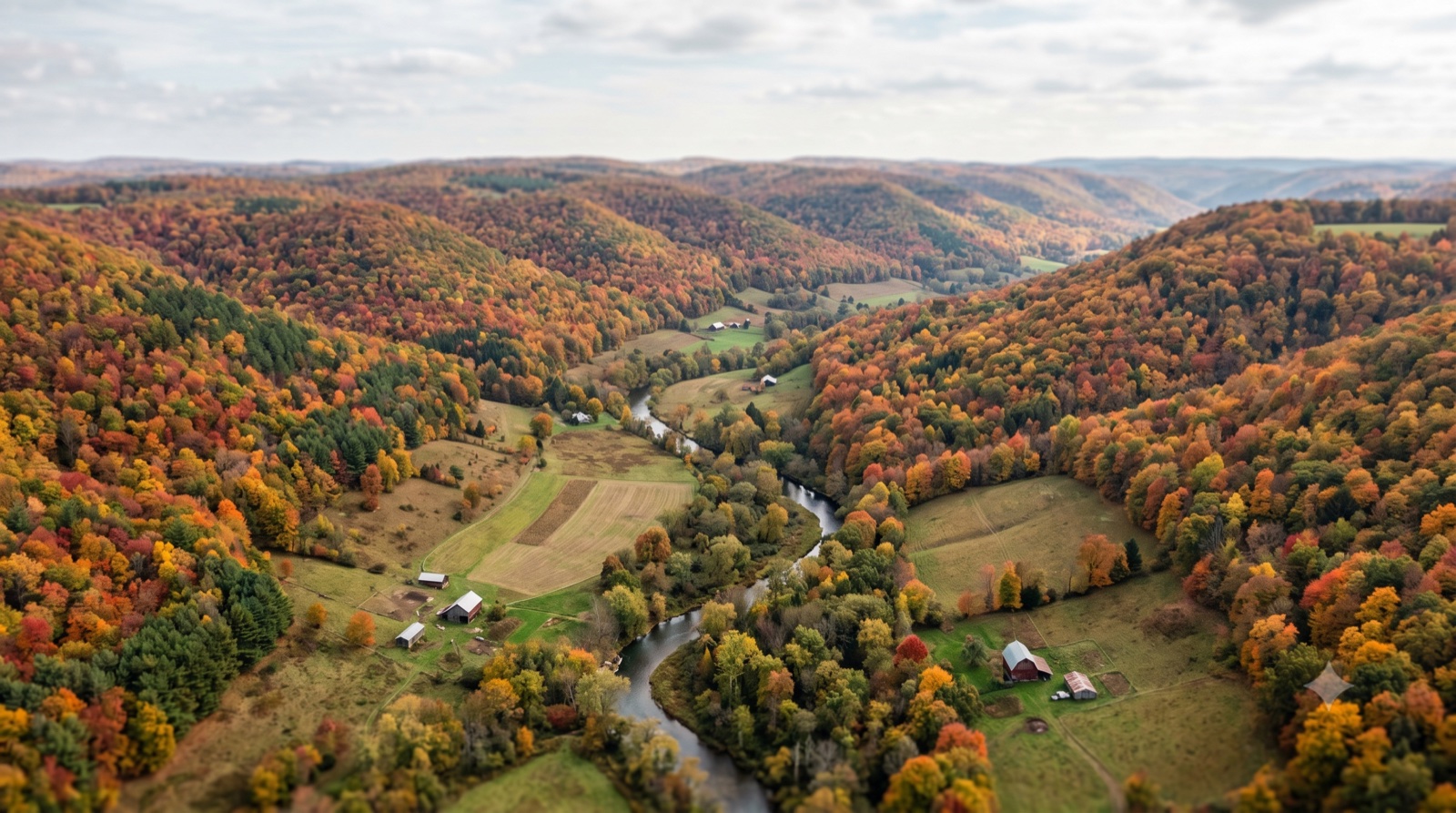
Selling land in Northumberland County, Pennsylvania means navigating a rural-and-small-city market shaped by a century of coal mining, a long population decline that has only briefly paused, and a title company-centered closing process common across the state. Northumberland County covers roughly 458 square miles of land in central Pennsylvania's Susquehanna Valley, anchored by the county seat of Sunbury, where the North and West Branches of the Susquehanna River meet. Anthracite coal mining was historically the county's main employer, with underground mines dotting the landscape through the early-to-mid 20th century before operations began winding down in the 1950s, according to Wikipedia — a legacy still visible today in reclaimed culm banks, former mine patch towns, and split mineral titles across the southern half of the county. Alongside that coal history, Northumberland remains a working farm county: the 2022 USDA Census of Agriculture counted 724 farms averaging 169 acres apiece, working 122,483 acres — mostly cropland, with smaller shares in woodland and pasture — and generating a market value of products sold that rose 27% between 2017 and 2022.
Understanding how Pennsylvania's property tax and Common Level Ratio system, realty transfer tax, and title closing requirements interact — and how the county's anthracite coal history factors into a mineral-rights title search — will help you set realistic expectations, whether you plan to list on the open market, sell by owner, or request a no-obligation cash offer from a direct buyer. For a statewide overview, start with our guide on how to sell land in Pennsylvania.
This guide covers Northumberland County's tax and assessment mechanics, the Pennsylvania closing process and realty transfer tax, how Northumberland compares to neighboring counties, and the practical options available to landowners ready to sell. For the full range of topics affecting Pennsylvania sellers, browse our blog.
What Are the Tax Costs of Holding Land in Northumberland County?
Northumberland County's effective property tax rate runs around 1.13% of a property's fair market value, according to PropertyTax101 — below the national average near 1.08% by only a small margin, and ranking the county 65th of Pennsylvania's 67 counties. The median property tax bill on the county's median home value of $93,500 runs about $1,055 a year; total effective rates vary by municipality and school district, since each taxing authority sets its own millage on top of the county rate.
Pennsylvania counties do not reassess property on a fixed schedule, and Northumberland's assessed values are pegged to an old base year, corrected each year by a Common Level Ratio (CLR) factor published by the Pennsylvania Department of Revenue. The Department's current factor list shows Northumberland County's CLR factor is 10.53 for documents accepted July 1, 2026 through June 30, 2027 — meaning assessed values average only about 9.5% of current market value. That factor gets applied whenever a deed's stated consideration is challenged for realty transfer tax purposes, multiplying the assessed value up to an estimated fair-market equivalent; in most ordinary sales, though, the transfer tax is simply based on the actual price stated in the deed. Vacant land carrying a low, decades-old assessment can look artificially cheap to hold on paper — a gap worth understanding before you set expectations for a sale.
Delinquent Pennsylvania property taxes are collected at the county level under the state's Real Estate Tax Sale Law. Contact the Northumberland County Assessment Bureau (399 Stadium Drive, Sunbury, PA 17801, 570-988-4112) to confirm your parcel's current assessed value, or the Northumberland County Tax Claim Bureau (399 Stadium Drive, Third Floor, Sunbury, PA 17801, 570-988-4116) to confirm whether any delinquent balance exists before you list or accept an offer. If you're behind on payments, our guide on selling land with back taxes explains your options before a tax sale is scheduled. If you've inherited land and aren't sure of its tax or title status, how to sell inherited land walks through the process.
Clean and Green Act 319 Preferential Assessment
Landowners with at least 10 acres devoted to agricultural use, open space, or forest reserve can apply for Pennsylvania's Clean and Green program (Act 319), which taxes enrolled land at use value rather than fair market value, according to the Pennsylvania Department of Agriculture. Given that farmland covers roughly 42% of Northumberland County's land area, this program is directly relevant to many sellers here. Withdrawing enrolled land from Clean and Green triggers a rollback tax — seven years of the difference between market-value taxes and use-value taxes, plus 6% annual interest — so if your parcel is enrolled, factor that rollback exposure into your net proceeds before agreeing to a sale.
What Zoning and Closing Rules Apply to Northumberland County Land?
Zoning in Northumberland County is set at the municipal level rather than countywide, so requirements vary depending on which of the county's boroughs or townships your parcel sits in — many of the county's rural townships outside Sunbury, Shamokin, and Mount Carmel are lightly zoned or unzoned. For zoning and permitting questions, contact the supervisors for the township where your land is located.
For deed history, legal descriptions, and recorded easements, contact the Northumberland County Register & Recorder (201 Market Street, 1st Floor, Sunbury, PA 17801, 570-988-4143), where Tina Mertz currently serves as Register & Recorder and also as Clerk of Orphans' Court. The office records all documents relating to real estate, along with related filings, and offers a free Record Alert service to flag any document recorded against your name.
A Note on the Anthracite Coal Legacy, Mineral Rights, and Mine Subsidence
Northumberland County's southern tier sits within the Western Middle Anthracite Field, one of Pennsylvania's four historic anthracite coal fields, which threads across Schuylkill, Northumberland, and Columbia counties through mining towns including Shamokin and Mount Carmel, according to Wikipedia. Nearby Kulpmont grew up around the Scott Colliery, whose operations left a lasting mark on the Shamokin Creek watershed through acid mine drainage — one example of the environmental and title legacy that anthracite mining left across this part of the county. As is common practice across Pennsylvania's coal counties, coal, oil, and gas rights beneath a surface tract were frequently sold or reserved separately from the surface, sometimes generations ago — a title search through the Register & Recorder is the only reliable way to confirm whether your deed conveys those rights or only the surface. This guide does not, and cannot, tell you whether any specific parcel sits over old mine workings, has a culm bank on it, or quantify subsidence risk — that determination requires checking the parcel directly.
To check, Pennsylvania's Department of Environmental Protection maintains the MSI Risk mapping tool at gis.dep.pa.gov/msiRisk, searchable by address or coordinates, and a site-specific mine-map request form through its Office of Active and Abandoned Mine Operations for a more detailed report. The DEP also administers a Mine Subsidence Insurance program, running since 1961, that covers buildings and structures (not vacant land) against collapse of underground coal or clay mines — coverage that homeowner's policies typically exclude — at a published rate of roughly 27 cents per $1,000 of coverage, with limits from $5,000 to $1,000,000. That program is relevant if you or a future buyer plan to build; it is not a substitute for a site-specific mine-map check on raw land. If your title search turns up severed coal, oil, or gas rights, or if your parcel sits over former underground workings, our guides on selling land with severed mineral or oil-and-gas rights and selling land over a former underground coal mine explain how these issues affect a sale.
Pennsylvania's Title Company Closing Process
Pennsylvania does not require a licensed attorney to conduct real estate closings. Most land transactions are handled by a title company or settlement agent, which runs the title search, prepares closing documents, disburses funds, and records the deed with the county recorder. Attorneys are often involved but are not legally required for the closing itself.
The closing process for land in Northumberland County typically works as follows:
- Title search: The title company searches public land records through the Northumberland County Register & Recorder to verify clear title — no outstanding liens, unpaid taxes, or unresolved encumbrances — and to identify any severed coal, oil, or gas interests
- Title insurance: A lender's or owner's title insurance policy protects against defects not caught in the standard search
- Closing: Buyer, seller, and any agents execute the deed and settlement statement, typically overseen by the title company or settlement agent
- Recording: After closing, the deed is recorded with the Northumberland County Register & Recorder, making the transfer part of the public record
For the full documentation checklist, see our guide on paperwork needed to sell land.
Pennsylvania Realty Transfer Tax
Pennsylvania imposes a 1% state realty transfer tax on all real property transfers, according to the Pennsylvania Department of Revenue. A local realty transfer tax also applies — commonly around 1% statewide, split between the municipality and school district — but the exact local rate is set independently by each of Northumberland County's boroughs and townships and their school districts, so it can vary; confirm the specific rate for your parcel's municipality with the settlement agent handling your closing rather than assuming a countywide figure.
By custom, the tax is typically split equally between buyer and seller, though the allocation can be negotiated. Cash buyers who advertise no closing costs to the seller typically absorb both sides of the transfer tax as part of their offer terms. The deed must be recorded with the Register & Recorder in the county where the property is located.
How Does Northumberland County Compare to Neighboring Pennsylvania Counties?
Northumberland County's population of 91,647 (2020 Census) is down from 94,528 in 2010, and the county's own trajectory since 1930 tells a longer story: from a peak of 128,504 residents that year, the county declined in nine of the next ten census counts, with the lone exception a slight 1.2% increase between 1970 and 1980, for a cumulative decline of nearly 29% by 2020. The Census Bureau's most recent estimate, cited on Wikipedia's county profile, puts the population near 89,920 — a continued modest decline. Northumberland borders nine counties: Lycoming, Montour, Columbia, and Schuylkill to the north and east, Dauphin to the south, and Snyder, Union, Perry, and Juniata across the Susquehanna to the west, per Wikipedia.
| Factor | Northumberland County | Snyder County | Schuylkill County | Columbia County |
|---|---|---|---|---|
| County seat | Sunbury | Middleburg | Pottsville | Bloomsburg |
| Population (2020 Census) | 91,647 | 39,736 | 143,049 | 64,727 |
| Effective property tax rate | ~1.13% | ~1.17% | ~1.57% | ~1.17% |
| Common Level Ratio factor (2026–2027) | 10.53 | 10.87 | 1.00 | 7.35 |
| Regional character | Susquehanna Valley mix of anthracite coal towns and farmland | Ridge-and-valley farmland, Plain-sect farming presence | Anthracite coal heritage, mixed farmland and hardwood ridges | Susquehanna Valley farmland, home to the Centralia mine-fire site |
Effective property tax rates per PropertyTax101; CLR factors per the Pennsylvania Department of Revenue's current factor list; figures are county averages and vary by municipality and school district within each county.
Northumberland's Place in the Western Middle Anthracite Field
Northumberland, Schuylkill, and Columbia counties all share a stretch of the Western Middle Anthracite Field, and each carries some version of the same legacy: former mine lands and patch towns, split mineral titles on older parcels, and — in Columbia County's case — the extreme example of Centralia, the town largely abandoned over an underground mine fire that has burned since 1962. Northumberland's own land base splits between the agricultural acreage tracked in the 2022 USDA Census of Agriculture — 724 farms averaging 169 acres, with cropland (93,133 acres) making up the largest share of farmed land, followed by woodland (16,838 acres) and pasture (6,032 acres) — and additional unfarmed hardwood ridgeline and reclaimed mine-land acreage that doesn't show up in farm statistics at all. Livestock, poultry, and products accounted for 66% of the county's $196.9 million in 2022 agricultural sales, with poultry and eggs alone contributing roughly $83.5 million, according to the USDA. If your land is timber or hunting acreage rather than working farmland, our guides on selling timberland and selling hunting land cover what drives value for recreational parcels; if it's cropland or pasture, selling farmland covers the basics for working ag land. For a look at how a neighboring anthracite county handles a similar mix, see our guides to Snyder County and Schuylkill County.
What Are Your Options for Selling Land in Northumberland County?
With a population that has declined in nearly every census since 1930, a Common Level Ratio factor of 10.53 signaling assessed values that sit far below current market levels, and — for many older parcels in the southern coal towns — coal, oil, or gas rights that may have been severed from the surface generations ago, Northumberland County landowners face a straightforward carrying-cost equation: taxes, insurance, and maintenance accumulate every year a parcel sits unsold, and an unclear mineral-rights picture can slow down a sale further. Understanding what your land is actually worth — and exactly what you own — is the logical first step. Our guide on how much is my land worth explains the factors that drive valuation for rural parcels.
Before pursuing any sale path, verify your property's legal description and mineral-rights status through the Northumberland County Register & Recorder (570-988-4143, 201 Market Street, 1st Floor, Sunbury, PA 17801), and confirm your current assessed value and tax status with the Northumberland County Assessment Bureau (570-988-4112, 399 Stadium Drive, Sunbury, PA 17801) or delinquent-tax status with the Tax Claim Bureau (570-988-4116, 399 Stadium Drive, Third Floor, Sunbury, PA 17801). If your parcel is enrolled in Clean and Green, understand the rollback tax exposure before agreeing to a sale price. Out-of-state owners can find more on remote selling in our guide on selling land as an out-of-state owner.
Northumberland County landowners have several selling paths:
Listing with a local real estate agent familiar with the county's farm and small-town buyers offers market exposure, but agent commissions of approximately 5–6%, combined with Pennsylvania's transfer tax and title company fees, reduce net proceeds — and in a market that has been shrinking for most of the last century, carrying costs continue accumulating through a listing period that can stretch for months. Our guide on whether you need a realtor to sell land weighs the tradeoffs.
Selling by owner (FSBO) eliminates agent commissions but puts the burden of marketing, disclosures, mineral-rights research, and coordinating a title company on you. Raw or access-limited parcels — including former mine land or landlocked tracts — can be especially difficult to move this way; see our guide on selling raw, undeveloped land if that describes your tract.
For landowners who want to avoid extended timelines, ongoing tax exposure, and the uncertainty of a thin rural market, companies like Jerez Land provide direct cash offers priced individually to the parcel — a firm written number, not a range or a formula. We absorb the carrying costs, marketing risk, and resale uncertainty, and we close in weeks rather than months. There are no agent commissions, and the same title company closing process applies. Request a cash offer to see what your parcel is worth to a direct buyer.
Frequently Asked Questions
I inherited a few acres above Shamokin and I've been told there are old mine workings under it — can I still sell?
Yes. You can sell land even if underground mine workings are mapped beneath it — you're simply required to disclose what you know and let a title search and, if a buyer requests one, a site-specific mine-map check confirm the condition of the parcel. Check Pennsylvania DEP's MSI Risk mapping tool at gis.dep.pa.gov/msiRisk by entering your address or coordinates, or submit a site-specific mine-map request through the DEP's Office of Active and Abandoned Mine Operations, before you list or accept an offer.
My grandparents' small farm near Sunbury has been in the family since before anyone can remember, but none of us farm anymore — how do we sell it?
You can sell the farm through a Pennsylvania title company closing without needing an attorney, by listing with a local agent, selling by owner, or requesting a direct cash offer. First confirm the legal description through the Northumberland County Register & Recorder (201 Market Street, 1st Floor, Sunbury, PA 17801, 570-988-4143) and check whether the property is enrolled in the Clean and Green program, since withdrawing enrolled land triggers a rollback tax equal to seven years of deferred taxes plus 6% annual interest — a cost worth understanding before you price a sale.
I live out of state and just learned I inherited a vacant lot in one of the old coal towns like Mount Carmel or Kulpmont — how do I sell without traveling to Pennsylvania?
Yes, you can sell remotely. Pennsylvania land sales close through a title company or settlement agent rather than requiring an attorney or an in-person courthouse visit, and closing documents can typically be signed remotely or through a mobile notary. You can request a title search, receive a cash offer, and complete the entire closing by mail or electronically; our guide on selling land as an out-of-state owner covers the remote process in detail.
Our family's land near Northumberland County is enrolled in Clean and Green — what happens to the rollback tax if we sell it?
Pennsylvania's Clean and Green program (Act 319) taxes qualifying farm, forest, or open-space land at use value instead of market value. Selling does not automatically trigger a penalty if the buyer keeps the land in a qualifying use, but withdrawing it from the program triggers a rollback tax equal to seven years of the difference between market-value and use-value taxes, plus 6% interest per year. Confirm your parcel's enrollment status with the Northumberland County Assessment Bureau (399 Stadium Drive, Sunbury, PA 17801, 570-988-4112) before agreeing to a price.
Is a title company required to close a land sale in Northumberland County PA, or do I need an attorney?
Pennsylvania does not legally require a licensed attorney to close a real estate transaction. Most land sales in Northumberland County are handled by a title company or settlement agent, which runs the title search through the Register & Recorder, prepares the deed and settlement statement, and records the transfer after closing. An attorney may be involved but is optional under state law.
What does Northumberland County's Common Level Ratio factor of 10.53 mean for what I pay in realty transfer tax?
The Common Level Ratio factor is a multiplier the Pennsylvania Department of Revenue applies to a county's assessed values to estimate current fair market value for realty transfer tax purposes; Northumberland County's factor is 10.53 for documents accepted July 1, 2026 through June 30, 2027, meaning assessed values average only about 9.5% of market value. In most ordinary sales, the transfer tax is based on the actual sale price stated in the deed, not the CLR-adjusted figure — the factor mainly comes into play if a deed's stated consideration is challenged or omitted, in which case the assessed value multiplied by 10.53 becomes the taxable base instead.
Disclaimer: This article is for informational purposes only and does not constitute legal, financial, or professional advice. Laws and regulations vary by jurisdiction and change over time. Always consult with qualified professionals before making land purchase decisions. Jerez Land is not responsible for actions taken based on this information.