
Sell My Land in Indiana County PA - What Landowners Need to Know
Key Takeaways
- Indiana County's population has declined for over four decades: the county peaked at 92,281 residents in 1980, fell to 88,880 by the 2010 Census, then to 83,246 by the 2020 Census — a 6.3% drop in that decade — and sits at an estimated 82,953 as of the Census Bureau's 2024 vintage estimate, a loss of more than 9,300 residents since 1980, according to Wikipedia's Census-sourced profile and U.S. Census Bureau QuickFacts
- Indiana's assessed values sit unusually close to current market value for this part of Pennsylvania: the Pennsylvania Department of Revenue's Common Level Ratio factor for Indiana County is just 1.42 for documents accepted July 1, 2026 through June 30, 2027 — meaning assessed values average about 70% of market value, a far tighter gap than the 11%–24% ratios common in neighboring coal counties
- The effective property tax rate runs about 1.51% of market value, ranking Indiana County 23rd of Pennsylvania's 67 counties, according to PropertyTax101 — a recurring carrying cost on parcels that may sit unsold for years in a market with a shrinking population base
How Can You Sell Land in Indiana County Pennsylvania?
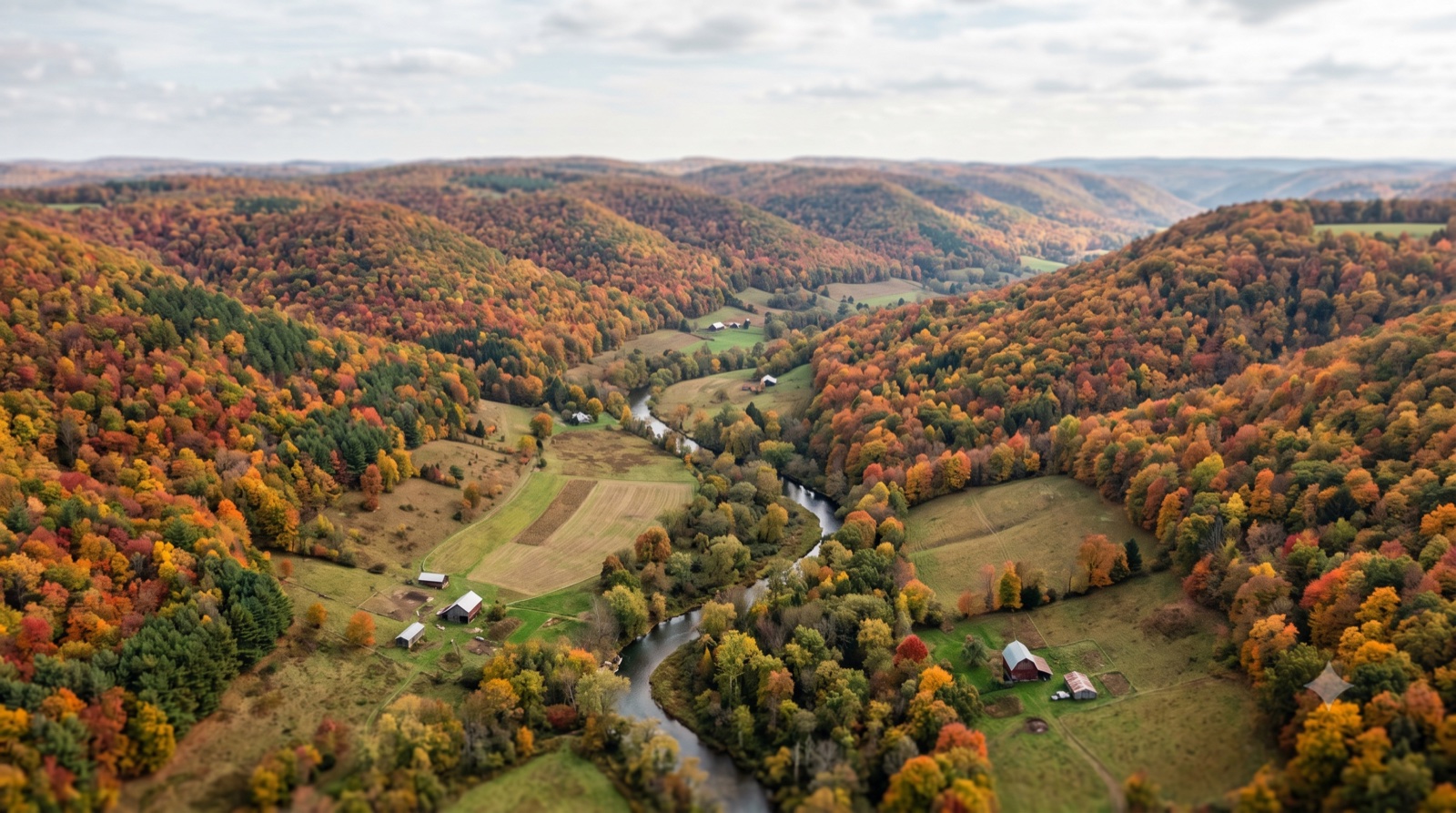
You can sell land in Indiana County through a title company closing — no attorney required — by listing with a local agent, selling by owner, or requesting a direct cash offer from a land buyer. Selling land in Indiana County, Pennsylvania means navigating a decades-long population decline, a bituminous coal heritage that frequently leaves surface and mineral ownership split between different parties, an assessment system that (unlike many of its neighbors) tracks fairly close to current market value, and a title company-centered closing process. Indiana County covers roughly 834 square miles of the Allegheny Plateau in west-central Pennsylvania — about 827 square miles of land and 7.3 square miles of water — anchored by the borough and county seat of Indiana, home to Indiana University of Pennsylvania.
Understanding how Pennsylvania's property tax system, realty transfer tax, and title closing requirements interact — and how a shrinking population and a coal-mining past factor into a sale — will help you set realistic expectations, whether you plan to list on the open market, sell by owner, or request a no-obligation cash offer from a direct buyer. For a statewide overview, start with our guide on how to sell land in Pennsylvania.
This guide covers Indiana County's property tax mechanics, the Pennsylvania closing process and realty transfer tax, how Indiana County compares to neighboring counties, and the practical options available to landowners ready to sell.
What Are the Tax Costs of Holding Land in Indiana County?
Pennsylvania does not use a uniform statewide assessment ratio — each county sets and maintains its own assessed values based on periodic reassessments, and the relationship between a county's assessed values and current market value varies enormously from one county to the next. The State Tax Equalization Board publishes an annual Common Level Ratio (CLR) that captures that relationship, and the Pennsylvania Department of Revenue republishes the reciprocal "factor" for each county every July. For Indiana County, the current CLR factor — applicable to documents accepted July 1, 2026 through June 30, 2027 — is 1.42, meaning assessed values in the county average roughly 70% of current market value — a notably tighter gap than most of the coal-belt counties that surround it: Armstrong's factor sits at 4.07 (about 25% of market value), Clearfield's at 5.21 (about 19%), and Cambria's at 8.93 (about 11%). An Indiana County deed's stated consideration is therefore less likely to draw a CLR-based challenge for realty transfer tax purposes than a deed in most of its neighboring counties.
Indiana County's effective property tax rate is approximately 1.51% of fair market value, according to PropertyTax101 — ranking it 23rd of Pennsylvania's 67 counties, and above the county's own historical median. The median property tax bill in Indiana County runs about $1,485 annually on a median home value near $98,200. Total effective rates vary by municipality and school district, as each taxing authority layers its own millage on top of the county rate.
How Property Tax Bills Add Up for Vacant Land
Pennsylvania does not impose a separate, higher assessment ratio on vacant land — all real property is assessed under the same countywide framework. But vacant land that produces no income still generates a recurring tax obligation with no offsetting revenue. A parcel carrying a county market value of $40,000 at an effective rate of 1.51% produces an annual tax bill of roughly $604 before municipal and school district millage; parcels in school districts with above-average millage will see higher combined bills. Over a decade of holding, those payments compound into thousands of dollars on land in a market where a shrinking population can mean fewer buyers and longer marketing periods.
Pennsylvania property tax payments are typically split into installments with deadlines set by each taxing authority — often with a discount period, a face period, and a penalty period. Delinquent county and municipal taxes are collected under the state's Real Estate Tax Sale Law by the Indiana County Tax Claim Bureau (Indiana County Courthouse, 2nd floor, 825 Philadelphia Street, Indiana, PA 15701-3973, (724) 465-3810). Properties with multiple years of delinquent taxes become eligible for the county's tax sale process. If you're behind on payments, our guide on selling land with back taxes explains your options before a sale is scheduled.
Clean and Green Act 319 Preferential Assessment
Landowners with parcels of at least 10 acres devoted to agricultural use, open space, or forest reserve can apply for Pennsylvania's Clean and Green program (Act 319), which taxes land based on use value rather than fair market value — ordinarily producing significant tax savings, according to the Pennsylvania Department of Agriculture. Given how much of Indiana County's rural acreage is farmed, wooded, or planted in Christmas trees, the agricultural-use and forest-reserve categories are both directly relevant here. Enrolled parcels must remain in qualifying use; withdrawing from the program triggers a rollback tax equal to seven years of the difference between market-value taxes and use-value taxes, plus 6% interest per year. Applications and status checks run through the Indiana County Tax Assessment Office (Indiana County Courthouse, 2nd floor, 825 Philadelphia Street, Indiana, PA 15701-3973, (724) 465-3812). If your parcel is enrolled, factor the rollback exposure into your net proceeds before agreeing to a sale.
What Zoning and Closing Rules Apply to Indiana County Land?
Indiana County land use is governed largely at the municipal level. Township and borough zoning is handled locally, so requirements vary depending on which boroughs or townships your parcel sits in — many rural townships surrounding the county seat are lightly zoned or unzoned outside the borough of Indiana itself. For zoning and permitting questions, contact the relevant township supervisors or the Indiana County Planning Department.
For current deed information, legal descriptions, and recorded easements, contact the Indiana County Register and Recorder (825 Philadelphia Street, Indiana, PA 15701-3973, (724) 465-3860), where Maria Jack serves as Recorder of Deeds, Register of Wills, and Clerk of Orphans' Court. Confirming exactly what your deed conveys is especially important in a county with this much mining history.
A Note on Severed Coal, Oil, and Gas Rights
Indiana County was one of western Pennsylvania's most productive bituminous coal counties for much of the 20th century — the Rochester & Pittsburgh Coal & Iron Company alone had purchased several thousand acres in the county's northwest section by 1900 and was operating fifteen mines there by 1920, including the Ernest mine, one of the region's largest. Across many older tracts in the county, the coal, oil, and gas rights underlying a surface parcel were sold or reserved separately from the surface itself, sometimes generations ago, as mining companies acquired mineral estates while farmers and homeowners retained the surface. Before you sell, it is worth confirming through a title search whether your deed conveys the minerals along with the surface, or only the surface. This affects what you actually own, what a buyer is paying for, and whether legacy mine workings, subsidence risk, well pads, pipelines, or access easements run across the land — details that can slow a closing and narrow the buyer pool in an already thin rural market. If your title search turns up a split estate, our guides on selling mineral rights vs. surface rights and selling land with severed mineral or oil-and-gas rights explain how that affects a sale.
Pennsylvania's Title Company Closing Process
Pennsylvania does not require a licensed attorney to conduct real estate closings. Most land transactions in the state are handled by a title company or settlement agent, which coordinates the title search, prepares closing documents, disburses funds, and records the deed with the county recorder. Attorneys are often involved but are not legally required for the closing itself.
The closing process for land in Indiana County typically works as follows:
- Title search: The title company searches public land records through the Indiana County Register and Recorder to verify clear title — no outstanding liens, unpaid taxes, or unresolved encumbrances — and to identify any severed coal, oil, or gas interests
- Title insurance: A lender's or owner's title insurance policy protects against defects not found in the standard search
- Closing: Buyer, seller, and agents execute the deed and settlement statement; the title company or settlement agent oversees the signing
- Recording: After closing, the deed is recorded with the Indiana County Register and Recorder, making the transfer part of the public record
For more detail on what documents are needed to complete a Pennsylvania land sale, our guide on paperwork needed to sell land covers the full checklist.
Pennsylvania Realty Transfer Tax
Pennsylvania imposes a 1% state realty transfer tax on all real property transfers, according to the Pennsylvania Department of Revenue. Municipalities and school districts may also levy a local realty transfer tax that varies across Indiana County's boroughs and townships — set independently at the local level, so confirm the exact combined rate with the title company handling your parcel before closing.
By custom and in most transactions, the tax is split equally between buyer and seller — each paying half of the combined rate — though the allocation can be negotiated. Cash buyers who advertise "no closing costs to seller" typically absorb both sides of the transfer tax as part of the offer terms. The deed must be recorded with the Register and Recorder in the county where the property is located.
How Does Indiana County Compare to Neighboring Pennsylvania Counties?
Indiana County's population has been declining for over four decades. From a peak of roughly 92,281 in 1980, the county fell to 89,605 by the 2000 Census, 88,880 by 2010, and 83,246 by the 2020 Census — a 6.3% decline in that decade alone — and sits at an estimated 82,953 residents as of the Census Bureau's 2024 vintage estimate. That is a loss of more than 9,300 residents since 1980, driven by the long contraction of the county's coal-mining employment base and a broader outmigration pattern common across Pennsylvania's Allegheny Plateau. Median household income runs approximately $60,208, and the poverty rate sits near 14%, according to Data USA.
Indiana County borders Jefferson, Clearfield, Cambria, Westmoreland, and Armstrong counties in west-central Pennsylvania. Out-of-state and absentee owners who inherited timber, hunting, small farm, or Christmas tree acreage from family members tied to the county's coal-mining and agricultural past represent a common seller profile here, as generational transitions, rising carrying costs, and a shrinking local buyer base motivate liquidation. Legacy mining infrastructure and severed mineral estates further complicate many of these older holdings, much as they do in Cambria County immediately to the southeast.
| Factor | Indiana County | Armstrong County | Clearfield County | Cambria County |
|---|---|---|---|---|
| County seat | Indiana | Kittanning | Clearfield | Ebensburg |
| Population (latest estimate) | ~82,953 (2024 est.) | ~64,622 (2024 est.) | ~78,600 (2024 est.) | ~128,968 (2025 est.) |
| Population trend | Declining (−6.3% 2010–2020) | Declining (−5,200 since 2010) | Declining (~3,000 since 2010) | Declining (−7.1% 2010–2020) |
| Effective property tax rate | ~1.51% | ~1.87% | ~1.47% | ~1.34% |
| CLR factor (2026–2027) | 1.42 | 4.07 | 5.21 | 8.93 |
| Median household income | ~$60,208 | ~$65,008 | ~$62,152 | ~$58,418 |
| Defining feature | Coal heritage, IUP, Christmas Tree Capital of the World | Allegheny River valley, Marcellus Shale oil/gas heritage | Moshannon State Forest timberland | Johnstown steel/coal heritage, steep long-term decline |
Indiana County's economy centers on health care, retail, and education. According to Data USA, the top employment sectors are Retail Trade (about 5,920 workers), Health Care & Social Assistance (about 5,263), and Educational Services (about 4,084) — the last of those anchored heavily by Indiana University of Pennsylvania, based in the county seat and one of the county's largest employers alongside the health care sector. Indiana County has also long billed itself the "Christmas Tree Capital of the World," a title that dates to an estimated 700,000 trees cut countywide in 1956 and peaked at over one million trees a year and roughly 200 tree farms by the 1960s; about a dozen tree farms continue the tradition today.
Indiana County's rural acreage remains substantially agricultural and wooded: the 2022 USDA Census of Agriculture counted 936 farms covering 153,032 acres (a 3% increase in farmed acreage since 2017, even as the number of farms fell 2%), with an average farm size of 163 acres and a total market value of products sold of about $100.8 million — up 40% from 2017. Crops account for 56% of sales and livestock/poultry 44%, with forage (hay/haylage) the top crop by acreage at 28,108 acres, followed by corn for grain (22,085 acres) and soybeans (16,197 acres); the county's farmed land includes 96,354 acres of cropland, 32,267 acres of woodland, and 14,075 acres of pasture. Much of the rural land that changes hands in Indiana County is recreational timberland, hunting tracts, small farms, and former or active Christmas tree acreage rather than large-scale row-crop operations. If your land falls into those categories, our guides on selling timberland, selling farmland, and selling hunting land cover what drives value for rural parcels.
For a broader view of land markets across the region, explore our blog.
Why Indiana County's Assessment Base Stands Apart
Unlike Cambria, Clearfield, and Armstrong — where a CLR factor of 4 to nearly 9 signals assessed values sitting at roughly a tenth to a quarter of market value — Indiana County's factor of 1.42 means its assessment base has stayed comparatively current, so its tax bills already reflect something closer to true market value rather than a decades-stale base year. Confirming your parcel's current assessed value with the county Tax Assessment Office before pricing a sale remains the right first step regardless.
What Are Your Options for Selling Land in Indiana County?
With a population that has fallen by more than 9,300 residents since its 1980 peak, a thin and shrinking rural buyer pool, and land that may have been held by families tied to the county's coal-mining or Christmas-tree-farming past for generations — sometimes with the coal already severed — Indiana County landowners face a clear carrying-cost equation: annual property taxes, insurance, and maintenance accumulate every year a parcel sits unsold in a market with fewer buyers each census cycle. Understanding what your land is actually worth, and whether you even hold the mineral rights, is the logical first step. Our guide on how much is my land worth explains the factors that drive valuation for rural parcels.
Before pursuing any sale path, verify your property's legal description and mineral-rights status through the Indiana County Register and Recorder (825 Philadelphia Street, Indiana, PA 15701-3973, (724) 465-3860). Confirm your assessment status and any Clean and Green enrollment through the Indiana County Tax Assessment Office (825 Philadelphia Street, Indiana, PA 15701-3973, (724) 465-3812) to understand rollback exposure before agreeing to a sale price, and confirm there are no delinquent amounts with the Indiana County Tax Claim Bureau (same courthouse address, (724) 465-3810).
Indiana County landowners have several selling paths:
Listing with a local real estate agent familiar with the Indiana borough and Allegheny Plateau rural market offers exposure to buyers searching for hunting, timber, or acreage properties. However, agent commissions of approximately 5–6%, combined with Pennsylvania's transfer tax and title company fees, reduce net proceeds, and carrying costs continue accumulating through a listing period that can stretch for many months in a shrinking market. Our guide on whether you need a realtor to sell land weighs the tradeoffs.
Selling by owner (FSBO) eliminates agent commissions but requires the seller to handle marketing, disclosures, mineral-rights research, and coordinating the title company. Online platforms provide some exposure to out-of-state buyers — a common consideration for out-of-state owners — but landlocked or access-limited parcels near old mine sites can be especially hard to move; see our guide on selling landlocked land if that describes your tract. If you inherited the parcel and the family is scattered, how to sell inherited land walks through that process.
For landowners who want to avoid extended timelines and ongoing carrying costs, companies like Jerez Land provide direct cash offers priced individually to the parcel — a firm written number, not a range or a formula. We absorb the carrying costs, marketing risk, and resale uncertainty, and we close in weeks rather than months. There are no agent commissions, and the title company closing process that Pennsylvania uses applies equally. Request a cash offer to see what your parcel is worth to a direct buyer.
Frequently Asked Questions
My father left me 30 acres outside Homer City and I live in Ohio — can I sell without coming back to Pennsylvania?
Yes. Pennsylvania land sales close through a title company or settlement agent rather than requiring an attorney or an in-person courthouse visit, so you can typically sign closing documents remotely or through a mobile notary. Start by confirming the legal description and any mineral-rights status through the Indiana County Register and Recorder ((724) 465-3860), then decide among listing with a local agent, selling by owner, or requesting a direct cash offer that lets you close without traveling.
I inherited my grandfather's old Christmas tree farm near Indiana borough, but nobody in the family wants to keep growing trees — what are my options?
You can sell the acreage as raw or agricultural land even if the tree rows haven't been actively maintained; a buyer doesn't need to continue the Christmas tree operation. First confirm whether the parcel is enrolled in Pennsylvania's Clean and Green program, since withdrawing enrolled agricultural land triggers a seven-year rollback tax plus 6% annual interest — check with the Indiana County Tax Assessment Office ((724) 465-3812) before pricing a sale. From there you can list with an agent, sell by owner, or request a direct cash offer.
We think the coal rights under our land near the old Rochester & Pittsburgh mines were sold off decades ago — can we still sell just the surface?
Yes. You can sell the surface even if the coal, oil, or gas rights were severed generations ago — you simply convey what your deed actually holds. Indiana County was one of western Pennsylvania's most productive bituminous coal counties for much of the 20th century, so severed mineral estates are common on older tracts. A title search through the Indiana County Register and Recorder ((724) 465-3860) will confirm whether your deed conveys the minerals along with the surface or only the surface.
What are my yearly property tax costs if I keep holding a vacant lot in Indiana County?
Indiana County's effective property tax rate is approximately 1.51% of fair market value, according to PropertyTax101 — ranking 23rd of Pennsylvania's 67 counties. On a parcel valued near $40,000, that runs roughly $604 a year before municipal and school district millage, which varies by location. Held over a decade with no income, those taxes plus insurance and maintenance compound into thousands of dollars.
Do I need to hire an attorney to close my land sale in Indiana County?
Pennsylvania does not require a licensed attorney for real estate closings, unlike some states. Most transactions use a title company or settlement agent to conduct the title search, prepare the deed, disburse funds, and record the transfer with the Indiana County Register and Recorder. An attorney may be retained by either party but is not legally mandated by the state.
My aunt's farm in Indiana County is enrolled in Clean and Green — what happens to the rollback tax if we sell it?
Pennsylvania's Clean and Green program (Act 319) taxes qualifying farm, forest, or open-space land at use value instead of market value. Selling does not automatically trigger a penalty if the buyer keeps the land in qualifying use, but withdrawing it triggers a rollback tax equal to seven years of the difference between market-value and use-value taxes, plus 6% interest per year. Confirm your parcel's status with the Indiana County Tax Assessment Office ((724) 465-3812) before agreeing to a price.
Disclaimer: This article is for informational purposes only and does not constitute legal, financial, or professional advice. Laws and regulations vary by jurisdiction and change over time. Always consult with qualified professionals before making land purchase decisions. Jerez Land is not responsible for actions taken based on this information.