
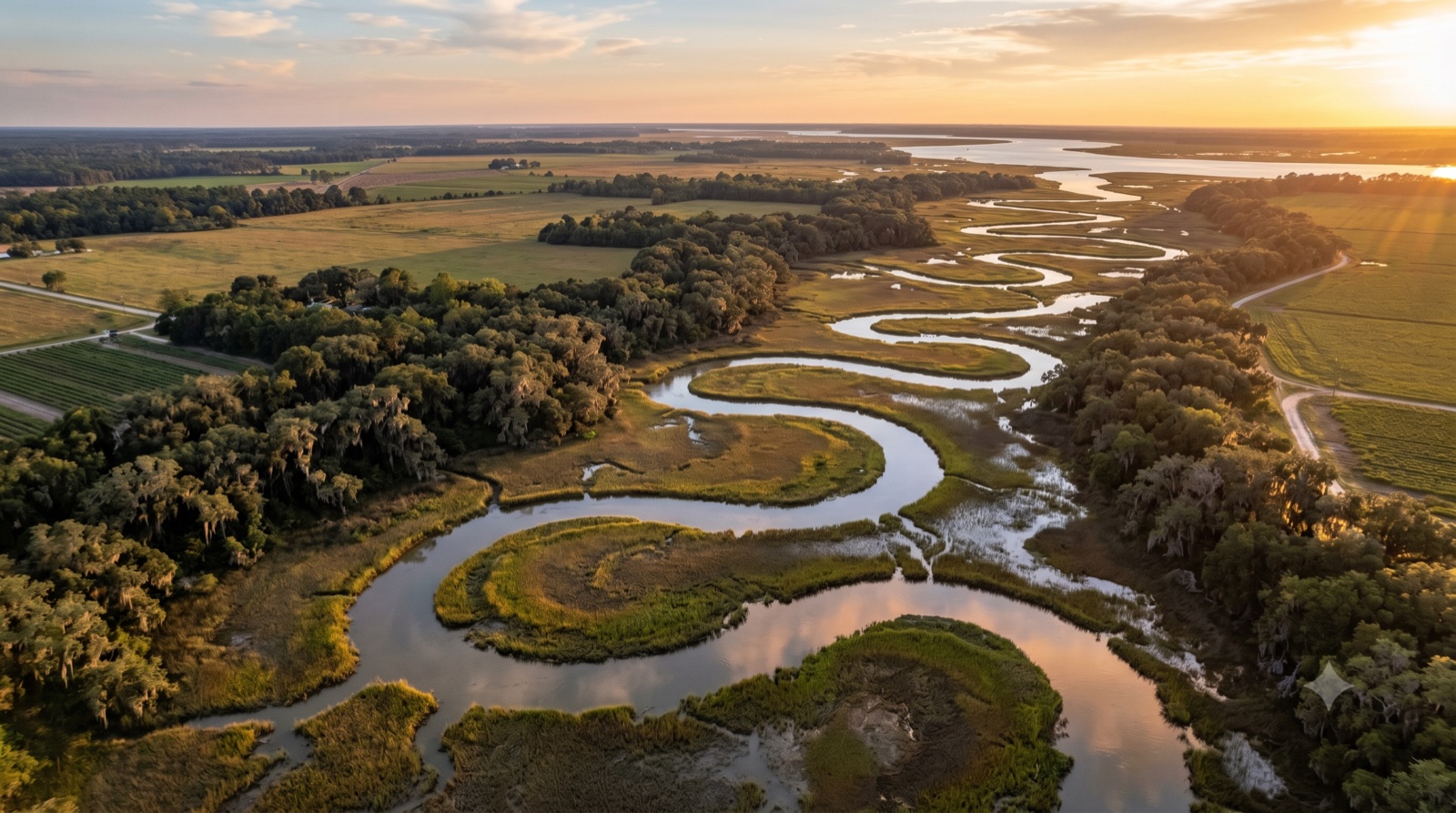
Sell My Land in Oconee County SC - What Landowners Need to Know
Key Takeaways
- Oconee County's population is growing, not declining — 74,273 in 2010, 78,607 in 2020, and an estimated 83,775 by 2025 — a roughly 13% increase driven largely by lake-recreation and retiree in-migration around Lakes Hartwell, Keowee, and Jocassee, according to Census-derived county data
- Vacant and non-owner-occupied land is assessed at 6% of fair market value under South Carolina's tiered system (SC Code § 12-43-220), versus 4% for owner-occupied residences, and Oconee County's base 2024-25 unincorporated-area millage runs 74.9 mills before school and special-district levies, per the county Auditor
- Oconee County touches three lakes under two different managing entities — the U.S. Army Corps of Engineers on Lake Hartwell and Duke Energy on Lakes Keowee and Jocassee — meaning dock rights, buffer rules, and shoreline permits differ depending on which lake a parcel borders
How Can You Sell Land in Oconee County South Carolina?
You can sell land in Oconee County by confirming title through the Oconee County Register of Deeds, engaging a South Carolina attorney to supervise the closing (required by state law), and choosing between a local agent listing, an online land marketplace, or a direct cash offer — the process typically runs several weeks from title verification to deed recording.
Oconee County sits in South Carolina's far northwestern corner, a region locals call the "Golden Corner." It covers roughly 626 square miles of Blue Ridge foothills, includes part of the Sumter National Forest's Andrew Pickens Ranger District, and borders three major reservoirs — Lake Hartwell, Lake Keowee, and Lake Jocassee — that draw retirees, second-home buyers, and recreational land investors from across the Southeast. Unlike many of the rural counties this series covers, Oconee's population has been rising, not falling, which changes the demand picture for land here in ways sellers should understand before they list or accept an offer.
This guide explains what South Carolina's assessment ratio system means for your annual holding costs on vacant Oconee County land, what the attorney-supervised closing process requires, how the three-lake permitting landscape differs by shoreline, how Oconee compares to its Upstate neighbors, and what options you have when you're ready to sell. For state-level rules that apply everywhere in South Carolina, see our South Carolina land selling guide; for other county-level breakdowns, browse our full blog.
What Are the Tax Costs of Holding Land in Oconee County?
Vacant and non-owner-occupied land in Oconee County is assessed at 6% of fair market value under SC Code § 12-43-220, compared with 4% for an owner-occupied primary residence, meaning an absentee landowner pays 50% more in assessed value on an identically priced parcel than a resident homeowner next door. This gap is a South Carolina constitutional provision, not a local Oconee policy, so it applies to vacant land in every county in the state.
Oconee County's base millage rate for fiscal year 2024-25 is 74.9 mills for unincorporated areas, which includes 2.9 mills earmarked for Emergency Services, according to the county Auditor's published millage documents and reporting by the local paper Upstate Today. The School District of Oconee County levies a separate combined millage of approximately 140 mills (110 for operations, 30 for debt service). Depending on fire district, library, and any municipal levies that apply to a specific parcel, the combined millage a vacant land parcel actually pays can vary — landowners should confirm the exact rate for their parcel's tax district directly with the Oconee County Auditor before budgeting a holding-cost estimate.
How Property Tax Bills Add Up for Vacant Land Near Oconee's Lakes
For a vacant parcel with a fair market value of $100,000 — a realistic range for a wooded acre or two within reach of Lake Keowee or Lake Hartwell — the 6% assessment ratio produces an assessed value of $6,000. Combining the county's 74.9-mill base rate with the school district's approximately 140 mills gives a combined rate in the neighborhood of 215 mills for an unincorporated parcel with no additional fire or special-district levies; at that rate the annual bill on this example parcel works out to roughly $1,290. Waterfront and near-lake parcels frequently carry higher fair market valuations than inland tracts of comparable acreage, which pushes the assessed-value math — and the resulting tax bill — higher for lakefront owners even though the millage itself doesn't change.
South Carolina counties reassess on a five-year cycle, and property taxes are due by January 15 each year; unpaid bills accrue penalties and can eventually lead to a tax sale. Absentee owners — a meaningful share of Oconee's lake-lot owners live out of state — are especially exposed to missing a notice. If a tax lien has already attached to your parcel, our guide on who pays closing costs when selling land walks through how outstanding taxes get resolved at closing.
Agricultural and timber use classification, available under SC Code § 12-43-232 for parcels of five or more acres in active farm, grazing, or timber production, can bring the assessment ratio down to 4% of use value rather than 6% of market value. The USDA's 2022 Census of Agriculture county profile for Oconee County (FIPS 45073) shows the county's farm base is dominated by small operations — the large majority of Oconee farms fall under 50 acres — reflecting a working landscape of small farms and wooded tracts rather than large-scale row-crop agriculture. Landowners must apply for the agricultural classification through the Oconee County Assessor's Office; it is not automatic.
What Zoning and Closing Rules Apply to Oconee County Land?
South Carolina requires every real estate closing — including all-cash sales of vacant land with no mortgage — to be supervised by a licensed South Carolina attorney, because the state Supreme Court held in State v. Buyers Service Co., 357 S.E.2d 15 (S.C. 1986), that examining title, preparing the deed, and disbursing proceeds all constitute the practice of law. This rule applies the same way in Oconee County as everywhere else in the state.
For a typical Oconee County land sale, the closing process runs through these steps:
- Title search: A licensed South Carolina attorney examines records at the Oconee County Register of Deeds (415 S. Pine Street, Walhalla, SC 29691; 864-638-4285) to confirm the chain of title and flag any liens, easements, or lake-permit encumbrances tied to the parcel
- Deed preparation: The attorney drafts the appropriate deed — warranty, limited warranty, or quitclaim — based on the transaction
- Closing and deed recording fee: At recording, South Carolina's deed recording fee of $1.85 per $500 of sale price applies statewide — split $1.30 state and $0.55 county — per the SC Department of Revenue's Deed Recording Fee Manual
- Disbursement: Proceeds go to the seller once any liens, back taxes, or legal fees are satisfied
For heirs navigating an inherited Oconee County parcel, our guide on how to sell inherited land covers the title-clearing steps South Carolina requires before a sale can close.
Zoning, Buffers, and Lake-Specific Permitting in Oconee County
Land-use zoning for unincorporated Oconee County is administered by the county's own planning function, and any parcel sale should confirm current zoning and any recorded easements directly with the county before closing — our guide to selling land with an easement explains how recorded access or utility easements affect a sale. What makes Oconee distinctive is that its three lakes are not managed by the same authority, and shoreline rules differ accordingly:
- Lake Hartwell is a U.S. Army Corps of Engineers reservoir. Docks require a Corps-issued Shoreline Use Permit, valid for a five-year term, and — critically for sellers — that permit does not automatically transfer with the property: it becomes void at sale, and a new owner must apply to the Hartwell Project Office for their own permit before building or maintaining a dock.
- Lake Keowee and Lake Jocassee are Duke Energy hydroelectric reservoirs governed by the utility's Keowee-Toxaway Shoreline Management Plan. Any dock, boatlift, or shoreline modification requires Duke Energy's written authorization in addition to any county-level building, septic, and floodplain permits Oconee County requires.
If you're buying or selling a lake lot, do not assume dock rights or shoreline access transfer automatically with the deed — verify directly with the Corps (Lake Hartwell) or Duke Energy's Lake Services team (Lakes Keowee and Jocassee) which permit, if any, currently attaches to the specific parcel, since we were not able to confirm parcel-specific permit status from public sources and it varies lot by lot.
How Does Oconee County Compare to Neighboring South Carolina Counties?
Oconee County's roughly 80,000–84,000 residents make it a mid-sized Upstate county, smaller than its fast-growing neighbors Anderson and Greenville but comparable in scale to neighboring Pickens County, with which it shares both Lake Keowee and Lake Jocassee shoreline.
| Factor | Oconee County | Pickens County | Anderson County | Greenville County |
|---|---|---|---|---|
| Population (recent est.) | ~80,000–84,000 | ~135,000 | ~220,000 | ~583,000 |
| Population trend | Growing | Growing | Growing | Growing rapidly |
| County seat | Walhalla | Pickens | Anderson | Greenville |
| Shared lake(s) | Hartwell, Keowee, Jocassee | Keowee, Jocassee | Hartwell | — |
| Land area | ~626 sq mi | — | — | — |
| Key land market signal | Lake-recreation, foothills, National Forest | Lake-recreation, Clemson proximity | Hartwell shoreline, I-85 corridor | Metro/suburban development pressure |
Lake Access as Oconee's Regional Differentiator
What sets Oconee apart from its neighbors is the combination of shoreline on all three Upstate reservoirs plus a large share of federally managed forest land. Pickens County shares Keowee and Jocassee shoreline and sits closer to Clemson University, giving it a different, more institution-driven demand pattern. Anderson County's land market centers on its own stretch of Lake Hartwell and the I-85 industrial corridor. Greenville County, by contrast, is dominated by metro and suburban development pressure rather than recreational-acreage demand. For a seller, this means an Oconee parcel's value story is tied more closely to which lake it touches (or how close it sits to the Sumter National Forest boundary) than to broader Upstate population growth alone.
For a general sense of how land value factors like road frontage, timber, and lake proximity interact, see our guide on how much your land is worth.
What Are Your Options for Selling Land in Oconee County?
Oconee County's growing population and three-lake recreational draw make it a more actively traded land market than many rural South Carolina counties, but the same features — attorney-supervised closings, a 6% vacant-land assessment ratio, and lake-specific permit complications on waterfront parcels — mean sellers still need to do real diligence before listing.
Before you sell, confirm your property's legal description and tax status through the Oconee County Register of Deeds (415 S. Pine Street, Walhalla, SC 29691; 864-638-4285) and check your current tax standing with the Oconee County Treasurer's Office (415 S. Pine Street, Walhalla, SC 29691; 864-638-4147) or the Assessor's Office (864-638-4150). If your parcel borders Lake Hartwell, Lake Keowee, or Lake Jocassee, verify separately with the Corps of Engineers or Duke Energy whether any dock or shoreline permit is attached and whether it will transfer to a buyer. If the land was inherited, have a South Carolina attorney confirm the chain of title before assuming a sale can proceed.
Oconee County sellers generally have three paths. Listing with a local agent experienced in lake and recreational land offers market exposure, typically at a standard real estate commission. Online platforms like Land.com and LandWatch reach out-of-state lake-lot buyers and recreational investors directly. Or request a cash offer from Jerez Land — we provide a firm, parcel-specific written number, handle the South Carolina attorney-supervised closing, and can close without listing fees, repairs, or waiting on a buyer's financing.
If you're managing a sale from outside South Carolina, our guide on selling land as an out-of-state owner covers how to handle the attorney-closing requirement remotely.
Frequently Asked Questions
How do I sell vacant land in Oconee County SC?
Confirm your property's legal description and tax status through the Oconee County Register of Deeds (415 S. Pine Street, Walhalla, SC 29691; 864-638-4285), then verify the chain of title, especially if the land was inherited. South Carolina law requires a licensed attorney to supervise the closing. From there, you can list with a local agent, use an online land marketplace, or request a direct cash offer.
I own a wooded lot near Lake Keowee in Oconee County but live out of state — can I sell without traveling back to South Carolina?
Yes. A South Carolina attorney can handle the title search, deed preparation, and closing remotely, with documents signed via mail-away closing or a notarized power of attorney in many cases. You do not need to be physically present in Oconee County to complete the sale, though your attorney will confirm the exact remote-signing process for your specific transaction.
What is South Carolina's deed recording fee and who pays it?
South Carolina charges $1.85 per $500 of sale price — $1.30 state and $0.55 county — paid at recording, according to the SC Department of Revenue's Deed Recording Fee Manual. By custom the seller pays this fee, though the buyer and seller can negotiate otherwise in the purchase agreement.
I inherited land near Lake Jocassee in Oconee County and the deed is still in my late parent's name — what do I need before I can sell?
You'll need to clear title through the South Carolina probate process or, if the estate was never opened, work with an attorney to establish your legal ownership before a sale can close. Because South Carolina requires an attorney to supervise every closing, that same attorney can typically confirm what probate or heirship documentation your specific situation requires as part of the title search.
My property borders Lake Hartwell — does it come with dock rights, or do I need a separate permit?
Lake Hartwell is a U.S. Army Corps of Engineers reservoir, and dock rights are not automatic. The Corps issues Shoreline Use Permits for five-year terms, and a permit becomes void when the property changes ownership — a buyer must apply to the Hartwell Project Office for a new permit rather than inheriting the seller's. Confirm current permit status with the Corps before assuming dock access transfers with the deed.
Is Oconee County SC's population growing or declining?
Oconee County's population is growing — 74,273 at the 2010 Census, 78,607 in 2020, and an estimated 83,775 by 2025 — a roughly 13% increase over 15 years. This sets Oconee apart from many rural South Carolina counties with flat or declining populations, and reflects lake-recreation and retiree in-migration around Lakes Hartwell, Keowee, and Jocassee.
Disclaimer: This article is for informational purposes only and does not constitute legal, financial, or professional advice. Laws and regulations vary by jurisdiction and change over time. Always consult with qualified professionals before making land purchase decisions. Jerez Land is not responsible for actions taken based on this information.