
Sell My Land in Sumter County SC - What Landowners Need to Know
Key Takeaways
- Sumter County's population fell from 107,456 in 2010 to 105,556 in 2020 — a decline of roughly 1.8% — and eased further to an estimated 105,067 by 2025, according to U.S. Census Bureau data, even as the city of Sumter itself held near 43,000 residents on the strength of Shaw Air Force Base
- The USDA's 2022 Census of Agriculture counted 445 farms working 163,578 acres in Sumter County, led by corn, soybeans, cotton, and wheat, with a total market value of agricultural products sold of $171,076,000 — the 10th-highest total among South Carolina's 46 counties
- Vacant and non-owner-occupied land in Sumter County is assessed at 6% of fair market value under SC Code § 12-43-220, compared to 4% for owner-occupied homes, while the county's own base millage rate of 113.90 mills in 2023 ran lower than every one of its rural neighbors, according to the SC Association of Counties
How Can You Sell Land in Sumter County South Carolina?
Selling land in Sumter County means hiring a licensed South Carolina attorney to supervise the closing, confirming title and tax status through the Sumter County Register of Deeds and Assessor, and understanding that farmland outside the city trades in a genuinely rural market that behaves nothing like the base-driven economy around the city of Sumter and Shaw Air Force Base.
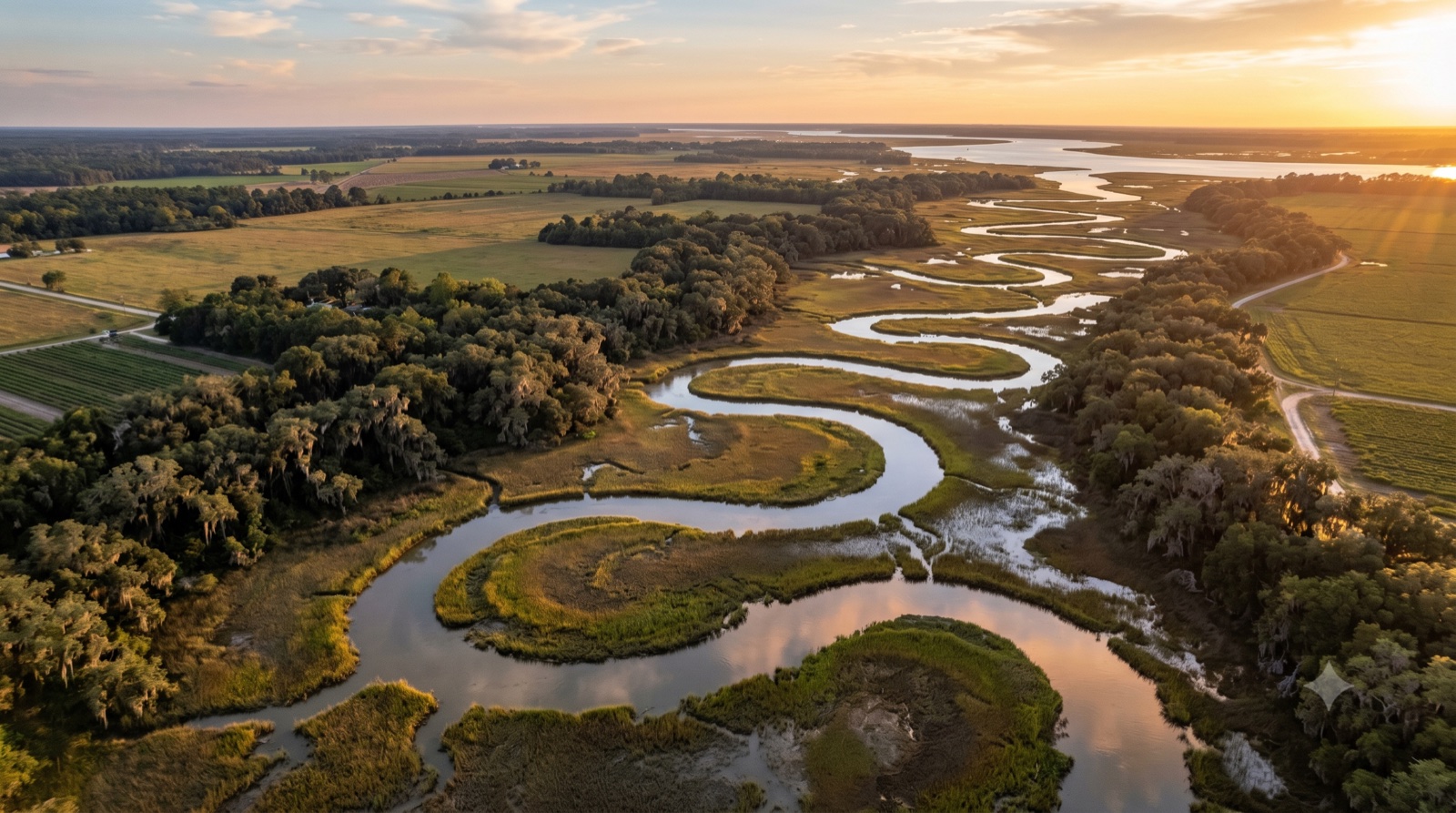
That split is the defining fact about this county, and it's easy to get wrong. Sumter County covers 665 square miles in South Carolina's sandhills and inner coastal plain, according to Wikipedia, and it is not a tiny depopulating rural county — the city of Sumter itself carries roughly 43,000 residents, and Shaw Air Force Base, home to the 9th Air Force, the 20th Fighter Wing, and U.S. Army Central, anchors a real regional labor market. But drive ten or fifteen minutes outside the city limits — toward Pinewood, Wedgefield, Mayesville, or Rembert — and the land turns to cotton, corn, soybean, and wheat cropland worked by a shrinking number of farm operations, exactly the kind of countryside covered by USDA's 2022 Census of Agriculture. A landowner holding a rural parcel near Manchester State Forest is dealing with a fundamentally different buyer pool, price expectation, and timeline than a landowner holding a lot near the base. This guide separates the two markets and covers the tax picture, the closing process, how Sumter compares to its neighbors, and what your realistic options are. For the state-level rules that apply everywhere in South Carolina, see our South Carolina land selling guide.
What Are the Tax Costs of Holding Land in Sumter County?
Vacant and non-owner-occupied land in Sumter County is assessed at 6% of fair market value under SC Code § 12-43-220, while owner-occupied primary residences are assessed at only 4%. That 50% higher assessment ratio applies to every idle or investment parcel in the county, whether it's a wooded 20-acre tract near Poinsett State Park or a 300-acre row-crop farm outside Mayesville.
Sumter County's own base millage rate was 113.90 mills in 2023 (expressed as 0.11390, with a county mil valued at $317,413), according to the SC Association of Counties' 2024 County Profiles report. That county-only rate is notably lower than every neighboring county covered in this guide — Lee County's base rate was 179.40 mills and Clarendon County's was 179.50 mills the same year — a reflection of Sumter County's larger and more diversified tax base, driven in part by Shaw Air Force Base and city-area development. On top of the county-only figure, school district and any municipal or special-purpose district levies apply depending on exactly where the parcel sits, so the total combined rate for a specific tract will run higher than the county base alone.
Sumter County's overall effective property tax rate is approximately 0.62% of assessed home value, with a median annual property tax bill near $614 on a median home value of $98,800, according to tax-rates.org — among the lower effective rates in South Carolina, though the figure reflects primarily residential parcels and doesn't capture the higher 6% assessment ratio landowners pay on vacant or investment land.
How the Rollback Tax Applies to Agricultural Land
If land has been taxed at the lower agricultural-use assessment and is then converted to a non-agricultural use — subdivided, developed, or simply taken out of active farming or timber production in a way inconsistent with agricultural use — South Carolina imposes a rollback tax. Under Act No. 173 of 2020 (House Bill 3596), which amended SC Code § 12-43-220(d)(4), the rollback tax period was reduced from five years to three years, effective January 1, 2021, and applies to agricultural real property changed to another use after 2020, according to the SC Department of Revenue's Information Letter #20-31. In practice, that means a landowner converting agricultural-use land owes the difference between what was paid under the agricultural valuation and what would have been paid under standard valuation for the current tax year plus the three tax years immediately preceding — not five, as under the older rule. This matters for Sumter County landowners specifically because so much of the county's rural acreage — 163,578 acres in farms as of the 2022 USDA Census of Agriculture — currently sits under agricultural-use valuation, and a change in use ahead of a sale can trigger an unexpected tax bill.
Taxes are due by January 15 each year, and South Carolina requires countywide reassessments every five years. Landowners who believe their parcel may still qualify for the agricultural-use assessment, or who want to confirm current valuation before listing, should contact the Sumter County Assessor's Office (13 East Canal St., Sumter, SC 29150; 803-436-2115). For more on how unpaid or delinquent taxes affect a sale, see our guide on selling land with back taxes.
What Zoning and Closing Rules Apply to Sumter County Land?
South Carolina requires a licensed attorney to supervise every real estate closing, with no exception for cash sales, vacant land, or simple transactions. Under the precedent set in State v. Buyers Service Co., 357 S.E.2d 15 (S.C. 1986), the South Carolina Supreme Court held that conducting a real estate closing constitutes the practice of law — meaning a title company alone cannot close a deed transfer in this state; a South Carolina attorney must handle it.
The closing process in Sumter County follows this sequence:
- Title search: The attorney examines records at the Sumter County Register of Deeds (141 N. Main St., Room 202, Sumter, SC 29150; 803-436-2177) to confirm the seller holds clear, marketable title, which is especially important for inherited or intestate parcels
- Deed preparation: The attorney drafts the warranty or quitclaim deed based on the confirmed chain of title
- Closing: Buyer, seller, and attorney execute the documents and transfer funds, either in person or remotely
- Recording: The attorney records the deed with the Register of Deeds and remits the deed recording fee — $1.85 per $500 of the sale price, split between a $1.30 state portion and a $0.55 county portion, according to the SC Department of Revenue Deed Recording Fee Manual 2024
- Disbursement: The attorney disburses net proceeds to the seller after satisfying any outstanding liens, delinquent taxes, or legal fees
For a full rundown of the documents a seller needs to gather before closing, see our paperwork needed to sell land guide.
Zoning Differs Sharply Between the City, the Base Area, and the Countryside
Zoning enforcement in Sumter County is not uniform, and that matters more here than in most South Carolina counties because of the city/countryside split described above. The City of Sumter administers its own municipal zoning within city limits, separate from Sumter County's zoning ordinance for unincorporated areas. Parcels near Shaw Air Force Base may also fall under Air Installation Compatible Use Zone (AICUZ) guidance, which can restrict certain types of development near flight paths regardless of the underlying county or city zoning district. Rural parcels farther out — toward Pinewood, Wedgefield, or Rembert — are typically zoned agricultural or rural residential under the county's own code, with far fewer restrictions but also far less by-right development potential. Before listing or accepting an offer, confirm the exact zoning designation and any AICUZ overlay with the Sumter County Planning Department or the Assessor's Office, particularly if the parcel sits within several miles of the base.
How Does Sumter County Compare to Neighboring South Carolina Counties?
Sumter County is considerably larger and more economically diverse than the rural counties that border it — Lee, Clarendon, Calhoun, Kershaw, Florence, and Richland — precisely because it combines a real city and a major military installation with a wide agricultural base. That combination shows up clearly against three neighbors already covered in this series.
| Factor | Sumter County | Lee County | Clarendon County | Calhoun County |
|---|---|---|---|---|
| Population (2020 Census) | 105,556 | 16,531 | 31,144 | 14,119 |
| Population trend | Slowly declining | Sharply declining | Declining | Roughly flat |
| County seat | Sumter | Bishopville | Manning | St. Matthews |
| County base millage (2023) | 113.90 mills | 179.40 mills | 179.50 mills | 130.30 mills |
| Anchor institution | Shaw Air Force Base + city of Sumter | None — thin rural market | Lake Marion recreation | None — smallest county by land area |
| Top land use outside city | Cotton, corn, soybeans, wheat | Cotton, soybeans | Timber, row crops, lake tracts | Cotton, soybeans, Congaree bottomland |
Sumter County's own numbers stand out against every neighbor in this table: a population more than three times Clarendon's and over six times Lee's or Calhoun's, alongside the lowest county-only millage rate of the group. That's the base-and-city effect. But strip the city of Sumter out of the picture and the remaining acreage looks a great deal like Lee or Clarendon County — flat, sandhill and coastal-plain farmland with a thin pool of active local buyers for anything not already under lease to a working farm operation. Neighboring Florence County, to the northeast, shares a similar Pee Dee-adjacent row-crop profile, though it isn't covered in this series yet.
The Farm Economy Behind the Cropland
The USDA's 2022 Census of Agriculture counted 445 farms in Sumter County working 163,578 acres — down 15% in farm count and 2% in acreage since 2017, even as average farm size rose 15% to 368 acres, a pattern consistent with smaller operations consolidating into larger ones. Cropland accounts for 96,118 of those acres, with another 51,647 acres in woodland and 5,147 in pastureland. Corn led all crops at 30,094 harvested acres, followed by soybeans at 26,557 acres, cotton at 10,220 acres, and wheat at 8,560 acres. Total market value of agricultural products sold reached $171,076,000 in 2022, an increase of 12% since 2017, split almost evenly between crops ($85,558,000) and livestock, poultry, and products ($85,518,000) — poultry and eggs alone accounted for $79,008,000 of that livestock total. Sumter County ranked 10th among South Carolina's 46 counties for total agricultural sales, and 1st in the state for "other crops and hay" sales, according to the same USDA profile.
Outside the row-crop belt, timber and recreational land carry their own value. Manchester State Forest, a 28,675-acre state forest spanning both Clarendon and Sumter counties, provides timber production alongside hunting, fishing, and trail recreation, and Poinsett State Park sits within Sumter County near Wedgefield, connecting to the Palmetto Trail through the forest, according to South Carolina Parks and Wikipedia. Wooded acreage near either tract can carry recreational or timber value distinct from straight row-crop pricing. For landowners specifically holding timber acreage, see our selling timberland guide, and for row-crop or pastureland, see selling farmland.
For more county-level land analysis across South Carolina, including our guides to Lee County, Clarendon County, and Calhoun County, explore our blog.
What Are Your Options for Selling Land in Sumter County?
Selling land in Sumter County starts with confirming exactly what kind of parcel you have, because the city-and-base market and the rural farm-and-timber market do not behave the same way. A lot near Shaw Air Force Base or inside the city of Sumter typically has a broader pool of local buyers and faster turnover. A row-crop or timber tract out toward Pinewood, Mayesville, or Wedgefield is competing in a much thinner market, where most working farmland is already tied up in long-term leases with established operators, and a vacant or absentee-owned parcel can sit for a long time without the right buyer showing up.
Before you list or accept any offer, confirm your property's legal description and current tax status through the Sumter County Register of Deeds (141 N. Main St., Room 202, Sumter, SC 29150; 803-436-2177) and verify the parcel's current assessed value and any agricultural-use classification through the Sumter County Assessor's Office (13 East Canal St., Sumter, SC 29150; 803-436-2115). If the land was inherited without a will or has multiple co-owners, consult a South Carolina real estate attorney about clearing title before you go any further — see our guide on selling inherited land with multiple heirs for what that process typically involves. If you live out of state and inherited or acquired Sumter County land from a distance, our selling land as an out-of-state owner guide covers the added logistics.
From there, sellers generally have three paths. Listing with a local agent who understands both the base-area market and the rural farm market provides exposure but adds commission costs and time. Online land platforms can reach out-of-state buyers interested in hunting, timber, or recreational acreage near Manchester State Forest or Poinsett State Park. For landowners who want a specific, firm number rather than an open-ended listing, request a cash offer from Jerez Land. We evaluate each parcel individually and provide a firm, parcel-specific written offer — we are the buyer, we absorb the carrying costs, marketing time, and resale risk ourselves, and we handle the South Carolina attorney-supervised closing directly, often closing in weeks without listing fees or commissions.
Before negotiating with any buyer, understanding who pays closing costs when selling land and how much your land is worth puts you in a stronger position regardless of which path you choose.
Frequently Asked Questions
My family has 60 acres of row-crop farmland outside Pinewood that nobody in the family farms anymore, and the property taxes keep showing up every October — what are our realistic options?
You can keep leasing the land to a working farm operation to help offset the tax bill, list it for sale with a local land agent, or request a direct cash offer from a land buyer. First confirm the parcel's current assessed value and whether it still qualifies for the agricultural-use assessment ratio through the Sumter County Assessor's Office (13 East Canal St., Sumter, SC 29150; 803-436-2115), since converting the land away from agricultural use can trigger a rollback tax covering the current year plus the three preceding tax years under SC Code § 12-43-220(d)(4). If multiple family members hold ownership, all co-owners generally need to agree, or clear title through the estate, before a sale can close.
I inherited 30 acres of timberland near Manchester State Forest with two cousins and neither of them agree on what to do with it — can I sell my share without their approval?
Generally, no — South Carolina requires clear title from all owners before a deed can transfer, and if the property was inherited informally without a recorded will splitting ownership, it may qualify as heirs' property with multiple co-owners holding an interest. In that situation, selling typically requires either an agreement among all co-owners or a quiet-title or partition action, and a South Carolina attorney is essential to walk through the options, since every closing in the state must be attorney-supervised regardless of how the sale is structured.
I have a small lot near Shaw Air Force Base that I bought years ago as an investment — does it sell differently than raw farmland out in the county?
Yes. Land near Shaw Air Force Base and inside or near the city of Sumter sits in a much broader, faster-moving market than the row-crop and timber acreage found outside the city, because it benefits from the base's steady population of active-duty personnel, contractors, and civilian employees. That said, parcels near the base may fall under Air Installation Compatible Use Zone (AICUZ) guidance, which can limit certain types of development regardless of the underlying zoning — confirm any AICUZ overlay with the Sumter County Planning Department or Assessor's Office before listing, since it can affect what a buyer is able to do with the lot.
How do I sell vacant land in Sumter County SC?
Start by confirming your property's legal description and tax status through the Sumter County Register of Deeds (141 N. Main St., Room 202, Sumter, SC 29150; 803-436-2177) and the Assessor's Office (13 East Canal St., Sumter, SC 29150; 803-436-2115). South Carolina requires a licensed attorney to supervise the closing, including title examination, deed preparation, and recording. From there, you can list with a local agent, use a land-focused online platform, or request a direct cash offer from a land buyer.
What will my annual property taxes be on vacant land in Sumter County SC?
Vacant and non-owner-occupied land is assessed at 6% of fair market value under SC Code § 12-43-220, compared to 4% for owner-occupied homes. Sumter County's own base millage rate was 113.90 mills in 2023, according to the SC Association of Counties — lower than every neighboring county in this guide — though the total bill also includes school district and any applicable special-district levies layered on top of the county base rate. Actively farmed or timbered parcels of at least five acres may qualify for the lower agricultural-use assessment under SC Code § 12-43-232, subject to verification by the Assessor's Office.
Do I need to hire an attorney to close a land sale in Sumter County SC, or can the buyer's title company handle it?
You need a licensed South Carolina attorney; a title company alone cannot close the transaction in this state. Under State v. Buyers Service Co., 357 S.E.2d 15 (S.C. 1986), the South Carolina Supreme Court ruled that conducting a real estate closing constitutes the practice of law, so every deed transfer in Sumter County — including vacant land and all-cash sales — must be supervised by a licensed South Carolina attorney who handles the title search, deed preparation, and recording with the Register of Deeds.
Disclaimer: This article is for informational purposes only and does not constitute legal, financial, or professional advice. Laws and regulations vary by jurisdiction and change over time. Always consult with qualified professionals before making land purchase decisions. Jerez Land is not responsible for actions taken based on this information.