
Sell My Land in Kershaw County SC - What Landowners Need to Know
Key Takeaways
- Kershaw County's population grew 6.0% between the 2010 and 2020 Census — from 61,697 to 65,403 — and continued climbing toward roughly 73,000 by the mid-2020s, according to U.S. Census Bureau data, but that growth is concentrated in the Lugoff-Elgin corridor along I-20 inside the Columbia metro area, not countywide
- Kershaw County ranked first among South Carolina's 46 counties for total agricultural product sales in 2022, at $364,568,000, according to the USDA Census of Agriculture — but 96% of that came from poultry and egg operations, not the row crops or timber sales the Sandhills terrain might suggest
- South Carolina assesses vacant land at 6% of fair market value under SC Code § 12-43-220, and the state's deed recording fee runs $1.85 per $500 of sale price, paid at closing through Kershaw County's Register of Deeds
How Can You Sell Land in Kershaw County, South Carolina?
To sell land in Kershaw County, confirm your parcel's legal description and tax status with the Kershaw County Assessor and Treasurer, retain a licensed South Carolina attorney to supervise the closing — a statewide legal requirement — and choose a sales path: list with an agent, use an online land platform, or request a direct cash offer. Selling land in Kershaw County, South Carolina means navigating a statewide framework built on attorney-supervised closings and a deed recording fee that functions as a transfer tax, layered on top of a county-specific reality: a Midlands market split between fast-growing suburban ground near Columbia and a quieter, more rural interior.
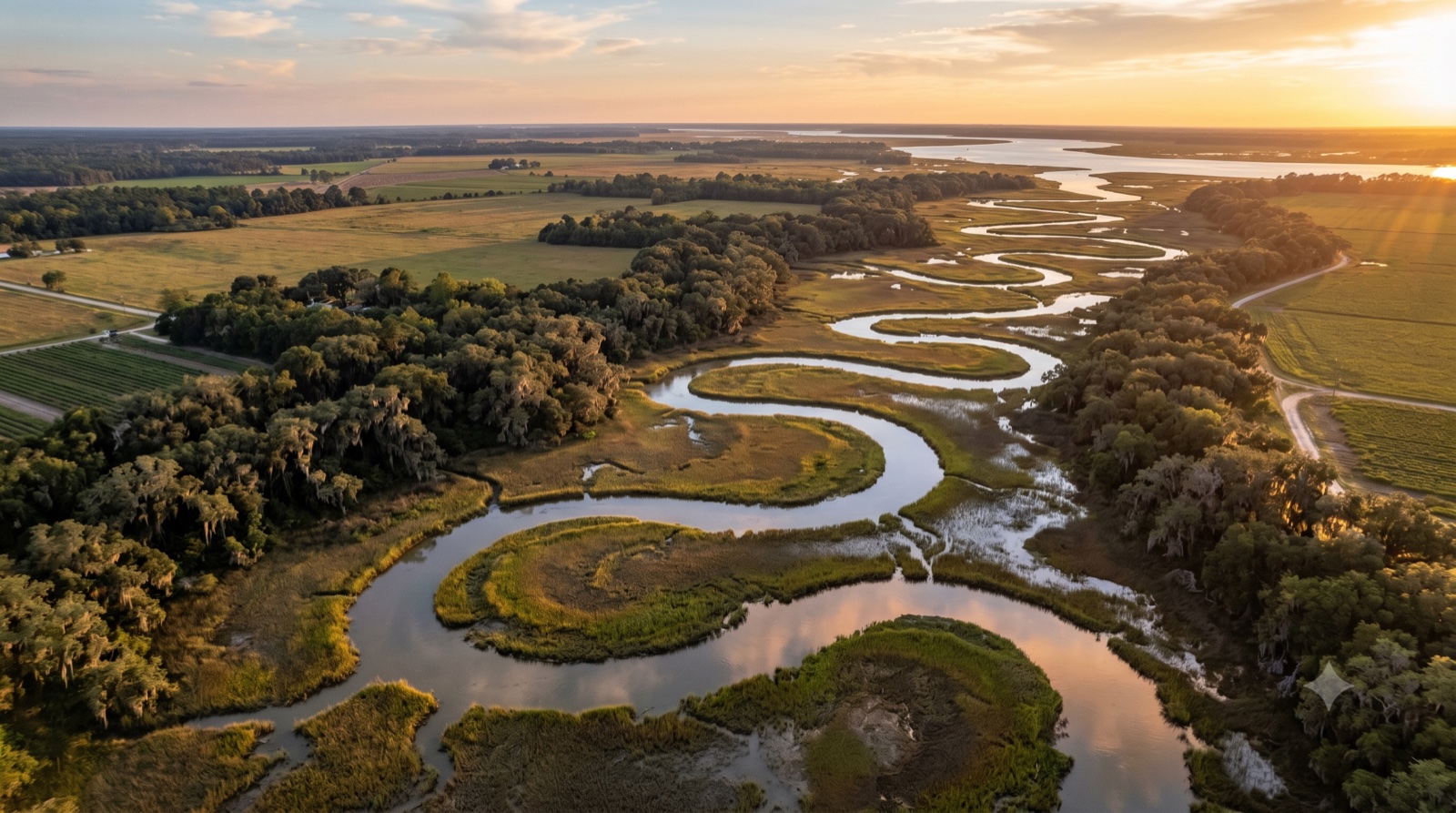
The county covers about 727 square miles in the Sandhills region of central South Carolina, with the historic town of Camden — one of the state's oldest inland settlements — as its county seat. Kershaw County is part of the Columbia, SC Metropolitan Statistical Area, and its western edge, centered on Lugoff and Elgin along Interstate 20 and U.S. Highway 1, functions almost as a Columbia suburb. The Wateree River splits the county roughly down the middle, and land east of it — toward communities like Bethune and Cassatt — sits well outside that commuter pull. Kershaw County borders Lancaster, Chesterfield, Darlington, Lee, Sumter, Richland, and Fairfield counties. For a broader look at South Carolina's statewide rules, see our South Carolina land selling guide; for more county guides, browse the Jerez Land blog.
That geographic split matters more here than in most Sandhills counties. Population growth and land demand are real but uneven — strong along the I-20/US-1 corridor where subdivisions, retail, and a rail-served industrial megasite are pulling in new residents and jobs, and comparatively thin in the county's rural east and south, where land moves more like it does in a shrinking Pee Dee county. Understanding which side of that line a parcel sits on — along with the tax obligations and closing requirements that apply countywide — is the starting point for any Kershaw County landowner weighing a sale.
What Are the Tax Costs of Holding Land in Kershaw County?
South Carolina assesses vacant land at 6% of fair market value under SC Code § 12-43-220, compared with 4% for an owner-occupied primary residence and 4% for land in bona fide agricultural use assessed at use value rather than market value — meaning a vacant parcel in Kershaw County can carry 50% higher assessed value, and a correspondingly higher tax bill, than a comparable owner-occupied home.
Kershaw County's effective property tax rate runs approximately 0.48% of assessed fair market value, according to Tax-Rates.org, with a median annual property tax bill of $528 on a median home value of $110,800 — figures drawn from residential parcels, but a useful baseline before county, school district, and special-purpose district millage is layered on top for vacant acreage. South Carolina performs countywide reassessments on a five-year cycle, and taxes are due by January 15 each year; unpaid balances accrue penalties and can eventually trigger a tax sale.
If a Kershaw County parcel is actively farmed or in managed timber production on at least five acres, it may qualify for the 4% agricultural use-value assessment under SC Code § 12-43-232 rather than the 6% rate applied to dormant vacant land. Eligibility should be confirmed directly with the Kershaw County Assessor's Office (515 Walnut Street, Room 100, Camden, SC 29020; 803-425-1523).
How Rollback Taxes Work If You Change Agricultural Use
If land enrolled in the agricultural use-value program is sold and the new owner discontinues the qualifying agricultural use, the county assesses a rollback tax — the difference between what was paid under use-value assessment and what would have been owed under the standard 6% fair-market-value assessment, plus interest. Under SC Code § 12-43-220(d)(4), that rollback now applies to the current tax year plus three prior tax years, not five. The shorter lookback was set by 2020 Act No. 173, effective for agricultural real property changed to another use after 2020 — a meaningfully smaller potential liability than the longer lookback period that applied before that change. Rollback exposure should be identified and allocated between buyer and seller before closing, and it's a real consideration for a Kershaw County landowner near the growth corridor whose farmland or woodland is being eyed for residential or commercial development. For more on how back taxes and liens affect a sale, see our guide on selling land with back taxes.
What Zoning and Closing Rules Apply to Kershaw County Land?
South Carolina is an attorney-closing state. Under State v. Buyers Service Co., 357 S.E.2d 15 (S.C. 1986), the South Carolina Supreme Court held that conducting a real estate closing constitutes the practice of law, so every deed transfer in Kershaw County — including cash sales of vacant land — must be supervised by a licensed South Carolina attorney. Unlike some South Carolina counties where deed recording runs through the Clerk of Court, Kershaw County maintains a standalone Register of Deeds office at 515 Walnut Street, Room 180, Camden, SC 29020 (803-425-7235), which handles recording of deeds, mortgages, liens, plats, and powers of attorney for the county.
The closing process follows this sequence:
- Title search: The attorney examines the chain of title through the Kershaw County Register of Deeds' land records, confirming clear, marketable title — a step that matters even more where heirs' property or an unadministered estate is involved
- Deed preparation: The attorney drafts the warranty or quitclaim deed based on that title history
- Closing: Buyer and seller sign the deed and settlement documents, in person or remotely, with the attorney overseeing execution
- Recording: The attorney records the deed with the Register of Deeds and remits the deed recording fee — $1.85 per $500 of sale price, split $1.30 state and $0.55 county
- Disbursement: The attorney disburses net proceeds to the seller after satisfying any liens, delinquent taxes, or rollback obligations
For the documents typically needed before a closing attorney can proceed, see our paperwork needed to sell land guide.
Zoning and Land Use in Kershaw County
Kershaw County's Planning & Zoning Department (515 Walnut Street, Room 160, Camden, SC 29020; 803-425-7233) administers zoning and land-use regulation for unincorporated areas of the county, while the incorporated communities — including Camden — maintain their own separate municipal zoning. Zoning matters more here than in most rural Sandhills counties because of where the growth is: parcels near Lugoff, Elgin, or the I-20/US-1 corridor can sit close to active rezoning and annexation activity tied to residential and industrial development, including the roughly 1,426-acre Central South Carolina Megasite near Lugoff, while land in the county's rural east and south is typically zoned for low-density agricultural or forestry use with far less development pressure. Before listing or closing on a parcel, sellers and buyers should confirm the current zoning designation and check for any pending rezoning or annexation activity nearby.
How Does Kershaw County Compare to Neighboring South Carolina Counties?
Kershaw County's population grew from 61,697 in the 2010 Census to 65,403 in 2020 — a 6.0% increase — and has continued climbing toward an estimated 73,000 by the mid-2020s, according to U.S. Census Bureau data. That growth is not evenly distributed: it's concentrated in the Lugoff-Elgin market on the county's western edge, inside the Columbia Metropolitan Statistical Area, where residential permitting has run in the hundreds of homes per year since the early 2000s. Neighboring Lancaster County, part of the fast-growing Charlotte suburban ring, has grown far faster — up 25.5% since 2010. Richland County, home to Columbia itself, is also growing, if more modestly. Chesterfield County, bordering Kershaw to the northeast in the Pee Dee, has instead lost population since 2010 — a pattern much closer to what Kershaw's own rural east experiences than what its I-20 corridor does.
| Factor | Kershaw County | Lancaster County | Richland County | Chesterfield County |
|---|---|---|---|---|
| Population (2020 Census) | 65,403 | 96,016 | 416,147 | 43,273 |
| Population trend since 2010 | Up 6.0% | Up 25.5% | Up 7.8% | Down 7.2% |
| County seat | Camden | Lancaster | Columbia | Chesterfield |
| Top land use | Woodland acreage, poultry-driven ag sales | Suburban growth, row crops | Urban/suburban Columbia core | Sandhills pine timber, row crops |
| Key land market signal | Split: I-20/Lugoff-Elgin growth vs. static rural east | Charlotte-suburb growth corridor, rising land demand | Large urban buyer pool, higher land costs | Thin, rural, declining population |
Kershaw's Land Use: Woodland Acreage, Poultry-Driven Ag Economy
The county's farm economy doesn't match the usual "Sandhills timber county" assumption. Kershaw County had 575 farms working 100,593 acres in 2022, up 23% and 27% respectively since 2017, according to the USDA Census of Agriculture. By acreage, woodland is the single largest land-use category on those farms at 46,773 acres, ahead of 27,514 acres of cropland and 10,693 acres of pastureland. But by dollar value, the county's $364,568,000 in total agricultural product sales — first among all 46 South Carolina counties — was overwhelmingly driven by poultry and eggs, which alone accounted for $350,387,000, or 96% of total sales, also ranking first in the state. Crop sales, by comparison, totaled just $10,288,000, about 3% of the county total, spread across 9,527 acres of hay and forage, 5,219 acres of soybeans, 3,572 acres of wheat, and 878 acres of corn.
In practical terms, that means a lot of Kershaw County land is wooded — whether managed pine timber, cutover ground, or simply unfarmed acreage within a larger operation — but the county's actual agricultural income is concentrated in contract poultry operations rather than in stumpage or crop sales. For a landowner with wooded acreage, that distinction shapes realistic expectations: the land itself may carry real timber value, but it isn't likely to be part of an active, income-generating farm operation the way cropland or a poultry contract would be. Landowners with wooded or agricultural acreage may find our guides to selling timberland and selling farmland useful for the specific issues that come with each.
What Are Your Options for Selling Land in Kershaw County?
Kershaw County landowners face different realities depending on where their parcel sits. Land inside or near the Lugoff-Elgin growth corridor benefits from real, sustained demand tied to the Columbia MSA, industrial development like the Central South Carolina Megasite, and a population that keeps climbing. Land in the county's rural east and south, across the Wateree River, competes in a much thinner market closer to what a shrinking Pee Dee county experiences — and every vacant parcel, regardless of location, carries the 6% assessment ratio and any applicable rollback exposure if agricultural use changes.
Before selling, confirm your legal description and delinquent-tax status through the Kershaw County Assessor's Office (515 Walnut Street, Room 100, Camden, SC 29020; 803-425-1523) and the Kershaw County Treasurer's Office (515 Walnut Street, Room 140, Camden, SC 29020; 803-425-1529). If the parcel came down through an estate without a will and has multiple co-owners, consult a South Carolina real estate attorney about clearing title before you list — heirs' property is common across South Carolina, and a sale generally cannot close until every co-owner's interest is accounted for.
Sellers generally have three paths. Listing with a local or regional land agent provides broader exposure and can work well for parcels in the growth corridor, but adds commission costs and, for rural acreage, an extended timeline. Online land platforms can reach out-of-state buyers interested in hunting, timber, or investment acreage. For landowners who want a firm number rather than an open-ended listing, request a cash offer from Jerez Land — we provide parcel-specific written offers, coordinate with the closing attorney on title and any rollback-tax calculations, and can close without a listing period or commission.
Reviewing who pays closing costs when selling land and how much your land is worth before you negotiate puts you in a stronger position no matter which side of the county your parcel is on.
Frequently Asked Questions
How do I sell vacant land in Kershaw County SC?
Confirm your property's legal description and tax status through the Kershaw County Assessor's Office (515 Walnut Street, Room 100, Camden, SC 29020; 803-425-1523) and check for delinquent taxes with the County Treasurer (515 Walnut Street, Room 140, Camden, SC 29020; 803-425-1529). South Carolina requires a licensed attorney to supervise the closing, including title examination, deed preparation, and recording with the Register of Deeds. From there, you can list with a local land agent, use an online land platform, or request a direct cash offer from a land buyer.
I own vacant land in Kershaw County SC — what will my annual property taxes be?
Vacant land is assessed at 6% of fair market value under SC Code § 12-43-220, versus 4% for owner-occupied residences. Kershaw County's effective property tax rate is approximately 0.48% of assessed value, according to Tax-Rates.org, though the actual bill depends on the combined county, school district, and special-district millage applied to your parcel's location. If at least five acres are actively farmed or in managed timber production, the land may qualify for the lower 4% agricultural use-value assessment under SC Code § 12-43-232 instead of the 6% rate.
What is South Carolina's deed recording fee and who pays it?
South Carolina charges $1.85 per $500 of sale price at closing — a $1.30 state portion plus a $0.55 county portion — under the Deed Recording Fee Manual administered by the SC Department of Revenue. By custom, the seller pays this fee, though the purchase contract can allocate it differently. In Kershaw County, the fee is remitted through the Register of Deeds office in Camden at the time the deed is recorded.
I'm selling farmland in Kershaw County that was enrolled in agricultural use — how far back can the rollback tax reach?
Under SC Code § 12-43-220(d)(4), a rollback tax applies to the current tax year plus the three tax years immediately preceding a change out of qualifying agricultural use — not five years, as older South Carolina rules once required. The change took effect for agricultural real property switched to another use after 2020, under 2020 Act No. 173. The rollback amount is the difference between what was paid under the 4% use-value assessment and what would have been owed under the standard 6% fair-market-value assessment for each of those years, plus interest, and it should be identified and allocated in the purchase agreement before closing.
I inherited land in Kershaw County with family members and we can't agree on whether to sell — what happens next?
Land inherited without a clear will, held by multiple relatives as co-owners, is a common pattern across South Carolina, sometimes called heirs' property. The Center for Heirs' Property Preservation works with South Carolina families to resolve exactly this situation. In most cases, a sale requires either agreement among all co-owners or a court-supervised partition or quiet-title action, and a South Carolina real estate attorney is essential to determine which path applies and to get clear title before any deed can transfer.
Is Kershaw County's population growing or shrinking, and how does that affect selling my land?
Kershaw County's population grew from 61,697 in 2010 to 65,403 in 2020, a 6.0% increase, and has continued climbing toward roughly 73,000 by the mid-2020s, according to U.S. Census Bureau data — but that growth is concentrated in the Lugoff-Elgin area along I-20, inside the Columbia metro area, not spread evenly across the county. For a land seller, that means a parcel's location matters more than the countywide trend: land in or near the growth corridor is likely to see real buyer interest, while land in the county's rural east or south, across the Wateree River, faces a thinner market closer to what neighboring Pee Dee counties experience. Pricing realistically for your parcel's specific location — or considering a direct cash offer for rural acreage that would otherwise sit on the market — are both reasonable responses.
Disclaimer: This article is for informational purposes only and does not constitute legal, financial, or professional advice. Laws and regulations vary by jurisdiction and change over time. Always consult with qualified professionals before making land purchase decisions. Jerez Land is not responsible for actions taken based on this information.