
Sell My Land in Florence County SC - What Landowners Need to Know
Key Takeaways
- Florence County's population has barely moved since 2010 — 136,885 to 137,059 by the 2020 Census, and holding near 137,000–138,000 today — a trend essentially flat compared to every one of its Pee Dee neighbors, which have each lost thousands of residents over the same period, according to U.S. Census Bureau data
- South Carolina's deed recording fee is $1.85 per $500 of sale price, with a $1.30 state portion and $0.55 county portion, customarily paid by the seller, according to the SC Department of Revenue Deed Recording Fee Manual 2024
- Vacant land is assessed at 6% of fair market value in Florence County, compared to 4% for owner-occupied homes and for agricultural land held by individuals, under SC Code § 12-43-220 — even though the county's overall effective tax rate, at roughly 0.43% of home value, ranks among the lowest in South Carolina per PropertyTax101.org
How Can You Sell Land in Florence County South Carolina?
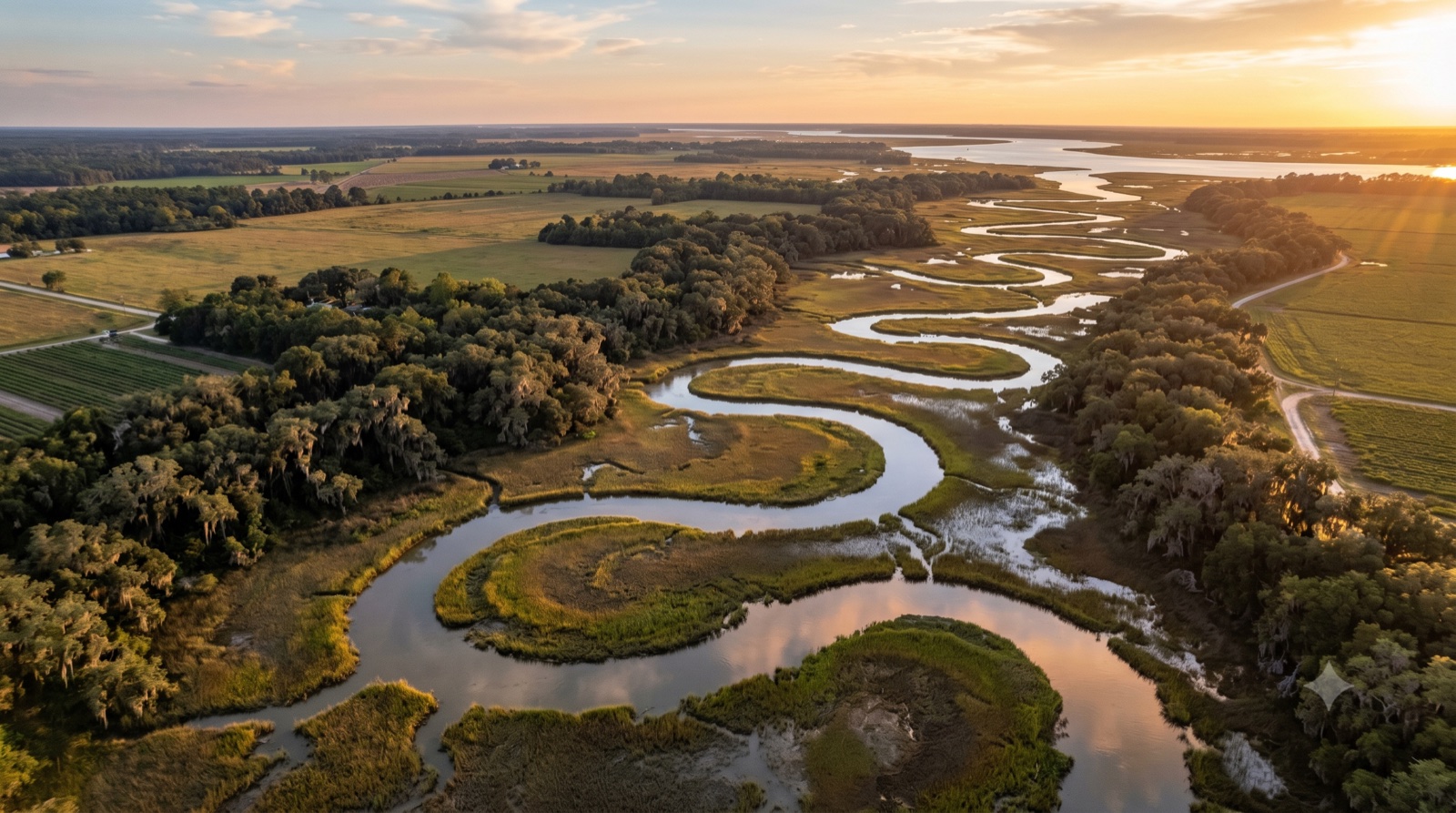
To sell land in Florence County, confirm your property's legal title and tax status with the Florence County Register of Deeds and Tax Assessor, hire a licensed South Carolina attorney to supervise the closing — a legal requirement with no exceptions — and choose your sales method: list with an agent, use an online land platform, or request a direct cash offer from a buyer. Florence County is the largest county Jerez Land has profiled in South Carolina, and it doesn't fit the shrinking-rural-county mold that describes most of its Pee Dee neighbors. The county covers roughly 804 square miles between the Great Pee Dee River and the Lynches River, with Florence — a genuine regional city of about 40,000 people, anchored by McLeod Health, Francis Marion University, GE HealthCare, Honda, and Duke Energy — serving as both county seat and economic engine.
That distinction matters for anyone trying to sell land here. The city of Florence and its immediate suburbs behave like a real, functioning small metro: steady population, diversified employment, active residential and commercial real estate. Step outside that ring, though, and the land market in unincorporated Florence County — the soybean, corn, cotton, and pine-timber acreage that stretches toward Marlboro, Dillon, Marion, Williamsburg, Clarendon, Sumter, Lee, and Darlington counties — behaves much more like the thin, family-held rural markets found throughout the Pee Dee. Understanding which of those two markets your parcel actually belongs to is the first step toward pricing expectations, timeline, and how to sell. For a broader look at South Carolina's statewide rules, see our South Carolina land selling guide.
What Are the Tax Costs of Holding Land in Florence County?
South Carolina assesses vacant land at a higher rate than an owner-occupied home. Under SC Code § 12-43-220, owner-occupied primary residences are assessed at 4% of fair market value, while vacant land, investment parcels, and non-owner-occupied real property — the category most inherited or held acreage falls into — is assessed at 6%. Agricultural real property gets its own split: land held by individuals, partnerships, or qualifying family farm corporations (ten or fewer shareholders, one class of stock, no nonresident alien shareholders) is assessed at 4% of its agricultural use value, while agricultural land held by a larger or non-family corporation is assessed at 6%.
Despite the higher 6% ratio applied to most vacant land, Florence County's overall property tax burden is comparatively light. PropertyTax101.org places the county's average effective rate at about 0.43% of home value — a median annual bill near $463 on a median home value of $108,400 — ranking Florence 44th of South Carolina's 46 counties, among the state's lower-tax jurisdictions. The county's 2024 base millage was 9.73 mills, according to the SC Association of Counties, made up mostly of county operations (2.40 mills), public safety (4.38 mills), county bonds (0.92 mills), and smaller library, senior-services, and technical-college levies. That base millage is added to whichever of Florence County's five school districts (Florence 1 through 5, with total school millage ranging from about 25.3 to 30.9 mills) and any municipal millage applies to the specific parcel.
How the Agricultural Rollback Tax Works If Land Use Changes
If your land carries the lower 4% agricultural-use assessment because it's been actively farmed or growing timber, converting it to a non-agricultural use — including selling to a buyer who develops it — can trigger a rollback tax. Under SC Code § 12-43-220(d)(4), the rollback tax recaptures the difference between what was paid at the agricultural rate and what would have been paid at the standard 6% rate, covering the year of the change in use plus the three immediately preceding tax years. That three-year lookback replaced a longer five-year lookback under a 2020 legislative change effective January 1, 2021, which cut two years off the exposure for anyone converting agricultural land after that date. Vacant parcels that were never actively farmed are typically already assessed at the standard 6% rate, so no rollback applies when they change hands.
South Carolina also requires countywide reassessments every five years, and property taxes are due by January 15 each year; unpaid taxes accrue penalties and can eventually lead to a tax sale. Absentee owners — especially heirs who inherited a parcel without a will and live outside South Carolina — should confirm current tax status directly with the Florence County Tax Assessor (180 N. Irby St., Florence, SC 29501; 843-665-3056) before assuming a bill has been paid. For more on how unpaid taxes affect a sale, see our guide on selling land with back taxes.
What Zoning and Closing Rules Apply to Florence County Land?
South Carolina requires every real estate closing, including vacant land and all-cash sales, to be supervised by a licensed attorney — there is no exception for simple transactions. In State v. Buyers Service Co., 357 S.E.2d 15 (S.C. 1986), the South Carolina Supreme Court held that conducting a real estate closing constitutes the practice of law, which is why title companies alone cannot close a South Carolina land sale the way they might in other states.
The closing process in Florence County follows this sequence:
- Title search: The attorney examines records at the Florence County Register of Deeds (180 N. Irby St., Florence, SC 29501; 843-665-3032) to confirm the seller holds clear, marketable title — a step that takes longer where heirs' property or intestate succession is involved
- Deed preparation: The attorney drafts the warranty or quitclaim deed based on the confirmed chain of title
- Closing: Buyer, seller, and attorney execute documents and transfer funds, either in person or remotely by mail and power of attorney for out-of-state sellers
- Recording: The attorney records the deed and pays the deed recording fee — $1.85 per $500 of sale price, split between a $1.30 state portion and a $0.55 county portion — to the Register of Deeds
- Disbursement: The attorney disburses net proceeds to the seller after satisfying any outstanding liens, delinquent taxes, or legal fees
For a full rundown of what documentation a South Carolina closing typically requires, see our paperwork needed to sell land guide.
Zoning Differs Sharply Between the City and the Countryside
Florence County's Planning Department (843-676-8600) administers zoning, the comprehensive plan, and land development regulations for unincorporated areas of the county, while the incorporated municipalities — Florence, Johnsonville, Lake City, Olanta, Pamplico, and Timmonsville — each maintain their own separate zoning ordinances. That split is exactly where the county's dual character shows up most concretely: a parcel inside the Florence city limits may carry commercial or higher-density residential zoning tied to the city's growth, while a nearly identical-looking tract a few miles into unincorporated county land is likely zoned for agricultural or low-density rural use with far fewer buyers actively shopping for it. Confirm the applicable zoning designation with the county Planning Department or the relevant municipality before listing or closing, particularly for parcels near a town boundary, the Great Pee Dee River floodplain, or Lynches River bottomland.
How Does Florence County Compare to Neighboring South Carolina Counties?
Florence County's population moved from 136,885 in the 2010 Census to 137,059 in 2020, and Data USA's 2024 estimate places it around 137,100 — a gain of roughly 0.1% to 0.9% depending on the estimate used, according to U.S. Census Bureau and Data USA data. That flatness stands out sharply against the rest of the Pee Dee: Darlington County, which borders Florence to the west, fell 8.4% between 2010 and 2020; Dillon County, to the northeast, fell roughly 14%; and Marion County, to the east, fell roughly 11.7% over the same period. Florence's stability is not evenly distributed across the county, though — it is concentrated in and around the city of Florence, whose $8.5 billion county-level GDP and health care, manufacturing, and retail employment base pull in residents and jobs that the surrounding farm country does not generate on its own.
| Factor | Florence County | Darlington County | Dillon County | Marion County |
|---|---|---|---|---|
| Population (2020 Census) | 137,059 | 62,905 | 28,292 | 29,183 |
| Population trend since 2010 | Essentially flat | Down 8.4% | Down ~14% | Down ~11.7% |
| County seat | Florence | Darlington | Dillon | Marion |
| County base millage (2024) | 9.73 mills | 8.58 mills | 15.70 mills | 15.10 mills |
| Top land use | Soybeans, corn, cotton, pine timber | Cotton, soybeans, corn | Tobacco, cotton, soybeans, corn | Tobacco, soybeans, corn, pine timber |
| Key land market signal | Stable city ring, thin rural countryside | Larger county, thin but more diverse | Very thin, scarce recent comps | Thin, steadily declining |
Florence County's own agricultural base looks more like its rural neighbors than its population chart suggests. The USDA's 2022 Census of Agriculture counted 391 farms working 116,428 acres — down 28% in farm count and 20% in acreage since 2017 — with an average farm size of 298 acres. Of that farmed acreage, 75,104 acres was cropland (dominated by 31,197 acres of soybeans, 14,174 acres of corn, and 8,434 acres of cotton) and 34,124 acres was farm woodland. Separately, the South Carolina Forestry Commission's 2019 county forest inventory found forest cover on roughly 338,829 of the county's 532,749 total acres — close to two-thirds of the county — making timber the single largest land-cover category across Florence County as a whole, even though cropland dominates the acreage that's actively farmed. Ninety-seven percent of the county's farms are family operations, a figure consistent with a land market driven by long-held family and inherited acreage rather than active corporate buying and selling.
Heirs' Property Is a Significant Factor Outside the City
The Center for Heirs' Property Preservation — a nonprofit that helps landowners resolve title on land passed down informally through generations without a recorded will — operates a dedicated office in Florence and lists Florence among the 22 South Carolina counties in its service area. That local presence reflects how common heirs' property is in the rural communities surrounding Florence, where multiple generations of a family may hold an undivided interest in a single farm or timber tract without any one person holding clear, marketable title. Selling heirs' property generally requires either an agreement among every co-owner or a court-supervised partition or quiet-title action before a deed can transfer. Our selling inherited land with multiple heirs guide covers the process in more detail, and our guides on selling timberland and selling farmland address the two land types most common outside Florence's city limits. For more county-level land guides across the region, browse our blog.
What Are Your Options for Selling Land in Florence County?
Landowners holding vacant, farmed, or timbered acreage in unincorporated Florence County face a market that looks nothing like the stable city numbers suggest. Rural parcels carry the higher 6% vacant-land assessment (or a rollback exposure if agricultural status changes), heirs' property complicates title on a meaningful share of family-held tracts, and the pool of active buyers for row-crop or timber acreage outside the city ring is genuinely thin — even though the county overall isn't losing population the way Darlington, Dillon, and Marion are.
Before selling, confirm your property's legal description and tax status through the Florence County Register of Deeds (180 N. Irby St., Florence, SC 29501; 843-665-3032) and the Tax Assessor (180 N. Irby St., Florence, SC 29501; 843-665-3056). If the parcel was inherited without a will, a South Carolina real estate attorney — or the Center for Heirs' Property Preservation's Florence office — can help determine whether title needs to be cleared before you can close. Check zoning with the county Planning Department (843-676-8600) if the parcel sits near Florence, Johnsonville, Lake City, Olanta, Pamplico, or Timmonsville, since municipal zoning can differ meaningfully from the county's rural designations.
From there, sellers have several paths. Listing with a local agent works best for parcels inside or near the city, where buyer traffic is real. Online land platforms reach out-of-state hunters, timber investors, and land buyers for the more rural tracts. For landowners who want a specific number rather than an open-ended listing, request a cash offer from Jerez Land. We provide firm, parcel-specific written offers, handle the attorney-supervised closing, and absorb the carrying costs, marketing time, and resale risk ourselves — so you can close in weeks without commissions or listing fees. Understanding who pays closing costs when selling land and how much your land is worth before you negotiate puts you in a stronger position regardless of which path you choose.
Frequently Asked Questions
How do I sell vacant land in Florence County SC?
Confirm your property's legal description and any delinquent taxes through the Florence County Register of Deeds (180 N. Irby St., Florence, SC 29501; 843-665-3032) and the Tax Assessor (843-665-3056). South Carolina requires a licensed attorney to supervise the closing, including title examination, deed preparation, and recording with the Register of Deeds. You can list with a local or regional land agent, use land-focused online platforms, or request a direct cash offer from a land buyer like Jerez Land.
I own vacant land in Florence County SC — what will my annual property taxes be?
Vacant and non-owner-occupied land is assessed at 6% of fair market value under SC Code § 12-43-220, compared to 4% for owner-occupied homes and for agricultural real property held by individuals or qualifying family farm corporations. Florence County's average effective property tax rate is about 0.43% of home value, among the lower rates in South Carolina, according to PropertyTax101.org, and the county's 2024 base millage was 9.73 mills before school district, municipal, and special district levies are added. Actively farmed parcels of five or more acres may qualify for the lower 4% agricultural use-value assessment under SC Code § 12-43-232.
I inherited 60 acres of pine timber outside Lake City and I live in Charlotte — do I have to come to South Carolina to close?
No, but a licensed South Carolina attorney must still supervise the closing regardless of where you live. Under State v. Buyers Service Co., 357 S.E.2d 15 (S.C. 1986), the South Carolina Supreme Court held that real estate closings are the practice of law, so every deed transfer — including vacant timberland — must go through an attorney who examines title, prepares the deed, and records it with the Florence County Register of Deeds. Out-of-state sellers routinely close by mail, courier, or remote notarization with power of attorney; your closing attorney can set this up so you never have to travel to South Carolina in person.
My grandparents left my siblings and me a soybean farm near Pamplico with no will — can we sell it without every heir agreeing?
Generally, no — heirs' property, land passed down informally through generations without a recorded will, leaves multiple co-owners with an undivided interest in the whole parcel, and selling typically requires either an agreement among all co-owners or a court-supervised quiet-title or partition action. The Center for Heirs' Property Preservation, which operates an office in Florence and serves 22 South Carolina counties including Florence, helps landowners resolve exactly this kind of title problem before a sale can close. A South Carolina real estate attorney can tell you whether your family's title is clear enough to sell now or needs to be resolved first.
I have 15 acres of vacant land near Timmonsville that I've been paying taxes on for years but never farmed — should I worry about a higher tax bill if I sell to a buyer who develops it?
That risk falls on whoever changes the land's classification, not automatically on you as the seller, but it's worth understanding before you negotiate. If your 15 acres has been carrying the agricultural-use assessment at 4% and the buyer converts it to a non-agricultural use, South Carolina imposes a rollback tax — the difference between what was paid at the agricultural rate and what would have been paid at the standard 6% rate — for the year of the change plus the three preceding tax years, under SC Code § 12-43-220(d)(4). If your land has never been actively farmed, it was likely already assessed at the standard 6% vacant-land rate, in which case no rollback applies at sale.
Is Florence County SC's land market strong for a quick sale, or is it as rural as the smaller Pee Dee counties?
It's both, depending on where in the county your parcel sits. Florence County's population has stayed essentially flat since 2010 — 136,885 in the 2010 Census to 137,059 in 2020, and holding near 137,000-138,000 today, according to U.S. Census Bureau data — but that stability is concentrated in and around the city of Florence, population roughly 40,000, and its hospital, logistics, and manufacturing economy. Once you're outside the city and its suburbs, the land market in unincorporated Florence County behaves like its shrinking Pee Dee neighbors: dominated by long-held family farms, soybean and cotton acreage, and pine timberland, with a thinner pool of active buyers than the county's overall population trend would suggest.
Disclaimer: This article is for informational purposes only and does not constitute legal, financial, or professional advice. Laws and regulations vary by jurisdiction and change over time. Always consult with qualified professionals before making land purchase decisions. Jerez Land is not responsible for actions taken based on this information.