
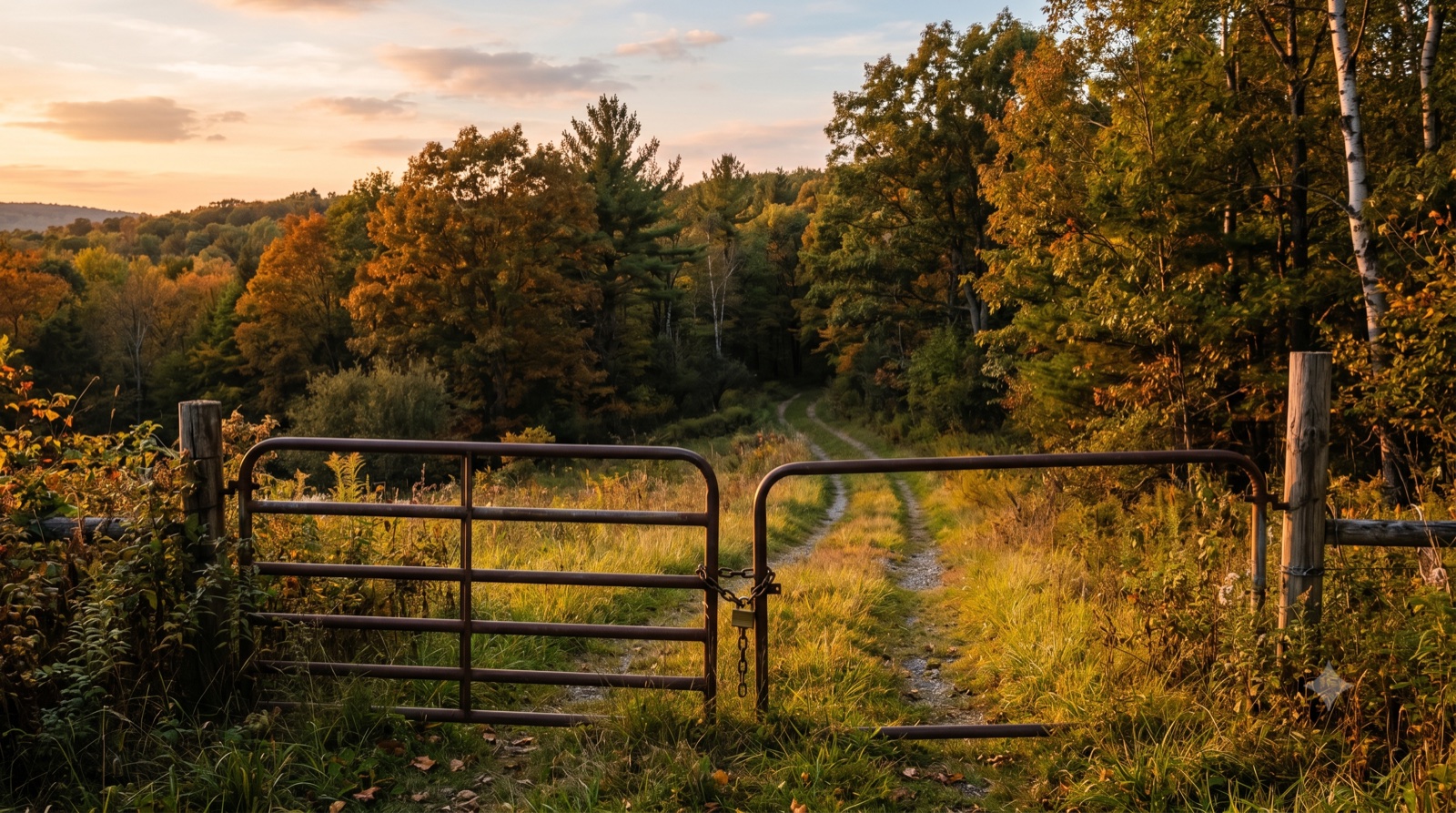
Selling Land When a Neighbor Blocks Your Deeded Easement
Key Takeaways
- A recorded easement appurtenant runs with the land and passes to your buyer automatically: Unlike an easement in gross, which is personal to an individual, an easement appurtenant is tied to the property itself, according to Cornell's Legal Information Institute. Your access right does not evaporate at closing just because it is currently obstructed
- Non-use does not kill an easement, no matter how long the blockage has lasted: Abandonment requires an affirmative act showing intent never to use the easement again — mere non-use, even for decades, generally is not enough. This directly rebuts the fear that being locked out for years quietly forfeited the right
- Standard title insurance covers legal access, not physical access: A policy insures that a right of access exists of record; it does not guarantee that the route is passable. Closing that gap requires an ALTA 17-06 Access and Entry endorsement or, where access runs over an appurtenant easement, ALTA 17.1-06 — and even those address legal adequacy, not physical condition
What Can You Do When a Neighbor Blocks Your Deeded Easement?
Start by pulling the recorded easement instrument and reading its exact language, then send a written demand by certified mail and consult a real-estate attorney licensed in the property's state. Do not cut the lock or drive through the obstruction — self-help is the single most common piece of advice online and the one most likely to turn your strong position into a lawsuit against you. Your remedies are injunctive relief to compel removal, a quiet title or declaratory judgment action to confirm the easement's terms, and damages for interference.
This post is about a specific situation: you hold a recorded easement and someone has physically gated, chained, fenced, or plowed it shut. That is different from having no access rights at all — covered in our guide on selling land with no road access or easement — and different from an easement that burdens your property, covered in selling land with an easement. The distinction matters, because the legal tools are not interchangeable.
Can Your Neighbor Legally Put a Gate Across Your Easement?
Sometimes yes, which surprises most owners. The servient owner — the one whose land your easement crosses — retains the right to use their own property, but they may not unreasonably interfere with your easement's purpose. Courts apply a balancing test weighing the necessity of the restriction for protecting the servient estate against the degree of interference with the easement holder's use.
North Carolina's case law illustrates the line clearly, as summarized by NC State Extension's farm law program. The general rule from Chesson v. Jordan, 224 N.C. 289 (1944), applied in Taylor v. Hiatt (N.C. Ct. App. 2019), is that gates are permissible if necessary to the reasonable enjoyment of the servient owner's estate, provided they do not materially impair or unreasonably interfere with the easement's purpose. But there is a hard exception: where the recorded instrument itself says the way shall remain open, a gate is prohibited outright regardless of interference, per Setzer v. Annas, 286 N.C. 534 (1975).
That is why step one is reading your actual deed language rather than asking a general question. Attorney commentary consistently treats a locked gate with no key or combination provided to the easement holder as unlawful interference, even where an unlocked gate would be fine — but that is a widely-held general position rather than a single controlling rule, and it varies by state. We were not able to verify the specific gate standard for Alabama, Georgia, Michigan, Mississippi, Oklahoma, Pennsylvania, South Carolina, or Tennessee, so do not assume North Carolina's rule travels.
Can They Move the Easement Somewhere Less Convenient?
The traditional common-law rule bars a servient owner from relocating an easement without the dominant owner's consent. The Restatement (Third) of Property: Servitudes § 4.8(3) departs from that, permitting unilateral relocation — absent contrary agreement — if it does not significantly lessen the easement's utility, increase the holder's burden, or frustrate its purpose. States are genuinely split, with some adopting the Restatement approach and others expressly rejecting it. We could not confirm which position any of the nine states we work in has taken, so treat this as a question for a local attorney rather than something with a general answer.
Separately, your neighbor may raise a scope objection — arguing that your use exceeds what the granting instrument allowed, such as running heavy equipment over what was granted as a footpath. A court can enjoin the excess use while leaving the core easement intact.
Is Cutting the Lock or Driving Through Ever a Good Idea?
No — and this is the most important correction in this entire post, because "just cut the lock, it's your easement" is the advice that dominates online threads. Removing a gate, cutting a chain, or bulldozing through exposes you to liability for the property you damaged, a trespass claim, and potentially criminal charges. The law generally disfavors people taking matters into their own hands, even when the underlying right is valid.
Some crowd-sourced attorney answers reference a narrow self-help "abatement" privilege — removing an obstruction without damaging it. That concept is contested, jurisdiction-specific, and was not backed by a citable statute or appellate holding in our research. We also found no reported decision in any of our nine states imposing liability on an easement holder for cutting a lock on their own blocked easement. The risk is well-supported as a general principle; the specific outcome in your state is not something anyone should promise you.
The practical problem is bigger than the legal one. The moment you damage your neighbor's gate, you hand them a counterclaim, you muddy a clean record, and you convert a dispute where you were plainly in the right into a fight where both sides have grievances. If you intend to sell, that is the opposite of what you want a title company to see.
What actually works: document the obstruction with dated photos, send a formal written demand by certified mail referencing the recorded instrument and setting a deadline, and if that fails, pursue injunctive or declaratory relief through counsel.
Other Advice You'll See That Is Wrong
- "They can't put up a gate at all, ever." False as a categorical rule — the question is almost always whether this particular gate or lock unreasonably interferes, not whether any gate is per se illegal
- "Call the police and they'll make him open it." Easement disputes are civil property matters. Law enforcement generally will not adjudicate them at the scene; the remedy runs through the courts
- "We haven't used it in twenty years, so we lost it." Non-use alone generally does not extinguish an express easement. Abandonment requires an affirmative act showing intent never to use it again
- "My title insurance covers this." A standard policy insures that legal access exists, not that it is physically passable — see below
One genuinely open question we could not resolve: whether a servient owner's long-standing, unchallenged obstruction can itself ripen into a prescriptive right to keep it. That is distinct from your own non-use, and it needs state-specific legal review rather than a general answer.
Can You Use a Cartway or Private Road Statute?
Probably not — and this is a trap worth naming, because these statutes come up constantly in searches about blocked access. Several states we work in provide court proceedings to create access for a landowner who has none:
| State | Mechanism |
|---|---|
| North Carolina | G.S. § 136-68 cartway proceeding before the Clerk of Superior Court; jury of view lays out an 18–30 ft cartway |
| Georgia | O.C.G.A. § 44-9-40 private way petition (up to 20 ft); § 44-9-54 addresses prescriptive private ways |
| Mississippi | § 65-7-201 private road through a Special Court of Eminent Domain |
| Pennsylvania | Private Road Act of 1836 (up to 25 ft), narrowed by recent appellate decisions |
| Michigan | Act 283 of 1909, private roads up to 24 ft |
| Tennessee | T.C.A. § 54-14-101 et seq.; § 54-14-117 provides the statutory easement reverts on non-use and restricts gates on that statutory road |
Every one of these is designed for an owner with no adequate legal access at all. You already have a recorded easement. Your route is a civil action to enforce the instrument you hold — injunction, quiet title, damages — not a petition to create a new way. Filing the wrong proceeding wastes time and can imply your existing easement is inadequate.
For Alabama, South Carolina, and Oklahoma we found only common-law easement-by-necessity doctrine and could not verify a discrete cartway statute, so we are not claiming one exists.
How Do You Sell Land While the Easement Dispute Is Live?
You can sell, but you need to control three things: disclosure, documentation, and the buyer's ability to insure access. Handled well, a blocked-easement parcel is sellable to the right buyer. Handled badly, it dies in escrow.
The Title Insurance Gap Most Sellers Never Learn About
This is the sharpest practical point in the whole situation. A standard title policy insures that a right of access exists — that there is a recorded easement. It does not insure that the access is physically usable. A title company generally has no liability under a standard policy when a recorded right-of-way is blocked by a gate, because legal access exists on paper.
Closing that gap requires an endorsement: ALTA 17-06 (Access and Entry), or ALTA 17.1-06 (Indirect Access and Entry) where access runs over an appurtenant easement rather than direct road frontage. Even those endorsements address the legal adequacy of access rather than its physical condition, so inspection and survey remain the buyer's responsibility. Expect a sophisticated buyer or their lender to ask for one — and expect that request to surface your dispute early.
Get a Survey
A survey plots the easement's actual location, width, and course on the ground, which a deed description alone cannot show. That matters more here than on an ordinary tract, because the entire dispute turns on where the easement runs relative to the obstruction. Lenders commonly require a survey before financing vacant land, and title companies may require one before issuing certain coverage. Our guide on whether you need a survey to sell land covers the general case.
Disclose It
Known material defects affecting the property generally must be disclosed, and access is a textbook material fact. Many states' residential seller-disclosure statutes do not apply to vacant land, but common-law and contractual duties not to conceal or misrepresent known material facts can still apply regardless of whether a statutory form is required. This is state-specific — confirm your obligations with a local attorney rather than assuming vacant land exempts you.
Assemble the Documentation Package
A buyer's willingness to take this on scales directly with how well documented it is. Put together:
- The recorded easement instrument, with book and page or instrument number
- A current survey or plat showing the easement's course and the obstruction's location
- Dated photographs of the obstruction over time
- Copies of any written demand letters sent, and any response
- Sheriff or incident reports, if any
- All correspondence with the neighbor
Understand What a Lis Pendens Does
If you file suit, a lis pendens — a recorded notice that litigation affecting title is pending — does not legally bar a sale, but it puts every subsequent buyer and lender on constructive notice. In practice, lenders generally will not finance and title insurers generally will not insure while one is active, which effectively limits you to cash buyers until the case resolves or the notice is released.
Which Path Should You Take?
| Factor | Enforce the easement (injunction / quiet title) | Negotiate a written settlement | Sell as-is to a buyer who takes it on |
|---|---|---|---|
| Time to resolution | Unpredictable — depends on the court's docket and whether the neighbor contests | Fastest if the neighbor cooperates; can stall indefinitely if not | Proceeds on your timeline |
| Cost predictability | Low — scales with how contested the matter becomes | Higher — bounded by what both sides agree to | Shifts to the buyer's price expectations |
| Effect on buyer pool | Narrows while a lis pendens is recorded | Widens once a recorded resolution gives title something to underwrite | Narrowest — largely cash buyers |
| Certainty of outcome | Depends on your instrument's language and state case law | Only as certain as what gets put in writing and recorded | Shifts to what the buyer will accept |
| Neighbor relationship | Adversarial by design | Preserved or repaired if it works | Becomes the buyer's problem |
| Best fit | Clear deed language, an uncooperative neighbor, and time before you need to close | Both sides want to avoid court and a keyed gate or written agreement would settle it | You need to move now and will accept a disclosed, as-is sale |
What Should You Actually Do First?
Work the sequence in order — each step makes the next one cheaper.
- Pull the recorded easement instrument and read its exact terms. Language like "free and uninterrupted" or "shall remain open" can decide the gate question outright
- Get a current survey locating the easement and the obstruction precisely
- Send a written demand by certified mail, referencing the instrument and requesting removal or a key by a specific date. This creates the record every later remedy depends on
- Consult a real-estate attorney licensed in the property's state. Gate standards, relocation rules, disclosure duties, and prescription questions are all state-specific — this is where the unknowns above actually get resolved for your parcel
- Weigh injunction against settlement. A recorded agreement — the neighbor keeps a gate, you get keys, maintenance is spelled out — often resolves things faster than litigation and leaves a document a title company can work with. See selling land with a shared or private road maintenance agreement
- Decide whether to resolve it before listing or sell as-is — deliberately, with counsel, rather than by default
If the dispute is really about where the line falls rather than about access itself, selling land with a boundary dispute or encroachment covers that situation. If it turns out you never had a recorded easement at all, see selling landlocked land.
If you would rather not spend a year litigating access before you can sell, companies like Jerez Land buy parcels with active access disputes and make direct cash offers priced individually to the parcel — a firm written number, not a range or a formula. We absorb the carrying costs and the resolution risk, and we are used to reading a recorded easement and a survey rather than needing a clean file. Request a cash offer, or explore our blog for more on selling difficult parcels.
Frequently Asked Questions
My neighbor put a locked gate across the gravel road that's my only deeded access — can they legally do that?
It depends on your recorded instrument's exact language and your state's case law. A servient owner may generally erect a gate if it is necessary to the reasonable enjoyment of their own land and does not materially impair your easement's purpose. But where the instrument says the way shall remain open, a gate is prohibited outright — that is the rule from Setzer v. Annas in North Carolina. A locked gate with no key given to you is widely treated as unlawful interference regardless.
I haven't been able to use my easement for years because it's been blocked — did I lose it?
Almost certainly not. Mere non-use, however long, generally does not extinguish an express recorded easement. Abandonment requires an affirmative act demonstrating intent never to use the easement again, which being locked out against your will is not. Whether a servient owner's long unchallenged obstruction could separately ripen into a prescriptive right to maintain it is an open, state-specific question worth asking a local attorney.
My neighbor blocked my easement and I'm ready to just cut the lock — is that legal?
Don't. Cutting a lock, removing a gate, or driving through exposes you to liability for the damaged property, a trespass claim, and potentially criminal charges — and it hands your neighbor a counterclaim in a dispute where you were otherwise plainly in the right. Some sources reference a narrow self-help abatement privilege, but it is contested and jurisdiction-specific. Document the obstruction, send a certified written demand, and pursue injunctive relief through an attorney instead.
I want to sell but the easement dispute isn't resolved — do I have to tell buyers?
Assume yes. Known material defects affecting a property generally must be disclosed, and blocked access is a textbook material fact. Many states' residential seller-disclosure statutes do not cover vacant land, but common-law and contractual duties not to conceal or misrepresent known material facts can still apply. Concealment also tends to surface anyway during title work or survey, at which point it kills the deal instead of merely repricing it.
Does title insurance protect a buyer against a blocked easement?
Not under a standard policy. A standard title policy insures that a right of access exists of record — it does not guarantee the access is physically passable, so a recorded but gated right-of-way may leave the policyholder without a claim. Closing that gap requires an ALTA 17-06 Access and Entry endorsement, or ALTA 17.1-06 where access runs over an appurtenant easement, and even those address legal adequacy rather than physical condition.
Can I use a cartway or private road statute to force the gate open?
Generally no, because those statutes solve a different problem. North Carolina's cartway proceeding, Georgia's private way petition, Mississippi's private road procedure, Pennsylvania's Private Road Act, Michigan's Act 283, and Tennessee's private road statute all exist to create access for an owner who has none. You already hold a recorded easement, so your route is a civil action to enforce it — injunction, quiet title, or damages — rather than a petition to establish a new way.
Disclaimer: This article is for informational purposes only and does not constitute legal, financial, or professional advice. Laws and regulations vary by jurisdiction and change over time. Always consult with qualified professionals before making land purchase decisions. Jerez Land is not responsible for actions taken based on this information.