
Sell My Land in Alleghany County NC - What Landowners Need to Know
Key Takeaways
- North Carolina's Present-Use Value rollback is the current year plus the three preceding years, plus interest, per NCDOR — and in Alleghany County this matters more than almost anywhere, because Christmas tree ground, hay, and pasture are exactly the land types most likely to be enrolled
- Christmas trees are Alleghany's #1 commodity but only about half its farm economy — $26.9 million, or 50.3% of $53.5 million in total agricultural sales, ranking #2 in North Carolina and #4 in the United States, per the USDA 2022 Census of Agriculture (cp37005)
- North Carolina charges excise tax of $1.00 per $500 of consideration (0.2%), collected by the Register of Deeds at recording, and Alleghany is not among the seven coastal counties authorized to add a local land-transfer tax
How Can You Sell Land in Alleghany County North Carolina?
Selling land in Alleghany County, North Carolina means working with a licensed North Carolina attorney — the state requires attorney-supervised closings — paying excise tax of $1.00 per $500 of the price, and, critically, finding out whether your parcel is enrolled in Present-Use Value before you agree to anything. If it is, a rollback of three years of deferred taxes plus interest can come due at sale.
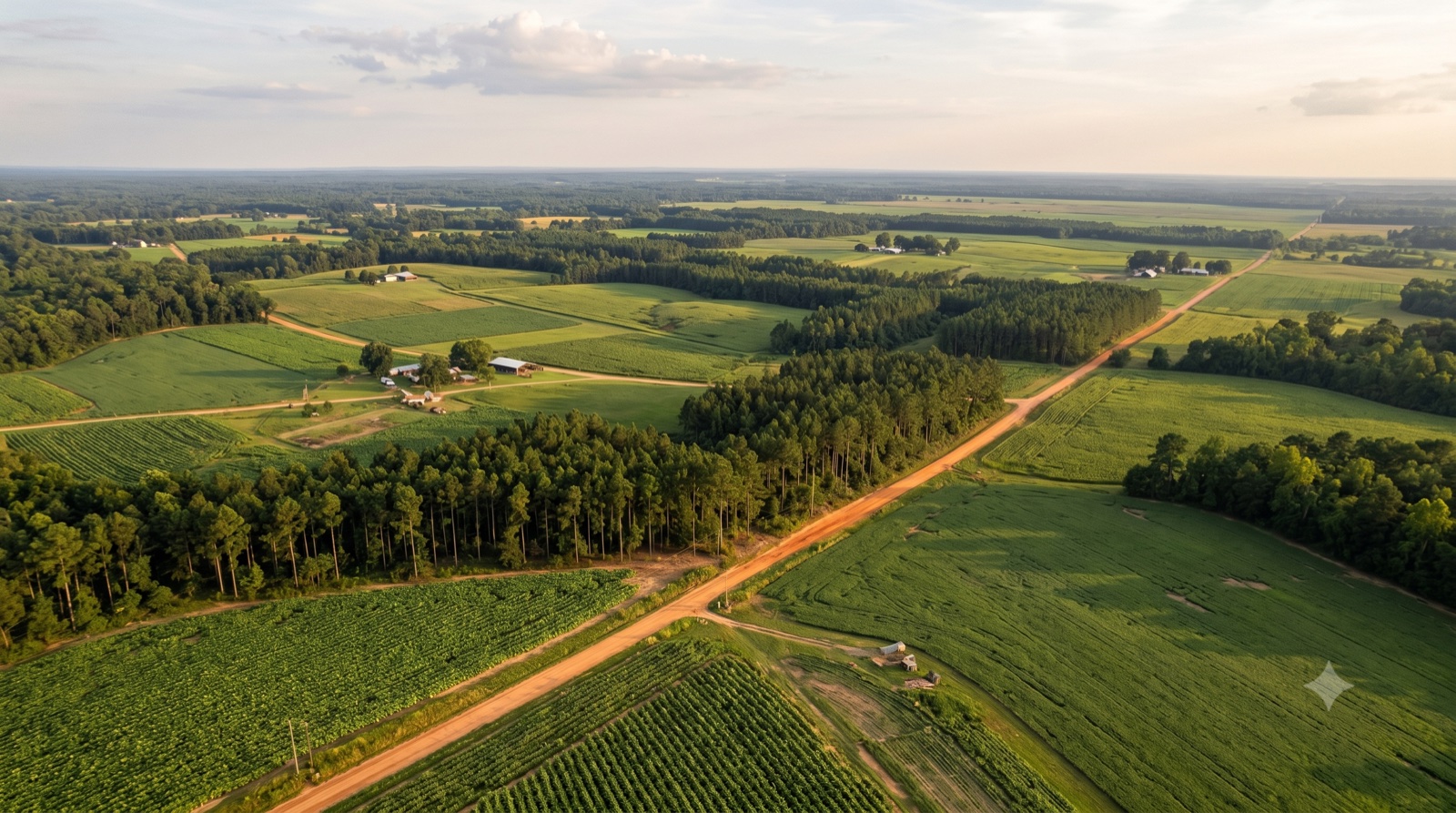
Alleghany County sits in North Carolina's northwestern Blue Ridge, with Sparta as the county seat, covering about 236 square miles. General elevation runs roughly 2,500 to 3,000 feet, topping out at 4,175 feet at Catherine Knob on Peach Bottom Mountain. The Blue Ridge Parkway runs along the eastern and southern edge, and the North and South Forks of the New River meet at the Alleghany–Ashe line.
This guide covers Alleghany's property tax picture, the Present-Use Value program and its rollback, North Carolina's attorney-closing and excise-tax mechanics, how the county compares to its neighbors, and your options for selling. For the statewide picture, start with our North Carolina land selling guide, or browse the full land selling library.
What Are the Property Tax and Carrying Costs of Holding Land in Alleghany County?
Alleghany County's statutory property tax rate is $0.597 per $100 of assessed value for FY 2025-26 and 2026-27, per the county's own tax office. Effective-rate estimates from third parties come in lower or higher depending on method: Tax-Rates.org reports roughly 0.50% (median tax $663 on a $133,100 median home value), while Ownwell reports about 0.64% countywide, with Sparta near 0.69% and Roaring Gap near 0.68%.
Those three figures are not contradictory so much as differently constructed. The statutory rate applies to assessed value from the county's 2021 general reappraisal. Effective rates measure tax against current market value, which has moved since 2021. Do not average them — and note that Alleghany's next scheduled revaluation is 2027, which means assessed values across the county are due to reset in the near term.
Present-Use Value: Three Classes, Three Sets of Rules
North Carolina's Present-Use Value (PUV) program taxes qualifying land on its agricultural, horticultural, or forest use value rather than market value. The three classes have genuinely different requirements, and in Alleghany County you may well have land in more than one:
- Agriculture: minimum 10 acres in commercial agricultural production, with an average gross income of at least $1,000 per year over three years
- Horticulture: minimum 5 acres in commercial horticultural production, same $1,000 income requirement. Christmas trees fall under horticulture, not forestry — NCDOR's language covers land "used to produce evergreens intended for use as Christmas trees"
- Forestry: minimum 20-acre tract under sound commercial timber management, with no income requirement
That Christmas-tree classification catches people out. A grower who assumes their trees are "forestry" and applies the 20-acre forestry minimum has the wrong rule; the horticulture class applies at 5 acres with an income test.
The Rollback Is the Number That Changes Your Deal
When PUV land is disqualified, deferred taxes become due for the current year plus the three immediately preceding years, plus interest on the differential for each of those years — 36 months of interest on the first year back, 24 on the second, 12 on the third. Deferred tax from before that three-year lookback is permanently forgiven.
Consider what that means in Alleghany specifically. The county has 63,298 acres in farms, split roughly 24,563 acres cropland, 21,126 acres pasture, and 13,800 acres woodland. Tree, hay, and pasture ground here is heavily enrolled. If your buyer does not continue the qualifying use, the rollback triggers, and who pays it is a negotiated term in the purchase agreement — not a foregone conclusion. Get the figure from the Alleghany County Tax Office in writing before you agree to a price.
If your parcel is primarily wooded, see our guide on selling timberland; if it is working farm ground, see selling farmland.
What Closing and Zoning Requirements Apply in Alleghany County?
North Carolina requires a licensed North Carolina attorney to supervise a real estate closing. This is not optional and it is not a title-company-only state. The attorney handles the title examination, deed preparation, settlement statement, closing, and recording. Title insurance is issued through the attorney's work rather than independently of it.
Your two conveyance costs are straightforward and set statewide:
- Excise tax (revenue stamps): $1.00 per $500 of consideration, or 0.2%, under NCGS § 105-228.30, collected by the Register of Deeds at recording. On a $150,000 sale that is $300. Only seven counties — Camden, Chowan, Currituck, Dare, Pasquotank, Perquimans, and Washington, all in the coastal northeast — are authorized to levy an additional local land-transfer tax. Alleghany is not one of them, so no local add-on applies here.
- Recording fee: $26 for a deed up to 15 pages, $4 per page beyond that, uniform statewide under NCGS § 161-10.
The Alleghany County Register of Deeds, Miranda H. Roupe, is at 348 S. Main Street, County Administration Building, Office 110, Sparta, NC 28675 (mailing: PO Box 186), phone 336-372-4342.
The Alleghany County Tax Administrator, Rita B. Miller, is at 348 South Main Street, Suite 150, Sparta, NC 28675 (mailing: PO Box 1027), phone 336-372-8291. This is the office for PUV enrollment status and rollback figures.
Zoning and Buildability
Alleghany County appears not to have a countywide comprehensive zoning ordinance. The county's published ordinance list includes a subdivision ordinance, a property rights protection ordinance, and floodplain, watershed, and ridge-development rules — but no general zoning code — and land listing sites market Alleghany parcels as unrestricted. We are stating this with some hedging on purpose: the evidence is an absence of a zoning ordinance plus consistent third-party description, not a single authoritative government statement that the county has none. Confirm with the county Planning and Inspections office before you make it a selling point in writing.
What we can say is that ridge-development and watershed rules do exist and can affect what a buyer may build on high-elevation ground. We did not pull the actual slope thresholds, so do not assume a specific limit applies to your tract without checking the ordinance text.
If you are managing this parcel from elsewhere, see selling land as an out-of-state owner.
How Does Alleghany County Compare to Neighboring Counties?
Alleghany County declined from 11,155 residents in 2010 to 10,888 in 2020, then grew again to roughly 11,479 by a 2025 estimate — the same pattern seen across the North Carolina High Country, where post-2020 in-migration reversed a long slow decline. It remains one of North Carolina's smallest counties by population.
| Factor | Alleghany County | Ashe County | Wilkes County | Surry County |
|---|---|---|---|---|
| Population | ~11,479 (2025 est.) | ~27,514 (2025 est.) | Not verified this pass | ~71,400 |
| Effective tax rate | 0.597% statutory; 0.50%–0.64% effective | ~0.48%–0.56% | ~0.62%–0.64% (one outlier figure disregarded) | ~0.55%–0.75% |
| County seat | Sparta | Jefferson | Wilkesboro | Dobson |
| Christmas trees | $26.9M, 50.3% of ag sales, #2 in NC | $55.8M, 76% of ag sales, #1 in NC / #2 in US | Not a leading commodity | Not a leading commodity |
| Land character | Diversified high-country: trees, pumpkins, cattle/hay | Tree-dominated high country | Blue Ridge slope to Yadkin valley; Stone Mountain, W. Kerr Scott Reservoir | Yadkin Valley vineyard and Piedmont-transitional ground |
Two honest gaps in that table. Wilkes County's population was not cleanly verifiable in this research pass, and one reported Wilkes effective rate of 1.54% is so far out of line with every other rate in the region that we treat it as a methodology artifact and exclude it rather than publish it.
How Alleghany Actually Differs From Ashe
If you have read about Ashe County next door, do not assume Alleghany is a smaller copy of it. It is a genuinely different agricultural county.
Ashe is close to a Christmas tree monoculture: $55.8 million in tree sales, 76% of all county agricultural sales, on 13,096 planted acres, ranking #1 in North Carolina and #2 in the United States. Alleghany's tree sales are $26.9 million on just 3,356 planted acres — about a quarter of Ashe's tree acreage — and represent only 50.3% of the county's $53.5 million total.
The other half is where Alleghany diverges. Its #2 commodity by dollars is not cattle but vegetables, melons, and pumpkins at $10.2 million (19.1% of sales); Alleghany is reported by NC Cooperative Extension as the state's top pumpkin-producing county, though the Ag Census withholds the county's specific pumpkin figures to protect grower confidentiality. Cattle come third at $9.3 million (17.3%, ranking #9 in the state) on an inventory of 20,054 head.
And by acreage the ranking inverts entirely. Forage — hay and haylage — is the single largest land use at 11,110 acres, more than three times the county's Christmas tree acreage. So trees win on dollars, but cattle and hay ground cover far more of Alleghany's physical landscape than trees do. If you own pasture here, you own the county's most typical land type, not its most famous one.
Two further notes for accuracy. Land in farms is about 42% of the county's total land area, so a majority of Alleghany's ground sits outside the Ag Census entirely. And the Ag Census reports no forest-products sales line for Alleghany at all — so while there are 13,800 woodland acres within farms, there is no USDA-verified figure for timber as a revenue commodity here, and we are not going to invent one.
For what drives value on a specific tract, see how much is my land worth, and if you are deciding whether to list, see do you need a realtor to sell land.
What Are Your Options for Selling Land in Alleghany County?
The typical Alleghany seller is an aging grower or an heir. Tree farms and cattle operations here are frequently multi-generational, and the succession question arrives whether or not the family is ready for it. The signals: the trees have not been sheared in two seasons, the hay is being cut by a neighbor on a handshake, the parcel came through an estate to siblings scattered across three states, or the PUV income test is getting hard to meet because nobody is actively farming.
Before accepting any offer, do four things. Get your PUV enrollment status and the exact rollback figure from the Tax Administrator at 336-372-8291 — this single number can move your net proceeds materially. Pull your deed and check for easements and rights-of-way at the Register of Deeds, 336-372-4342. If you have standing timber or a mature tree crop, get an independent opinion on its value separately from the land. And find out whether your buyer intends to continue the qualifying use, because that determines whether the rollback triggers at all.
From there the paths are real. A North Carolina land specialist or High Country broker can reach second-home and recreational buyers drawn by the Parkway and the New River, which was designated a State Scenic River in 1975 and added to the National Wild and Scenic Rivers System in 1976 — a genuine amenity. But commissions apply, and mountain acreage with slope or access constraints can sit. For owners who want a specific number without an open-ended marketing period, Jerez Land makes a direct, parcel-specific written cash offer for your land. We buy for cash and absorb the carrying costs, marketing expense, and resale risk ourselves, so the offer reflects the certainty and speed we provide rather than a retail listing price. No commissions, no listing period, and a closing driven by when title is clear.
Frequently Asked Questions
My family's Christmas tree land in Alleghany County is in Present-Use Value — what happens to that when I sell?
A rollback may come due. When PUV land is disqualified, deferred taxes become payable for the current year plus the three immediately preceding years, plus interest on each year's differential — 36 months of interest on the earliest year, 24 on the next, 12 on the last. Anything older is forgiven. Whether it triggers depends on whether your buyer continues the qualifying use. Note that Christmas trees qualify under the horticulture class (5-acre minimum plus a $1,000 average annual income test), not forestry. Get the exact figure from the Alleghany County Tax Administrator at 336-372-8291 before agreeing to a price.
I inherited mountain land near Sparta and live out of state — can I sell it without coming to North Carolina?
Yes, though North Carolina requires a licensed NC attorney to supervise the closing, so you will be working through one either way. You do not need to appear in person — the attorney can arrange remote signing and wired funds. Start by pulling the deed through the Alleghany County Register of Deeds at 336-372-4342 to confirm how title is held, since inherited land often needs an estate matter cleared first, and check PUV status and any rollback exposure with the Tax Administrator at 336-372-8291.
I'm selling my Alleghany County land for $150,000 — how much excise tax will I owe?
$1.00 per $500 of consideration, or 0.2% of the sale price, under NCGS § 105-228.30, collected by the Register of Deeds when the deed is recorded. On a $150,000 sale that is $300. Only seven North Carolina counties — all in the coastal northeast — are authorized to add a local land-transfer tax, and Alleghany is not among them, so no additional local levy applies. Recording costs $26 for a deed up to 15 pages plus $4 per additional page, uniform statewide.
Do I need an attorney to sell land in North Carolina?
Yes. North Carolina requires a licensed North Carolina attorney to supervise real estate closings, covering title examination, deed preparation, the settlement statement, closing, and recording. This distinguishes NC from title-company states like Michigan or Oklahoma, where closings proceed without mandatory attorney involvement. Budget for attorney fees as a standard part of any North Carolina land sale, and expect the title work to flow through that attorney rather than around them.
Does Alleghany County have zoning that would restrict what a buyer can build?
Probably not countywide, but do not treat that as settled. Alleghany's published ordinances include subdivision, property rights protection, floodplain, watershed, and ridge-development rules, but no general countywide zoning code, and listing sites describe county parcels as unrestricted. That evidence is an absence plus consistent third-party description rather than an authoritative government statement. Ridge-development and watershed rules do exist and can limit high-elevation building. Confirm both points with Alleghany County Planning and Inspections before relying on "unrestricted" in any listing.
Is Alleghany County the same kind of Christmas tree market as Ashe County next door?
No, and the difference is substantial. Ashe is nearly a tree monoculture — $55.8 million in sales, 76% of its agricultural economy, on 13,096 planted acres, ranking #1 in NC and #2 nationally. Alleghany sells $26.9 million in trees on 3,356 acres, just 50.3% of its farm economy, ranking #2 in NC and #4 in the US. Alleghany's second commodity is vegetables and pumpkins at $10.2 million, with cattle third at $9.3 million — and hay and forage cover 11,110 acres, more than three times the county's tree acreage.
Disclaimer: This article is for informational purposes only and does not constitute legal, financial, or professional advice. Laws and regulations vary by jurisdiction and change over time. Always consult with qualified professionals before making land purchase decisions. Jerez Land is not responsible for actions taken based on this information.