Sell My Land in Bladen County NC - What Landowners Need to Know
Key Takeaways
- Bladen County's population fell 15.8% from 2010 to 2020: The county dropped from 35,190 residents in 2010 to 29,606 in 2020, according to U.S. Census Bureau data — one of the steepest percentage declines in southeastern North Carolina, though the 2024 estimate shows a slight stabilization at approximately 29,777
- The county tax rate is $0.7850 per $100 of assessed value: Bladen County's 2024-25 millage produces an effective rate of approximately 0.86–0.88%, slightly above the statewide average, according to the North Carolina Department of Revenue and property tax comparison sources
- Smithfield Foods operates the world's largest pork processing plant in Bladen County: The plant in Tar Heel is the county's largest single employer, anchoring a hog and agriculture-dependent economy that directly shapes land use patterns across the county
How Can You Sell Land in Bladen County North Carolina?
You can sell land in Bladen County through a licensed real estate agent, online land platforms, or directly to a cash buyer. The process requires an attorney-supervised closing under North Carolina law, and you'll pay the state's excise tax of $2 per $1,000 of sale price at closing. Cash sales typically close within two to four weeks of a clear title review.
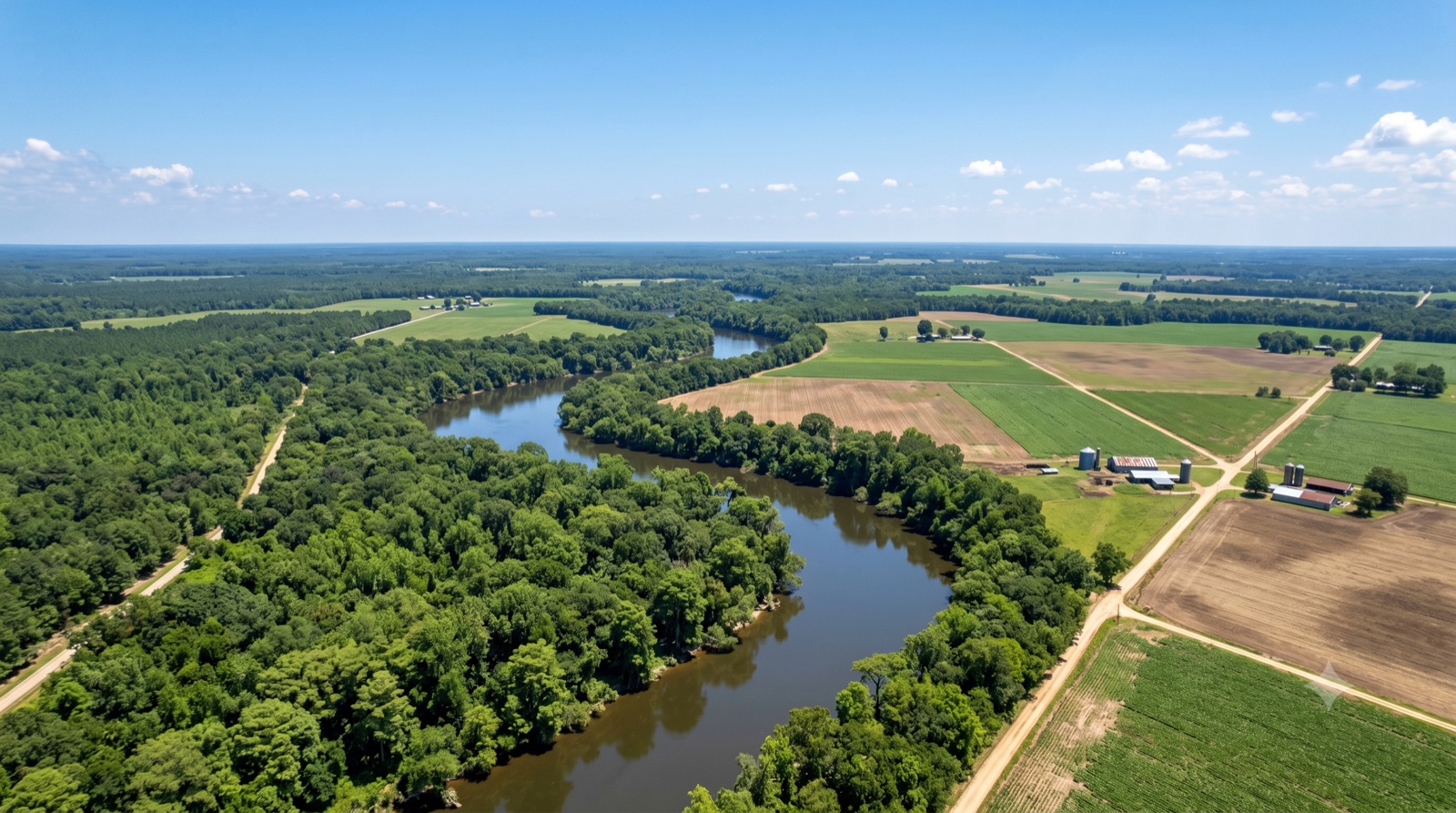
Selling land in Bladen County, North Carolina means navigating a county shaped by large-scale hog production, bottomland hardwoods along the Cape Fear River, and a population that has declined significantly over the past fifteen years. The county's land-use profile — dominated by agriculture, timber, and light manufacturing — creates a specific set of buyer motivations and title considerations that differ from more urbanized parts of the state.
This guide covers North Carolina's property tax structure and the Present-Use Value deferral program for agricultural and forested land, what the state's mandatory attorney-close requirement means for your closing timeline, how Bladen County compares to neighbors Columbus, Sampson, and Cumberland, and the practical paths available to landowners who want to sell. For the full state-level framework, visit our guide on how to sell land in North Carolina.
What Are the Tax Costs of Holding Land in Bladen County?
North Carolina taxes real property at 100% of assessed fair market value — there is no fractional assessment ratio as found in some other states. Bladen County's 2024-25 base tax rate is $0.7850 per $100 of assessed value, according to the North Carolina Department of Revenue's county rate schedule. The effective rate — incorporating any applicable municipal district or fire district overlays — is approximately 0.86–0.88%, according to property tax comparison data. This sits modestly above the North Carolina statewide average of about 0.77%.
Bladen County conducts periodic property reappraisals on the schedule set by the county Tax Assessor's office. Between reappraisal years, assessed values remain fixed unless an appeal is filed or an improvement is made. Delinquent real estate taxes for 2025 began accruing interest on January 6, 2026, according to Bladen County Tax Administration notices — and unpaid balances appear as liens in any title search.
How the Present-Use Value Program Affects Bladen County Land
North Carolina's Present-Use Value (PUV) program — authorized under N.C. Gen. Stat. §§ 105-277.2 through 105-277.7 — is especially relevant in Bladen County given the prevalence of working farmland, managed pine plantations, and bottomland hardwoods along the Cape Fear River. The NC Forest Service states that PUV can reduce annual property taxes by up to 90% for qualifying parcels by taxing land on its income-producing value rather than market value.
To qualify, land must meet minimum acreage thresholds: 10 acres for field crops or pasture, 5 acres for horticultural use, and 20 acres under a qualified timber management plan. Crop and horticultural land must generate at least $1,000 in average annual gross income. Applications are due to the Bladen County Tax Assessor by January 31 each year.
The critical implication for any sale: PUV is a tax deferral program. When a PUV-enrolled parcel changes ownership or the qualifying use ceases, deferred taxes from the current year and the three prior years become immediately due with interest. Sellers should calculate this rollback obligation before accepting any offer — it is a real closing cost. Our guide on selling land with back taxes covers situations where delinquency or deferred obligations complicate a sale.
The NCDOR's 2024 Use-Value Manual caps agricultural land PUV rates at no more than $1,200 per acre for the highest classification tier, with forestland capitalized at a fixed 9% rate as mandated by statute.
Bladen County Tax Administration Contact
Bladen County Tax Administration | P.O. Box 1048, Elizabethtown, NC 28337 | Phone: (910) 862-6730
What Closing Requirements and Zoning Rules Apply in Bladen County?
North Carolina is an attorney-close state. A licensed North Carolina attorney must conduct or supervise every real estate closing — including title examination, deed preparation, payoff coordination, and recording of the deed with the Register of Deeds. Title companies can issue insurance but cannot legally replace the attorney's role, according to the North Carolina State Bar's guidance and legal commentary from multiple closing firms. This requirement applies to all deed-based transfers, including vacant land parcels.
The seller pays North Carolina's excise tax — called "revenue stamps" — at the time the deed is recorded with the Register of Deeds. The rate is $1 per $500 of the conveyed property value, equivalent to $2 per $1,000 of sale price, per N.C. Gen. Stat. § 105-228.30, according to HomeLight's transfer tax analysis. On a $60,000 sale, the excise obligation would be $120. The excise tax is a seller cost in North Carolina's customary practice. For a detailed breakdown of cost allocation, see our guide on who pays closing costs when selling land.
For a checklist of documents to gather before closing, see our overview of paperwork needed to sell land.
Zoning and Building Permits in Bladen County
Bladen County's Planning Department enforces the county's land use ordinances, zoning code, and subdivision regulations in unincorporated areas. Building permits are required for construction, manufactured home placement, and certain agricultural structures. The Building Inspections Department handles permit applications and inspections.
Bladen County Building Inspections | 450 Smith Circle, P.O. Box 1076, Elizabethtown, NC 28337 | Phone: (910) 862-6780 | Email: BCInspections@bladenco.org | Hours: 8:30 AM–5:00 PM
Bladen County Register of Deeds | 106 East Broad St., P.O. Box 247, Elizabethtown, NC 28337 | Phone: (910) 862-6710 | Website: bladenncrod.org
How Does Bladen County Compare to Neighboring Counties?
Bladen County's 2024 population estimate of approximately 29,777 — compared to 35,190 in 2010 and 29,606 in 2020 — reflects a county that experienced significant outmigration over the decade but may be stabilizing, according to U.S. Census Bureau data and World Population Review. The median age of 44.7 years is among the higher county-level medians in the region, reflecting an aging population base.
| Factor | Bladen County | Columbus County | Sampson County | Cumberland County |
|---|---|---|---|---|
| Population (2024 est.) | ~29,800 | ~54,000 | ~60,400 | ~335,000 |
| Population trend | Declining / stabilizing | Declining | Mild decline / stabilizing | Growing |
| County tax rate (per $100) | $0.7850 | $0.8050 | $0.62 | $0.80 |
| Effective rate (approx.) | ~0.87% | ~0.88% | ~0.75–0.82% | ~1.14% |
| Top industry | Manufacturing (Smithfield) | Agriculture / Timber | Agriculture (#1 NC, $2.2B) | Military / Healthcare |
| Key selling challenge | Small market; specialized buyers | Thin buyer pool | CAFO compliance complexity | High competition / urban |
The county's economy is anchored by manufacturing — specifically food processing. According to Bladen Online, Smithfield Foods is the largest employer, followed by the Bladen County School System, Gildan Yarns, and Cape Fear Valley Bladen County Hospital. Manufacturing accounted for 6,524 jobs in the first quarter of 2022, making it the county's largest employment sector, according to a state industry sector report. Bladen County's gross domestic product was approximately $1.86 billion in 2024, according to Federal Reserve Economic Data (FRED).
The presence of the Smithfield plant — the world's largest pork processing facility — in Tar Heel has a direct relationship to land use in surrounding areas, as contract hog operations supply the plant and their infrastructure shapes what buyers look for in agricultural parcels. The Border Belt Independent has documented growing uncertainty among hog farmers about long-term viability of contract growing arrangements, which is a factor prospective buyers of hog-infrastructure land will weigh.
For context on valuation methodology, see our guide on how much is my land worth.
Motivated-Seller Signals in Bladen County
Bladen County's motivated sellers fall into recognizable patterns. Heirs' property is prevalent — the National Consumer Law Center's 2024 report on heirs' property in North Carolina documents how land informally held by multiple family members after a death becomes vulnerable to tax foreclosure because heirs often cannot obtain homestead exemptions in their own names without completing probate. Bladen County's delinquent tax rolls and county-owned properties from foreclosure are listed on the county's Tax Administration page. Absentee ownership is also common among families who relocated to Fayetteville, Raleigh, or out of state while retaining inherited parcels. Timber parcels without active management can accumulate liability exposure and ongoing maintenance costs that make selling attractive.
For more land research across North Carolina's southeastern counties, explore our blog.
What Are Your Options for Selling Land in Bladen County?
A county with fewer than 30,000 residents and a specialized economy means a narrower pool of active land buyers than in suburban or transitional markets. The buyers who are active in Bladen County tend to be agricultural operators, timber investors, hunting lease developers, and cash buyers specifically targeting southeastern NC. Setting realistic expectations about marketing timelines is important.
Listing with a real estate agent familiar with Bladen County gives your parcel exposure through the MLS and specialty land platforms. Agents who work the southeastern NC market know which buyers are active and what they prioritize — road frontage, soil classification, timber inventory, water access. Commission typically runs 5–6% of sale price, plus the NC excise tax and other closing costs. If your property involves multiple heirs, all ownership interests must be resolved before a listing can proceed.
Online land platforms including Land.com, LandWatch, and LandAndFarm currently show approximately 116–139 active listings in Bladen County at various price points and acreages. Effective FSBO marketing for rural parcels requires boundary maps, aerial imagery, and clear documentation of access, zoning, and any environmental constraints.
Working with a direct cash buyer like Jerez Land is often the most efficient path for inherited land, estate-owned parcels, or properties with PUV rollback obligations or title complications. We evaluate your specific parcel — its location, access, encumbrances, and condition — and make a firm written offer based on that review. We do not apply a universal percentage formula; we look at what your land actually is and what we can do with it. We absorb the carrying costs, resale uncertainty, and marketing risk.
Request a cash offer for your Bladen County parcel, or read our full analysis of whether you need a realtor to sell land before deciding which route fits your situation.
Frequently Asked Questions
I need to sell my land in Bladen County quickly—what's the fastest closing path?
The fastest closing path is a cash sale that bypasses mortgage financing timelines. Before initiating a sale, check your tax status through the Bladen County Tax Administration office, confirm your property's legal description through the Register of Deeds, and determine whether the parcel is enrolled in the PUV program — because rollback taxes from PUV deferral become payable at closing and reduce your net proceeds. Cash buyers can typically close within two to four weeks of a clear title review.
Who pays closing costs when selling land in North Carolina?
The seller is conventionally responsible for the state excise tax — $1 per $500 of sale price — payable to the Register of Deeds at deed recording. Attorney fees, title search costs, and other closing expenses are negotiated between buyer and seller and are specified in the purchase contract. North Carolina law does not mandate how non-excise-tax costs must be allocated between the parties.
Do I need an attorney to sell land in North Carolina?
Yes. North Carolina is an attorney-close state. Under North Carolina law and State Bar guidance, a licensed North Carolina attorney must supervise every real estate closing, including title examination, deed preparation, and recording. A title company cannot legally perform these functions independently. This requirement applies to vacant land, farm parcels, and all other deed-based real estate transfers.
What is the property tax rate in Bladen County NC?
Bladen County's base tax rate is $0.7850 per $100 of assessed value for the 2024-25 fiscal year, according to the North Carolina Department of Revenue. The effective tax rate — incorporating any applicable fire district or special district levies — is approximately 0.86–0.88%. North Carolina taxes all real property at 100% of assessed fair market value with no fractional assessment ratio.
I inherited land enrolled in the PUV program—what happens to my taxes when I sell?
North Carolina's PUV program, authorized under N.C. Gen. Stat. §§ 105-277.2 through 105-277.7, allows qualifying agricultural, horticultural, and forestland to be taxed on income-producing value rather than market value — potentially reducing annual taxes by up to 90%, according to the NC Forest Service. When PUV-enrolled land is sold or converted to a non-qualifying use, deferred taxes from the current year and the prior three years become immediately due with interest. This "rollback tax" is a real closing cost that affects your net proceeds and should be disclosed to prospective buyers.
I inherited land from my parents and don't have a clear deed—is this a problem in Bladen County?
Yes. According to the National Consumer Law Center's 2024 report on heirs' property in North Carolina, informally held land — where title has not been formally settled after the death of the original owner — is common in rural southeastern NC counties including Bladen. Heirs' property creates title defects that must be resolved before a warranty deed can be delivered. Heirs often cannot access property tax exemptions in their own names without completing probate, making such parcels vulnerable to delinquency and tax foreclosure. A real estate attorney and the Bladen County Register of Deeds can help identify and resolve title clouds before marketing.
Disclaimer: This article is for informational purposes only and does not constitute legal, financial, or professional advice. Laws and regulations vary by jurisdiction and change over time. Always consult with qualified professionals before making land purchase decisions. Jerez Land is not responsible for actions taken based on this information.