Sell My Land in Chippewa County MI - What Landowners Need to Know
Key Takeaways
- Chippewa County is one of only two U.S. counties with shoreline on two different Great Lakes — Lake Superior and Lake Huron — a distinction confirmed on the county's own Wikipedia geography summary, and it sits on part of the 894,836-acre Hiawatha National Forest along with the Sault Tribe and Bay Mills tribal trust lands
- Michigan's transfer tax is seller-paid at $3.75 per $500 state plus $0.55 per $500 county — a combined $4.30 per $500, or about 0.86% of the sale price, funded by the seller at closing regardless of which county the parcel sits in
- Population fell from 38,520 (2010) to 36,785 (2020) to roughly 36,300 (2024 estimate) — a genuine decline, though the county is also home to Kinross Correctional Facility, a state prison whose incarcerated population is counted in Census totals and complicates any simple reading of the trend
How Can You Sell Land in Chippewa County Michigan?
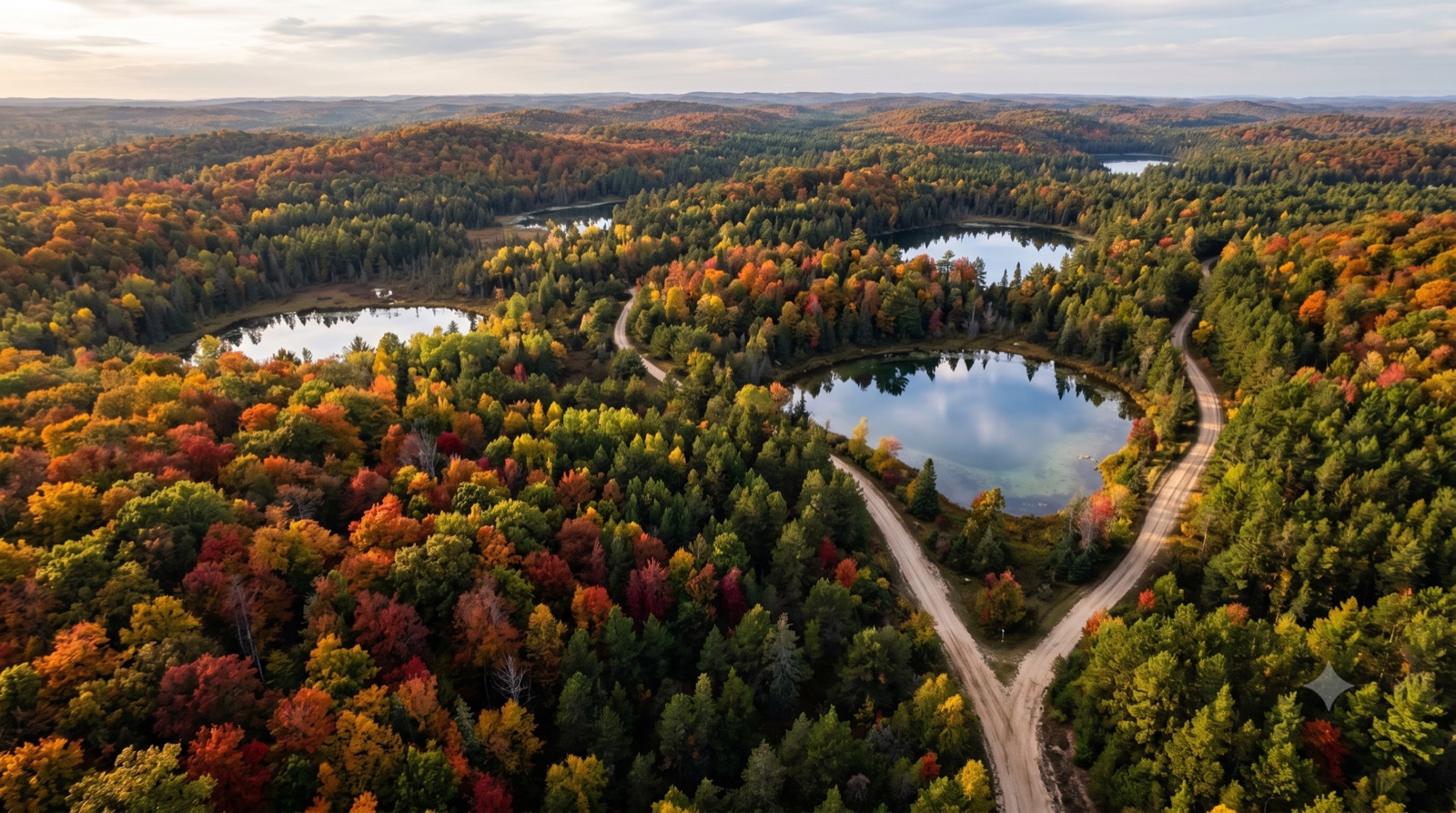
Selling land in Chippewa County, Michigan means working inside the only Michigan county with frontage on two separate Great Lakes, a county where public and tribal-trust forest sits alongside real working farmland, and a population base that has been slowly shrinking for over a decade. Practically, that means a title-company closing, a seller-paid transfer tax of $4.30 per $500, and a buyer pool split between timber/recreational land buyers on the shoreline and outside interest and working-farm buyers inland.
Chippewa County occupies the far eastern end of Michigan's Upper Peninsula, at the U.S.-Canada border along the St. Marys River, with Sault Ste. Marie as the county seat. Wikipedia's geography summary puts the county at 1,558 square miles of land and 1,140 square miles of water — a genuinely large county by Michigan standards, with Lake Superior forming its northern edge and Lake Huron reaching its eastern shore.
This guide covers Chippewa County's property tax mechanics, Michigan's title-company closing process, the forest and farmland programs that can trigger a recapture bill at sale, how the county compares to its Upper Peninsula neighbors, and your practical options for exiting a parcel. For the statewide picture, start with our Michigan land selling guide, or browse everything in our land selling library.
What Are the Tax Costs of Holding Land in Chippewa County?
Chippewa County's effective property tax rate on land depends heavily on which source you check, and the spread is wide. Ownwell reports a median effective rate of 0.52% with a median annual bill of $899, while Tax-Rates.org reports a countywide average of 1.29% with a median bill of $1,332 — nearly triple the Ownwell figure on the low end. Neither number is wrong; they use different methodologies and vintages, and you should not average them.
The within-county spread matters more than the headline number. Ownwell's town-level data shows Sault Ste. Marie at the high end near 1.12%, while Barbeau — a small unincorporated community on the county's eastern edge — sits near 0.41%. Where your parcel falls, and which township and school district it's in, moves your actual bill far more than any countywide average.
Like every Michigan county, Chippewa County parcels carry two relevant values: the State Equalized Value (SEV), roughly 50% of the assessor's estimate of true cash value, and the taxable value, the number millage rates are actually applied to. Under Proposal A (1994), taxable value rises each year at the lesser of the Consumer Price Index or 5%, capping how fast a long-term owner's bill can grow. But when a property transfers, taxable value uncaps and resets to the parcel's SEV the following year, per the Michigan Department of Treasury. On land held in the same family for decades — common on both the timber and farm side of this county — that reset can raise a buyer's first full-year bill sharply. It is not a cost you pay as the seller, but it is a real part of how a buyer prices what they're offering.
Michigan Transfer Tax: The Seller Funds Both Levies
Michigan's real estate transfer tax is seller-paid at two levels, the same statewide rule that applies whether you're selling in Chippewa County or anywhere else in Michigan:
- State transfer tax: $3.75 per $500 of sale price, or fraction thereof
- County transfer tax: $0.55 per $500 of sale price, or fraction thereof
- Combined: $4.30 per $500 — approximately 0.86% of the purchase price
On a $90,000 land sale, the combined transfer tax comes to $774. The tax generally applies when consideration is $100 or more. Certain transfers are exempt, including transfers between spouses and transfers where no money changes hands; the Michigan Department of Treasury publishes the full exemption list. Confirm your recording fees directly with the Register of Deeds — those are set locally and change more often than the transfer tax rate does.
If you are managing a Chippewa County parcel from downstate or out of state, our guide on selling land as an out-of-state owner covers the remote-closing logistics Michigan title companies handle as routine work.
What Zoning and Closing Rules Apply to Chippewa County Land?
Michigan does not require an attorney at a real estate closing, and Chippewa County land sales are handled by title companies as a matter of course. The title company runs the search, issues title insurance, prepares the warranty or limited warranty deed, collects the transfer tax, and records with the county Register of Deeds. Attorney involvement is optional but genuinely worth it where shoreline permitting, tribal-trust adjacency, timber rights, or a forest-program recapture are in play.
The Chippewa County Register of Deeds, Gigi Ferro, is located at 319 Court Street, Sault Ste. Marie, MI 49783, phone (906) 635-6312.
The Chippewa County Treasurer, Jenni Pace, is at the same address, 319 Court Street, Sault Ste. Marie, MI 49783, phone (906) 635-6308. Delinquent county property taxes are handled through this office.
The Chippewa County Equalization Department, directed by Dulcee Ranta, oversees county property assessment and can confirm your SEV and taxable value, at 319 Court Street, Sault Ste. Marie, MI 49783, phone (906) 635-6304.
Trust Land and Shoreline Permitting: What to Confirm Before You List
Two Chippewa County-specific issues are worth checking before you assume a parcel is a straightforward fee-simple sale. First, both the Sault Ste. Marie Tribe of Chippewa Indians and the Bay Mills Indian Community hold trust and restricted land within the county — the Sault Tribe with scattered parcels in Kinross Charter Township, Sugar Island Township, and the city of Sault Ste. Marie, and Bay Mills with holdings in Bay Mills, Superior, and Sugar Island Townships, per Wikipedia's county summary. Trust and restricted land is a distinct title category with federal involvement; it is not the same as ordinary privately held fee-simple land, and the vast majority of Chippewa County parcels are unaffected. If your parcel is anywhere near one of those townships, confirm its status with your title company before you assume a standard closing applies.
Second, if your parcel touches Lake Superior or Lake Huron shoreline, Michigan's Sand Dune Protection and Management Act and its High Risk Erosion Area (HREA) program, both administered by EGLE, may apply. Statewide, EGLE has designated roughly 250 miles of Great Lakes shoreline — where the historical erosion recession rate is 1 foot or more per year over at least 15 years — as high risk erosion areas, and any construction on a designated HREA parcel requires a permit regardless of how far the project sits from the water. Whether any specific Chippewa County shoreline segment carries this designation is not something this guide can confirm for your parcel — check EGLE's HREA maps directly, or call EGLE's water resources division, before you price a shoreline lot as unencumbered.
Michigan's Qualified Forest Program: Real Savings, Real Recapture
Michigan's Qualified Forest Program (QFP), administered by MDARD, is worth knowing about here given how much of the county's private acreage is forest. QFP requires a minimum of 20 contiguous acres per tax parcel. Parcels between 20 and 39.9 acres must be at least 80% stocked with productive forest; parcels of 40 acres or more must be at least 50% stocked, according to MSU Extension. Enrolled owners receive an exemption from school operating millage and protection from taxable-value uncapping on qualifying transfers.
The recapture is where sellers get caught. When QFP land leaves the program, repayment is calculated as the school operating millage minus 2 mills, multiplied by the taxable value at conversion, multiplied by the number of years the property was enrolled — and if no qualifying harvest ever occurred, that amount is doubled, per MSU Extension. Get the number from MDARD in writing before you sign anything.
Michigan's Commercial Forest (CF) program, administered by the DNR, works differently: a withdrawal application fee of $1 per acre with a $200 minimum and $1,000 maximum, plus a withdrawal penalty calculated as acres withdrawn times the county valuation per acre times the average township millage rate times the years enrolled, capped at seven years, under MCL 324.51108. CF land also carries a public access requirement for hunting and fishing that transfers with the land.
If your parcel is primarily wooded, our guide on selling timberland covers what buyers actually evaluate.
How Does Chippewa County Compare to Neighboring Michigan Counties?
Chippewa County's population trend is genuinely downward, though the exact pace depends on which vintage you check. The 2010 Census counted 38,520 residents; the 2020 Census counted 36,785, a decline of about 4.5%. Data USA's most recent estimate puts the county near 36,295 for 2024, suggesting the decline has slowed to roughly flat over the last several years rather than continuing at the 2010s pace.
One complicating factor unique to this county: Kinross Correctional Facility, a Michigan Department of Corrections prison south of Kincheloe, sits within Chippewa County, and incarcerated residents are counted toward the county's Census population under standard usual-residence rules. That doesn't invalidate the population figures, but it means a portion of the county's "population" is not a household that will ever buy, sell, or hold land here — worth keeping in mind before reading too much into year-over-year swings.
| Factor | Chippewa County | Mackinac County | Luce County | Schoolcraft County |
|---|---|---|---|---|
| Population | 36,785 (2020); ~36,295–36,300 (2024 est.) | 10,834 (2020); 10,740–11,144 (2024 est., sources differ) | 5,339 (2020) | 8,047 (2020) |
| Effective tax rate | 0.52%–1.29% (sources differ) | 0.81%–0.97% (sources differ) | 0.86%–0.98% | 0.45%–1.01% (sources differ) |
| County seat | Sault Ste. Marie | St. Ignace | Newberry | Manistique |
| Defining land feature | Dual Great Lakes shoreline (Superior + Huron); part of Hiawatha National Forest; Sault Tribe and Bay Mills trust land | 54% public land; 51% water; Straits shoreline and Les Cheneaux Islands | Very high public-land share; Tahquamenon Falls and Muskallonge Lake State Parks | Seney National Wildlife Refuge (95,212 acres) dominates the interior |
| Market character | Largest population base in the eastern UP; mix of shoreline, forest, and real working farmland | Thin, seasonal, waterfront-driven | Smallest population in the group | Lake Michigan frontage at Manistique |
Treat the tax-rate ranges as directional, not precise — for every county in this table, at least two independent sources disagree by a meaningful margin, which is typical for rural Michigan counties where taxable value and market value drift apart on long-held parcels. Confirm your own parcel's number with the Equalization Department.
Working Farmland Sets Chippewa County Apart From Its Neighbors
Unlike neighboring Mackinac County, where under 3% of the land base is farmed, Chippewa County has a real agricultural sector. The USDA 2022 Census of Agriculture (cp26033) counts 335 farms working 84,200 acres — about 8.4% of the county's roughly 997,000 land acres — averaging 251 acres per farm, though both farm count (-22%) and land in farms (-5%) declined since 2017. Of that farmland, 51,959 acres is cropland, 12,140 acres is woodland, and 9,823 acres is pastureland. Sales split 51% livestock and 49% crops, with cattle and calves ($2,276,000) and milk from cows ($2,106,000) the two largest livestock categories, and forage (hay and haylage) the dominant crop by far at 34,833 acres — nearly triple every other crop combined. Total market value of agricultural products sold was $15,646,000, up 47% since 2017.
That mix matters for a seller: a Chippewa County parcel might be evaluated by a hay or cattle operation looking to expand, not only by a timber or recreational buyer, which is a meaningfully different buyer pool than the almost entirely forest-and-shoreline market in Mackinac County next door.
The county also carries the region's largest population center and its only international border crossing, at Sault Ste. Marie, along with a share of the 894,836-acre Hiawatha National Forest (its Eastside unit covers Chippewa and Mackinac counties). Exactly what percentage of Chippewa County's land is publicly owned is not published on the county's own site the way Mackinac County's 54% figure is — treat any specific percentage you see elsewhere with caution until you can confirm the source.
For help understanding what drives value here, see how much is my land worth, and if you are weighing whether to involve an agent at all, see do you need a realtor to sell land.
What Are Your Options for Selling Land in Chippewa County?
The most common Chippewa County seller is either an out-of-state or downstate owner holding a wooded or shoreline-adjacent parcel that has sat unused for years, or a family holding inherited farm ground it no longer actively works. The usual signals apply: you could not confidently walk someone to the property line, the tax bill arrives and you resent it, you inherited the parcel alongside siblings who all live elsewhere, or a plat association or forest-program enrollment keeps generating paperwork for land nobody visits.
Before accepting any offer, do four things. Confirm your SEV and taxable value with the Equalization Department at (906) 635-6304. Verify your deed and title through the Register of Deeds at (906) 635-6312. Check for delinquent taxes with the Treasurer at (906) 635-6308 — Michigan's tax-forfeiture timeline moves faster than most states once a parcel falls behind. And if the parcel is enrolled in QFP, Commercial Forest, or PA 116, or touches shoreline that might fall inside an EGLE-designated high risk erosion area, get the relevant recapture figure or permit requirement in writing from MDARD, the DNR, or EGLE before you agree to a price, because any of those numbers changes what the deal is actually worth to you.
From there, sellers have real choices. Listing with a Michigan land specialist or recreational property broker reaches downstate buyers through platforms like LandSearch and Lands of America — but demand for shoreline and forest parcels here is seasonal, commissions apply, and a remote owner can wait a long time for the right buyer. For landowners who want a specific number in hand without riding out a seasonal demand cycle, Jerez Land provides a direct, parcel-specific written cash offer for your land. We buy for cash and absorb the carrying costs, marketing expense, and resale risk ourselves, so our offer reflects the certainty and speed we provide rather than a retail listing price. No agent commissions, no listing period, and a closing timeline driven by when title is clear.
Frequently Asked Questions
I inherited 40 acres of cedar swamp outside Sault Ste. Marie and I live out of state — is it even sellable?
Yes. Michigan does not require an attorney or the seller's physical presence at closing, and Chippewa County land sales are handled by title companies that close remotely as routine work. Wetland and swamp acreage is sellable — it just narrows the buyer pool to timber, recreational, and conservation-minded buyers rather than build-ready lot buyers. Start by confirming your deed and title through the Chippewa County Register of Deeds at (906) 635-6312, and check for delinquent taxes with the Treasurer at (906) 635-6308.
My parcel touches Lake Superior or Lake Huron shoreline — do I need an EGLE permit before I can sell?
You don't need a permit to sell the land itself, but you do need to know whether your parcel falls inside a designated High Risk Erosion Area before you or a buyer plans any construction. EGLE has designated roughly 250 miles of Great Lakes shoreline statewide — where the recession rate is 1 foot or more per year over at least 15 years — as high risk erosion areas, and any structure on a designated HREA parcel requires a permit regardless of distance from the water. Check EGLE's HREA maps for your specific parcel, since designation varies segment by segment and this guide cannot confirm status for an individual lot.
I'm selling my Chippewa County land for $90,000 — what transfer tax will I owe?
You will owe $774. Michigan charges two seller-paid transfer taxes: $3.75 per $500 of sale price at the state level and $0.55 per $500 at the county level, totaling $4.30 per $500, or about 0.86% of the price. The tax generally applies when consideration is $100 or more. Certain transfers are exempt, including those between spouses and those where no money changes hands. The tax is paid at closing and recorded with the deed at the Chippewa County Register of Deeds.
Is an attorney required to close a land sale in Michigan?
No. Michigan does not require a licensed attorney at a real estate closing. Title companies conduct the title search, issue title insurance, prepare the deed, collect the transfer tax, and record with the county Register of Deeds. Attorney involvement is optional but advisable for transactions involving Qualified Forest Program or Commercial Forest recapture, shoreline high risk erosion area permitting, adjacency to tribal trust land, timber rights, or a complicated ownership history.
Why would the property tax bill on my Chippewa County land jump after I sell it?
Because Michigan's taxable value uncaps on transfer. Under Proposal A (1994), taxable value rises annually at the lesser of CPI or 5% while you own the property, but when the parcel sells, taxable value resets to the State Equalized Value in the following year, per the Michigan Department of Treasury. On land held in one family for decades — common in this county on both forest and farm parcels — taxable value can sit far below SEV, so the buyer's first full-year bill can be much higher than yours ever was. It is a buyer cost rather than a seller cost, but it affects what buyers will offer.
Is Chippewa County's population growing or declining?
It is declining, though the pace has slowed. The 2010 Census counted 38,520 residents; the 2020 Census counted 36,785, a drop of about 4.5%. Data USA's most recent estimate puts the county near 36,295 for 2024, suggesting the decline has leveled off rather than continued at the 2010s rate. One wrinkle specific to this county: Kinross Correctional Facility, a state prison within county lines, has its incarcerated population counted in Census totals, which complicates reading the trend as a pure measure of households and land demand.
Disclaimer: This article is for informational purposes only and does not constitute legal, financial, or professional advice. Laws and regulations vary by jurisdiction and change over time. Always consult with qualified professionals before making land purchase decisions. Jerez Land is not responsible for actions taken based on this information.