
Sell My Land in Cheboygan County MI - What Landowners Need to Know
Key Takeaways
- Roughly 19% of Cheboygan County is water — 170 of its 885 square miles — and three of the five lakes in Michigan's Inland Waterway (Black, Mullett, and Burt) sit inside or on the county's border, per the U.S. Census Bureau and Michigan DNR, making shoreline and near-water parcels the defining category of land here
- Michigan's transfer tax is seller-paid at $3.75 per $500 state plus $0.55 per $500 county — a combined $4.30 per $500, or about 0.86% of the sale price, funded by the seller at closing
- Land in farms fell 7% since 2017 to 41,010 acres across 268 farms (down 19% in farm count), per the USDA 2022 Census of Agriculture (cp26031) — that's still about 9% of the county's roughly 457,600 land acres, meaning most of Cheboygan County's private ground is forest, lakeshore, and recreational land that never appears in farm statistics
How Can You Sell Land in Cheboygan County Michigan?
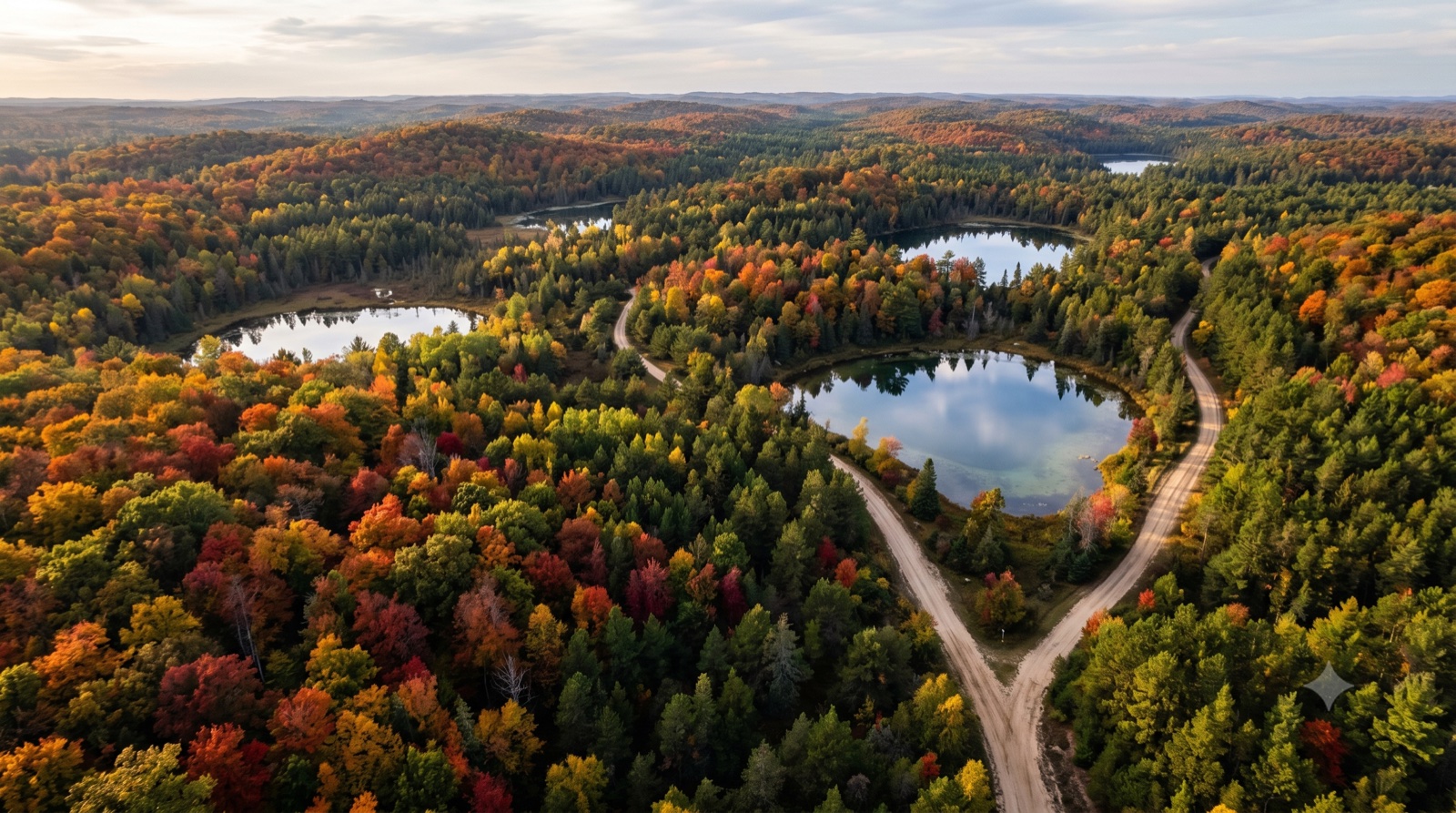
Selling land in Cheboygan County, Michigan means selling into a market defined by inland lakes and private forest rather than public wilderness — the county sits at the hub of Michigan's Inland Waterway, with Black, Mullett, and Burt lakes running through it, and its private land base is proportionally larger than in the Upper Peninsula counties just across the Straits. Practically, that means a title-company closing, a seller-paid transfer tax of $4.30 per $500, and a buyer pool split between lake-adjacent recreational buyers and inland forest and hunting-ground buyers.
Cheboygan County occupies the tip of Michigan's Lower Peninsula, with the city of Cheboygan as the county seat. The U.S. Census Bureau puts the county's total area at 885 square miles — 715 square miles of land and 170 square miles of water, or about 19% water. That water share is driven almost entirely by the Inland Waterway: Black Lake (10,130 acres), Mullett Lake (16,630 acres), and Burt Lake (17,120 acres) are all inside or bordering the county, part of a roughly 50,000-acre, nearly 40-mile chain of connected lakes and rivers that is the longest inland boating route in Michigan, according to the Michigan DNR.
This guide covers Cheboygan County's property tax mechanics, Michigan's title-company closing process, the forest and farmland programs that can trigger a recapture bill at sale, how the county compares to its neighbors, and your practical options for exiting a parcel. For the statewide picture, start with our Michigan land selling guide, or browse everything in our land selling library.
What Are the Tax Costs of Holding Land in Cheboygan County?
Cheboygan County's effective property tax rate on land runs between about 0.86% and 0.9% depending on the source, with real variation by township underneath that countywide figure. Ownwell reports a median effective rate of 0.86% and a median annual bill of $1,565. Tax-Rates.org reports the county collects an average of 0.9% of assessed fair market value, with an average annual bill of $1,113 on a median home value of $123,400.
Those two figures rest on different denominators and different vintages, and you should not average them. What matters more for a landowner is the spread within the county: Ownwell's sub-area data runs from 0.67% in Onaway up to 1.25% in Mackinaw City, with the city of Cheboygan itself near 0.89% and several lakefront communities — Burt Lake, Carp Lake, Pellston — clustered between 0.96% and 1.08%. Where your parcel sits, and which school district taxes it, moves your bill more than the countywide average does.
Michigan's property tax system runs on two separate values for every parcel: the State Equalized Value (SEV), roughly 50% of the assessor's estimate of true cash value, and the taxable value, the number your millage rate is actually applied to.
Under Proposal A (1994), taxable value can only rise each year by the lesser of the Consumer Price Index or 5%, no matter how fast market values move. That cap protects long-term owners. But when a property transfers, taxable value "uncaps" and resets to the parcel's SEV the following year, per the Michigan Department of Treasury. On land held in the same family for decades — common on the older platted tracts around Black Lake and Mullett Lake — that reset can push the buyer's first full-year bill well above what the seller ever paid. It is a buyer cost, not a seller cost, but a well-informed seller should expect it to shape what buyers are willing to pay.
Michigan Transfer Tax: The Seller Funds Both Levies
Michigan's real estate transfer tax is seller-paid at two levels:
- State transfer tax: $3.75 per $500 of sale price, or fraction thereof
- County transfer tax: $0.55 per $500 of sale price, or fraction thereof
- Combined: $4.30 per $500 — approximately 0.86% of the purchase price
On a $70,000 land sale, the combined transfer tax comes to $602. The tax generally applies when consideration is $100 or more, and certain transfers — including those between spouses and those where no money changes hands — are exempt under the full list the Michigan Department of Treasury publishes. Confirm your recording fees separately with the Register of Deeds; those are set locally and change more often than the transfer tax rate does.
If you're managing a Cheboygan County parcel from downstate or out of state, our guide on selling land as an out-of-state owner covers the remote-closing logistics Michigan title companies handle routinely.
What Zoning and Closing Rules Apply to Cheboygan County Land?
Michigan does not require an attorney at a real estate closing, and Cheboygan County land sales are handled by title companies as standard practice: the title company runs the search, issues title insurance, prepares the deed, collects the transfer tax, and records the transaction with the county Register of Deeds. Attorney review is optional but genuinely worth the cost where lake-access or riparian rights, an active timber or Commercial Forest enrollment, or a forest-program recapture is part of the deal.
The Cheboygan County Clerk / Register of Deeds, Karen Brewster, is at 870 South Main St, Room 204, PO Box 70, Cheboygan, MI 49721, phone (231) 627-8808.
The Cheboygan County Treasurer, Buffy Jo Weldon, is in the same building at 870 S. Main St, Room 201, PO Box 70, Cheboygan, MI 49721, phone (231) 627-8821. Delinquent taxes transfer from townships and cities to the County Treasurer's office each March 1, at which point the county — not the local unit — collects them.
The Cheboygan County Equalization Department, directed by Elizabeth Zabik, MAAO, is at 870 S. Main St, PO Box 70, Cheboygan, MI 49721, phone (231) 627-8810. This is the office to confirm your parcel's SEV and taxable value before you price a sale.
Michigan's Qualified Forest Program: Real Savings, Real Recapture
Michigan's Qualified Forest Program (QFP), administered by MDARD, matters in Cheboygan County because a meaningful share of the county's private acreage outside the lakeshore corridors is productive forest.
QFP requires a minimum of 20 contiguous acres per tax parcel. Parcels of 20 to 39.9 acres must be at least 80% stocked with productive forest; parcels of 40 acres or more must be at least 50% stocked, per MSU Extension. Enrolled land is exempt from school operating millage and protected from taxable-value uncapping on qualifying transfers.
The recapture is where sellers get caught by surprise. When QFP land leaves the program, the repayment equals the school operating millage minus 2 mills, multiplied by the taxable value at conversion, multiplied by the number of years enrolled — and if no qualifying harvest ever took place, that amount is doubled, according to MSU Extension. Get the exact figure from MDARD in writing before you negotiate a price.
Michigan's Commercial Forest (CF) program, run by the DNR, is a separate track with its own exit cost: a withdrawal application fee of $1 per acre (minimum $200, maximum $1,000), plus a withdrawal penalty of acres withdrawn times county valuation per acre times average township millage times years enrolled, capped at seven years, under MCL 324.51108. CF land also carries a public hunting and fishing access requirement that runs with the land — a fact buyers routinely ask about.
For agricultural ground, PA 116 Farmland Development Rights Agreements run 10 to 90 years and cover parcels of 40+ acres with at least 51% active agricultural use, or 5 to 39.9 acres meeting an income test, per MDARD. Early termination outside death or disability requires repaying the last seven years of tax credits plus 6% simple interest, with any unpaid balance recorded as a lien against the property.
If your parcel is primarily wooded, our guide on selling timberland covers what buyers actually evaluate before making an offer.
Zoning and Land Use
Cheboygan County's townships administer their own zoning, and rural land is generally classed forest-recreational, agricultural, or rural residential, with forestry and recreational uses broadly permitted by right. Parcels fronting Black Lake, Mullett Lake, Burt Lake, or any waterway feeding them carry additional shoreline setback and riparian rules on top of standard township zoning, and older platted subdivisions around the lakes frequently carry deed restrictions and, in some cases, association dues that survive a sale.
If your parcel is one lot inside a recorded plat or subdivision, our guide on selling an HOA or subdivision lot explains how those restrictions and dues factor into a closing.
How Does Cheboygan County Compare to Neighboring Michigan Counties?
Cheboygan County's population has been on a slow, genuine decline at the county level even as its county seat has stayed essentially flat. The county's decennial counts show 26,152 in 2010 and 25,579 in 2020, a drop of roughly 2.2%, and World Population Review's current-year estimate puts the county near 25,694 — a continued, gradual contraction rather than a rebound. The city of Cheboygan tells a different story: 4,774 residents at the 2020 Census and an estimated 4,831 in 2024, per Neilsberg — essentially unchanged, and if anything a slight uptick. The county is losing population in its townships while its seat holds steady, which is the opposite pattern from a county whose town is hollowing out.
| Factor | Cheboygan County | Presque Isle County | Otsego County | Emmet County |
|---|---|---|---|---|
| Population (2020 Census) | 25,579 | 12,982 | 25,091 | 34,112 |
| Effective tax rate | 0.86%–0.9% (sources differ) | 0.96%–1.06% (sources differ) | 0.90%–0.93% | 0.97%–1.05% |
| County seat | Cheboygan | Rogers City | Gaylord | Petoskey |
| Defining land feature | Black, Mullett, and Burt lakes on the Inland Waterway; 19% of the county is water | Lake Huron shoreline, lighthouses, and a working limestone quarry | Jordan River headwaters and Mackinaw State Forest interior | Little Traverse Bay and Lake Michigan resort shoreline |
| Market character | Inland-lake and forest, seasonal cabin and hunting-ground buyers | Smallest population of the four, quiet Great Lakes shoreline market | Gaylord's tourism and golf-resort economy anchors demand | Most developed, highest-value resort market of the group |
Treat the tax-rate ranges as directional. For three of these four counties, the two rate sources disagree by several tenths of a point, a common pattern in rural Michigan where taxable value and market value drift apart on long-held parcels. Confirm your own parcel's number with the Equalization Department rather than the county average.
The Inland-Lake Factor and Who Actually Buys Here
Cheboygan County's land market is shaped less by public land, and more by water, than its Upper Peninsula neighbors across the Straits. The Inland Waterway — Black, Mullett, and Burt lakes plus the rivers connecting them — draws boating and second-home buyers who can run a nearly 40-mile chain without ever crossing open Great Lakes water, according to the Michigan DNR. That corridor supports real, steady demand for shoreline and near-water parcels, but it also means land even a mile or two off the lakes competes in a much thinner, more forest- and hunting-oriented market.
The USDA 2022 Census of Agriculture (cp26031) shows 268 farms working 41,010 acres, averaging 153 acres each — up 15% in average size even as the farm count fell 19% and total farmed acreage fell 7% since 2017, a pattern consistent with smaller operations consolidating or exiting. Sales split 84% crops and 16% livestock, with forage/hay the dominant crop at 15,879 acres and cropland totaling 20,807 acres against 10,816 acres of woodland and 5,663 acres of pastureland on farmed ground. Against the county's roughly 457,600 land acres, farmed ground is about 9% — a meaningfully larger farm share than in the UP counties across the Straits, but still a small minority of the county's private land base, most of which is forest and lakeshore recreational tract.
Absentee owners in this county consistently underestimate what a decade of holding actually costs: annual taxes, liability exposure, HOA or plat-association dues where they apply, and the slow erosion of clear title as a parcel passes between generations without a survey or an updated deed. For help understanding what drives value on a parcel like this, see how much is my land worth, and if your land runs to timber or hunting ground rather than lakeshore, see selling hunting land.
What Are Your Options for Selling Land in Cheboygan County?
The most common Cheboygan County seller is a downstate or out-of-state owner who bought or inherited a wooded, hunting-ground, or near-lake parcel years or decades ago and is now weighing whether the annual carrying cost is still worth it. The familiar signals apply: you couldn't confidently walk someone to the property corners, the tax bill arrives and you resent it, siblings inherited the land together and live in three different states, or a QFP or Commercial Forest enrollment is quietly ticking up a recapture bill nobody has priced out.
Before accepting any offer, do four things. Confirm your SEV and taxable value with the Equalization Department at (231) 627-8810. Verify your deed and title through the Clerk / Register of Deeds at (231) 627-8808. Check for delinquent taxes with the Treasurer at (231) 627-8821 — Michigan's tax-forfeiture timeline moves faster than many states expect once a parcel falls behind. And if the parcel is enrolled in QFP, Commercial Forest, or PA 116, get the recapture or withdrawal figure in writing from MDARD or the DNR before you agree to a price, because it changes what the deal is actually worth to you.
From there, sellers have real choices. Listing with a Michigan land specialist or recreational-property broker can reach downstate buyers through platforms like LandSearch and Lands of America, but demand is seasonal and lake-driven, commissions apply, and a remote owner can wait a long time for the right buyer on ground that isn't on the water. For landowners who want a specific number in hand without riding out a seasonal demand cycle, Jerez Land provides a direct, parcel-specific written cash offer for your land. We buy for cash and absorb the carrying costs, marketing expense, and resale risk ourselves, so our offer reflects the certainty and speed we provide rather than a retail listing price. No agent commissions, no listing period, and a closing timeline driven by when title is clear.
Frequently Asked Questions
I own 20 acres near Mullett Lake and inherited it from my father — do I have to clear the estate before I can sell?
Yes, the estate generally needs to be settled, or at minimum you need clear legal authority to sign as personal representative, before a title company will close. If the estate went through Michigan probate, the title company needs the letters of authority and the recorded deed showing the transfer into the estate or into your name. If your father died without a will and the estate was never opened, you may need to open probate first — a probate attorney can typically move this faster than you'd expect for a straightforward single-heir estate. Start by pulling the current deed at the Cheboygan County Clerk / Register of Deeds, (231) 627-8808, to see exactly what's recorded now.
My family has owned land on Black Lake for three generations and none of us agree on selling — what are our options?
You have three realistic paths: sell together with proceeds split per your ownership shares, one or more co-owners buy out the others, or — if agreement is truly impossible — any co-owner can file a partition action in circuit court, which can force a sale of the property. Partition is slow and expensive compared to a negotiated buyout, so most families reach a private agreement first, often after getting an independent written offer to anchor the conversation in a real number rather than guesses. Confirming current ownership shares and any liens through the Register of Deeds is the right first step regardless of which path you take.
I live in Ohio and inherited vacant land in Cheboygan County — can I sell it without traveling up there?
Yes. Michigan does not require an attorney or the seller's physical presence at closing, and Cheboygan County land sales are handled by title companies that close remotely as routine work. You can sign with a mobile notary or through remote online notarization where the title company permits it, and funds are wired to your account. Start by confirming your deed and title through the Cheboygan County Clerk / Register of Deeds at (231) 627-8808, and check for delinquent taxes with the Treasurer at (231) 627-8821.
My Cheboygan County land is enrolled in the Qualified Forest Program — what happens when I sell?
A recapture bill may come due. Michigan's Qualified Forest Program requires 20 contiguous acres minimum and exempts enrolled owners from school operating millage. When the land leaves the program, repayment equals the school operating millage minus 2 mills, times the taxable value at conversion, times the years enrolled — and that amount is doubled if no qualifying harvest ever occurred, according to MSU Extension. Get the figure in writing from MDARD before agreeing to a price, and address in the purchase agreement who pays it.
I'm selling my Cheboygan County land for $70,000 — what transfer tax will I owe?
You will owe $602. Michigan charges two seller-paid transfer taxes: $3.75 per $500 of sale price at the state level and $0.55 per $500 at the county level, totaling $4.30 per $500, or about 0.86% of the price. The tax generally applies when consideration is $100 or more, and certain transfers — including those between spouses and those where no money changes hands — are exempt. The tax is paid at closing and recorded with the deed at the Cheboygan County Clerk / Register of Deeds.
Is Cheboygan County's population growing or shrinking?
The county as a whole has been shrinking slowly, even though the city of Cheboygan itself has held roughly flat. The county's decennial counts fell from 26,152 in 2010 to 25,579 in 2020, and the current estimate sits near 25,694, per World Population Review — a continued gradual decline. The city of Cheboygan, by contrast, went from 4,774 residents in 2020 to an estimated 4,831 in 2024, essentially unchanged. The decline is happening in the townships, not the town, which is consistent with older, rural, and seasonally held land losing year-round residents while the county seat holds its base.
Disclaimer: This article is for informational purposes only and does not constitute legal, financial, or professional advice. Laws and regulations vary by jurisdiction and change over time. Always consult with qualified professionals before making land purchase decisions. Jerez Land is not responsible for actions taken based on this information.