
Sell My Land in Delta County MI - What Landowners Need to Know
Key Takeaways
- Michigan transfer tax is seller-paid at $3.75 per $500 state plus $0.55 per $500 county: Delta County sellers fund both levies at closing, totaling $4.30 per $500 (0.86%) of the sale price — a real cost on the pulpwood and recreational tracts that dominate the county's rural land market
- Delta County's median effective property tax rate is 1.15%, with a median annual tax bill of approximately $1,626 against a median home value of $138,000 — above the national median rate, according to Ownwell — and taxable value uncaps to full State Equalized Value the year after any sale
- Population has declined slowly for over a decade: From 37,069 in 2010 to 36,903 in 2020, with a 2024 estimate near 36,687, according to U.S. Census Bureau data — a shrinking base in the largest Upper Peninsula county by population outside Marquette, where forest and Little Bay de Noc recreational land turns over slowly
How Can You Sell Land in Delta County, Michigan?
Selling land in Delta County, Michigan means navigating a two-layer property tax system — State Equalized Value (SEV) and a taxable value that uncaps at sale — a seller-paid transfer tax of $3.75 per $500 (state) plus $0.55 per $500 (county), and a market anchored by industrial pulpwood demand, Little Bay de Noc recreational property, and a countywide zoning ordinance that governs most of the county's townships directly.
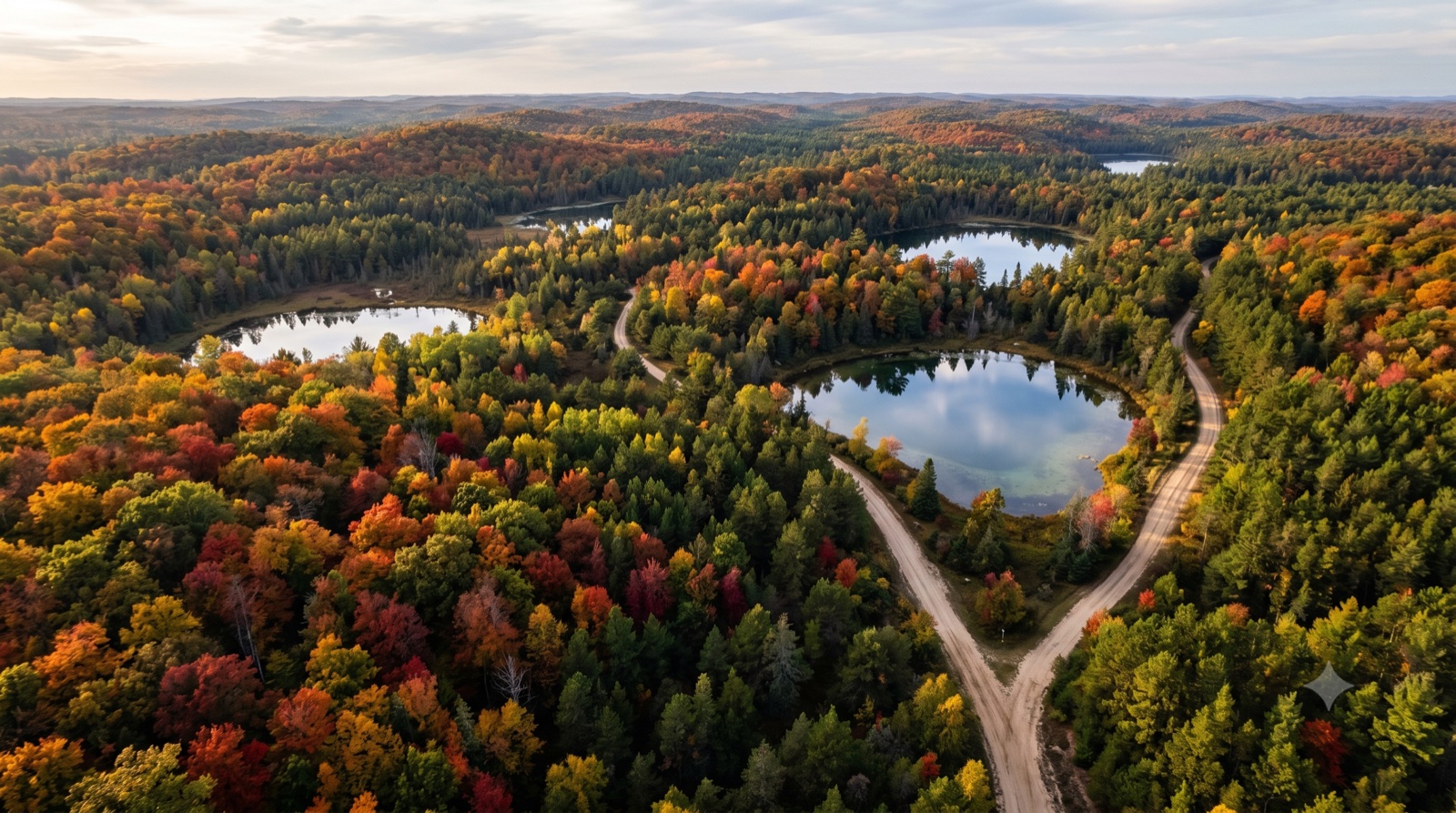
Delta County sits on the western shore of Lake Michigan in the central Upper Peninsula, with Escanaba as the county seat on Little Bay de Noc. It is Michigan's fifth-largest county by total area — 1,171 square miles of land plus another 820 square miles of Lake Michigan and bay water, according to the U.S. Census Bureau. The interior holds a mix of second-growth pine and hardwood pulpwood stands, the westside unit of the Hiawatha National Forest, state forest land, and inland lakes and rivers around communities like Gladstone, Rapid River, Bark River, Wells, and Cornell. Escanaba itself functions as the commercial hub for the central Upper Peninsula, anchored in part by a large integrated pulp-and-paper mill that has run continuously for more than a century and remains a major source of regional demand for pulpwood timber.
This guide walks through Delta County's property tax mechanics, Michigan's title-company closing process, how the county compares to its neighbors, and your practical options for exiting a parcel. For the statewide picture, start with our Michigan land selling guide, or browse more county guides on the blog.
What Are the Tax Costs of Holding Land in Delta County?
Michigan property carries two relevant values: the State Equalized Value (SEV), equal to 50% of the assessor's estimate of true cash value (market value), and the taxable value, the figure millage rates are actually applied to.
Under Proposal A (1994), taxable value rises annually at the lesser of the Consumer Price Index or 5%, protecting long-term owners from sudden tax jumps even as market values climb. But when a property sells, taxable value uncaps and resets to the property's current SEV in the year following the sale. For buyers of Delta County land that has been held for decades — common on pulpwood tracts and Little Bay de Noc-area recreational parcels passed through a family for two or three generations — that uncapping can noticeably raise the annual bill the new owner pays.
Delta County's median effective property tax rate runs at 1.15% of true cash value, with a median annual property tax bill of approximately $1,626 against a median home value of $138,000, according to Ownwell — above the national median rate of 1.02%, even though the actual dollar bill stays below the national median annual bill because Delta's home values sit well below the national median. Rates vary meaningfully within the county: Ownwell reports effective rates as high as 1.27% in Escanaba and as low as roughly 0.40%–0.56% in outlying townships like Rock and Gladstone, reflecting differing millage rates by township and school district. The Delta County Equalization Department publishes current assessment and millage data, and the Michigan Department of Treasury publishes total statewide millage rates.
Michigan Transfer Tax: Seller Pays Both State and County Levies
Michigan's real estate transfer tax is seller-paid at two levels:
- State transfer tax: $3.75 per $500 of sale price (or fraction thereof)
- County transfer tax: $0.55 per $500 of sale price (or fraction thereof)
- Combined: $4.30 per $500, or approximately 0.86% of the purchase price
On a $35,000 land sale, the combined transfer tax would be $301. Certain transfers are exempt, including transfers between spouses, certain foreclosure deeds, and transfers where no money changes hands. See the Michigan Department of Treasury for a complete exemption list.
If you're an out-of-state owner managing a Delta County parcel from afar, our guide on selling land as an out-of-state owner covers the remote-closing logistics Michigan title companies handle routinely.
What Zoning and Closing Rules Apply to Delta County Land?
Michigan does not require a licensed attorney to be present at a real estate closing. Closings are routinely handled by title companies, which conduct the title search, issue title insurance, prepare the deed (warranty deed or limited warranty deed), collect the transfer tax, and record documents with the county Register of Deeds. Attorney involvement is optional but advisable for transactions involving easements, water access rights, timber or mineral rights, landlocked parcels, or forest-program recapture.
Closing on a Delta County land sale generally follows these steps:
- A title company or attorney opens escrow and orders a title search on the parcel.
- Any liens, unpaid taxes, or forest-program enrollments are identified and addressed before closing.
- Buyer and seller sign the purchase agreement and closing documents; the seller signs the deed.
- The seller-paid state and county transfer tax is calculated and collected at closing.
- The deed is recorded with the Delta County Register of Deeds, and the sale becomes part of the public record — this is also the event that uncaps taxable value for the following tax year.
The Delta County Register of Deeds is located at the Delta County Courthouse, 310 Ludington Street, Escanaba, MI 49829, phone (906) 789-5100. The Delta County Treasurer, which handles delinquent taxes and tax-forfeiture, is at the same courthouse address, phone (906) 789-5171. The Delta County Equalization Department, which oversees county property assessment, can be reached at (906) 789-5109.
Michigan's Forest Programs: Tax Savings with Recapture on Sale
Delta County includes substantial forested acreage, so two Michigan tax-incentive programs matter for many rural sellers here. The Qualified Forest Program (QFP), administered by MDARD, is available to owners of at least 20 acres of productive forestland with a management plan. It exempts the land from school operating millage and prevents taxable-value uncapping during a qualifying transfer, according to MSU Extension. The separate Commercial Forest (CF) program, administered by the Michigan DNR under Part 511 of Michigan's Natural Resources and Environmental Protection Act, applies to tracts of at least 40 contiguous forested acres where the landowner holds the timber rights. Instead of standard ad valorem property tax, CF land is taxed at a specific tax of $1.35 per acre annually for 2022–2026 (the rate rises 5 cents every five years) — a fixed per-acre tax rate, not a land value — in exchange for the landowner keeping the enrolled acreage open to public foot access for hunting, fishing, and trapping, per the DNR's official CF Program Summary (IC4171).
Both programs carry consequences at sale. When QFP land is sold to a buyer who does not continue the program, a recapture provision requires repayment of the school operating millage savings for up to 10 years, according to MSU Extension. CF land works differently: any deed transferring CF land must state the land remains subject to Part 511, and a buyer who acquires CF-enrolled land has 90 days from the deed date to submit an active forest management plan (or a contract to have one written) to the DNR, or the land must be withdrawn from the program — which triggers a DNR-calculated withdrawal penalty paid to the township treasurer, per the DNR's own program summary. Recapture and withdrawal penalties on a long-enrolled tract can run into the thousands of dollars and should be addressed in the purchase agreement before closing.
Before accepting any offer on program-enrolled land, confirm enrollment and calculate potential recapture or withdrawal cost with MDARD (for QFP) or the DNR Commercial Forest Program (for CF). If your parcel is primarily wooded, our guide on selling timberland covers what buyers look for, and if it was recently harvested, selling a cutover timber tract addresses that specific situation.
Zoning and Land Use
Unlike some Upper Peninsula counties where individual townships handle zoning independently, Delta County has administered a countywide zoning ordinance since 1976, and most of the county's townships fall under it directly; a handful of townships elected to adopt and manage their own zoning ordinances and planning commissions instead. The county ordinance governs how land can be used, sets zone-specific building requirements, and restricts certain uses — including commercial operations, kennels, and wind energy facilities — in agricultural, forest, and residential zones. The Delta County Building & Zoning Department is located at the Delta County Service Center, 2910 College Avenue, Escanaba, MI 49829.
Much of Delta County's interior is second-growth pulpwood forest interspersed with the westside unit of the Hiawatha National Forest and state forest land — the National Forest Reservation Commission originally established the purchase unit that became Hiawatha National Forest across Alger, Schoolcraft, and Delta counties in 1928, according to the U.S. Forest Service. That public-land backbone, combined with Little Bay de Noc, the Escanaba and Whitefish Rivers, and numerous inland lakes, shapes demand for hunting, fishing, and recreational parcels. If your land has no direct road frontage — common on interior forest sections accessed by two-track or easement — our guide on selling landlocked land explains how access affects a sale.
How Does Delta County Compare to Neighboring Michigan Counties?
Delta County's population has declined slowly for well over a decade — 37,069 in 2010, 36,903 in 2020, and an estimated 36,687 in 2024, per U.S. Census Bureau data. Median household income is approximately $57,809, with a poverty rate near 12.7%, according to Data USA. Delta remains the commercial and service hub of the central Upper Peninsula, but its rural land market still moves at a recreational and timber pace rather than a suburban one.
| Factor | Delta County | Menominee County | Dickinson County | Schoolcraft County |
|---|---|---|---|---|
| Population (recent) | ~36,687 | ~23,050 | ~25,995 | ~8,128 |
| Population trend | Slow decline | Slow decline | Roughly flat (+0.2%) | Slow decline |
| Effective tax rate | ~1.15% | ~1.16% | ~1.46% | ~1.00% |
| County seat | Escanaba | Menominee | Iron Mountain | Manistique |
| Setting | Little Bay de Noc/Lake Michigan, regional hub, pulp mill | Lake Michigan shore, Wisconsin border, farm/forest mix | Inland, former iron-range mining towns, forest | Lake Michigan shore, swamp/forest, Hiawatha NF |
| Key recreational draw | Bays de Noc fishing/boating, Hiawatha NF, snowmobiling | Lake Michigan beaches, Menominee River, agriculture | Piers Gorge, ORV/snowmobile trails, mining heritage | Indian Lake, Seney NWR, Hiawatha NF |
The comparison shows Delta as the largest and most commercially developed of the four counties — Escanaba's regional retail, healthcare, and industrial base (including the Billerud pulp-and-paper mill) sets it apart from the smaller, more purely recreational markets in Schoolcraft and, to a lesser degree, Dickinson. Menominee and Dickinson both carry higher effective tax rates than Delta despite similar or smaller populations, reflecting different local millage structures. All four counties share a broadly forested, water-adjacent character that keeps timber and recreational land central to their private land markets.
Economy and Absentee Ownership
Delta County's economy leans on forestry and wood products — anchored by the Billerud paper mill in Escanaba, a fully integrated pulp-and-paper operation running three paper machines and its own kraft and mechanical pulp production on a roughly 2,000-acre site — along with healthcare, retail and regional services, and tourism tied to Little Bay de Noc, Lake Michigan, and the surrounding state and national forest land, according to the mill's own production profile. That mill anchors substantial regional demand for pulpwood, which supports timber values on private forest tracts across the county and its neighbors even when residential land activity is slow.
Even so, agriculture occupies only a small share of Delta County's land base. The 2022 USDA Census of Agriculture counted 282 farms covering 74,221 acres countywide — up 26% in acreage since 2017 — with an average farm size of 263 acres and a total market value of products sold of about $15.16 million. Of that farmed acreage, roughly 32,944 acres was woodland and 30,406 acres cropland. Set against Delta County's roughly 749,000 total land acres, farmed land covers well under 10% of the county — consistent with a county whose private rural acreage is overwhelmingly forest, not row crops.
Absentee ownership is a steady feature of that forest and recreational market. Interior pulpwood forties, hunting parcels bordering the Hiawatha National Forest and state forest land, and lakefront or river lots around Little Bay de Noc and the county's inland lakes are frequently owned by families based downstate, in Wisconsin, or further afield who bought the land decades ago for deer camp, timber income, or a place on the water. As those original owners age or pass the land to heirs who live elsewhere, estate settlement and maintenance fatigue become common reasons to sell — particularly once a Commercial Forest or Qualified Forest enrollment adds paperwork obligations an out-of-state heir doesn't want to manage.
For help understanding what your parcel might be worth before you list, our guide on how much is my land worth explains the factors that drive value in a timber and recreational market. If your parcel has no well or septic and no utilities run to it, selling recreational or off-grid land walks through what that means for a sale.
What Are Your Options for Selling Land in Delta County?
The most common Delta County seller is an out-of-state or downstate owner who inherited or bought a forest, hunting, or lakefront parcel years ago, no longer visits it, and is weighing whether the taxes and the drive north still make sense. Watch for the signals that usually mean it's time to sell: the tax bill arrives every year for land you haven't walked in a long time, you inherited an interior pulpwood forty alongside siblings scattered across several states, the Commercial Forest or Qualified Forest paperwork keeps landing in your mailbox, or you're simply ready to stop carrying a cost with no return. Any one of those is reason enough for many Delta County landowners to decide it's time to move on.
Before accepting any offer, take a few verification steps. Confirm your current taxable value and SEV through the Delta County Equalization Department ((906) 789-5109, Delta County Courthouse, 310 Ludington Street, Escanaba). Verify deed and title through the Register of Deeds ((906) 789-5100, same address). If the land is enrolled in the Qualified Forest or Commercial Forest program, calculate potential recapture or withdrawal cost before you sign a purchase agreement. Check for delinquent county taxes with the Delta County Treasurer ((906) 789-5171) — Michigan's tax-forfeiture timeline moves faster than in many states once a parcel falls behind, and our guide on selling land with back taxes explains that clock.
Sellers have several realistic paths. Listing with a Michigan land-specialist or recreational-property broker gives access to hunters, timber buyers, and out-of-state recreational buyers through platforms like LandSearch and Lands of America — but demand in a market this seasonal is thin outside prime summer and fall months, commissions apply, and a distant owner may wait many months for the right buyer to appear. For landowners who want a specific number in hand quickly — without the uncertainty of a slow rural market — Jerez Land provides a direct, parcel-specific written cash offer for your land. Because we buy for cash and absorb the carrying, marketing, and resale risk ourselves, our offer reflects the certainty and speed we provide, not a retail listing price. There are no agent commissions, no repairs, and a closing timeline driven by when the title is clear, not by when a seasonal buyer finally shows up. If you're missing the deed or other paperwork, our guide on what paperwork you need to sell land covers what to gather first.
Frequently Asked Questions
How do I sell vacant land in Delta County Michigan?
Verify your deed and title through the Delta County Register of Deeds ((906) 789-5100, 310 Ludington Street, Escanaba). Confirm your current taxable value and any Qualified Forest or Commercial Forest enrollment through the Equalization Department ((906) 789-5109). Michigan does not require an attorney at closing — title companies handle most rural land transactions. You can list with a recreational land broker, market on platforms like LandSearch and Lands of America, or request a direct cash offer from a land buyer.
I inherited 80 acres of cutover pulpwood near Rapid River and live out of state — what do I need to know before selling?
Confirm the parcel's forest-program status first: if it's enrolled in Michigan's Commercial Forest program, a buyer has 90 days from the deed date to submit a forest management plan to the DNR or the land must be withdrawn, which triggers a withdrawal penalty, according to the DNR's Commercial Forest Program Summary. If it's in the Qualified Forest Program instead, selling to a non-continuing buyer can trigger up to 10 years of recaptured school-tax savings, per MSU Extension. Verify title through the Delta County Register of Deeds and check for delinquent taxes with the County Treasurer before you accept an offer. A recently logged tract sells differently than standing timber — our guide on selling a cutover timber tract covers what to expect.
I'm selling my Delta County land for $30,000 — what transfer tax will I owe?
Michigan charges two seller-paid transfer taxes: $3.75 per $500 of sale price (state) and $0.55 per $500 (county), totaling $4.30 per $500 — approximately 0.86% of the purchase price. On a $30,000 land sale, the combined transfer tax is $258. Certain transfers — between spouses, some foreclosure deeds — are exempt. The transfer tax is paid at closing and recorded alongside the deed with the Delta County Register of Deeds.
My land is enrolled in Michigan's Commercial Forest program — what happens when I sell?
Michigan's Commercial Forest (CF) program, administered by the DNR under Part 511, taxes qualifying tracts of at least 40 contiguous forested acres at a fixed specific tax of $1.35 per acre annually (for 2022–2026) instead of standard millage, in exchange for the land staying open to public foot access for hunting, fishing, and trapping. The deed transferring CF land must state it remains subject to Part 511. A buyer who does not continue the enrollment must withdraw the land within the required timeframe and pay a DNR-calculated withdrawal penalty to the township treasurer. Confirm the parcel's CF status with the DNR and address recapture terms in the purchase agreement before closing.
We own a lot near Little Bay de Noc with no house on it — is Delta County zoning going to limit what a buyer can do with it?
Possibly, depending on the township. Delta County has administered a countywide zoning ordinance since 1976 that covers most of its townships directly, governing permitted uses, setbacks, and building requirements; a handful of townships have opted out and manage their own separate zoning instead. Before listing, check with the Delta County Building & Zoning Department (Delta County Service Center, 2910 College Avenue, Escanaba) or the specific township office to confirm which zoning applies to your parcel and what it permits, since that affects how a buyer will value and use the lot.
Is an attorney required to close a land sale in Michigan?
No. Michigan does not require a licensed attorney to be present at a real estate closing. Title companies conduct the title search, issue title insurance, prepare the deed, collect the transfer tax, and record the documents with the Register of Deeds. Attorney involvement is optional but recommended for transactions involving Qualified Forest or Commercial Forest recapture, water access rights, timber or mineral rights, landlocked parcels, or complex ownership history.
Disclaimer: This article is for informational purposes only and does not constitute legal, financial, or professional advice. Laws and regulations vary by jurisdiction and change over time. Always consult with qualified professionals before making land purchase decisions. Jerez Land is not responsible for actions taken based on this information.