Sell My Land in Sampson County NC - What Landowners Need to Know
Key Takeaways
- Sampson County is the #1 agricultural county in North Carolina: According to the 2022 USDA Census of Agriculture, the county contributed $2.2 billion in agricultural sales — ranking 14th nationally — with 89% of farms family-owned and 53% of county employment tied to agriculture
- The county's population declined from 63,431 in 2010 to 59,036 in 2020: A 6.9% drop over the decade, according to U.S. Census Bureau data, though recent estimates show a modest recovery trend toward approximately 60,400 by 2024
- North Carolina sellers pay a $2-per-$1,000 excise tax: The state's revenue stamp tax of $1 per $500 of sale value is paid by the seller at deed recording, per N.C. Gen. Stat. § 105-228.30, according to HomeLight's transfer tax guide
How Can You Sell Land in Sampson County North Carolina?
You can sell Sampson County land through a real estate agent, on FSBO platforms, or to a direct cash buyer. All closings must be supervised by a licensed North Carolina attorney, and any Present-Use Value enrollment will trigger rollback taxes at closing.
Selling land in Sampson County, North Carolina means operating inside the most agriculturally productive county in the state — a distinction that cuts both ways for landowners. On one hand, farm ground here has genuine productive value that can support long-term holding strategies. On the other hand, farm consolidation, the specialized nature of hog and poultry infrastructure, and the county's rural character mean that vacant or transitional parcels can take time to find the right buyer through traditional channels.
This guide covers how North Carolina's property tax system and the Present-Use Value deferral program affect Sampson County landowners, what the state's attorney-closing requirement means for your sale timeline, how the county compares to neighboring Duplin, Wayne, and Cumberland counties, and your practical selling options. For the full statewide framework, see our guide on how to sell land in North Carolina.
What Are the Tax Costs of Holding Land in Sampson County?
North Carolina assesses all real property at 100% of fair market value — there is no fractional assessment ratio applied before the millage rate is calculated. According to the North Carolina Department of Revenue's 2025-2026 county rate schedule, Sampson County's base tax rate is $0.62 per $100 of assessed value. The effective tax rate — which incorporates overlapping municipal and fire district levies where applicable — is reported at approximately 0.75–0.82%, modestly below the state average of approximately 0.77% in many rural areas, according to multiple rate comparison sources.
For a vacant parcel assessed at $80,000 at the base county rate alone, the annual tax bill would be approximately $496. Municipal overlay taxes in Clinton or other incorporated areas would add to this total.
How the Present-Use Value Program Works for Farm and Forest Land
North Carolina's Present-Use Value (PUV) program — authorized under N.C. Gen. Stat. §§ 105-277.2 through 105-277.7 — is the most consequential tax tool for Sampson County landowners given the county's agricultural character. The program taxes qualifying land on its income-producing value rather than its market value, and the NC Forest Service states it can reduce annual property taxes by up to 90% for eligible parcels.
Qualifying thresholds require at least 10 acres in field crops or pasture, 5 acres in horticultural use, or 20 acres under a qualified timber management plan, with minimum gross annual income of $1,000 for crop and horticultural classifications. Applications must be submitted to the Sampson County Tax Assessor by January 31 each year.
The critical sale implication: if you sell land currently enrolled in PUV, deferred taxes from the current year and the three prior years become immediately payable with interest at closing. This "rollback tax" can be a substantial figure that directly reduces your net proceeds and must be disclosed in any contract. Buyers will factor the rollback into their offer.
Landowners carrying delinquent property taxes should also review our guide on selling land with back taxes before listing.
Sampson County Tax Assessor Contact
Sampson County Tax Administration | 126 W. Elizabeth St., Sampson County Courthouse Annex, Clinton, NC 28328 | Phone: (910) 592-8146
What Attorney-Closing and Zoning Rules Apply in Sampson County?
North Carolina is an attorney-close state. Licensed North Carolina attorneys must supervise every real estate closing — not just residential transactions, but all deed-based conveyances, including vacant land and farm parcels. Title companies can issue insurance but cannot legally substitute for the attorney's role in North Carolina, according to legal commentary from Pierce Law Group and Matheson Law Office. The attorney handles title examination through Sampson County's deed records, prepares the warranty deed, coordinates payoffs of any existing liens, and records the deed with the Register of Deeds.
The state excise tax — commonly called "revenue stamps" — is paid by the seller to the Register of Deeds at recording. The rate is $1 per $500 of the conveyed value (equivalent to $2 per $1,000 of sale price), per N.C. Gen. Stat. § 105-228.30. On a $75,000 sale, the excise obligation would be $150. Our guide on who pays closing costs when selling land explains how this and other costs are typically allocated in a purchase contract.
See our full overview of paperwork needed to sell land for a checklist of what to gather before listing.
Zoning and Permitting in Sampson County
Sampson County's Planning & Zoning Department enforces the county's zoning ordinance for unincorporated areas, covering residential, commercial, industrial, and agricultural districts. Building permits, zoning permits, and development approvals run through this office. For agricultural land that may be subdivided or repurposed, a pre-application conversation with the planning department is worthwhile before marketing the parcel.
Sampson County Planning & Zoning | 335 County Complex Rd., Building D, Clinton, NC 28328 | Phone: (910) 631-1039 | Email: planning@sampsoncountync.gov | Hours: Mon–Thu, 7 AM–5:30 PM
Sampson County Register of Deeds | 126-A W. Elizabeth St., Clinton, NC 28328 | Phone: (910) 592-8026 | Website: sampsonrod.org
How Does Sampson County Compare to Neighboring Counties?
Sampson County's 2020 Census count of 59,036 — down from 63,431 in 2010 — reflects a pattern common across rural southeastern North Carolina. The county's most recent estimates show recovery toward approximately 60,400 residents by 2024, according to World Population Review, suggesting the decline may have stabilized. The median age of the county's population skews toward older residents, consistent with aging farm communities across the region.
| Factor | Sampson County | Duplin County | Wayne County | Cumberland County |
|---|---|---|---|---|
| Population (2024 est.) | ~60,400 | ~49,300 | ~119,000 | ~335,000 |
| Population trend | Mild decline / stabilizing | Declining | Stable | Growing |
| County tax rate (per $100) | $0.62 | ~$0.70 | ~$0.81 | $0.80 |
| Top industry | Agriculture (#1 in NC, $2.2B) | Agriculture / Hogs | Healthcare / Military | Military / Healthcare |
| Land listing activity | Moderate | Low | Moderate | High (urban pressure) |
| Key selling challenge | Specialized ag buyers | Thin buyer pool | Competition from Goldsboro | Urban fringe premium |
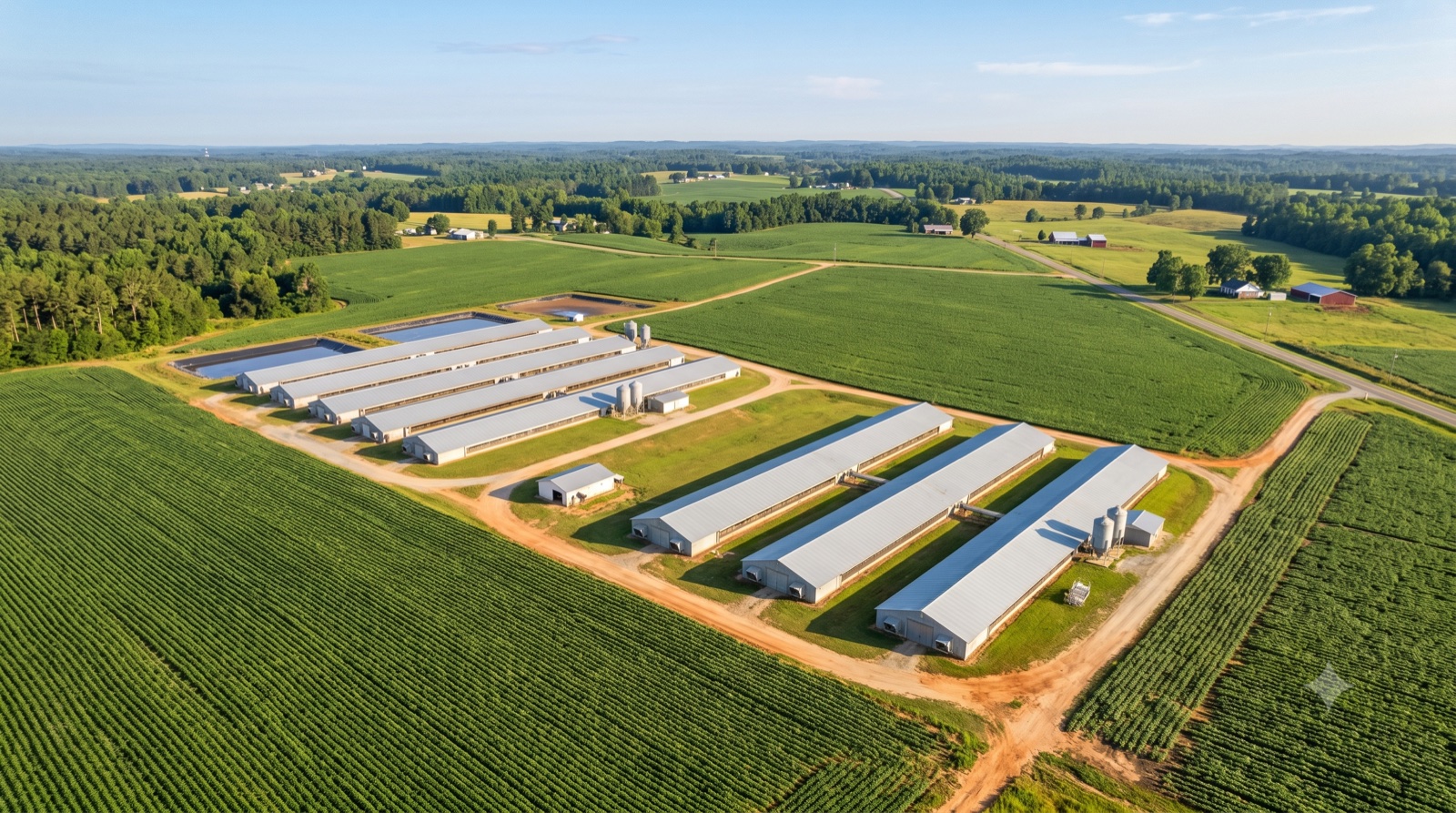
Sampson County's agricultural dominance is unmatched in the state. According to the 2022 USDA Census of Agriculture, the county ranked #1 in North Carolina and #14 nationally for total agricultural sales, generating $2.2 billion in output. It leads the state in vegetables, melons, potatoes, sweet potatoes, poultry and eggs, turkeys, and hogs. Along with neighboring Duplin County, Sampson is home to more hog farms than any other county pair in the United States, according to NCpedia's hog farming overview.
The county's top employers — anchored by Smithfield Foods, Sampson County Schools, Sampson Regional Medical Center, and Hog Slat, Inc. — reflect an economy built around processing and supporting the agricultural supply chain, according to the Sampson County Economic Development Commission. Approximately 53% of county employment is connected to agriculture in some capacity, according to NC State Extension.
Land that qualifies as working farmland, wooded tracts suitable for hunting leases, or acreage near Clinton or the I-40 corridor will find different buyer audiences than land-locked or flood-prone rural parcels. Understanding your parcel's specific characteristics is essential before setting expectations. Review our guide on how much is my land worth for a framework.
Motivated-Seller Patterns in Sampson County
Sampson County's motivated sellers most commonly fall into three groups: heirs of tobacco or hog farming families who relocated decades ago and now inherit land they have no practical connection to; absentee landowners in out-of-state cities who inherited parcels with ongoing tax and insurance obligations; and operators of hog or poultry infrastructure who are exiting the industry due to regulatory pressures or market consolidation. Each situation creates different title, zoning, and PUV complications that a buyer must evaluate.
For more county-level land research across North Carolina, explore our blog.
What Are Your Options for Selling Land in Sampson County?
The range of buyers for Sampson County land is narrower than in metropolitan counties — but the buyers who are active here are often well-capitalized farmers, agricultural investors, and hunting lease operators who know the local market well. Pricing and marketing strategy matter more than in areas with broad residential demand.
Listing with a real estate agent experienced in eastern North Carolina farm and land transactions gives your parcel exposure through the MLS and land-focused platforms. The agent can help price the parcel appropriately for its agricultural classification, water access, and road frontage. Agent commissions typically run 5–6% of the sale price, and the seller also pays the NC excise tax at closing. If the parcel is inherited land with multiple owners, all parties will need to agree on the listing strategy.
FSBO platforms like Land.com, LandWatch, and LandAndFarm have active audiences for rural eastern NC parcels. Current listings in Sampson County on LandAndFarm run approximately 140 active parcels across various price ranges. Marketing requires accurate boundary descriptions, aerial photography, and documentation of any PUV enrollment or existing agricultural leases.
Working with a direct cash buyer like Jerez Land is often the most straightforward path for inherited land, estate parcels, or properties with complicated PUV rollback calculations. We make parcel-specific firm written offers based on a full review of the property's access, zoning, encumbrances, and condition — no formula or percentage-of-market-value rule. We absorb the holding costs, marketing uncertainty, and resale risk so you get a clean, known number.
Request a cash offer for your Sampson County parcel, or read our overview of whether you need a realtor to sell land to weigh the options.
Frequently Asked Questions
I need to sell my Sampson County land quickly — what's the fastest path?
The most direct path to a fast closing is working with a cash buyer who doesn't rely on financing contingencies. Before any sale, verify your parcel's legal description with the Sampson County Register of Deeds, confirm tax status with the Tax Administration office, and determine whether the land is enrolled in the Present-Use Value program — because deferred (rollback) taxes from PUV enrollment become due at closing and affect your net proceeds.
Who pays closing costs when selling land in North Carolina?
The seller is conventionally responsible for the state excise tax — $1 per $500 of sale price — paid to the Register of Deeds when the deed is recorded. Attorney fees and title search costs are negotiated between buyer and seller in the contract; they are not fixed by state law. Neither party is required to pay all costs by default, though typical NC practice places attorney fees on the buyer.
Do I need an attorney to sell land in North Carolina?
Yes. North Carolina is an attorney-close state. A licensed North Carolina attorney must supervise every real estate closing, including the title examination, deed preparation, and recording. No alternative — including a title company acting alone — satisfies this requirement under North Carolina law and State Bar guidance.
What is the property tax rate in Sampson County NC?
Sampson County's base tax rate is $0.62 per $100 of assessed value, according to county budget documents, with an effective rate of approximately 0.75–0.82% when municipal and special district overlays are included. North Carolina assesses all real property at 100% of fair market value, so there is no fractional assessment ratio applied before the rate is calculated.
I have land enrolled in PUV — will I owe deferred taxes at closing?
If the land you are selling is enrolled in PUV — which covers agricultural, horticultural, or forestland meeting minimum acreage and income thresholds — deferred property taxes from the current year and the three prior years become payable with interest when ownership transfers. This rollback amount can be several thousand dollars on a mid-size parcel and will appear as a lien to be satisfied at closing. Any buyer will factor this into their offer.
I'm selling a hog or poultry operation in Sampson County — how complex is the process?
Yes, they can be. Existing hog or poultry confinement infrastructure is often regulated under county zoning ordinances and may carry operating permits, environmental compliance records, and lease agreements with integrators like Smithfield or Mountaire. Buyers of operational or transitional livestock parcels typically conduct due diligence on permit transfer, CAFO (Confined Animal Feeding Operation) compliance status, and any lagoon or waste management system conditions. A real estate attorney and environmental consultant are advisable for these transactions.
Disclaimer: This article is for informational purposes only and does not constitute legal, financial, or professional advice. Laws and regulations vary by jurisdiction and change over time. Always consult with qualified professionals before making land purchase decisions. Jerez Land is not responsible for actions taken based on this information.