
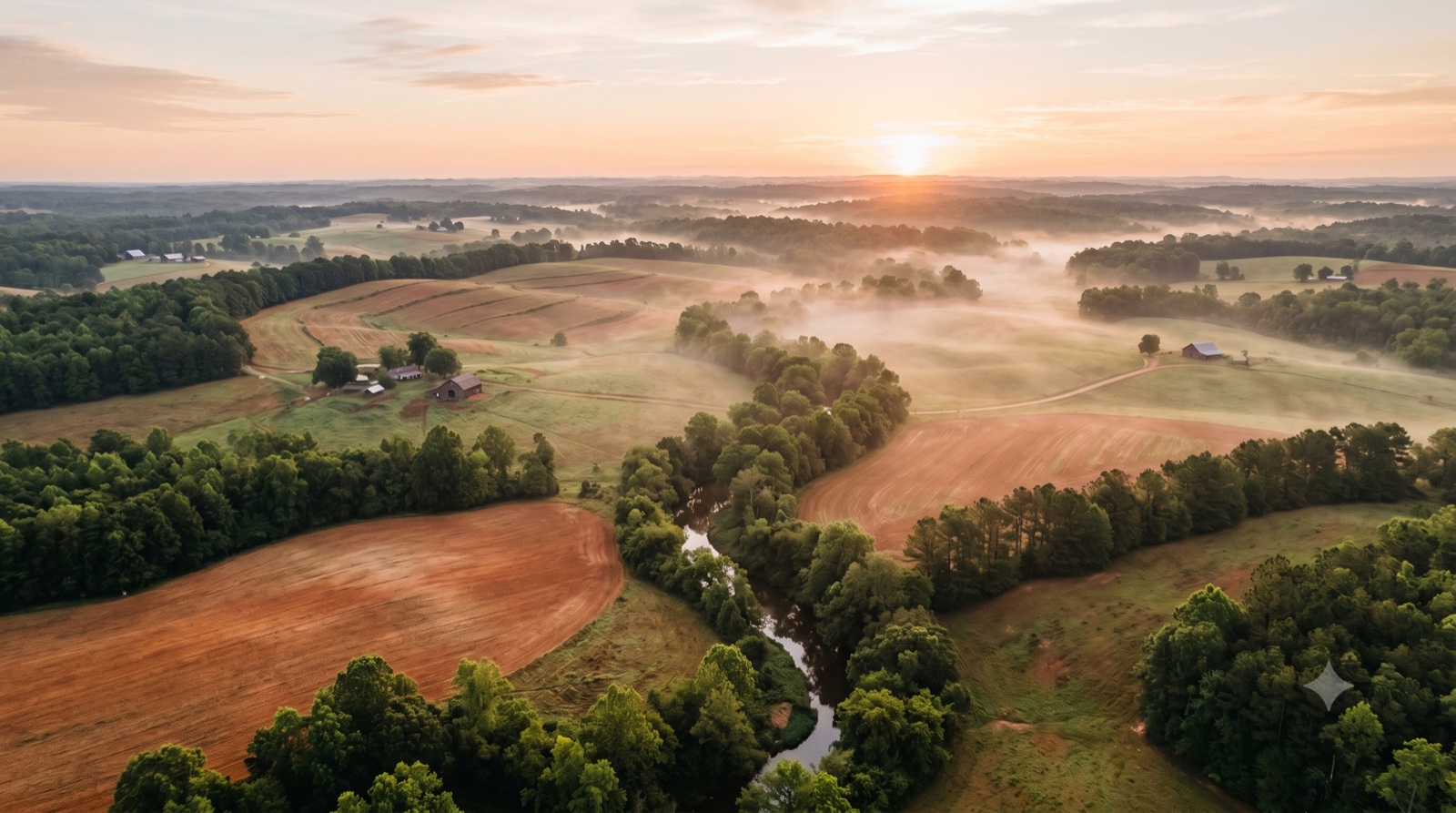
Sell My Land in Wheeler County GA - What Landowners Need to Know
Key Takeaways
- Georgia assesses all real property at 40% of fair market value: Unlike states that use different ratios for owner-occupied versus vacant land, Georgia applies the same 40% assessment ratio statewide — but Conservation Use Value Assessment (CUVA) can dramatically lower the taxable value for qualifying agricultural or timber parcels to 40% of current-use value instead of 40% of market value, a meaningful break in a county where managed pine plantations and row-crop acreage dominate the landscape.
- Georgia charges a real estate transfer tax of $1 per $1,000 of consideration: The seller typically pays this at closing; on a $100,000 parcel the tax is $100. Georgia law also requires an attorney to oversee every real estate closing, including title examination and deed preparation.
- Wheeler County's population was 7,421 in 2010 and 7,471 in 2020, but estimates show it declining toward roughly 7,335 by 2024: Wheeler is one of Georgia's least-populous rural counties — a southeast Coastal Plain landscape of pine plantations and row-crop ground drained by the Little Ocmulgee River and centered on the county seat of Alamo, according to U.S. Census Bureau data and Georgia Demographics projections.
How Can You Sell Land in Wheeler County Georgia?
Selling land in Wheeler County, Georgia involves attorney-required closings, a statewide 40% assessment ratio, and a transfer tax of $1 per $1,000 — plus the strong possibility that a CUVA or FLPA conservation-use covenant sits on your parcel and affects the sale. Wheeler County covers roughly 300 square miles of flat to gently rolling Coastal Plain terrain in southeast-central Georgia, with the county seat of Alamo on the Little Ocmulgee River anchoring an economy built almost entirely on row-crop agriculture and managed timber. According to the 2022 USDA Census of Agriculture, Wheeler County reported a total market value of agricultural products sold of approximately $19.95 million across 127 farms and 52,995 acres of farmland — with crops accounting for roughly 98% of that total ($19.57 million) and a modest livestock component making up the remainder.
This guide covers Georgia's property tax structure for vacant land, the CUVA and FLPA programs that affect sale timelines, the attorney-managed closing process, how Wheeler County compares to its neighbors, and practical steps for landowners ready to sell. For a broader look at the Georgia closing framework, see our guide on how to sell land in Georgia.
What Are the Tax Costs of Holding Land in Wheeler County?
Georgia uses a uniform 40% assessment ratio applied to the fair market value of all real property, including vacant land. The Board of Assessors determines fair market value; the Tax Commissioner then applies the millage rate to the assessed value. Wheeler County's combined millage rate — county operations plus schools — for unincorporated areas of the county produces an effective tax rate in the neighborhood of 0.90% of fair market value for properties taxed at their full market rate, according to the Georgia Department of Revenue's county ad valorem tax digest millage rates and county property tax facts for Wheeler County.
For a parcel assessed at market value, that means a $100,000 vacant tract carries an assessed value of $40,000, and the annual tax bill reflects that combined millage. Properties enrolled in CUVA, however, are taxed on 40% of current-use value — the income-producing value of the land for agriculture or timber — rather than 40% of market value. The difference can be substantial on the pine plantations and row-crop ground that define Wheeler County: in 2024, the Georgia Department of Revenue published per-acre conservation-use values by soil productivity class and county grouping, with many south-central Georgia timber acres valued well below their open-market prices. In a county where managed pine and row crops account for the vast majority of farmed ground, this conservation-use break shapes carrying costs for a large share of rural parcels.
CUVA and FLPA: What They Mean for a Sale
Georgia's Conservation Use Valuation Assessment (CUVA) requires landowners to sign a 10-year covenant promising to keep the property in agricultural or conservation use, per Georgia law and the Georgia EPD fact sheet. If the property is sold and the buyer refuses to assume the covenant — or if the use changes — the covenant is breached. A breach triggers a penalty equal to twice the tax savings accumulated during the covenant period, plus interest. That potential liability must be disclosed and negotiated at closing, which is why verifying covenant status with the Wheeler County Tax Assessor before listing is essential — especially in pine-plantation country like Wheeler, where conservation-use enrollment is common.
The Forest Land Protection Act (FLPA) functions similarly but is specifically for qualifying forest land of 200 acres or more. FLPA covenants run 10 years and carry comparable rollback tax penalties on breach. If your parcel carries an active CUVA or FLPA covenant, you have three options: sell with the covenant assigned to the buyer, breach the covenant and pay the penalty, or wait until the covenant expires.
Beyond taxes, vacant land in Wheeler County carries standard carrying costs: liability insurance, potential fencing and brush maintenance, and ad valorem taxes that accrue regardless of whether the land produces income. If you're managing timber or farm ground, our guides on selling timberland and selling farmland walk through how the dominant land uses here affect a sale.
What Zoning Rules and Closing Requirements Apply in Wheeler County?
Wheeler County's land-use and planning functions are managed through the county government. The city of Alamo maintains its own local ordinances for property within municipal limits, while unincorporated areas of the county — which make up the vast majority of its rural land — are subject to county land-use regulations. For specific zoning classification or setback questions on a given parcel, contact the Wheeler County Tax Assessor's Office at (912) 568-7924 (P.O. Box 149, Alamo, GA 30411, Chief Appraiser Rhonda J. Cason), which can direct you to the appropriate county planning contact.
Deed transfers are recorded through the Wheeler County Clerk of Superior Court at 16 W Pearl Street, Suite 101, P.O. Box 38, Alamo, GA 30411, (912) 568-7137, Clerk Carol W. Bragg. This office maintains the public land records and is where you will verify the legal description, check for liens, and confirm any covenant status on your parcel.
Georgia's Attorney-Required Closing Process
Georgia law requires a licensed Georgia attorney to supervise every real estate closing. The attorney conducts the title examination, prepares the deed, handles disbursement of proceeds, and records the deed with the Clerk of Superior Court. The process for a vacant land sale typically runs:
- Contract execution: Buyer and seller agree on terms in writing. Georgia uses the standard GAR form or a custom purchase agreement.
- Title examination: The attorney searches the Wheeler County Superior Court deed records for a period sufficient to establish marketable title, checking for liens, encumbrances, judgments, and covenant status.
- Closing: All parties sign the deed and settlement statement. The attorney disburses funds and collects the transfer tax.
- Recording: The attorney records the warranty or limited warranty deed. Georgia's transfer tax of $1 per $1,000 of consideration (or fraction thereof) is paid at recording — on a $150,000 sale the tax is $150.
Georgia's transfer tax is among the lower state-level rates in the Southeast. There is no additional county-level transfer tax in Wheeler County. Seller closing costs (excluding commissions) typically run in the 1–3% range on Georgia land transactions, covering the attorney fee, title search, and prorated property taxes.
Wondering whether you even need an agent for a rural land sale? Our guide on whether you need a realtor to sell land breaks down the tradeoffs, and if you live elsewhere, see selling land as an out-of-state owner.
How Does Wheeler County Compare to Neighboring Georgia Counties?
Wheeler County's population of roughly 7,335 in 2024 makes it one of the smallest counties in Georgia by headcount — smaller than most of its immediate neighbors, and declining after a brief plateau between 2010 and 2020. Its population ticked up marginally from 7,421 in the 2010 Census to 7,471 in 2020, but Georgia Demographics projects an annual decline of approximately 1.5% going forward, reflecting a slow erosion typical of rural Coastal Plain counties whose economies depend almost entirely on agriculture, timber, and state facilities rather than diversified employment. With that thin and shrinking local population comes a thin local buyer pool, which is why pricing expectations for rural acreage here should account for limited day-to-day demand.
| Factor | Wheeler County | Telfair County | Montgomery County | Laurens County |
|---|---|---|---|---|
| Population (2024 est.) | ~7,335 | ~11,400 | ~9,200 | ~46,000 |
| Population trend (2010–2024) | Declining | Declining | Declining | Stable |
| Assessment ratio | 40% of FMV | 40% of FMV | 40% of FMV | 40% of FMV |
| Effective tax rate | ~0.90% | ~0.88% | ~0.82% | ~0.92% |
| County seat | Alamo | McRae-Helena | Mount Vernon | Dublin |
| Primary land use | Pine/row crops | Pine/row crops | Pine/timber | Pine/crops |
| Notable feature | Little Ocmulgee River | Little Ocmulgee headwaters | Oconee River | Highway 441 corridor |
Wheeler County is bordered by Laurens, Dodge, Telfair, Jeff Davis, Montgomery, and Treutlen counties — a ring of similarly rural southeast Georgia communities sharing the same sandy Coastal Plain soils and pine-and-row-crop economy. Wheeler's smaller population base means a shallower pool of local cash buyers than larger neighbors like Laurens County (anchored by Dublin and U.S. Highway 441) — a meaningful factor when marketing rural acreage that depends on finding the right buyer.
The agricultural base in Wheeler County is almost entirely crop-driven: of the approximately $19.95 million in 2022 market value of products sold, crops accounted for roughly 98% — reflecting a landscape dominated by cotton, row crops, and field crops rather than the poultry or dairy operations found in some neighboring counties. With 127 farms averaging roughly 417 acres each and 52,995 acres of farmland counted in the 2022 USDA census, plus extensive managed pine beyond formal farm boundaries, timber and row crops together define the county's rural land character.
For more county-level land analysis across the state, explore our blog.
What Are Your Options for Selling Land in Wheeler County?
Landowners in Wheeler County face a clear cost-benefit calculation: vacant land assessed at market value carries roughly a 0.90% annual effective tax rate with no income to offset it. Add liability insurance, brush and firebreak maintenance on timber tracts, and the risk of CUVA or FLPA penalty exposure on a breach, and the holding-cost picture becomes clearer — particularly in a thinly populated, depopulating county where a local buyer may take considerable time to find. If you own managed pine or hunting ground, our guides on selling timberland and selling hunting land walk through what drives those sales.
Before listing, take these steps. Confirm your parcel's legal description and check for any active CUVA or FLPA covenants through the Wheeler County Clerk of Superior Court at (912) 568-7137 (Carol W. Bragg, 16 W Pearl Street, Suite 101, Alamo, GA 30411) or the Board of Assessors at (912) 568-7924 (Chief Appraiser Rhonda J. Cason). Verify your property tax status with the Wheeler County Tax Commissioner at (912) 568-7131 (P.O. Box 431, Alamo, GA 30411) and confirm no delinquent taxes exist. If your land has merchantable timber, a certified forester's timber cruise will help establish standing wood value independent of the land itself. Curious where to even begin on value? See how much is my land worth.
For sellers who want a firm number quickly, Jerez Land provides parcel-specific written cash offers — no listing fees, no agent commissions, and the Georgia attorney closing process handled from our side. Because we buy for cash and absorb the carrying, marketing, and resale risk on a property that may sit before the right buyer appears in a county with fewer than 7,500 residents, our offers reflect that risk. Request a cash offer and we will review your parcel and respond with a specific written number, not a range.
Frequently Asked Questions
How do I sell vacant land in Wheeler County GA?
Start by confirming the legal description with the Wheeler County Clerk of Superior Court and checking for any CUVA or FLPA covenants through the Board of Assessors. Georgia requires a licensed attorney to conduct the title search, prepare the deed, and oversee the closing. You can list with an agent, market online, or request a direct cash offer from a land buyer.
What will I pay in property taxes on vacant land in Wheeler County?
Georgia assesses all property at 40% of fair market value. Wheeler County's combined millage rate for unincorporated areas — county operations plus schools — produces an effective tax rate of roughly 0.90% of fair market value for properties taxed at full market value. Parcels enrolled in CUVA are taxed on 40% of current-use value rather than 40% of market value, which can substantially reduce the annual bill for qualifying agricultural or timber land.
Does Georgia charge a transfer tax when selling land?
Yes. Georgia levies a real estate transfer tax of $1 per $1,000 of consideration (or fraction thereof). On a $100,000 parcel, the tax is $100. The seller typically pays it at closing when the deed is recorded with the Clerk of Superior Court. There is no separate county transfer tax in Wheeler County.
I have a CUVA covenant on my land — what does that mean for a sale?
CUVA (Conservation Use Valuation Assessment) is a 10-year covenant requiring the landowner to keep the property in agricultural or conservation use. If the land is sold and the buyer refuses to assume the covenant, or if the use changes, a penalty equal to twice the accumulated tax savings plus interest is triggered. Before any sale, confirm with the Wheeler County Board of Assessors whether your parcel carries an active CUVA or FLPA covenant and factor the potential rollback into your net proceeds calculation.
Do I need to hire an attorney to sell my Wheeler County land?
Yes. Georgia law requires a licensed Georgia attorney to supervise real estate closings, conduct the title examination, prepare the deed, disburse funds, and record the deed with the Clerk of Superior Court. This applies to all land transactions, including those between private parties and cash buyers.
Is Wheeler County Georgia's population growing or declining?
Wheeler County's population held roughly flat between 2010 and 2020 — rising slightly from 7,421 to 7,471 — but Georgia Demographics estimates the county has declined to approximately 7,335 by 2024, with projections showing continued annual losses of around 1.5%. This places Wheeler among the smallest and most sparsely populated rural counties in southeast Georgia, with a correspondingly thin local market for vacant land.
Disclaimer: This article is for informational purposes only and does not constitute legal, financial, or professional advice. Laws and regulations vary by jurisdiction and change over time. Always consult with qualified professionals before making land selling or purchasing decisions. Jerez Land is not responsible for actions taken based on this information.