
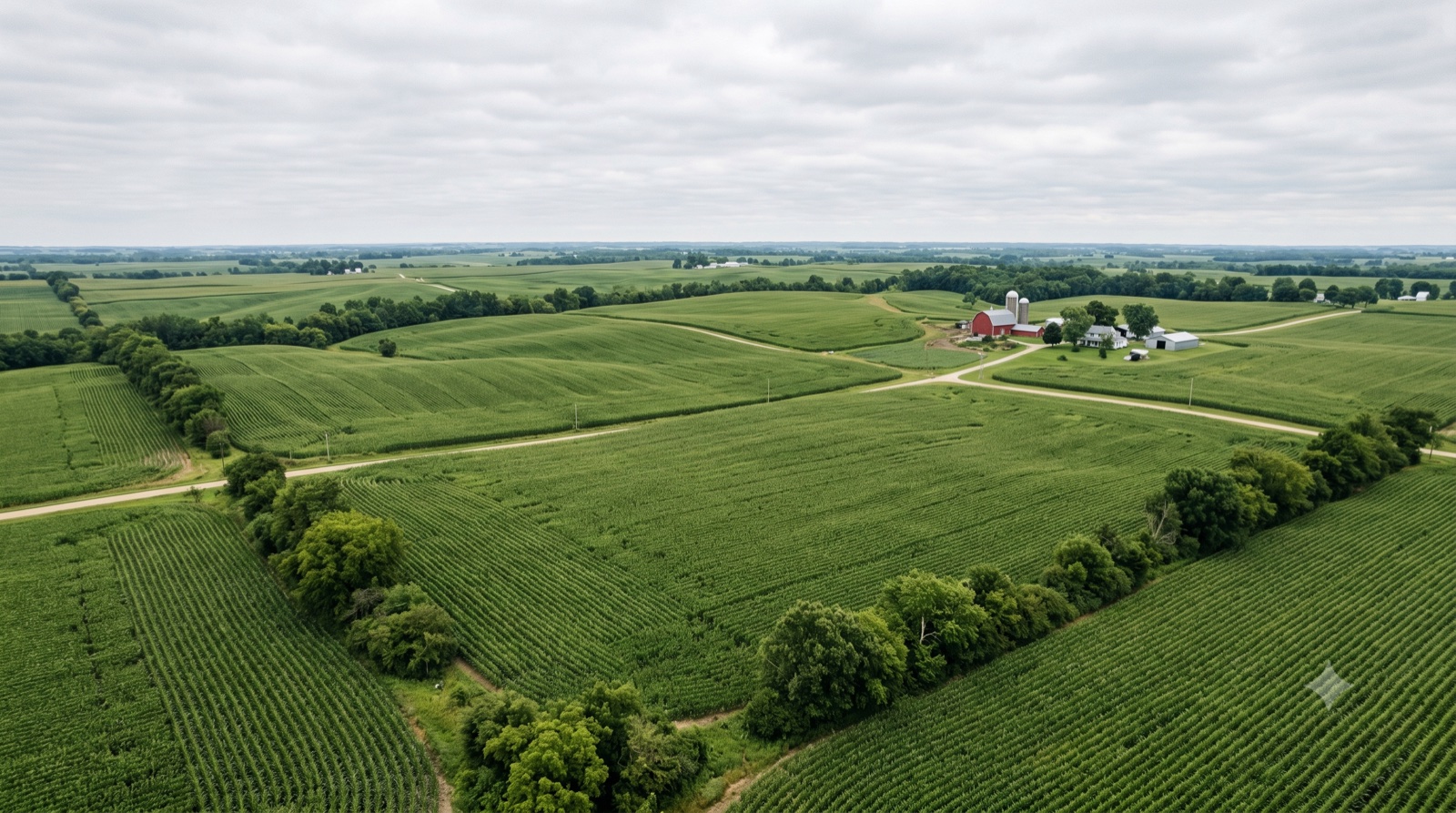
Should I Sell My Farmland? Sell vs. Keep, Lease, or 1031 Exchange
Key Takeaways
- Leasing generates recurring income but does not eliminate long-term carrying risk: USDA ERS cash rent data tracks average per-acre cash rent payments by state and crop type — income that can be meaningful for owners who do not need liquidity, but which does not resolve eventual capital gains exposure, succession complexity, or the operational burden of managing a tenant relationship over time
- Selling triggers the rollback tax clock in many states: When farmland under agricultural use valuation (also called current-use, greenbelt, or ag-use assessment) is sold to a non-agricultural buyer, most state programs impose a recapture tax — often covering three to ten prior years of tax savings — that sellers frequently miss when setting price expectations; the National Agricultural Law Center tracks these statutes by state
- A 1031 exchange preserves capital and defers federal capital gains tax but does not eliminate it: Under IRS Section 1031, the deferred gain carries into the replacement property — the exchange does not reset basis — and the 45-day identification and 180-day closing deadlines make execution time-sensitive, according to the IRS and Cornell Law School LII
Should You Sell Your Farmland?
Whether to sell your farmland depends on comparing your after-tax proceeds to your income needs, tax exposure, and succession plans — and whether you can manage a tenant relationship long-term. There is no universal right answer; the comparison requires running actual numbers for your specific parcel, your basis, and your tax situation. For most farmland owners, the decision to sell is not a single question — it is four questions stacked on top of each other: sell, lease, hold idle, or exchange into different property through a 1031. Each path produces a different income profile, a different tax result, a different management burden, and a different exit from the land. Choosing the wrong one — or drifting into the default of "we'll figure it out later" — is how farmland owners end up with five-figure rollback tax surprises at closing or years of tenant disputes that erode the income they expected from a lease.
This guide is about the decision, not the sale mechanics. If you've already decided to sell and want to understand buyer types, the listing vs. cash-sale comparison, and the process from offer to closing, that's covered in depth at how to sell farmland. What this post addresses is the question that comes before the process: which path is actually the right one for your situation?
Browse related guides on the blog, or if you want a written cash number on your specific parcel while you think through the options, request a no-obligation offer — it takes a few minutes and costs nothing.
What Is the Real Return on Leasing Your Farmland vs. Selling?
Leasing is often framed as the obvious alternative to selling — the land keeps generating income, nothing has to change, and the owner avoids the finality of a sale. That framing is partly right. But the return comparison is more complicated than it first appears, and the complications tend to favor selling more often than owners expect.
How Cash Rent Works
A cash rent lease is a fixed annual payment from the tenant farmer to the landowner, typically structured per acre, paid in full before the growing season begins. The tenant assumes all crop risk; the landowner receives the same payment regardless of yield or commodity prices. According to USDA ERS, cash rents vary substantially by region and soil productivity — prime Corn Belt ground commands significantly higher rents than marginal ground in less productive areas. Iowa State University Extension publishes annual per-county cash rent estimates that are widely used as benchmark references.
The landowner's net income from a cash rent lease is the gross rent minus property taxes, any maintenance costs (tile repair, fencing, erosion control), and management time. In states where the land maintains its agricultural use classification, the property tax bill stays low — which is the primary structural advantage of staying in a lease rather than selling.
What Changes When You Compare Lease Income to Sale Proceeds
The rent vs. sell comparison requires answering one question: how many years of net lease income equals the after-tax sale proceeds? That calculation depends on your specific tax basis, the rollback tax exposure (if any), and what you'd do with the sale proceeds — if they sit in a money market account, the comparison is different than if they're reinvested in other income-producing assets.
For owners with a very low basis — farmland held for decades, sometimes inherited and stepped up, sometimes not — capital gains exposure on a sale can be substantial, which shifts the math toward leasing. For owners who need liquidity, have health or succession issues that make long-term property management impractical, or hold marginal ground where cash rents are thin relative to carrying costs, the sale proceeds often win the comparison.
The honest answer is that neither option is universally better. The comparison has to be run on your specific parcel, your basis, your tax situation, and your income needs. The section below provides a framework for making that comparison directly.
The Option Most Owners Underestimate: Idle Land
If the farmland is not currently leased and you're not farming it yourself, you're already in the most expensive scenario: paying taxes, insurance, and maintenance with zero income. Idle land does not stay in agricultural use classification automatically — if the land is not being farmed, many state ag-use programs will reclassify it to market value assessment, triggering a higher tax bill going forward. This is a separate problem from the rollback tax that occurs at sale.
Owners who are holding idle farmland and deferring the sell/lease decision are often losing money every year while also accumulating potential rollback exposure. The status quo is not neutral.
The Ag-Use Rollback Tax: What It Is and Why It Catches Sellers Off Guard
The rollback tax is the single most common financial surprise in a farmland sale. It does not appear in the listing price, it does not show up in the buyer's offer, and it is not the title company's job to warn you about it before you've signed a contract. It shows up on the closing settlement statement, deducted from your proceeds, and by then there's nothing to do except pay it.
How Agricultural Use Valuation Works
Most states operate some form of agricultural use valuation (called current-use valuation, greenbelt assessment, preferential assessment, or ag-use classification depending on the state). The program allows farmland that is actively used for agriculture to be assessed for property tax purposes at a value based on what the land earns as farmland — its income-producing capacity — rather than its market value, which reflects what a developer, investor, or residential buyer would pay.
The practical benefit for working farmers and landowners is a meaningfully lower annual property tax bill. In areas where market values have risen significantly due to development pressure or land appreciation, the difference between use-value assessment and market-value assessment can be substantial.
What the Rollback Is and When It Triggers
The rollback is a recapture mechanism. When land under agricultural use valuation changes use — typically when it is sold to a buyer whose intended use is not agricultural, or when the land is removed from the program for any reason — the state collects the taxes that would have been paid under full market-value assessment during the rollback period, usually the preceding three to ten years (the specific window varies by state), plus statutory interest.
The rollback is assessed against the property, not the buyer's future plans — so the exposure is calculated based on what has accumulated during your ownership under the ag-use program, and it is typically paid from the seller's proceeds at closing.
What matters for sellers: whether the rollback triggers at all depends partly on the buyer's intended use. In many states, a sale to a buyer who will continue to farm the land — an adjoining operator, for instance — does not trigger rollback. A sale to a residential developer or non-farming investor typically does. But the rules are state-specific, and some states trigger rollback on any change in ownership regardless of intended use.
Before pricing your farmland or entering negotiations, confirm with your county assessor whether your parcel is currently under an agricultural use classification, what your rollback exposure is in dollar terms for each of the next several years, and whether your state's rollback rules are triggered by the intended use of the buyer or by the transaction itself. The National Agricultural Law Center maintains state-by-state resources on agricultural use valuation programs.
For the full capital gains and tax picture of a farmland sale, see capital gains tax on selling land.
Sell, Lease, Hold Idle, or 1031 Exchange: The Direct Comparison
This table is the decision framework. It does not make the decision for you — your specific numbers, tax situation, and goals determine which column wins — but it maps the key variables across the four paths in one place.
| Factor | Keep & Lease (Cash Rent) | Sell Now | Hold Idle | 1031 Exchange |
|---|---|---|---|---|
| Income | Recurring annual cash rent (tenant-dependent) | One-time lump sum at closing | None | Depends on replacement property |
| Liquidity | None (capital stays in land) | Full liquidity at closing | None | Capital reinvested, not liquid |
| Federal capital gains tax | Deferred (no sale event) | Due in year of sale on gain above basis | Deferred | Deferred into replacement property |
| Ag-use rollback tax | Not triggered (ag use continues) | Possible at sale (state-specific) | Risk if land reclassified | Triggered at sale (before exchange) |
| Management burden | Moderate (tenant selection, lease terms, renewals) | None after closing | High (maintenance, liability, compliance) | Moderate (identify/close replacement) |
| Succession risk | Passes to heirs with complexity intact | Resolved at closing | Complexity compounds over time | Deferred complexity |
| Exit flexibility | Can sell later (tax exposure grows) | Final; no reversal | Can sell or lease later | Locked into replacement property |
| Effort to execute | Low initially; ongoing | Low (relative to other paths) | Very low; problems accumulate | High (45-day ID window, 180-day close) |
Reading the Table
Selling now scores best on liquidity, certainty, and succession resolution — it converts a complicated asset into cash. It scores worst on capital gains tax in the year of sale, which is why owners with long holding periods and low basis often resist it.
Leasing scores best on income continuity and tax deferral, but it does not reduce complexity — it defers it. The succession question, the capital gains question, and the rollback question all remain to be answered by whoever comes next.
Holding idle farmland has almost no advantages. It generates no income, accumulates carrying costs, and may silently trigger the loss of ag-use classification. For owners who are genuinely uncertain about direction, leasing while deciding is almost always better than holding idle.
A 1031 exchange is worth serious consideration if: (1) you want to exit farmland but reinvest in other real property, (2) your capital gains exposure is large enough that the deferral provides significant value, and (3) you can identify and close on a suitable replacement property within the IRS deadlines. Under IRS Section 1031, qualifying like-kind exchanges of real property — including farmland exchanged for other investment real estate — defer recognition of the capital gain into the replacement property. The exchange does not eliminate the gain; it carries forward. See 1031 exchange when selling land for the full process.
Succession and the Retiring Farmer: When the Decision Has a Time Dimension
The USDA 2022 Census of Agriculture places the average age of U.S. farm operators at 58.1 years, and a significant share of U.S. farmland is owned by operators approaching or past traditional retirement age. For these owners, the sell-vs.-lease decision is not purely financial — it has a time dimension that changes which option makes sense.
When Retirement Is the Trigger
A farmer who is winding down an active operation has a specific transition challenge: the equipment and labor infrastructure that made farming viable disappears at retirement, and continuing to farm personally is no longer an option. The remaining choices are lease, sell, or find a successor. A cash rent lease to a neighboring operator is often the path of least resistance in the short term — the land stays productive, the owner maintains familiar income, and nothing has to change immediately.
The risk of defaulting to this path is that "short term" tends to extend indefinitely. Health events, cognitive changes, and eventual death convert a manageable transition decision into a probate and estate problem. The American Farm Bureau Federation has noted that farm succession planning is consistently underestimated by farm families — many farms transfer at death rather than through a deliberate succession plan, at significant tax and administrative cost to heirs.
If succession within the family is not on the table, the cleaner path is to execute a deliberate sale while the owner is in full capacity to negotiate, review offers, and make decisions. A cash sale to a direct buyer provides a defined exit date and eliminates the estate's need to manage a real estate transaction under time pressure. See selling land in a trust if the farmland has already been placed in a trust structure, and gifting or transferring land to family if a family succession path is still under consideration.
When Multiple Heirs Are Already Involved
Inherited farmland with multiple heirs is the succession scenario that most frequently ends in a forced or contentious sale. Co-owners who disagree about leasing terms, rental rates, maintenance responsibilities, or whether to sell at all create management deadlock. Tenants exploit disagreement. Property taxes accumulate. In the worst cases, any co-owner can force a partition action that results in a court-ordered sale at below-market conditions.
For inherited farmland situations, the economic case for a consensual cash sale — executed while all parties can agree on the terms — is typically stronger than it appears. The alternative is not "keep leasing peacefully forever"; it is "keep leasing until a health event, a dispute, or a partition action forces a sale on worse terms."
When Selling Your Farmland Is the Right Answer
Selling is the right answer in more situations than owners initially assume, particularly once the full cost picture — rollback tax, capital gains, carrying costs, opportunity cost of illiquidity — is laid out against the realistic net income from a lease.
Selling makes strong sense when:
- You need the capital for another purpose — retirement income, healthcare costs, estate equalization among heirs, or reinvestment in another asset class. Locked-up equity in farmland generates no liquidity.
- The land is idle or marginally leased — if cash rents don't cover carrying costs, or you can't find or keep reliable tenants, the income case for leasing disappears and the carrying costs accumulate.
- Succession is not resolved — if there is no plan for who manages this land after you, selling now converts a future problem into a present solution.
- You want a clean exit — managing a farm tenant relationship requires engagement even for a "passive" landlord. Lease renewals, rent negotiations, maintenance disputes, and tenant non-performance are ongoing responsibilities. A sale eliminates all of them.
- Rollback exposure is manageable now but grows every year — in states with long lookback windows, each additional year of ag-use assessment adds to the potential rollback recapture. If you're going to sell eventually, earlier often means lower rollback exposure.
For context on how to evaluate what your farmland is actually worth before making any path decision, see how much is my land worth. For the decision framework when the question is broader than farmland, should I sell my land or keep it covers the general version of that comparison.
When you're ready to see a firm written number — not a range, not a formula, but a parcel-specific offer you can compare directly to the income stream from a lease — request a no-obligation cash offer from Jerez Land. There's no cost, no obligation, and no pressure to move forward.
Frequently Asked Questions
I'm deciding between leasing and selling my farmland — which option makes more sense?
Neither is universally better — it depends on your income needs, basis, tax exposure, and how much management responsibility you want to retain. Leasing provides recurring income and defers capital gains tax but keeps the complexity of the asset intact: succession questions, tenant risk, potential rollback exposure at eventual sale, and ongoing carrying costs all remain. Selling provides immediate liquidity, resolves succession, and eliminates management burden, but triggers capital gains tax in the year of sale and — if the buyer's use is non-agricultural — may trigger state rollback recapture. The comparison requires running actual numbers for your parcel. Iowa State University Extension and University of Illinois Extension both publish practical farmland leasing guidance to help frame the income side of that comparison.
What is the rollback tax and will it apply when I sell my farmland?
The rollback tax is a recapture charge imposed by most states with agricultural use valuation programs when farmland under that program is sold to a buyer whose intended use is not agricultural. It equals the difference between what was paid in property taxes under the ag-use assessment and what would have been paid under full market value assessment, for each year in the rollback window (typically three to ten years, depending on state), plus statutory interest. Whether it applies to your sale depends on your state's specific rules and the buyer's intended use — some states trigger rollback only when the agricultural use ends; others trigger it on any transfer. Confirm your rollback exposure with your county assessor before pricing your land.
I want to defer capital gains tax when I sell my farmland — how does a 1031 exchange work?
Under IRS Section 1031, if you sell your farmland and reinvest the proceeds in other qualifying like-kind real property — which can include other farmland, commercial real estate, or most other investment real property — you can defer federal capital gains tax on the gain from the sale. The deferred gain carries into the replacement property and becomes taxable when that property is eventually sold without another exchange. The IRS imposes strict deadlines: you must identify potential replacement properties within 45 days of the farmland sale closing, and close on the replacement within 180 days. A qualified intermediary must hold the proceeds — you cannot touch the funds in between. See 1031 exchange when selling land for full details on the process and requirements.
What happens to my farmland if I don't make a succession plan?
Without a succession plan, farmland typically passes through your estate to your heirs according to your will or state intestacy laws. If the land passes to multiple heirs who disagree about what to do with it, management disputes are common — and any co-owner has the right to force a partition action in court, which can result in a forced sale at potentially unfavorable terms. The American Farm Bureau Federation has highlighted that farm succession is one of the most underplanned aspects of agricultural estate planning. Creating a deliberate plan — whether that means selling now, gifting to a specific heir, placing the land in a trust, or establishing a buy-sell agreement among heirs — is almost always better than leaving the decision to the probate process.
Can I sell my farmland without paying capital gains tax?
Not without either a 1031 exchange into qualifying replacement property or a stepped-up basis that brings your taxable gain to zero. If you inherited the farmland and received a full step-up in basis to the fair market value at the date of the prior owner's death, and market values have not risen significantly since then, your taxable gain may be small. If you've owned the land for many years with a low original basis, the gain on sale will typically be taxable as long-term capital gains under federal law. A qualified tax advisor can calculate your actual gain and model the after-tax outcome of a sale versus a 1031 exchange for your specific situation. See capital gains tax on selling land for a general overview.
I've been holding onto my farmland for a few years, hoping the market improves before I sell — is waiting actually paying off, or is it costing me more than I think?
Whether it's paying off is hard to know in advance, because timing the farmland market is difficult for the same reason timing any real estate market is difficult: you cannot know when prices have peaked until they haven't. What you can control is your cost of waiting — the carrying costs, rollback tax accumulation, management time, and opportunity cost of illiquid capital that accumulate with every year you hold. For sellers with a strong income need from the land, waiting makes sense if the lease income genuinely covers carrying costs and provides acceptable returns. For sellers with idle land, succession complexity, or health-driven timelines, waiting for a better market frequently costs more than whatever incremental price improvement it might produce. See when should you sell land for a fuller treatment of timing considerations.
Disclaimer: This article is for informational purposes only and does not constitute legal, financial, or tax advice. Agricultural use valuation programs, rollback tax rules, capital gains treatment, 1031 exchange requirements, and cash rent benchmarks vary by state and change over time. Always consult a qualified attorney, CPA, or licensed land professional before making farmland sale, leasing, or succession decisions. Jerez Land is not responsible for actions taken based on this information.