
Can I Sell My Land If Its Development Rights Were Severed Under a Local TDR Program?
Key Takeaways
- A confirmed, currently operating TDR program in Jerez Land's footprint exists in Pennsylvania — Buckingham Township in Bucks County has run one since 1975, one of the first jurisdictions in the country to do so, authorized under the state's Municipalities Planning Code, 53 P.S. § 10619.1.
- A TDR sending-area restriction is built to be permanent. Once the development-rights conveyance is recorded, the sending parcel is "permanently protected through a conservation easement or a restrictive covenant," per the WeConservePA Library, and Buckingham Township's own sending-parcel covenants are recorded as perpetual once the township's TDRs are sold.
- TDR is a different mechanism than a conservation easement or Pennsylvania's Agricultural Conservation Easement Purchase Program (ACEPP). With TDR, "the development rights purchased from the landowner can be used on another parcel"; with ACEPP, "the development rights are retired," according to WeConservePA — one moves the density to a private buyer, the other extinguishes it through a government purchase.
Can I Sell My Land If Its Development Rights Were Severed Under a Local TDR Program?
Yes — you can still sell land whose development rights were severed and transferred under a local Transferable Development Rights (TDR) ordinance. You still own and can convey the land itself; what moved was the buildable density, recorded as a restriction on your parcel and sold as a credit to a developer building somewhere else in a designated receiving area.
The closest thing Jerez Land has covered to this situation isn't a title defect — it's a severance. Structurally, a TDR sending-area restriction works the same way as selling surface land after the mineral rights were already severed: a prior action split one specific stick out of the bundle of rights that come with owning land, that stick went to someone else, and what's left — the surface, the farming, the hunting, the use of the dirt itself — is still fully yours to sell. With minerals, what got severed is the subsurface estate. With a TDR sending-area restriction, what got severed is the zoning-allowed development density above the surface. Different right, same basic shape of problem.
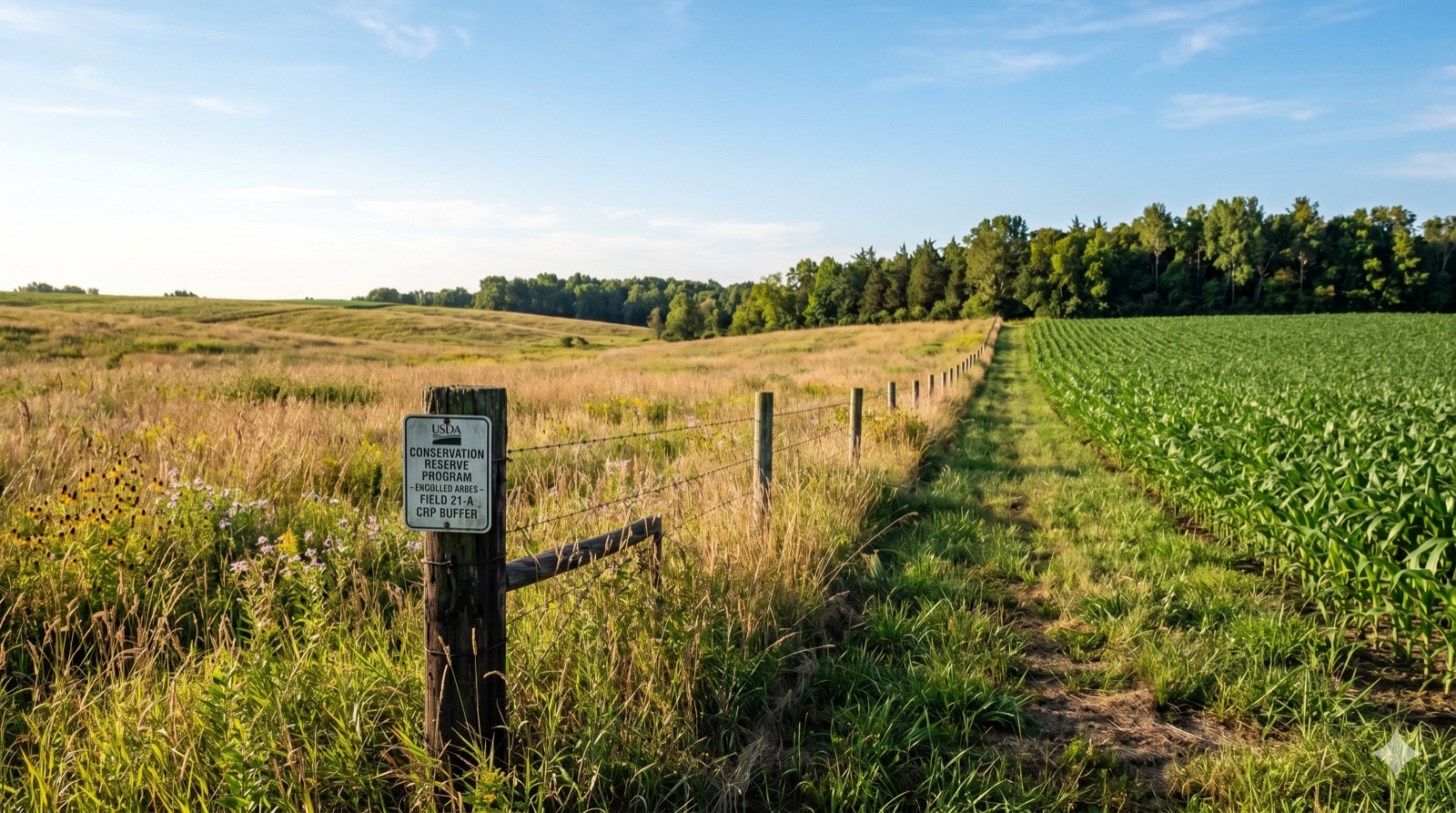
It's also easy to confuse a TDR restriction with a conservation easement or a USDA Conservation Reserve Program (CRP) contract, which Jerez Land has covered separately in selling land in a conservation easement or CRP contract. Those are worth telling apart, because they arise differently and they're administered by different people — a conservation easement is typically volunteered directly by the owner and often paid for by a land trust or government agency, while a TDR sending-area restriction arises because a specific local ordinance let the owner sell the parcel's development potential as a tradeable credit to a private buyer in a receiving area. This guide is about that narrower, more localized situation.
TDR programs are genuinely rare — they exist only where a specific municipality or county has adopted an ordinance under state enabling law, and confirming a real one matters more than assuming your county has one. The clearest, most established example Jerez Land has been able to verify operating in the states it buys in (AL, GA, MI, MS, NC, OK, PA, SC, TN) is in southeastern Pennsylvania, where the state's Municipalities Planning Code has let townships and counties run TDR programs for decades — Buckingham Township's, discussed throughout this guide, is one of the oldest and best-documented. If your land is in Pennsylvania and you're navigating a sale more broadly, see how to sell land in Pennsylvania. For more guides like this one, visit the Jerez Land blog.
How Does a Transferable Development Rights (TDR) Program Actually Work?
A TDR program lets a local government split a parcel's zoning-allowed development potential from the land itself and let the owner sell it as a credit to a developer building in a different, government-designated "receiving area" — while the original "sending" parcel keeps its owner and its everyday uses but permanently loses that density. The mechanism runs through two zones the municipality designates in its zoning ordinance or comprehensive plan: a sending area, usually farmland or open space the township wants to keep undeveloped, and a receiving area, usually a district with utilities and infrastructure already suited to more intensive building.
Buckingham Township's program, adopted in 1975 and revised in 1994, shows how the mechanics actually run in practice. Sending sites are limited to the township's AG-1 and AG-2 agricultural zoning districts, which together cover more than half of Buckingham's land area; to sell TDRs, an owner needs at least 25 acres enrolled in Pennsylvania's Agricultural Security District program, according to Smart Preservation's profile of the township. The number of transferable rights a parcel generates comes from a formula — the site's acreage multiplied by a ratio the township has adjusted over time (0.85 originally, reduced to 0.56 by 2020), minus one right for every existing dwelling already on the property. Receiving areas, expanded in the 1994 revision, now include Buckingham's two agricultural districts plus four residential zoning districts, where a developer who buys TDRs can build at higher density than the base zoning would otherwise allow.
The conveyance itself runs through a specific statutory mechanism, not an informal handshake. Under Pennsylvania's Municipalities Planning Code, 53 P.S. § 10619.1, development rights "are declared to be severable and separately conveyable from the estate in fee simple" and are conveyed "by a deed duly recorded in the office of the recorder of deeds" in the county where the municipality sits. Critically, the recorder "shall not accept for recording any such instrument of conveyance unless there is endorsed thereon the approval of the municipal governing body having zoning or planned residential development jurisdiction," dated no more than 60 days before recording — meaning every legitimate TDR conveyance has both a recorded deed and a documented municipal sign-off behind it. The broader TDR-enabling framework in the Municipalities Planning Code also includes 53 P.S. §§ 603(c)(2.2), 619.1, and 1105(b)(2), according to the WeConservePA Library's guide to the mechanism, and Chester County's planning commission describes the same core split in plainer terms: a sending parcel that "needs protection" and a receiving parcel "more appropriate for development."
Is a TDR Sending-Area Restriction on My Land Permanent?
Yes — in the program Jerez Land has been able to verify, the sending-parcel restriction is designed to be perpetual. Once the development-rights conveyance is recorded, the sending parcel is legally locked down the same way a conservation easement locks down a parcel, with no expiration date and no renewal window the way there is with a temporary program like a CRP rental contract.
The WeConservePA Library's guide is explicit on this point: "the land from which the development rights have been severed is permanently protected through a conservation easement or a restrictive covenant," and that protection is recorded with the county recorder before the municipality will approve any corresponding development in the receiving area — the permanence isn't an afterthought, it's a prerequisite the ordinance builds in before the credit can even be used. Buckingham Township's version works the same way: once TDRs are sold off a sending parcel, a covenant restricting the land to agricultural and resource-preservation use is recorded and becomes perpetual. Through 2020, roughly 505 acres in the township had been preserved through TDR sales — about a third of the township's 5,312 total permanently preserved acres, per Smart Preservation. That's a program that has been operating, and recording permanent restrictions, for decades — not a one-time pilot.
Don't assume every TDR-adjacent term you encounter carries this same permanence, though. A CRP contract, covered in Jerez Land's conservation easement and CRP guide, is a 10-to-15-year rental agreement that a buyer has to formally succeed to or it terminates — nothing like the perpetual covenant a TDR sending-area restriction records. If your title report or a planning department mentions "development rights" language, ask specifically whether the underlying instrument is a permanent recorded covenant or a term-limited program; the word "temporary" should never appear next to a properly executed TDR conveyance.
How Is a TDR Restriction Different From a Conservation Easement, a PDR Purchase, or Severed Mineral Rights?
All four of these permanently limit what you can build or extract on a parcel, but they differ in who receives the severed right and how it gets there: a TDR restriction sends buildable density to a private developer through a market sale, a purchase-of-development-rights (PDR) program like Pennsylvania's ACEPP sends development rights to a government board that retires them outright, a conservation easement is typically donated or sold directly to a land trust or agency, and severed mineral rights split off the subsurface estate rather than any zoning entitlement at all.
| Encumbrance | What got severed | Who holds it | Perpetual? | How it shows up on title | What the owner can still do |
|---|---|---|---|---|---|
| TDR sending-area restriction (e.g., Buckingham Twp., Bucks County, PA) | The parcel's zoning-allowed development density, calculated as a set number of TDR credits | A private developer (or a TDR bank) in a designated receiving area, via a market sale | Yes — recorded as a permanent covenant once the TDRs are conveyed (53 P.S. § 10619.1; WeConservePA) | A recorded deed/covenant approved by the municipality within 60 days of recording, filed with the county recorder of deeds | Own, farm, timber, hunt, or otherwise use the land — just can't build to the original zoning density |
| Conservation easement (voluntary) | The right to develop or subdivide beyond what the easement terms allow | A land trust or government agency that accepted or purchased the easement | Yes, typically — a recorded easement that runs with the land (our CE/CRP guide) | Recorded easement instrument in the chain of title | Whatever the specific easement terms allow — often continued agriculture, forestry, or a limited building envelope |
| PDR purchase (Pennsylvania's ACEPP) | Development rights, sold directly to a county agricultural land preservation board | The state/county board — the rights are retired, not resold (WeConservePA; PA.gov) | Yes — the rights are permanently extinguished, not reused elsewhere | Recorded conservation easement under the Agricultural Area Security Law and 7 Pa. Code Ch. 138E | Continue farming and retain "all privileges of land ownership, except the ability to sell the land for non-agricultural development" (PA.gov) |
| Severed mineral / oil & gas rights | The subsurface mineral estate — not zoning density at all | A prior owner, an oil/gas company, or their successors (our mineral-severance guide) | Yes, typically — mineral reservations generally don't expire on their own | Reservation/exception language in a prior recorded deed, listed in the title commitment's exceptions | Own and sell the surface; use it for anything not requiring subsurface access, subject to the mineral owner's implied right to reasonable surface use |
Why the Distinction Matters When You're Selling
Mixing these up can send you down the wrong process entirely. A CRP contract needs a buyer to formally succeed to it before closing or it terminates with a possible refund obligation — nothing to succeed to with a TDR restriction, because the credit already sold and the sending-parcel side of that transaction is closed. A conservation easement sometimes still involves an active relationship with the land trust that holds it; a TDR restriction, once recorded, is generally just a static covenant on the record, not an ongoing program you or a buyer has to manage. And a TDR restriction is nothing like a zoning violation — it's the opposite of one. The parcel is in full compliance with a program a prior owner (or you) used voluntarily; there's no fine, no cure period, no code officer to satisfy. It's simply a permanent, on-the-record limit on what can be built there.
How Do I Find Out Whether My Parcel's Development Rights Were Already Severed?
The clearest confirmation comes from the same place a mineral severance would surface: the chain of title. Because Pennsylvania's Municipalities Planning Code requires the conveyance deed to be recorded with the county recorder of deeds, with the municipality's approval endorsed on it, a title search or your title company's list of exceptions will pick up a recorded TDR conveyance the same way it would pick up any other recorded restriction against your parcel.
Two other places are worth checking directly. First, the township or county that administers the specific program keeps its own records — under 53 P.S. § 10619.1, the recorder can't even accept a TDR deed without the municipality's dated approval attached, which means the municipality necessarily has that approval on file for every legitimate conveyance out of a sending parcel. If you know or suspect your land sits in a TDR sending area (Buckingham Township publishes its eligibility criteria directly on its Land Preservation page), the planning or zoning office is the fastest way to confirm whether your specific parcel's rights were ever sold. Second, if you're already enrolled — or a prior owner enrolled the land — in a Pennsylvania Agricultural Security District, that enrollment itself is a signal worth asking the township about, since Buckingham's TDR eligibility runs through that same enrollment.
If a title report surfaces a recorded TDR covenant alongside other complications, or you're not sure what a particular title exception actually is, Jerez Land's broader guide on selling land with a lien or cloud on title walks through how to sort one kind of recorded item from another before deciding how it affects your sale.
What Does a TDR Restriction Actually Let Me Still Do With the Land?
You keep every use the restriction doesn't take away — farming, timbering, hunting, leasing, and building within whatever residual density or agricultural-use limits the covenant allows. The only thing gone is the original zoning-allowed development potential that was sold off as a credit, and that narrows your buyer pool to people who want the land for what it can still do rather than what it could have been built into.
Be honest with yourself and with prospective buyers about that narrower pool. A buyer specifically shopping for land to develop at the parcel's original zoning density isn't your market anymore — that density already moved to a receiving-area developer somewhere else in the township. Your realistic buyers are people who want the land for continued agricultural use, recreation, or a residence within whatever the covenant still permits — closer to the buyer profile you'd see selling farmland than the buyer profile for a raw development parcel. That's a real change in who's likely to make an offer, not a change in whether the land is sellable.
What to gather before you list or take an offer: the recorded instrument that conveyed the TDRs off your parcel, the specific local ordinance citation it was executed under, written confirmation from the township or county planning department of what the covenant restricts and permits, and a clear written disclosure of all of it to any buyer. Jerez Land's guide on the paperwork typically needed to sell land covers the broader document list a closing touches; a recorded TDR covenant and the planning department's confirmation of it belong on that list the same way a mineral reservation or an easement document would.
What Are My Options for Selling Land With a TDR Sending-Area Restriction?
You have the same three broad paths as any land seller, and none of them are closed off by a TDR restriction — the restriction changes who's likely to want the land, not whether you can sell it. Listing with a land broker who specializes in agricultural or restricted-use property can work well if your parcel still has strong farm, timber, or recreational appeal, but expect a narrower buyer list and be prepared to explain the covenant clearly and repeatedly, since retail buyers and their lenders often want extra time to understand an unfamiliar restriction before committing.
Selling to a neighbor or an adjoining landowner is worth considering too, particularly if your restricted parcel would add contiguous acreage, road frontage, or agricultural-use flexibility to land they already own and already understand the local zoning around — a neighbor doesn't need the same education on what a TDR sending-area restriction means that an out-of-area buyer would.
Selling directly to a cash buyer is the third option, and it's often the most straightforward one for a restricted parcel precisely because a direct buyer reads the recorded covenant and the underlying ordinance, decides what it means for the parcel's realistic use, and reflects that in a firm, individually priced written offer rather than walking away the way a financed retail buyer sometimes will when a title report shows something unfamiliar. Request a no-obligation cash offer and we'll go through what your title report actually shows, what the local planning department confirms, and what a straightforward closing looks like with the restriction fully accounted for. For more guides on selling land with title complications, visit the Jerez Land blog.
Frequently Asked Questions
I just found out my parcel is in a TDR sending area in Bucks County, Pennsylvania — does that mean I can't sell it?
No. Being in a TDR sending area doesn't block a sale on its own — it only matters if the parcel's development rights were actually conveyed away, which you can confirm through a title search or by asking the township's planning department directly. If the rights were sold, you still own and can sell the land itself; the restriction just narrows the realistic use to whatever the recorded covenant still permits, such as continued agriculture, timber, or recreational use.
My title company flagged a recorded "development rights covenant" on my land — what is that?
That's the recorded instrument a TDR ordinance requires once a parcel's development rights are conveyed away — in Pennsylvania, it's a deed recorded with the county recorder of deeds under the Municipalities Planning Code, 53 P.S. § 10619.1, endorsed with the municipality's approval. It means the zoning-allowed development density that used to apply to your parcel was sold as a credit to a developer building elsewhere, and the restriction on your land is generally permanent. Ask the title company or the township planning office for the specific recorded document so you know exactly what it restricts.
We inherited land that's enrolled in a Pennsylvania Agricultural Security District — could its development rights already be gone?
It's possible but not automatic — Agricultural Security District enrollment is a prerequisite some townships use for TDR eligibility, but enrollment alone doesn't mean the development rights were actually sold. Check with the township's planning or zoning department and pull a title search on the parcel; both should show whether a TDR conveyance was ever recorded against it, separate from the security-district enrollment itself.
Does a TDR restriction show up in county property tax records?
Not necessarily in a way you'd recognize without asking — property tax records generally reflect assessed value and use classification, not the specific recorded instrument behind a restriction. The reliable places to confirm a TDR restriction are a title search or title commitment, which will surface the recorded covenant, and the local planning department that administers the specific program and approved the original conveyance.
Can a TDR sending-area restriction ever be removed or bought back?
Not through any mechanism confirmed for the program covered in this guide. The restriction is recorded as permanent precisely so the municipality can rely on the sending parcel staying undeveloped in exchange for allowing higher density in the receiving area — reversing that would undercut the entire trade the ordinance is built on. Don't assume a buy-back option exists; confirm directly with the administering township or county rather than relying on a general assumption either way.
How is a TDR restriction different from a conservation easement on my deed?
Both are typically permanent, recorded restrictions, but they arise differently. A conservation easement is usually volunteered directly by the landowner and accepted or purchased by a land trust or government agency. A TDR sending-area restriction exists because a specific local ordinance let the parcel's development rights be sold as a tradeable credit to a private developer building in a designated receiving area elsewhere in the same municipality — a market transaction under a zoning program, not a direct donation or purchase by a conservation holder.
Disclaimer: This article is for informational purposes only and does not constitute legal, financial, or professional advice. Laws and regulations vary by jurisdiction and change over time. Always consult a licensed real estate attorney before making decisions about a TDR sending-area restriction, a conservation easement, or closing a property transaction affected by either. Jerez Land is not responsible for actions taken based on this information.