
Sell My Land in Benton County TN - What Landowners Need to Know
Key Takeaways
- Benton County's effective property tax rate is roughly 0.68%: that works out to a median annual property tax bill of about $578, according to Ownwell — below the national median of roughly 1.02% and the $2,400 national median bill — and all real property in Tennessee is assessed at 25% of appraised value, with Greenbelt current-use relief available for qualifying farm, forest, and open-space land
- Kentucky Lake forms the county's eastern border, and Benton County touches two of the three units of the 51,359-acre federal Tennessee National Wildlife Refuge (Big Sandy and Duck River) plus the state's 2,370-acre Big Sandy Wildlife Management Area, according to the U.S. Fish & Wildlife Service and Tennessee Wildlife Resources Agency — a genuine draw for duck hunters and anglers
- Population has been essentially flat for over a decade: 16,489 in 2010, 15,864 at the 2020 census, and roughly 16,000 today, according to the U.S. Census Bureau — a slow-moving rural county rather than a growth market
How Can You Sell Land in Benton County Tennessee?
You can sell land in Benton County through a local land-specialist agent, national platforms like LandWatch, or a direct cash offer, with the transaction governed by Tennessee's 25% property assessment ratio, a realty transfer tax of $0.37 per $100 of consideration, and — for shoreline tracts along Kentucky Lake — a federal TVA Section 26a permitting layer that catches many sellers off guard.
Selling land in Benton County, Tennessee is shaped by the same statewide framework that applies everywhere in the state: property is assessed at 25% of appraised value, a realty transfer tax of $0.37 per $100 of consideration is due at closing, and the Agricultural, Forest and Open Space Land Act — Tennessee's "Greenbelt Law" — offers meaningful tax relief for qualifying farm, forest, and open-space land, with rollback taxes owed if that land is later sold or converted to a non-qualifying use. On top of that statewide layer, Benton County has a federal wrinkle its neighbors mostly don't: any structure on the Kentucky Lake shoreline falls under Tennessee Valley Authority jurisdiction.
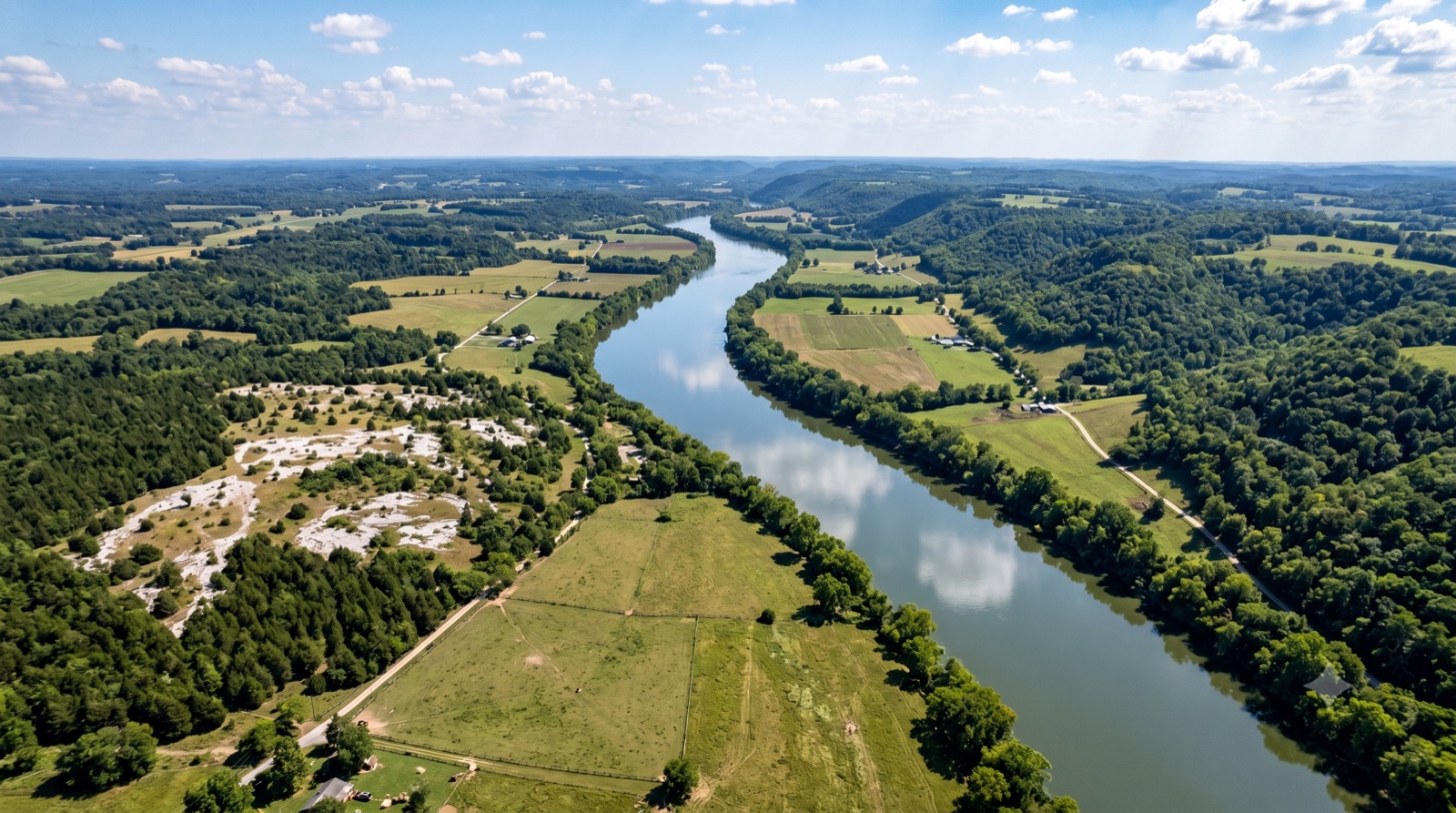
Benton County sits in northwest Middle Tennessee, bordered by Stewart, Houston, Humphreys, Perry, Decatur, and Carroll counties, plus Henry County to the north. Camden serves as the county seat. Kentucky Lake — the Tennessee River impoundment created by Kentucky Dam — forms the county's entire eastern boundary, with the Big Sandy River and its backwaters cutting through the northeastern part of the county around the community of Big Sandy. Inland, the terrain shifts to rolling, mixed cropland and hardwood woodland: Benton is one of the more crop-heavy counties in this corner of the state, with soybeans, hay, corn, and wheat covering a larger share of the land base than in most neighboring counties. That combination — working farmland inland, flooded timber and duck water along the lake — gives Benton County's rural land market two distinct buyer pools.
For landowners considering a sale, this guide walks through the county's carrying costs, the closing process, how Benton County stacks up against its neighbors, and your practical options for exiting a parcel. For the statewide picture first, see our Tennessee land selling guide, and for everything else we've published, browse the blog.
What Are the Tax Costs of Holding Land in Benton County?
Tennessee assesses all real property — vacant land included — at a uniform 25% of appraised value, the same ratio applied statewide regardless of county, though land enrolled in the Greenbelt program is assessed on its current-use value instead, which substantially lowers the bill on qualifying farm, forest, and open-space tracts.
Benton County's effective property tax rate is approximately 0.68%, with a median annual property tax bill of about $578 against a median home value of $80,700, according to Ownwell — well below the national median of roughly 1.02% and the $2,400 national median bill. That effective rate runs somewhat higher than several of Benton's immediate neighbors (see the comparison table below), but the absolute dollar cost of holding rural land here remains modest by national standards.
For a parcel with an appraised value of $100,000, the assessed value is $25,000 — appraised value divided by four. Applied against the county's effective rate, the annual tax bill lands in the low hundreds of dollars. That's a small number on paper, but it compounds year after year on remote acreage that produces no income, which is part of why so many owners eventually look to sell.
The Greenbelt Program: Lower Taxes, Deferred Liability
Tennessee's Greenbelt Law — formally the Agricultural, Forest and Open Space Land Act of 1976 — lets qualifying land be assessed on its current-use value rather than fair market value. To qualify:
- Agricultural land: At least 15 acres of actual farm use, or as few as 10 acres if the farm produces $1,500 or more in annual gross farm income
- Forest land: At least 15 acres of managed timber
- Open space land: Requires a written agreement with a state or local government
Given that USDA's 2022 Census of Agriculture found roughly 28,368 acres of cropland and another 28,892 acres of woodland classified as farmland in Benton County, Greenbelt enrollment is common across the county's row-crop ground and its wooded acreage alike. But when Greenbelt land is sold or converted to a non-qualifying use, the new or former owner owes rollback taxes — the gap between what was actually paid and what full-assessment taxes would have been — for up to three years on agricultural and forest land or five years on open space land, according to the UT County Technical Assistance Service. Rollback liability can blindside a buyer or seller who doesn't check the parcel's classification before closing, so always verify Greenbelt status first.
Benton County's Assessor of Property is Ryan Hall, located at 1 Court Square, Room 104, Camden, TN 38320, phone (731) 584-7615.
If you're carrying land with delinquent taxes, see our guide on how to sell land with back taxes.
What Zoning and Closing Rules Apply to Benton County Land?
Tennessee does not require an attorney to be present at real estate closings — title companies and closing agents routinely handle rural land transactions, and the deed is recorded with the Benton County Register of Deeds, Sonya Volz, at 1 Courtroom Square, Room 105, Camden, TN 38320, phone (731) 584-6661.
Tennessee's Realty Transfer Tax
Tennessee charges a realty transfer tax of $0.37 per $100 of consideration (the purchase price, or fair market value if higher), per Tenn. Code Ann. § 67-4-409, according to the UT County Technical Assistance Service. On a $50,000 land sale, that's $185 in transfer tax; on $100,000, it's $370. Certain transfers — between spouses, some corporate reorganizations, and gifts — are exempt, but arm's-length land sales to third parties are fully taxable. The tax is paid at closing and recorded alongside the deed; Benton County does not add a separate county-level transfer tax.
Zoning, TVA Jurisdiction, and Legal Access
Benton County has limited comprehensive zoning outside Camden and its smaller communities, and building permits are required for new construction; buyers and sellers should confirm specific requirements with the county's planning office for their exact parcel. The bigger wrinkle in Benton County specifically is federal, not local: any dock, boathouse, seawall, or similar structure along the Kentucky Lake shoreline is subject to Tennessee Valley Authority Section 26a permitting, and TVA also holds flowage easements over much of the private land adjoining the reservoir, which can restrict what an owner may build or clear near the water. If your parcel has an existing structure or permit near the lake, confirm its status and any transfer requirements directly with TVA through its shoreline construction permits program — we could not independently verify from TVA's own materials exactly how an existing 26a permit transfers when a property changes hands, so don't take a seller's or agent's word for it; get it from TVA in writing before you close.
Away from the lake, Benton County's terrain mixes open row-crop bottomland with wooded ridges, and as in most rural West and Middle Tennessee counties, legal recorded access is not guaranteed on every interior parcel — some tracts are reached only by old farm lanes or easements across a neighbor's land. Confirm a legal, recorded access route before purchase or sale.
If you've inherited the property and are unsure about title, our guide on how to sell inherited land walks through the process, and our guide on the paperwork needed to sell land covers what to have on hand before you list or accept an offer.
Typical closing steps for a Benton County land sale:
- Confirm the legal description and check for Greenbelt enrollment with the Assessor of Property
- Verify clean title and legal access through the Register of Deeds
- Check for delinquent taxes with the Trustee
- If the parcel touches Kentucky Lake, confirm any existing TVA Section 26a permit or flowage easement directly with TVA
- Sign a purchase agreement and open closing with a title company or closing attorney
- Pay the $0.37/$100 realty transfer tax and record the deed with the Register of Deeds
How Does Benton County Compare to Neighboring Tennessee Counties?
Benton County's population of roughly 16,000 has held essentially flat for over a decade — 16,489 in 2010, 15,864 at the 2020 census, with a modest rebound since — putting it in the middle of the pack among its neighbors, larger than Houston County but smaller than Henry and Humphreys.
| Factor | Benton County | Henry County | Humphreys County | Houston County |
|---|---|---|---|---|
| County seat | Camden | Paris | Waverly | Erin |
| Population (2020 census) | 15,864 | 32,199 | 18,990 | 8,283 |
| Population trend | Flat / modest rebound | Flat, slight recent growth | Growing (Nashville commuter influence) | Small / stable |
| Effective property tax rate | ~0.68% | ~0.48% | ~0.46% | ~0.44% |
| Land area | ~394 sq mi | ~562 sq mi | ~531 sq mi | ~278 sq mi |
| Key land feature | Kentucky Lake shoreline, row-crop farmland | Kentucky border, Big Sandy WMA (shared) | Nashville-exurb growth pressure | Land Between the Lakes region |
Benton County's land economy leans more heavily on row-crop farming than its immediate southern and eastern neighbors — a legacy of the flatter bottomland along the Tennessee River and Big Sandy River — while Henry County to the north shares part of the same Kentucky Lake and Big Sandy hunting country. Land here tends to trade among local farmers, hunters from the wider region drawn by the lake, and families holding long-term timber or pasture ground, rather than institutional buyers.
Recreation and Hunting Country
Kentucky Lake gives Benton County a recreational draw its inland neighbors can't match. The county touches two of the three units of the federal Tennessee National Wildlife Refuge — Big Sandy (shared with Henry County) and Duck River (shared with Humphreys County) — which together with the refuge's Busseltown unit in Decatur County span roughly 51,359 acres along 65 miles of the Tennessee River, established in 1945 for migratory waterfowl, according to the U.S. Fish & Wildlife Service. The state-managed Big Sandy Wildlife Management Area adds another 2,370 acres of riverbottom hardwoods, croplands, and swamp straddling Benton and Henry counties, with sub-impoundments specifically managed for duck and goose hunting, seasonal foot access before winter flooding, and boat access once the WMA floods for wintering waterfowl, according to the Tennessee Wildlife Resources Agency. That combination of refuge, WMA, and open lake makes wooded and bottomland tracts near Big Sandy and the lake genuinely attractive to recreational buyers — though the TVA permitting and easement questions covered above apply to any shoreline parcel.
Agricultural and Timber Land
Benton County's USDA 2022 Census of Agriculture data, published in the NASS county profile for Benton County (FIPS 47005), shows 401 farms working 70,176 acres — up modestly from 2017 — with an average farm size of 175 acres. Crops accounted for 84% of the county's $10.7 million in total agricultural sales, led by soybeans (7,763 harvested acres), hay and forage (6,003 acres), corn for grain (4,539 acres), and wheat (2,101 acres); cattle and calves remain the largest livestock category, with an inventory of 4,252 head as of the census. Land in farms breaks out to 28,368 acres of cropland, 28,892 acres of woodland, 7,273 acres of pastureland, and the remainder in other uses — a genuinely mixed base rather than a county dominated by any single land type.
If your tract is timbered, our guides on selling timberland and selling hunting land cover what recreational and timber buyers look for; if it's mostly open crop or pasture ground, our guide on selling farmland applies. For the full picture of what drives land value in the eyes of a buyer, see our land valuation guide.
What Are Your Options for Selling Land in Benton County?
Benton County landowners typically face one of two situations: row-crop or pasture ground that's been in the family for years with a Greenbelt classification attached, or wooded and bottomland acreage near Kentucky Lake or the Big Sandy backwaters that draws hunters but comes with TVA permitting questions most owners have never had to think through. Either way, the local buyer pool for rural land is thin and regional rather than national. If you own the land from out of state, those frictions multiply; our guide on selling land as an out-of-state owner covers the extra steps.
Before listing or accepting any offer, take these steps. Verify your deed and legal description through the Benton County Register of Deeds (Sonya Volz, 731-584-6661). Confirm the property's Greenbelt status and calculate any potential rollback tax liability with the Benton County Assessor (Ryan Hall, 731-584-7615). Check for delinquent taxes through the Benton County Trustee (Beverly Beal, 731-584-6211). If the parcel touches Kentucky Lake, contact TVA directly to confirm the status of any existing shoreline permit or flowage easement before you rely on it in a sale.
Sellers have several paths. Listing with a land-specialist agent gives exposure to recreational and farm buyers across the Kentucky Lake region and Middle Tennessee, but agent commissions of 5–6% plus the $0.37/$100 transfer tax reduce net proceeds, and TVA permitting or access questions can stall a listing for months. (Our guide on whether you need a realtor to sell land weighs that trade-off.) Online platforms — LandWatch, Lands of America — reach buyers specifically hunting for lake-country recreational land. For landowners who want a firm number fast, without months of showings and an uncertain closing timeline, Jerez Land provides a direct cash offer for your land. Each offer is parcel-specific and made in writing; as the buyer, we absorb the carrying costs, marketing, TVA and access diligence, and resale timeline — so the number you see is one number, with no commissions and a closing timeline measured in weeks, not months.
A direct cash sale will not be the highest theoretical price a perfectly marketed parcel might eventually fetch. What it offers instead is certainty and speed on land that can otherwise be genuinely hard to move, especially shoreline tracts carrying open TVA questions. If you need to understand the paperwork involved before you commit to any path, our blog covers what to expect at each stage.
Frequently Asked Questions
How do I sell vacant land in Benton County TN?
Confirm your legal description and any existing Greenbelt enrollment with the Benton County Assessor of Property (731-584-7615), verify clean title and legal access through the Register of Deeds (731-584-6661), and check for delinquent taxes with the Trustee (731-584-6211). Tennessee does not require an attorney at closing — a title company or closing agent can handle the transaction — and you can list with a local agent, use online platforms like LandWatch, or request a direct cash offer from a land buyer like Jerez Land.
What will I pay annually to hold land in Benton County?
Benton County's effective property tax rate is approximately 0.68%, with a median annual property tax bill of about $578, according to Ownwell — below the national median of roughly 1.02% and the $2,400 national median bill. All real property in Tennessee is assessed at 25% of appraised value, though land enrolled in the state's Greenbelt program is assessed on current-use value instead, producing a lower tax bill on qualifying farm, forest, and open-space acreage.
I inherited a hunting camp near Big Sandy in Benton County and none of my family hunts anymore — how do I sell it?
Start by confirming the deed, legal description, and any Greenbelt forest or agricultural enrollment with the Benton County Assessor (731-584-7615), and verify clean title through the Register of Deeds (731-584-6661). If the camp includes any dock or structure on Kentucky Lake, confirm the status of the TVA Section 26a permit directly with TVA before you list. From there you can market it to hunters through a land-specialist agent or platform, or request a direct cash offer from Jerez Land.
Does Tennessee charge a transfer tax on land sales?
Yes. Tennessee charges $0.37 per $100 of consideration on publicly recorded land transfers, per Tenn. Code Ann. § 67-4-409. On a $100,000 sale, the transfer tax is $370. Certain transfers — gifts, spousal transfers, corporate reorganizations — may qualify for exemptions. Benton County does not levy an additional county-level transfer tax on top of the state rate.
I own a tract on Kentucky Lake with an old dock or boathouse — what do I need to check before selling?
Any structure on the Kentucky Lake shoreline in Benton County likely falls under a Tennessee Valley Authority Section 26a permit, and TVA also holds flowage easements over much of the adjoining private land. Confirm the existing permit's status and any transfer requirements directly with TVA's shoreline construction permits program before closing — this is not something a title search alone will catch, and Jerez Land recommends verifying it in writing with TVA rather than assuming it carries over automatically.
I live out of state and inherited farmland in Benton County — can I sell without traveling there?
Yes. Tennessee does not require you to be present at closing or hire an attorney — a title company or closing agent can handle the transaction, with documents signed by mail or mobile notary. Confirm your legal description with the Register of Deeds, check for Greenbelt enrollment and any back taxes with the Assessor and Trustee, and consider a direct cash offer if you'd rather not manage a long-distance listing process yourself.
Disclaimer: This article is for informational purposes only and does not constitute legal, financial, or professional advice. Laws and regulations vary by jurisdiction and change over time. Always consult with qualified professionals before making land purchase decisions. Jerez Land is not responsible for actions taken based on this information.