
Sell My Land in McNairy County TN - What Landowners Need to Know
Key Takeaways
- McNairy County's population has held roughly flat for 15 years: 26,075 at the 2010 census, dipping slightly to 25,866 in 2020, then rebounding to an estimated 26,236, according to U.S. Census Bureau data — a stable, if unspectacular, rural buyer pool compared to declining neighbors
- Tennessee assesses vacant land at 25% of appraised value statewide, and McNairy County's median effective property tax rate is approximately 0.39%, according to Ownwell — well below the national median of roughly 1.02%, though farm and forest land enrolled in the Greenbelt program is taxed on its current-use value instead
- McNairy County counted 590 farms covering 115,586 acres in the 2022 USDA Census of Agriculture, a decline of 17% in farmed acreage since 2017, with soybeans the leading crop at 16,914 acres and 45,574 acres in woodland — a working farm-and-timber county where Greenbelt classifications are common
How Can You Sell Land in McNairy County, Tennessee?
Selling land in McNairy County, Tennessee means working through a state property tax system that assesses all real property at 25% of appraised value, a $0.37-per-$100 realty transfer tax due at closing, and the Agricultural, Forest and Open Space Land Act — Tennessee's "Greenbelt Law" — which can trigger rollback taxes if enrolled farm or forest land changes hands or use. Selmer, the county seat, sits on U.S. Highway 64 roughly halfway between Memphis and the Alabama line, and the surrounding land is a mix of hardwood ridge timber, cattle pasture, and row-crop bottoms typical of far West Tennessee.
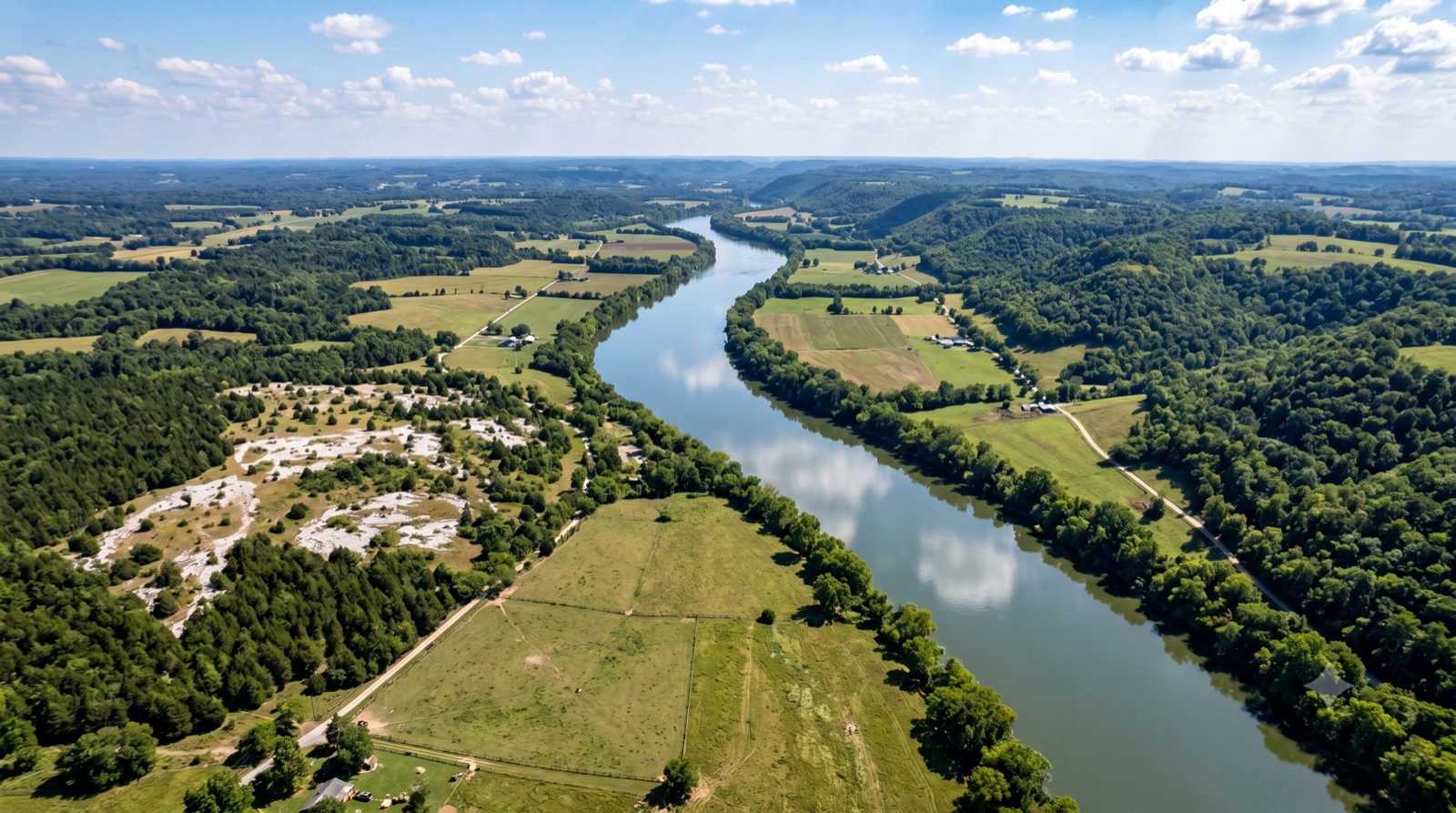
McNairy County borders Hardeman County to the west, Chester County to the north, Hardin County to the east, and Alcorn County, Mississippi to the south. The terrain reflects the Highland Rim: shallow, humus-poor soils less suited to large-scale plantation farming than the Mississippi River bottomlands further west, which historically pushed the county's land use toward mixed timber, pasture, and modest row-crop acreage rather than continuous cotton. Big Hill Pond State Park, in the county's southeastern corner near Pocahontas, anchors a stretch of bottomland hardwood and wetland habitat that shapes buildability and access on nearby tracts.
This guide covers the carrying costs of holding McNairy County land, the closing process and zoning realities, how the county compares to its Tennessee neighbors, and your practical options for selling. For the statewide rules that apply everywhere in Tennessee, see our Tennessee land selling guide, and for more county- and topic-specific guides, visit our blog.
What Are the Tax Costs of Holding Land in McNairy County?
Tennessee applies a uniform 25% assessment ratio to all real property statewide, including vacant land, farmland, and timberland — the assessed value equals 25% of the county assessor's appraised value, and tax rates are then applied to that assessed figure. McNairy County's median effective property tax rate is approximately 0.39% of property value, according to Ownwell — significantly below the national median of roughly 1.02%. On a parcel appraised at $100,000, that effective rate works out to roughly $390 in annual property tax, a modest but recurring carrying cost for raw or income-thin acreage.
The Greenbelt Program: Lower Taxes, Deferred Liability
Tennessee's Greenbelt Law — formally the Agricultural, Forest and Open Space Land Act of 1976 — lets qualifying land be assessed at its current-use value instead of fair market value, substantially reducing the tax bill on working farms, timber tracts, and open space. To qualify:
- Agricultural land: At least 15 acres of actual farm use, or as few as 10 acres if the farm produces $1,500 or more in annual gross farm income
- Forest land: At least 15 acres of managed timber
- Open space land: Requires a written agreement with a state or local government
Greenbelt enrollment is common across McNairy County's farm and timber tracts — the 2022 USDA Census of Agriculture recorded 45,574 acres of woodland and 62,398 acres of combined cropland and pastureland in the county, much of which likely carries agricultural or forest classification. But when Greenbelt land is sold or converted to a non-qualifying use, the new or former owner owes rollback taxes — the gap between what was actually paid and what would have been owed at full assessment — for up to three years on agricultural and forest land, or five years on open space land, according to the UT County Technical Assistance Service. That liability can catch both sellers and buyers off guard if Greenbelt status isn't checked before closing.
McNairy County's Property Assessor is Brandon Moore, with the office located at 170 West Court Ave, Selmer, TN 38375, phone (731) 645-5146.
If you're carrying land with delinquent taxes, see our guide on how to sell land with back taxes.
What Zoning and Closing Rules Apply to McNairy County Land?
Tennessee does not require an attorney to be present at real estate closings — title companies and closing agents routinely handle rural land transactions. The deed is recorded with the McNairy County Register of Deeds, Brian Dickey, at 170 West Court Ave, Selmer, TN 38375, phone (731) 645-3656.
A typical rural land closing in McNairy County runs through these steps:
- Confirm the legal description, chain of title, and any Greenbelt classification before signing a contract
- Order a title search or title insurance policy through a title company
- Confirm legal, recorded access to the parcel — many interior farm and timber tracts are reached only by field roads, shared lanes, or easements
- Sign closing documents (no attorney presence required by Tennessee law)
- Pay the $0.37/$100 realty transfer tax as part of closing costs
- Record the deed with the McNairy County Register of Deeds
Tennessee's Realty Transfer Tax
Tennessee charges a realty transfer tax of $0.37 per $100 of consideration — the purchase price, or fair market value if higher — per Tenn. Code Ann. § 67-4-409, according to the UT County Technical Assistance Service. On a $50,000 land sale, that comes to $185 in transfer tax. Certain transfers, including transfers between spouses, gifts, and some corporate reorganizations, are exempt, but an arm's-length sale to a third-party buyer is fully taxable. McNairy County does not levy an additional county-level transfer tax on top of the state rate.
Zoning and Land Use
McNairy County is largely rural with limited comprehensive zoning outside Selmer and the county's smaller towns — Adamsville, Bethel Springs, Finger, Guys, Michie, Ramer, and Stantonville. Building permits are required for new construction, and buyers and sellers should confirm specific requirements with county building officials, particularly for parcels near Big Hill Pond State Park or the Tuscumbia and Hatchie River drainages, where seasonal flooding and wetland conditions can affect buildability on lower-lying ground.
Legal access is a recurring issue on interior farm and timber tracts across the county — some parcels are reached only by field roads, shared farm lanes, or easements across neighboring land, with no clear recorded right-of-way. Buyers considering development or even reliable year-round access should confirm a legal access route and, where a septic system will be needed, obtain a site-specific soil evaluation from the county before purchase.
If your parcel is reached only by crossing someone else's land, our guide on how to sell landlocked land covers your options. If you inherited the property and are working through title questions, our guide on how to sell inherited land walks through the process.
How Does McNairy County Compare to Neighboring Tennessee Counties?
McNairy County's population has stayed close to 26,000 for a decade and a half: 26,075 at the 2010 census, a slight dip to 25,866 in 2020, and an estimated rebound to roughly 26,236, according to U.S. Census Bureau data. That flat-to-slightly-growing pattern sets McNairy apart from Hardeman County immediately to the west, which has been losing population steadily, while it trails the faster growth seen in Chester and Hardin counties to the north and east.
| Factor | McNairy County | Hardeman County | Chester County | Hardin County |
|---|---|---|---|---|
| Population (2024/25 est.) | ~26,236 | ~25,000 | ~17,876 | ~27,617 |
| Population trend | Stable / slight growth | Declining | Growing | Growing |
| Effective tax rate | ~0.39% | ~0.45% | ~0.49% | ~0.44% |
| Key economic driver | Agriculture, manufacturing | Agriculture, corrections | Freed-Hardeman University, agriculture | Pickwick Lake tourism, manufacturing |
| Closing attorney required | No | No | No | No |
McNairy County's economy rests on a mix of agriculture and light manufacturing around Selmer and Adamsville, without a single dominant employer comparable to Chester County's Freed-Hardeman University in Henderson or Hardin County's Pickwick Lake tourism and industrial base at Counce near the Pickwick Landing Dam. That middle-of-the-pack profile — steadier than Hardeman's long decline, less dynamic than Chester's or Hardin's growth — shows up in the land market as a dependable but unspectacular pool of local buyers: farmers expanding operations, neighbors buying adjoining tracts, and recreational buyers drawn to the timber and hunting ground near Big Hill Pond.
A Steady, Working-Land Market
Unlike counties losing population year over year, McNairy County's roughly flat trajectory means the local buyer pool for rural acreage hasn't been shrinking — but it also hasn't been expanding the way it has in growth counties along the Interstate 40 corridor further north. Demand comes mostly from established local buyers rather than an influx of new residents, so marketing timelines for raw land can still run long, and comparable sales for interior timber and pasture tracts remain thin.
Agricultural and Timber Land
McNairy County's 2022 USDA Census of Agriculture county profile confirms its working-land character: 590 farms covering 115,586 acres, a 17% decline in farmed acreage since 2017, with total farm production expenses of $26.6 million against $25.3 million in market value of products sold. Cropland accounts for 46,487 acres and pastureland for 15,911 acres, while woodland covers 45,574 acres — nearly 40% of all farmed land in the county. Soybeans lead all crops by acreage (16,914 acres), followed by hay and forage (8,211 acres), cotton (6,105 acres), and corn for grain (4,735 acres), alongside a cattle inventory of 8,537 head.
If your tract is timbered, our guides on selling timberland and selling hunting land cover what recreational and timber buyers look for. If it's working cropland or pasture, our guide on selling farmland walks through that market, and if the parcel carries a Greenbelt classification you're worried about, our guide on selling land with a current-use rollback tax penalty explains the mechanics in more detail. For the broader picture of what drives land values, see our land valuation guide.
What Are Your Options for Selling Land in McNairy County?
McNairy County landowners typically hold one of a few kinds of parcels: row-crop and pasture ground passed down through a family, mixed hardwood timber that may carry a Greenbelt forest classification, or a smaller recreational tract near Big Hill Pond or the Tuscumbia River drainage. Each comes with its own wrinkles — Greenbelt rollback exposure on a sale, floodplain and wetland constraints near the state park and river bottoms, and access questions on interior tracts reached by shared farm lanes. If you own the land from out of state, those frictions are harder to manage remotely; our guide on selling land as an out-of-state owner covers the extra steps.
Before listing or accepting any offer, take these steps. Verify your deed and legal description through the McNairy County Register of Deeds (Brian Dickey, 731-645-3656). Confirm the property's Greenbelt status and estimate any rollback tax exposure with the McNairy County Assessor of Property (Brandon Moore, 731-645-5146). Check for any delinquent tax balance with the McNairy County Trustee (Stanley Mitchell, 731-645-5476). Confirm there is a legal, recorded access route to the parcel, and if the land carries merchantable timber, have a registered forester quantify the standing value with a timber cruise.
Sellers have several paths forward. Listing with a land-specialist agent puts the parcel in front of farm and recreational buyers across West Tennessee, but agent commissions of 5–6% plus the $0.37/$100 transfer tax reduce net proceeds, and a steady-but-thin local buyer pool can mean months on market before a contract. (Our guide on whether you need a realtor to sell land weighs that trade-off.) Online platforms like LandWatch and Lands of America reach hunters and farmers actively searching for West Tennessee acreage. For landowners who want a firm number without an open-ended marketing campaign, Jerez Land makes a direct cash offer for your land. Each offer is parcel-specific and delivered in writing; as the buyer, we take on the carrying costs, marketing effort, access and floodplain risk, and resale timeline, so you're working with one number rather than an estimate that shifts as showings come and go.
A direct cash sale won't match the ceiling a perfectly marketed listing might eventually reach after months of showings. What it offers instead is certainty and speed on land that can otherwise sit for a long time in a market with a steady but limited buyer pool. If you want to understand the paperwork involved before committing to any path, our blog covers what to expect at each stage of a land sale.
Frequently Asked Questions
I own vacant land in McNairy County Tennessee — what's my first step to selling it?
Start by confirming your legal description, chain of title, and any Greenbelt enrollment with the McNairy County Assessor (731-645-5146), then verify clean title and legal access through the Register of Deeds (731-645-3656). Tennessee does not require an attorney at closing — a title company or closing agent can handle the transaction. From there you can list with a local land agent, use online platforms like LandWatch, or request a direct cash offer from a land buyer like Jerez Land.
What is the property tax rate in McNairy County Tennessee?
McNairy County's median effective property tax rate is approximately 0.39% of property value, according to Ownwell — well below the national median of roughly 1.02%. All real property in Tennessee is assessed at 25% of appraised value under state law, and land enrolled in Tennessee's Greenbelt program is assessed on its current-use value instead, which produces a significantly lower tax bill for qualifying farm, forest, and open space parcels.
My family's land near Selmer is enrolled in Tennessee's Greenbelt program — will I owe rollback taxes if I sell?
You may, depending on how the land is used after the sale. Tennessee's Greenbelt Law lets agricultural land (15+ acres, or 10+ acres with $1,500+ in annual farm income), forest land (15+ acres), and open space land be assessed at current-use value instead of fair market value. When Greenbelt land is sold or converted to a non-qualifying use, rollback taxes are owed for up to three years on agricultural or forest land, or five years on open space land — covering the difference between what was paid and what full-assessment taxes would have been, according to the UT County Technical Assistance Service. Always confirm Greenbelt status with the county assessor before closing.
Does Tennessee charge a transfer tax on land sales?
Yes. Tennessee charges $0.37 per $100 of consideration on publicly recorded real estate transfers statewide, per Tenn. Code Ann. § 67-4-409. On a $100,000 sale, that's $370 in transfer tax, generally paid at closing. Certain transfers — gifts, transfers between spouses, some corporate reorganizations — may qualify for exemptions. McNairy County does not add a separate county-level transfer tax on top of the state rate.
Is an attorney required to close a land sale in Tennessee?
No. Tennessee law does not require a licensed attorney to attend a real estate closing — title companies, closing agents, or attorneys can all handle the transaction. The deed is recorded with the McNairy County Register of Deeds after closing. Given the prevalence of Greenbelt classifications and access questions on the county's farm and timber tracts, working with a title company experienced in rural West Tennessee transactions is a good idea even without a legal requirement.
I'm out of state and inherited land in McNairy County — is there still a market for it?
Yes. McNairy County's population has stayed close to 26,000 for a decade and a half — 26,075 at the 2010 census, 25,866 in 2020, and an estimated rebound to roughly 26,236 more recently, per Census Bureau data — so the local buyer pool for farm, timber, and recreational acreage hasn't been shrinking the way it has in some neighboring counties. That said, managing a remote sale still means confirming Greenbelt status, legal access, and title from out of state, which is harder without local contacts; a direct cash offer removes most of that coordination burden.
Disclaimer: This article is for informational purposes only and does not constitute legal, financial, or professional advice. Laws and regulations vary by jurisdiction and change over time. Always consult with qualified professionals before making land purchase decisions. Jerez Land is not responsible for actions taken based on this information.