
Sell My Land in Giles County TN - What Landowners Need to Know
Key Takeaways
- Giles County is growing, not shrinking: Population rose from 30,346 at the 2020 census to roughly 31,433 by mid-2025 — about 3.6% growth — bucking the population decline common across rural Tennessee counties, according to U.S. Census Bureau estimates compiled by World Population Review
- This is a genuine cattle-and-hay county, and pasture leads the land mix: Giles ranked 4th in Tennessee for cattle and calves sales in 2022 at $33.8 million with 55,682 head, and pastureland (80,128 acres) is the single largest land-in-farms use — ahead of both cropland (74,136 acres) and woodland (66,302 acres) — per USDA's 2022 Census of Agriculture
- The county property tax rate was raised for FY2025-26, reportedly to $2.3053 per $100 of assessed value: Coverage of the July 2025 County Commission meeting reports a 32-cent increase adopted on a 13-6 vote to close a structural budget shortfall; we could not confirm that exact figure against the county's own published minutes, so treat it as reported rather than verified and confirm the current rate with the Giles County Trustee before estimating holding costs
How Can You Sell Land in Giles County Tennessee?
Selling land in Giles County, Tennessee means working within Tennessee's uniform 25% property assessment ratio, a $0.37-per-$100 realty transfer tax, no attorney requirement at closing, and — specific to this county — a real, active cattle-and-hay economy where open pastureland draws operator interest that heavily wooded back tracts simply do not.
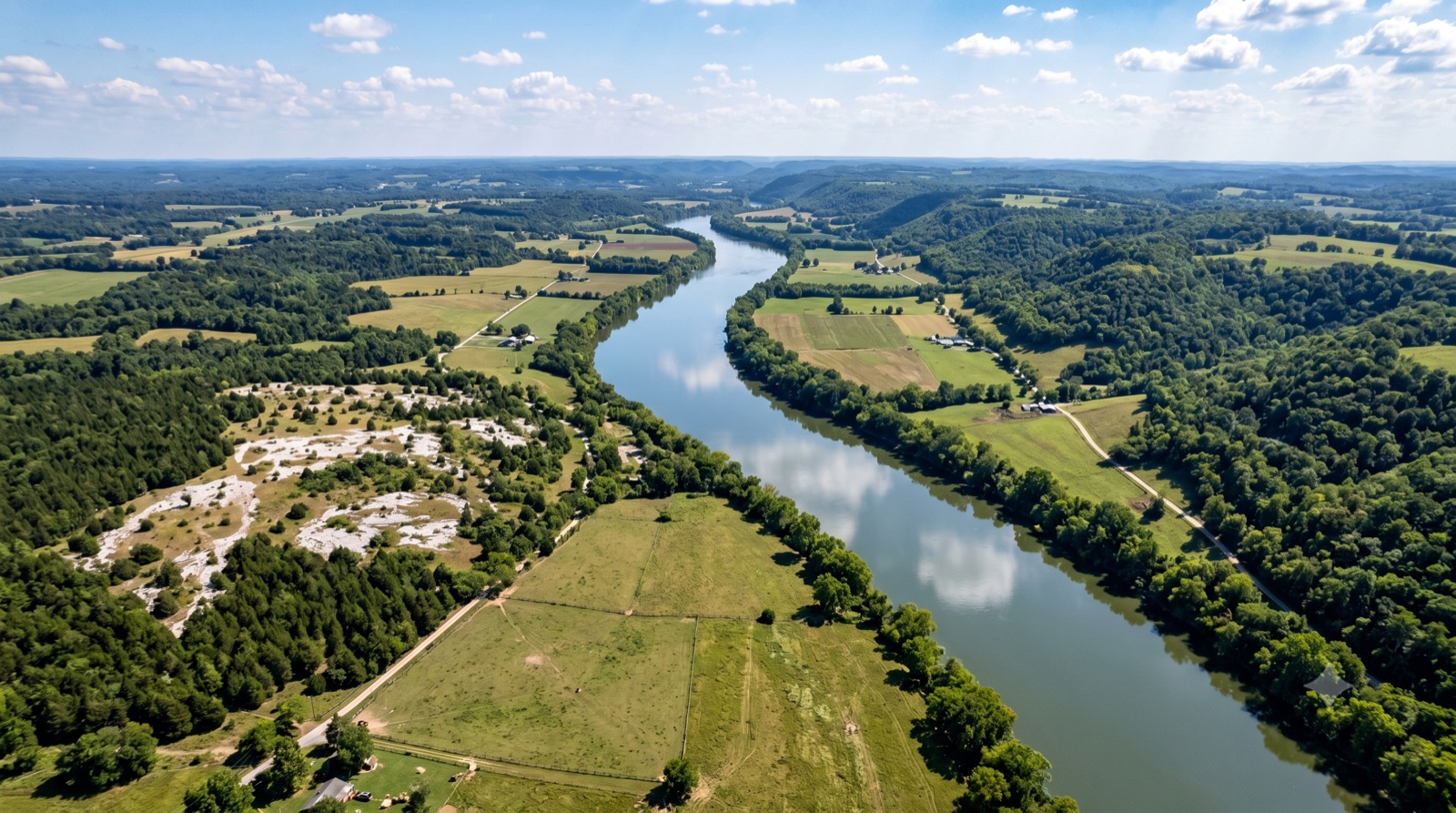
Giles County sits in south-central Tennessee on the Alabama line, bordered by Maury County to the north, Marshall and Lincoln counties to the east, Lawrence County to the west, and Limestone and Lauderdale counties, Alabama, to the south. Pulaski, the county seat, is roughly 74 miles south of Nashville. Unlike the timbered plateau counties common elsewhere in this blog series, Giles is open, rolling farm country — and the numbers back that up: 241,228 acres are in farms across 1,457 farms, an average size of 166 acres, according to USDA's 2022 Census of Agriculture.
For landowners considering a sale, this guide covers the county's carrying costs, its closing and zoning rules, how it stacks up against three Tennessee neighbors, and your practical options for exiting a parcel. For the statewide picture first, see our Tennessee land selling guide, or return to the blog for the full library.
What Are the Tax Costs of Holding Land in Giles County?
Giles County raised its property tax rate for fiscal year 2025-26, with meeting coverage reporting a new rate of $2.3053 per $100 of assessed value after a 32-cent increase adopted on a 13-6 vote in July 2025 — applied on top of Tennessee's statewide 25% assessment ratio on all real property. Verify the exact current rate with the Giles County Trustee before you rely on it: the increase itself is well documented in the county's own budget-committee minutes, but the final adopted figure appears in meeting coverage rather than in a published county rate schedule we could retrieve.
County Executive Graham Stowe framed the increase as overdue: the county cited roughly a $5 million annual structural budget shortfall and a $20 million infrastructure backlog built up over years of a flat rate, per the same reporting. An earlier committee proposal had floated a 56-cent increase to $2.5463 before the full commission settled on the smaller 32-cent hike.
For a parcel with an appraised value of $100,000, the assessed value under Tennessee's 25% ratio is $25,000. At the reported county rate of $2.3053 per $100 assessed, the resulting annual county tax works out to roughly $576 — before any city rate, if the parcel sits within Pulaski, Ardmore, Elkton, Minor Hill, or Lynnville city limits. Run the same arithmetic with whatever rate the Trustee confirms for your tax year.
A note on effective-rate figures: Third-party aggregators disagree on Giles County's effective property tax rate, and both figures predate the July 2025 increase. Ownwell lists a median effective rate around 0.50% (a $856 median annual bill on a $171,600 median home), while Tax-Rates.org has cited figures as high as 0.75% collected on average assessed fair market value. Given the recent rate change, sellers should treat both as dated and confirm a current, parcel-specific figure directly with the Giles County Trustee rather than relying on either aggregator.
The Greenbelt Program on Working Pasture
Tennessee's Greenbelt Law — the Agricultural, Forest and Open Space Land Act of 1976 — lets qualifying agricultural land (15+ acres of farm use, or 10+ acres producing $1,500+ in annual gross farm income), forest land (15+ acres of managed timber), and open space land be assessed on current-use value instead of fair market value. Given how much of Giles County's acreage is active pasture and hay ground rather than idle woodland, Greenbelt enrollment is common on working cattle operations here. When Greenbelt land is sold or converted to a disqualifying use, the new or former owner owes rollback taxes — up to three years for agricultural and forest land, five years for open space land — covering the gap between what was actually paid and what full assessment would have cost, per the Tennessee Comptroller. Always confirm a parcel's Greenbelt status with the Assessor before closing.
Giles County's Property Assessor is Tommy Hyatt, located at 1 Public Square, Pulaski, TN 38478, phone (931) 363-2166.
If you're carrying land with delinquent tax balances, our guide on selling land with back taxes walks through the process.
What Zoning and Closing Rules Apply to Giles County Land?
Unincorporated Giles County has no county-wide zoning ordinance — the county's own Regional Planning Commission page states plainly that "the unincorporated areas of Giles County are not subject to zoning regulations," with FEMA-designated 100-year floodplain development rules as the one regulation enforced countywide.
That doesn't mean anything goes. If a tract is subdivided, it must comply with the Giles County Subdivision Standards, and any deed restrictions or applicable state and federal rules — septic permitting, tower construction, agricultural operations — still apply. The five incorporated cities within the county (Pulaski, Ardmore, Elkton, Minor Hill, and Lynnville) each maintain their own local codes that supersede the county's approach inside city limits.
Tennessee does not require an attorney at closing; title companies and closing agents routinely handle rural land transactions. A typical Giles County closing looks like:
- Purchase and sale agreement — price, earnest money, and any contingencies (survey, title, soil work) are put in writing.
- Title search — the title company or closing agent searches Register of Deeds records for liens, judgments, or unpaid taxes.
- Realty transfer tax calculation — computed under TCA § 67-4-409 on the greater of sale price or appraised value, at Tennessee's flat $0.37 per $100 rate.
- Deed preparation and Greenbelt/rollback check — the closing agent confirms whether the parcel carries a Greenbelt classification that could trigger rollback taxes at sale.
- Closing and recording — signatures, fund disbursement, and deed recording with the Giles County Register of Deeds.
The Giles County Register of Deeds is Tammy Helton, 1 Public Square, Pulaski, TN 38478, phone (931) 363-5137.
If your land came to you through inheritance and the deed was never retitled, our guide on how to sell inherited land covers the probate steps you'll need first.
How Does Giles County Compare to Neighboring Tennessee Counties?
Giles County's population has grown from 30,346 at the 2020 census to a U.S. Census Bureau estimate of 31,433 as of July 1, 2025 — about 3.6% growth in five years, a steadier trajectory than many rural Tennessee counties. Its distinguishing feature against its neighbors isn't population, though — it's land use: Giles is the only one of its four closest neighbors where pastureland, not cropland, is the largest single use of farmland.
| Factor | Giles County | Lincoln County | Lawrence County | Maury County |
|---|---|---|---|---|
| Population (latest est.) | 31,433 (Census, Jul 2025) | ~36,991 | ~47,184 | ~121,806 |
| Population trend | Growing | Growing | Growing | Rapidly growing (Nashville exurb) |
| Land in farms (2022) | 241,228 ac | 270,934 ac | 238,241 ac | 209,805 ac |
| Largest land-in-farms use | Pastureland (80,128 ac) | Cropland (97,864 ac) | Cropland (114,066 ac) | Cropland (82,689 ac) |
| Cattle & calves sales, TN rank | #4 ($33.8M) | #1 ($49.4M) | #9 ($17.9M) | #11 ($17.1M) |
| Closing attorney required | No | No | No | No |
The Two-County Cattle Belt
Giles and Lincoln County together form a genuine cattle belt: Lincoln ranked #1 in Tennessee for cattle and calves sales in 2022 at $49.4 million and 69,050 head, and Giles ranked #4 at $33.8 million and 55,682 head — both far ahead of Lawrence (#9) and Maury (#11), despite Lawrence and Maury having more total farmland or a larger population, per USDA's 2022 Census of Agriculture. Giles also carries the largest hay and forage acreage of the group at 40,433 acres.
That distinction matters directly to a seller. In Lincoln, Lawrence, and Maury counties, cropland is the dominant use of farmed acreage — row-crop ground with its own buyer pool. In Giles, pastureland outranks cropland, which means local cattle operators are actively looking for fenced, cleared, water-accessed grazing ground specifically, not just any open acreage. A cleared, fenced pasture tract with cattle infrastructure sits in front of a real, identifiable buyer type in this county. A heavily wooded, unfenced interior tract does not have that same built-in operator demand — it competes instead for recreational, hunting, or timber buyers, a smaller and slower-moving pool. Neither situation determines what a specific parcel is worth, but it does shape how long a listing sits and who responds to it.
Maury County's population growth (nearly 50% since 2010, driven by Nashville-area sprawl toward Columbia and Spring Hill) stands in sharp contrast to Giles's slower, farm-driven growth — a reminder that "growing" doesn't mean the same thing in every neighboring county. If your land is timbered rather than open pasture, our guides on selling timberland and selling hunting land cover what recreational buyers look for; if it's active farm or pasture ground, see our guide on selling farmland. We also cover Lincoln County TN directly if your holdings span both counties.
What Are Your Options for Selling Land in Giles County?
Giles County landowners are working with more genuine buyer demand than many rural Tennessee counties — a growing population, an active cattle economy, and real operator interest in open pasture — but that demand is uneven. Open, fenced grazing or hay ground moves through a different channel than wooded back acreage, and a rising property tax rate adds pressure on anyone holding land that isn't producing income. If you own the land from out of state, our guide on selling land as an out-of-state owner covers the added logistics.
Before listing or accepting any offer, take these steps. Verify your deed and legal description through the Giles County Register of Deeds (Tammy Helton, 931-363-5137). Confirm the parcel's Greenbelt status and any rollback exposure with the Giles County Assessor (Tommy Hyatt, 931-363-2166). Get a current tax balance and this year's actual bill from the Giles County Trustee (Tony Risner, 931-363-1676) — don't rely on outdated third-party effective-rate estimates given the July 2025 increase. If the land is actively grazed or hayed, document that use; it's a genuine selling point in this county. If it's wooded, a timber cruise from a registered forester can establish standing value.
Sellers have several paths. Listing with a land-specialist agent gives exposure to cattle operators, farm buyers, and recreational buyers across the region, but agent commissions of 5–6% plus the $0.37/$100 transfer tax reduce net proceeds, and a listing can sit for months if the parcel doesn't match local demand. (Our guide on whether you need a realtor to sell land weighs that trade-off.) Online platforms like LandWatch and Lands of America reach both farm buyers and recreational buyers searching south-central Tennessee. For landowners who want a firm number without months of showings, appraisal uncertainty, or financing contingencies, Jerez Land provides a direct cash offer for your land. Each offer is parcel-specific and delivered in writing; as the buyer, we absorb the carrying costs, marketing, and resale timeline regardless of whether the tract is open pasture or wooded acreage — so the number you see is the number you get, with no commission and a closing timeline measured in weeks.
A direct cash sale won't be the highest theoretical price a perfectly marketed pasture tract might eventually fetch from a local cattle operator. What it offers instead is certainty and speed — particularly valuable on wooded acreage that doesn't have that same built-in buyer pool. If you want to understand the paperwork involved before committing to any path, our blog covers what to expect at each stage of a land sale.
Frequently Asked Questions
How do I sell vacant land in Giles County TN?
Confirm your legal description and current property tax status with the Giles County Assessor of Property (931-363-2166) and verify clean title through the Register of Deeds (931-363-5137). Tennessee does not require an attorney at closing — a title company or closing agent can handle the transaction. You can list with a local land agent, use online platforms like LandWatch, or request a direct cash offer from a land buyer like Jerez Land.
I inherited pastureland in Giles County but I live out of state — can I sell it without coming back to Tennessee?
Yes. Tennessee does not require an attorney or an in-person appearance at closing, so a title company can handle the entire transaction remotely through mailed or electronically notarized documents. You will still need to establish clear title — through probate if the deed was never transferred into your name — and confirm the parcel's Greenbelt or current-use status with the Giles County Assessor before listing or accepting an offer, since active pasture is often already enrolled. Our guide on selling inherited land covers the probate and title steps in detail.
My family's Giles County land has always been used for hay and cattle — does that make it worth more to a buyer than wooded acreage?
It can attract a different kind of buyer. Giles County ranked 4th in Tennessee for cattle and calves sales in 2022 at $33.8 million with 55,682 head, and pastureland (80,128 acres) actually outranks both cropland and woodland as the county's largest land-in-farms use, according to USDA's 2022 Census of Agriculture — so open, fenced, water-accessed pasture has real demand from local cattle operators that heavily wooded interior tracts typically do not. That demand affects marketing time and buyer pool, not a guaranteed price, and Jerez Land evaluates every parcel — pasture or timber — individually.
What is Giles County's current property tax rate, and could it increase again?
Giles County raised its property tax rate for fiscal year 2025-26. Coverage of the July 2025 County Commission meeting reports a new rate of $2.3053 per $100 of assessed value after a 32-cent increase adopted on a 13-6 vote to close a structural budget shortfall. We could not confirm that exact figure against a published county rate schedule, so treat it as reported rather than verified. Because the increase followed years of a flat rate and the county cited an ongoing $20 million infrastructure backlog, landowners should confirm the current rate directly with the Giles County Trustee (931-363-1676) before estimating annual holding costs, rather than relying on older third-party estimates.
I have 40 wooded acres in Giles County with no cattle or hay operation on it — is it still sellable?
Yes, but expect it to move through a different buyer pool than open pasture. Giles County's cattle and hay economy is real and well-documented — $33.8 million in cattle sales and 40,433 acres of hay and forage in 2022, per USDA — but that demand is concentrated among local livestock operators looking for fenced, cleared ground, not standing timber. Wooded, unfenced acreage typically appeals more to recreational, hunting, or timber buyers, and to direct buyers like Jerez Land who purchase parcels regardless of current use or access.
Is an attorney required to close a land sale in Tennessee?
No. Tennessee does not require a licensed attorney to be present at a real estate closing. Closings may be handled by title companies, closing agents, or attorneys. The deed is recorded with the Giles County Register of Deeds after closing. Because Giles County has no county-wide zoning outside its five incorporated cities, buyers and title companies typically rely on the Giles County Subdivision Standards and FEMA floodplain maps rather than zoning classifications to evaluate a rural parcel.
Disclaimer: This article is for informational purposes only and does not constitute legal, financial, or professional advice. Laws and regulations vary by jurisdiction and change over time. Always consult with qualified professionals before making land purchase decisions. Jerez Land is not responsible for actions taken based on this information.