
Sell My Land in Escambia County AL - What Landowners Need to Know
Key Takeaways
- Escambia County's farm economy runs the opposite direction of every county around it: 91% of the county's $36.1 million in 2022 agricultural sales came from crops — cotton (13,988 acres), peanuts (11,690 acres), and corn (6,812 acres) — while neighboring Covington County drew 86% of its sales from livestock and poultry, according to the 2022 USDA Census of Agriculture.
- The county lost a quarter of its farms in five years while the survivors got much bigger: Farm count fell 25% between 2017 and 2022 even as average farm size rose 36% to 329 acres — the steepest consolidation trend among its southwest Alabama neighbors — per the 2022 USDA Census of Agriculture, a pattern that thins the buyer pool for standalone tracts rather than growing it.
- Population has declined for well over a decade: Escambia County fell from 38,319 residents at the 2010 census to 36,757 in 2020, and is estimated at roughly 36,700 in 2025, according to USAFacts and Wikipedia's sourcing of U.S. Census Bureau data — a loss of about 1,600 residents over fifteen years.
How Can You Sell Land in Escambia County Alabama?
Selling land in Escambia County means recording the deed through the Probate Office in Brewton, paying Alabama's deed recordation tax of $0.50 per $500 of value, and recognizing that the county's growing agricultural economy is concentrated almost entirely in cotton, peanut, and corn operations that are consolidating onto fewer, larger farms rather than expanding to buy up standalone acreage.
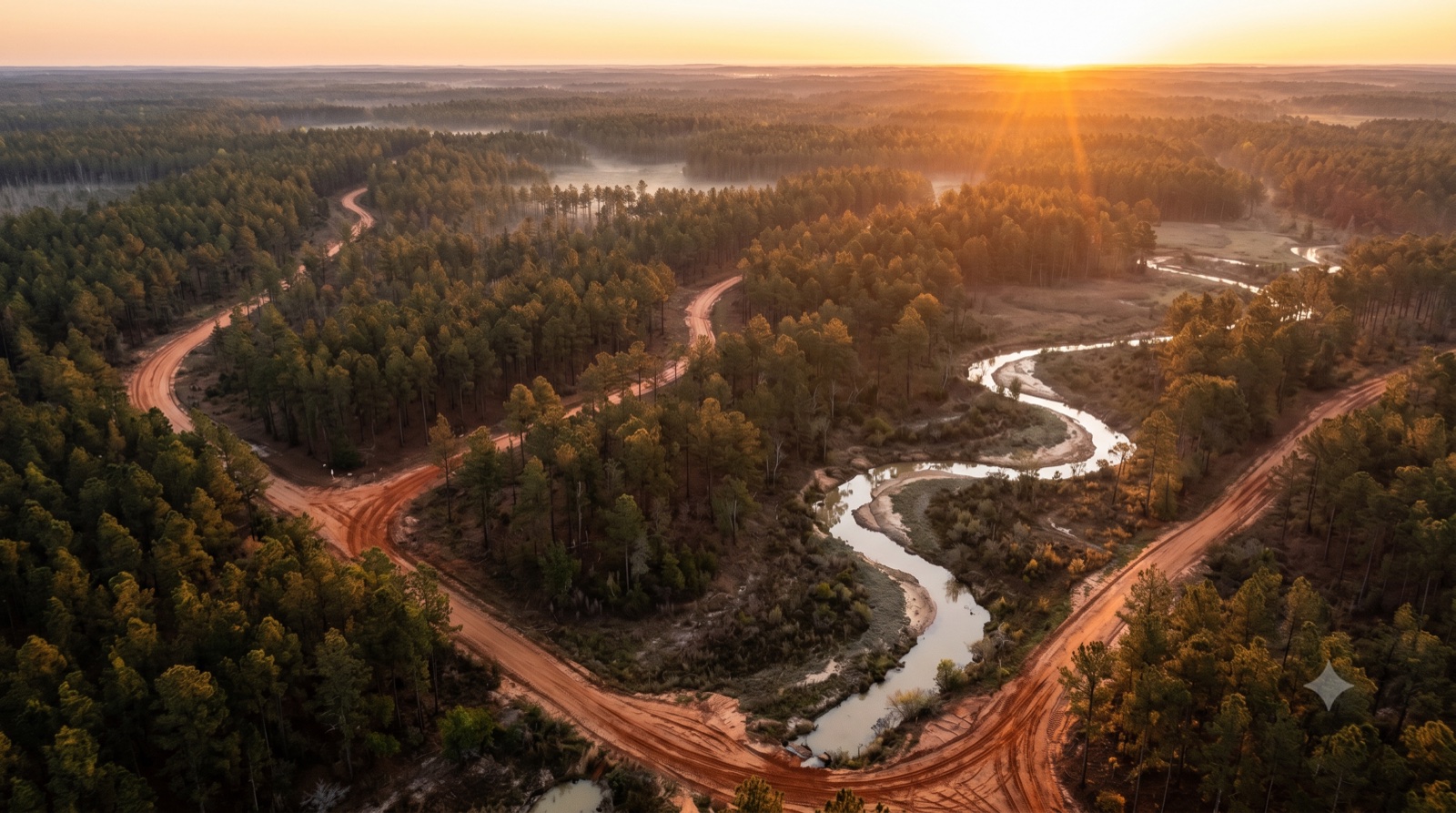
Escambia County sits in the far southwest corner of Alabama on the Florida line, covering roughly 945 square miles of pine woodland, peanut and cotton fields, and the Conecuh and Escambia river bottoms, with Brewton as the county seat, according to Wikipedia's sourcing of Census Bureau geographic data. Conecuh National Forest occupies part of the county's eastern reach, shared with neighboring Covington County. The population has been shrinking since at least 2010, and unlike most of its southwest Alabama neighbors, the county's agricultural money is overwhelmingly row-crop money — a distinction that changes who is actually in the market to buy land here.
This guide covers Alabama's property classification system and the current-use election that governs your annual tax bill, the closing and recording process in Escambia County, how the county compares with its Wiregrass and Black Belt neighbors, and the practical options for selling. For the statewide process, start with how to sell land in Alabama. For more guides across the region, browse the blog.
What Are the Tax Costs of Holding Land in Escambia County?
Vacant land in Escambia County is assessed as Class II property at 20% of its appraised market value unless it qualifies for Class III treatment — 10% of value for farm, forest, and owner-occupied residential property — meaning two otherwise identical tracts can carry assessed values that differ by a factor of two, according to the Escambia County Tax Assessor's office. A third class, Class I, applies only to public utilities at 30%, and a fourth, Class IV, applies to privately owned passenger vehicles at 15%.
The Tax Assessor's office maintains the mapping, appraisal, and assessment records that determine which class your parcel falls into, and it administers the Current Use election for landowners in row crops, pasture, or timber. Multiply the appraised value by the class ratio to get the assessed value, then apply the local millage rate to get the bill — the classification, not the millage, is what most often surprises an owner of idle acreage.
What Current Use Actually Values Escambia County Land At
The Alabama Department of Revenue's Property Tax Division sets statewide current-use values per acre by land type and productivity rating each year, and county officials apply them to qualifying parcels. Division Directive CU-2026, effective for the tax year beginning October 1, 2025, sets these values:
- Rowcrop and pastureland: $532 per acre for good productivity, $443 per acre for average, $310 per acre for poor, and $110 per acre for non-productive ground.
- Timberland current-use tax values: $837 per acre for good productivity, $638 per acre for average, and $364 per acre for poor.
Given that 57,211 of the county's 107,160 acres in farms are cropland, rowcrop values are the ones most Escambia County landowners with active or recently active agricultural ground will actually see applied. These are tax-assessment values, not market values — a current-use figure tells you what the state values your land at for computing a property tax bill on qualifying farm or forest ground. It is not an appraisal and not a number any buyer is required to honor. For a broader look at what it costs to hold land while you sell it, see do I pay property tax while trying to sell land.
The current-use election is tied to actual use, and converting qualifying land to a non-qualifying use can trigger back-tax consequences. Confirm your parcel's classification and any conversion exposure with the Escambia County Tax Assessor before you list or sign anything.
What Zoning and Closing Rules Apply to Escambia County Land?
Alabama conveys real property by recorded deed through the county Probate Office, and Escambia County's is in Brewton at 314 Belleville Avenue; most rural acreage outside the county's incorporated cities carries no zoning at all, so a buyer's intended use is rarely blocked by a zoning designation the way it might be in a platted subdivision. Access, soils, and road frontage do the work a zoning map would do elsewhere.
Recording, Deed Tax, and the Alabama Closing Process
Alabama's deed recordation tax is $0.50 per $500 of value, or fraction thereof — about $1.00 per $1,000 conveyed, or roughly $100 on a $100,000 transaction — with two-thirds of the collection going to the State General Fund and one-third to the county, according to the Alabama Department of Revenue.
A typical Escambia County land closing runs in this order:
- Confirm the legal description and current tax status with the Tax Assessor's office, and pull the prior deed from the Probate Office.
- Resolve title issues early — unprobated estates, unreleased mortgages, and undocumented access across neighboring parcels are the issues that most often stall a rural Alabama closing.
- Order a title examination. Alabama land closings are commonly handled by an attorney, and the title examination is where heirship and boundary problems surface.
- Verify current-use status. If the parcel is enrolled in Current Use, confirm what happens to that election when it changes hands.
- Execute and record the deed at the Escambia County Probate Office, paying the recordation tax at recording.
If back taxes are part of your situation, selling land with back taxes explains what buyers expect before you approach one, and paperwork needed to sell land covers the full document checklist.
How Does Escambia County Compare to Neighboring Alabama Counties?
Escambia County is the only one of its southwest Alabama neighbors where crops, not livestock or poultry, drive the farm economy — and it is consolidating faster than any of them. The comparison below uses 2022 USDA Census of Agriculture figures, the most reliable county-level land-use data available and directly comparable across counties.
| Factor | Escambia County | Covington County | Conecuh County | Monroe County |
|---|---|---|---|---|
| Population (2025 est.) | ~36,700 | ~37,600 | ~10,900 | ~19,000 |
| Population trend | Declining since 2010 | Flat, slightly declining | Declining sharply | Declining sharply |
| County seat | Brewton | Andalusia | Evergreen | Monroeville |
| Farm sales mix (2022) | 91% crops | 86% livestock/poultry | 61% livestock/poultry | 65% crops |
| Farm count change, 2017–2022 | -25% | -11% | +1% | -9% |
| Average farm size (2022) | 329 acres (+36%) | 204 acres (+15%) | 368 acres (+22%) | 369 acres (+25%) |
| Class III assessment ratio | 10% | 10% | 10% | 10% |
| Distinguishing pattern | Steepest farm-count decline; most consolidated | Poultry economy that buys almost no raw acreage | Highest livestock share of the four | Most land in farms; most cropland acres |
Why Escambia's Consolidation Story Matters for a Seller
Escambia County's agricultural sales rose 17% between 2017 and 2022 to $36.1 million, and on paper that looks like a market with money to spend. But the growth arrived through fewer, larger operations rather than new entrants: farm count fell 25% — the steepest decline of any county in this comparison — while land in farms held essentially flat at 107,160 acres and average farm size rose 36% to 329 acres, per the 2022 USDA Census of Agriculture. That combination means existing cotton, peanut, and corn operators are absorbing acreage that used to belong to smaller farms, not that new buyers are entering the market looking for a standalone tract.
For a seller, that has a specific, practical consequence: the realistic buyer for an ordinary parcel is frequently an adjoining or nearby row-crop operator expanding into ground they already know, not a diversified pool of investors. A tract with no working relationship to an existing operation — landlocked, oddly shaped, or far from the county's crop belt — can sit for a long time waiting for the right expanding operator to need exactly that ground. If your land is currently farmed or leased, selling farmland covers what a buyer in a market like this evaluates. If it is idle or was recently taken out of production, should I sell my land or keep it walks through the carrying-cost side of that decision.
A note on federal land: Conecuh National Forest occupies a portion of both Covington and Escambia counties, which removes private acreage from the local land base in that part of the county. We are not publishing an acreage split between the two counties — a prior attempt to verify one against a live U.S. Forest Service land-area report could not confirm it, and figures circulating on third-party sites could not be independently verified. If the federal boundary is near your parcel, confirm it directly with the U.S. Forest Service rather than relying on a listing site.
What Are Your Options for Selling Land in Escambia County?
You have three realistic paths in Escambia County: list with a land or farm broker, sell privately to a neighboring or expanding crop operator, or take a direct cash offer. Which one fits depends on your timeline, your parcel's relationship to the surrounding crop belt, and how clean your title is.
Before you choose, gather the facts every path requires. The Escambia County Tax Assessor, Thad Moore, Jr., is at P.O. Box 556, Brewton, AL 36427, reachable at (251) 867-0303 (Brewton) or (251) 368-8078 (Atmore); this office holds your parcel's classification, appraised value, and current-use status. Property taxes are billed by the Escambia County Tax Collector, Tim Pettis, at P.O. Box 407, Brewton, AL 36427, (251) 867-0209 (Brewton) or (251) 368-1032 (Atmore) — taxes are due October 1 and become delinquent January 1. The Escambia County Probate Office is at 314 Belleville Avenue, Suite 205, Brewton, AL 36426 (mailing address P.O. Box 557, Brewton, AL 36427), (251) 867-0301; that office records your deed and holds the chain of title. Note that the office changed hands recently — Natalie Rodgers was appointed Judge of Probate in June 2026 and sworn in that July, succeeding Doug Agerton, and the county website had not yet been updated when this guide was written.
Listing with a broker who specializes in southwest Alabama row-crop and timber ground makes sense for a clean, accessible tract, particularly one with existing lease income — but expect a marketing period measured in months, and commission plus closing costs will reduce net proceeds. Whether you need a realtor to sell land walks through that trade-off. A private sale to a neighboring operator is often the fastest route in a consolidating farm county like this one — the adjoining farmer expanding cotton or peanut acreage is frequently the only buyer with a specific reason to want your exact parcel, and reaching them may not require a broker at all. If your land came to you through an estate and the owner is out of state, selling land as an out-of-state owner covers the logistics of closing remotely in Alabama.
A direct cash sale fits when timeline matters more than the marketing period: an estate that needs settling, taxes accruing on ground nobody is farming, heirs spread across different states, or an owner who does not want to carry another season of tax bills on a tract that isn't earning anything. Request a no-obligation cash offer on your Escambia County land — we price each parcel individually rather than by formula, and we cover closing costs and absorb the marketing and resale risk that comes with a thin standalone-tract market.
Frequently Asked Questions
I inherited cotton and peanut cropland near Brewton but live out of state — can I sell without coming to Alabama?
Yes. Alabama conveys real property by recorded deed, and the deed can be signed and notarized wherever you live before it is recorded at the Escambia County Probate Office in Brewton. The complication is rarely distance — it is whether the estate that owned the land was ever probated. If the parcel is still titled in a deceased relative's name, no one has legal authority to sign a deed until an estate is opened or an Alabama heirship procedure establishes who the owners are. Confirm the current record owner with the Probate Office at (251) 867-0301 before setting a sale timeline.
My family's land in Escambia County isn't farmed or timbered — am I paying more property tax than my neighbor who grows peanuts?
Likely yes, and the gap can be substantial. Alabama assesses farm, forest, and owner-occupied residential property as Class III at a 10% assessment ratio, while most other property — including idle vacant land with no qualifying use on file — falls into Class II at 20%, according to the Escambia County Tax Assessor's office. An identical tract can carry double the assessed value of the parcel next door simply because one owner has a qualifying agricultural or forest use in place and the other does not. Contact the Escambia County Tax Assessor at (251) 867-0303 to confirm which class applies to your parcel.
Escambia County's farm sales are growing — why hasn't anyone made an offer on my land?
Because the growth is concentrated in fewer, larger crop operations, not in demand for standalone tracts. Escambia County's farm count fell 25% between 2017 and 2022 — the steepest decline among its southwest Alabama neighbors — while average farm size rose 36% to 329 acres, according to the 2022 USDA Census of Agriculture. Ninety-one percent of the county's $36.1 million in 2022 agricultural sales came from crops, mainly cotton, peanuts, and corn, so the active buyers are existing operators expanding acreage they already work, not investors shopping for an isolated parcel across the county. A standalone tract without road frontage or a working relationship to a nearby operation can sit for a long time.
What does it cost to record a deed in Escambia County?
Alabama charges a deed recordation tax of $0.50 per $500 of value, or fraction thereof — about $1.00 per $1,000 conveyed, or roughly $100 on a $100,000 transaction, according to the Alabama Department of Revenue. Two-thirds of the collection goes to the State General Fund and one-third to the county of record. The Escambia County Probate Office in Brewton handles recording; call (251) 867-0301 to confirm current fees before closing.
Is Escambia County Alabama's population growing or declining?
It is declining. Escambia County's population fell from 38,319 at the 2010 census to 36,757 at the 2020 census, and USAFacts estimates it at roughly 36,700 in 2025 — a loss of around 1,600 residents over fifteen years. That is a milder decline than neighboring Conecuh County, which fell from 13,228 residents in 2010 to an estimated 10,900 in 2025, or Monroe County, down from 23,068 to an estimated 19,000 over the same span, but it moves in the same direction: a shrinking, aging local buyer pool for rural land.
My two siblings and I inherited 60 acres of our grandfather's peanut ground and can't agree on whether to sell — what happens now?
Nothing can be sold until every owner of record signs the deed, so a single holdout blocks the sale outright. Your realistic options are a buyout of the reluctant sibling's share, a sale of your own undivided interest to a third party, or a partition action in Alabama court — the last being slow and expensive enough that it usually functions as leverage rather than a real plan. Start by pulling the deed at the Escambia County Probate Office to confirm exactly how the 60 acres is titled and whether the estate was ever probated before you negotiate with your siblings.
Disclaimer: This article is for informational purposes only and does not constitute legal, financial, or tax advice. Laws, tax rates, assessment classifications, and current-use valuation figures change over time and vary by parcel. Current-use values published by the Alabama Department of Revenue are tax-assessment figures, not market values or appraisals. Always confirm your parcel's classification and tax status with the Escambia County Tax Assessor and consult a licensed Alabama attorney before making land sale decisions. Jerez Land is not responsible for actions taken based on this information.