
Sell My Land in Henry County AL - What Landowners Need to Know
Key Takeaways
- Timber is Henry County's largest export: The Henry County Economic Development Authority, citing Alabama Agribusiness Council data, reports 274 timber jobs, 240,000 acres of timberland, and $39.6 million in market value of products — reinforced by Great Southern Wood's $40 million Abbeville Fiber sawmill, which processes 200,000 feet of finished wood a day
- Poultry and eggs drove 59% of a $105.49 million farm economy in 2022: The USDA Census of Agriculture counted 408 farms working 157,925 acres, with poultry and eggs at $62.03 million of $105.49 million in total product sales, alongside 22,282 acres of cotton and 19,467 acres of peanuts — both farm count and land in farms fell roughly 9-10% since 2017
- Henry County's effective property tax rate is 0.37%, well below the national median of roughly 1.02%, according to PropertyTax101 and Ownwell — and the county was originally Alabama's largest, formed the day before statehood before being carved up to create Barbour, Coffee, Covington, Crenshaw, Dale, Geneva, Houston, and Pike counties
How Can You Sell Land in Henry County Alabama?
You can sell land in Henry County through a closing prepared by a licensed Alabama attorney, with the deed recorded at the Henry County Probate Office and a deed recording tax of $0.50 per $500 of value due at recording. What shapes a sale here more than almost anywhere else in the Wiregrass is the county's working timber economy on top of its row-crop base, so a buyer for raw acreage is as likely to be evaluating standing pine as peanut or cotton ground.
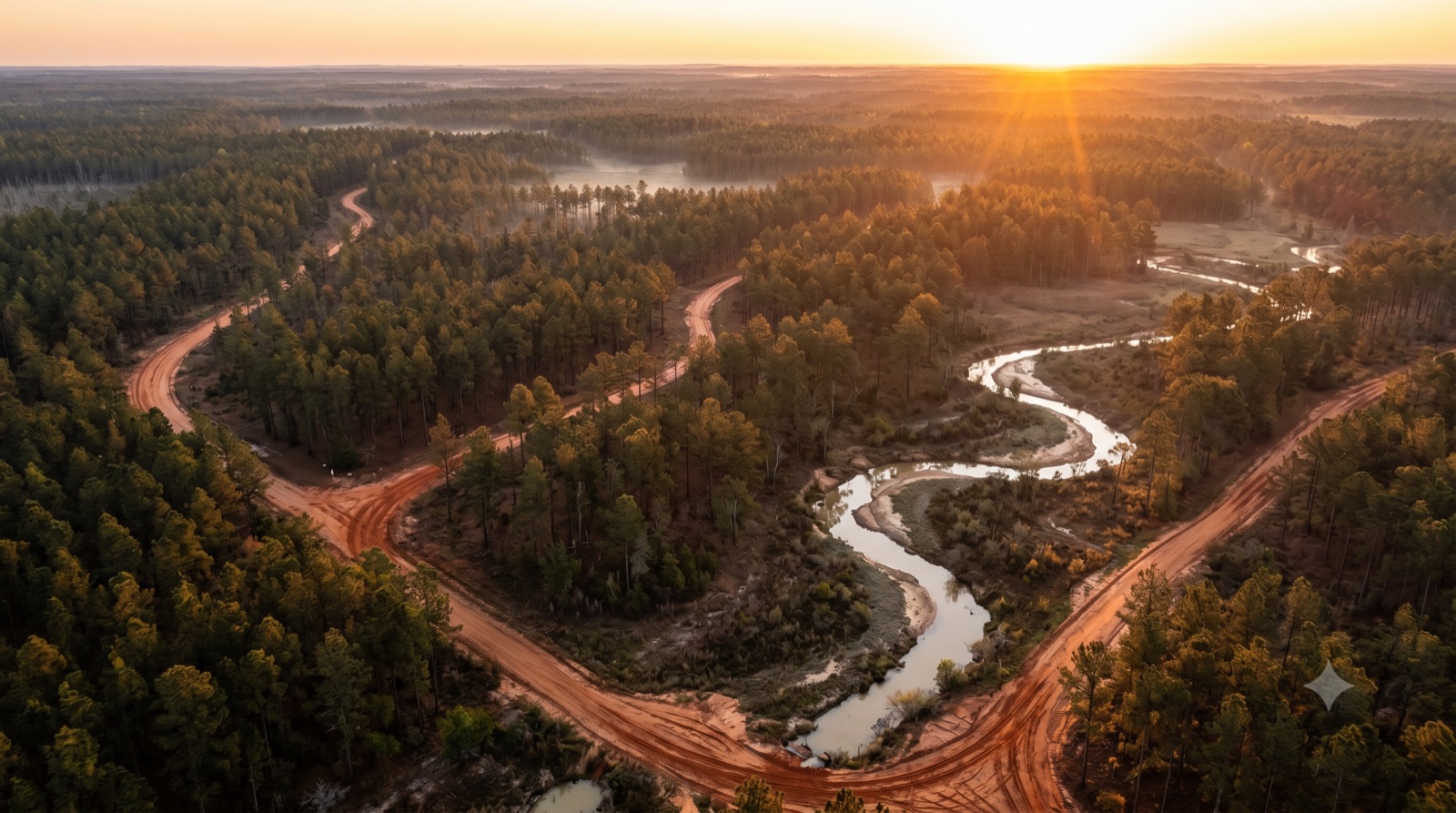
Henry County covers roughly 562 square miles in the far southeast corner of Alabama, with the Chattahoochee River forming its entire eastern boundary against Early and Clay counties in Georgia. Abbeville, the county seat, and the smaller community of Franklin both grew up as river ports on the Chattahoochee before the rail era, and the river's lower tributaries still cut through the county's sandy coastal-plain terrain. Henry County is also unusual among its neighbors historically: organized on December 13, 1819, one day before Alabama became a state, it was originally the largest county in Alabama, encompassing land that would later become all or part of Barbour, Coffee, Covington, Crenshaw, Dale, Geneva, Houston, and Pike counties as the legislature carved new counties out of it through 1903.
This guide covers Alabama's property tax classes and what they cost a Henry County landowner, the attorney-required closing process, how the county compares to the Wiregrass neighbors it once contained, and the realistic options for selling.
What Are the Tax Costs of Holding Land in Henry County?
Alabama's four-class property tax system determines what a Henry County landowner pays, and the classification is the biggest lever available. Vacant land with no qualifying agricultural, timber, or pasture use is assessed as Class II property at 20% of fair market value. Land accepted into Alabama's Current Use program is reclassified as Class III and assessed at just 10% of its current use value, according to the Alabama Department of Revenue — a change in both the ratio and the value it's applied against.
Henry County's median effective property tax rate is approximately 0.37% of fair market value, with a typical annual bill in the low hundreds of dollars, according to both PropertyTax101 and Ownwell. That places the county well below the national median effective rate of roughly 1.02%, consistent with the low millage rates found across rural southeast Alabama.
How Current Use Values Timberland Differently Than a Market Sale
Current Use applies its own valuation table to timberland rather than pulling from market sale prices, and the distinction matters for anyone holding wooded acreage. According to the National Timber Tax organization's summary of Alabama's program, forest land is assigned a current-use value per acre based on a soil productivity rating — roughly $773 for a "good" rating down to $336 for "non-productive" land, with the figure recalculated periodically off the Alabama Forestry Commission's weighted average pulpwood stumpage price. That appraised figure is then assessed at the 10% Class III ratio and taxed at the applicable millage. This is a tax-assessment number set by formula, not a market price for the land itself, and it should never be confused with what a buyer will actually pay for a tract.
Owners apply for Current Use with the county assessing official between October 1 and January 1, and the classification does not automatically transfer with a sale — a new owner must reapply, or the property reverts to Class II market-value assessment. If land is converted to a non-qualifying use within two years of a sale, a rollback tax covering the three preceding years applies, calculated at the higher of the sale price or fair market value. Standing timber itself is not subject to ad valorem tax; it is taxed only at harvest, through a severance tax. For land carrying delinquent taxes, our guide on how to sell land with back taxes walks through that separate process.
What Zoning and Closing Rules Apply to Henry County Land?
Alabama is an attorney-closing state: under Alabama Code § 34-3-6(c), a licensed Alabama attorney must prepare and review the legal documents in a real estate transaction, including the deed, title opinion, and closing statement. This applies whether you sell through an agent, sell directly to a neighboring farmer, or sell to a direct land buyer.
Outside the county's incorporated municipalities — Abbeville, Headland, Newville, Haleburg, Abbeville's smaller neighbors, and a handful of others — unincorporated Henry County has no comprehensive countywide zoning ordinance, so agricultural and timber use generally proceeds without a county land-use permit. A typical land closing runs in this order:
- Title search: An abstractor searches public land records through the Henry County Probate Office, which holds deed records dating to 1822, to confirm the chain of ownership and identify liens or easements
- Title opinion: The closing attorney issues a written opinion certifying that title is marketable
- Survey and access review: On tracts split among heirs over generations, or on timberland bordering the Chattahoochee bottomland, a survey resolves boundary and access questions before closing
- Closing and deed preparation: The attorney prepares the deed and settlement statement, and the parties execute
- Recording: The deed is recorded at the Henry County Probate Office / Records & Deeds Office, 101 Court Square, Suite A, Abbeville, AL 36310, phone (334) 585-3371
Alabama's deed recording tax is $0.50 per $500 of property value or fraction thereof — 0.10% of the sale price. Henry County's own recording fee schedule confirms this rate, plus a $5.00 transaction fee, $6.00 for the first recorded page, and $3.00 for each additional page. On a $60,000 land sale, the deed tax alone is $60. The buyer typically pays this cost, though it's negotiable. Alabama also charges a mortgage tax of $0.15 per $100 on financed amounts, which does not apply to a cash sale.
The Chattahoochee, Access, and What Buyers Check Before They Offer
Henry County's eastern boundary is the Chattahoochee River itself, and tracts along its lower tributaries carry the bottomland-hardwood character common to river-adjacent land across the Wiregrass. Before marketing riverfront or bottomland acreage, know the flood mapping for the parcel — a buyer will ask, and it's better to have the answer ready than to have them find it first. On timber tracts especially, deeded access is frequently informal on ground that has been divided among heirs for decades; a logging road everyone has always used is not the same thing as a recorded easement, and that gap surfaces during the title search.
If your parcel carries standing timber, see our guide on how to sell timberland. If it's row-crop or pasture ground, see sell farmland. If you're managing the sale from out of state, see selling land as an out-of-state owner.
How Does Henry County Compare to Neighboring Alabama Counties?
Henry County is the smallest and most timber-oriented of its immediate Alabama neighbors, and it's the only one bordered by an international-scale river rather than another Alabama county or a military installation on three of its four sides. Barbour lies to the north, Dale to the west, Houston to the south, and the Chattahoochee River — and Georgia — to the east.
| Factor | Henry County | Barbour County | Dale County | Houston County |
|---|---|---|---|---|
| Population (2020 Census) | 17,146 | 25,223 | 49,326 | 107,202 |
| Land area | ~562 sq mi | ~885 sq mi (land) | ~561 sq mi | ~580 sq mi |
| County seat | Abbeville | Clayton | Ozark | Dothan |
| Effective property tax rate | ~0.37% | ~0.40% | ~0.33-0.42% | ~0.34% |
| Primary economic driver | Timber, poultry, peanuts, cotton | Row-crop and cattle farming | Fort Novosel proximity | Dothan regional metro hub |
| Land character | Chattahoochee bottomland, working pine timberland, Wiregrass cropland | Wiregrass cropland and pasture | Military-driven, less agricultural | Urbanized, historic timber and cotton heritage |
Why a County That Used to Contain All Four Neighbors Now Has the Smallest Buyer Pool
This is the part that surprises people who assume "Alabama's mother county" still means a large market. It doesn't. Henry County's 2020 population of 17,146 is the smallest of the four, less than a fifth of Houston County's, and the county has essentially traded size for identity: every neighboring county on this table was carved, at least in part, out of Henry's original 1819 territory. What's left is a compact county where timber, not row crops, is the largest single export according to the county's own economic development authority, and where the Great Southern Wood-owned Abbeville Fiber mill — a $40 million investment producing roughly 200,000 board feet of finished wood daily and drawing yellow pine from within a 50-mile radius — anchors demand for standing timber more directly than any grain elevator or gin anchors demand for cropland.
That timber-first identity sits alongside a genuine Wiregrass row-crop base: the 2022 USDA Census of Agriculture counted 408 farms averaging 387 acres, working 157,925 acres, down roughly 9-10% in both farm count and acreage since 2017. Poultry and eggs accounted for $62.03 million of the county's $105.49 million in total farm product sales — 59% of the total — with cotton at 22,282 planted acres and peanuts at 19,467 acres rounding out the row-crop side. That combination of a working timber economy, a consolidating poultry-and-row-crop base, and a small population means the buyer pool for a given tract is genuinely narrow: timber companies and loggers evaluating standing pine, poultry and row-crop operators expanding contiguous acreage, and recreational buyers drawn to river-adjacent ground.
For a statewide overview of the process and the other counties we buy in, see our guide on how to sell land in Alabama, or browse county analysis on the blog. If your tract has hunting value along the Chattahoochee bottomland, see selling hunting land.
What Are Your Options for Selling Land in Henry County?
A Henry County landowner is usually holding one of two kinds of tract: working timberland or row-crop ground passed down through a family that no longer farms it, or a smaller, harder-to-place parcel that doesn't fit what the county's active timber and poultry operators are looking for. Either way, the carrying costs continue while the buyer pool stays genuinely thin in a county of about 17,000 people.
Start by verifying the record. Confirm your legal description and ownership through the Henry County Probate Office, Judge Ray Marler, Herndon Building, 102 North Court Square, Suite A, Abbeville, AL 36310, phone (334) 585-3257 (deed recording itself is handled at the Records & Deeds office, 101 Court Square, Suite A, phone (334) 585-3371). Confirm tax status and Current Use classification with the Henry County Revenue Commissioner, Pamela Dyson, Henry County Courthouse, 101 Court Square, Suite C, Abbeville, AL 36310, phone (334) 585-3043. If the tract carries merchantable pine, a timber cruise from a licensed forester establishes standing value before you negotiate with anyone, given how directly the local sawmill market prices that wood. If the parcel sits near the Chattahoochee, pull the flood mapping yourself before a buyer raises it.
From there, the paths are the same ones available across rural Alabama, with different tradeoffs. Listing with an agent who specializes in southeast Alabama timber and farm tracts reaches the operators and loggers most likely to want the land, but that exposure takes time and costs a commission. Online land platforms reach recreational and out-of-area buyers, including from across the Georgia line. Talking directly to the operation already farming or logging adjacent ground is often the fastest route and is regularly overlooked. And for an owner who wants a firm written number without months of marketing, Jerez Land makes a parcel-specific cash offer for your land. We buy directly and absorb the carrying costs, marketing time, and resale risk ourselves — there are no agent commissions, Alabama's recording tax is low, and a licensed Alabama attorney handles the closing as state law requires.
If you're weighing whether to use an agent at all, our guide on whether you need a realtor to sell land covers the trade-offs for a rural parcel like this. If the land came to you through inheritance, see how to sell inherited land.
Frequently Asked Questions
My grandmother left me 80 acres of peanut ground outside Abbeville and none of us farm — what do we do with it?
Your practical options are leasing the acreage to a neighboring farming operation, listing it with a southeast Alabama farmland agent, approaching the operator already farming the adjacent ground, or selling directly to a land buyer for a firm cash number. Start by confirming your legal description at the Henry County Probate Office at (334) 585-3257 and your tax and Current Use status with the Revenue Commissioner at (334) 585-3043. If the land is still titled in your grandmother's name, the estate must be resolved before clear title can pass, and your closing attorney will identify the exact route based on how the will or intestacy laws apply.
I own a wooded tract near the Chattahoochee River in Henry County — how much will I pay in property taxes each year?
Vacant or wooded land not enrolled in Alabama's Current Use program is assessed as Class II property at 20% of fair market value; qualifying timberland can instead receive Class III treatment at 10% of a current-use value that's set by soil productivity rating rather than market price, according to the Alabama Department of Revenue and the National Timber Tax organization. Henry County's median effective property tax rate is approximately 0.37% of fair market value, according to PropertyTax101 and Ownwell, well below the national median of roughly 1.02%. Your actual bill depends on the local millage for your specific districts, so call the Henry County Revenue Commissioner at (334) 585-3043 for the current rate on your parcel.
Does Alabama charge a transfer tax when I sell land?
Yes, but it's small. Alabama's deed recording tax is $0.50 per $500 of property value or fraction thereof — 0.10% of the sale price — and Henry County's own recording fee schedule confirms this same rate at the Records & Deeds office. On a $60,000 land sale, that comes to $60, plus modest per-page recording fees, and the buyer customarily pays it, though it's negotiable. Alabama also imposes a mortgage tax of $0.15 per $100 on financed amounts, which doesn't apply if the buyer is paying cash.
Is an attorney required to close a land sale in Henry County?
Yes. Under Alabama Code § 34-3-6(c), a licensed Alabama attorney must prepare and review the legal documents in a real estate transaction, including the deed, title opinion, and closing statement. The attorney also certifies title and oversees disbursement at closing. The deed is then recorded with the Henry County Probate Office's Records & Deeds division at 101 Court Square, Suite A, Abbeville, AL 36310, phone (334) 585-3371.
My family has a timber tract that's been logged before, and I've heard timber is Henry County's biggest export — does that make it easier to sell?
It can help, but it depends on the specifics. The Henry County Economic Development Authority reports, citing Alabama Agribusiness Council data, that timber is the county's largest export, supported by 240,000 acres of county timberland and the $40 million Abbeville Fiber sawmill owned by Great Southern Wood, which processes about 200,000 board feet of finished wood daily and sources yellow pine from within a 50-mile radius. That real, active demand for standing timber is a genuine advantage over a county with no local mill. But a buyer or logger will still want a current timber cruise from a licensed forester to establish standing value, confirmation of legal access for equipment, and clear title — a previously logged tract with thin regrowth and no documented access won't move on the strength of the county's timber economy alone.
Is Henry County Alabama's population growing or shrinking?
Henry County's population has been close to flat for the past decade and a half: 17,302 in the 2010 Census and 17,146 in the 2020 Census, according to Census Bureau figures cited by Wikipedia — a dip of less than 1%. More recent estimates from World Population Review put the county at roughly 18,500 as of 2026, suggesting modest growth rather than decline in the years since 2020. For a land seller, that means the buyer pool isn't shrinking the way it is in some depopulating rural Alabama counties, but it also isn't large to begin with in a county of under 20,000 people.
Disclaimer: This article is for informational purposes only and does not constitute legal, financial, or professional advice. Laws and regulations vary by jurisdiction and change over time. Always consult with qualified professionals before making land purchase decisions. Jerez Land is not responsible for actions taken based on this information.