
Sell My Land in Winston County AL - What Landowners Need to Know
Key Takeaways
- Winston County's population has declined roughly 2.6% since 2010: The county fell from 24,412 residents in 2010 to 23,503 in 2020, and sits at an estimated 23,682–23,788 today — a net loss of about 624 residents over 16 years, according to World Population Review and Data USA
- Alabama's deed recording tax is $0.50 per $500 of property value: The state charges one of the lowest deed transfer tax rates in the Southeast, roughly $100 per $100,000 of sale price, according to ListWithClever
- Woodland is the single largest use of Winston County farmland, and poultry dominates farm sales: Of the county's 43,756 acres in farms, 16,463 acres are woodland, and poultry and eggs account for $14.46 million of the county's $20.35 million in total 2022 agricultural sales, according to the USDA Census of Agriculture — on top of the roughly 181,230-acre William B. Bankhead National Forest that covers much of the county's northern and eastern reaches
How Can You Sell Land in Winston County Alabama?
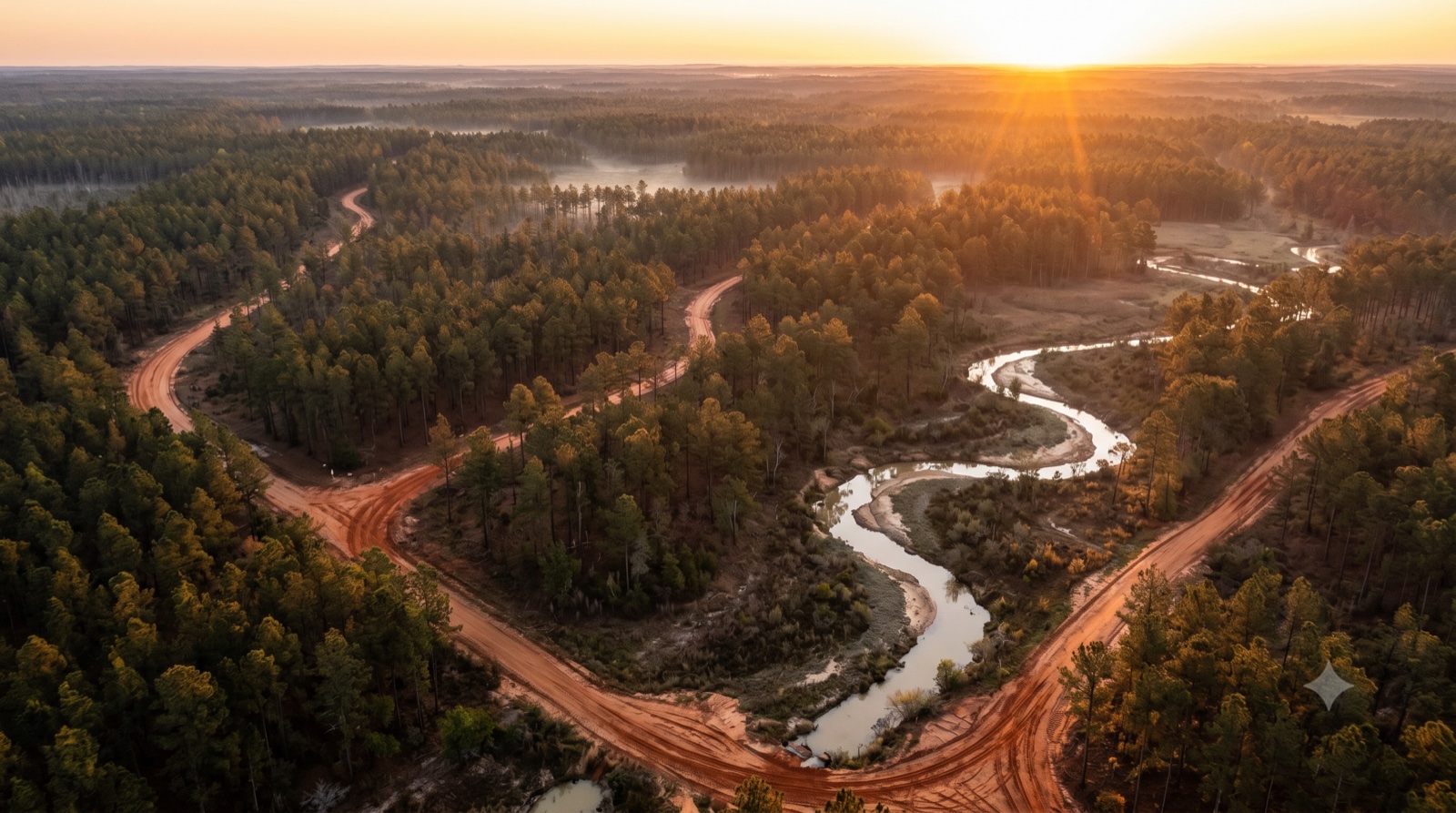
Selling land in Winston County, Alabama means working within the state's attorney-required closing process, a $0.50-per-$500 deed recording tax, and a rural market shaped by Bankhead National Forest timberland, poultry operations, and cattle pasture spread across 614 square miles of Cumberland Plateau hill country in northwest Alabama. The county's terrain runs from low rolling hills to the sandstone bluffs and gorges of the Sipsey Fork — Alabama's only federally designated Wild and Scenic River — and the Sipsey Wilderness, the state's first and largest wilderness area at 24,922 acres.
This guide covers how Alabama's property tax classification system applies to Winston County landowners, the county's land use and zoning framework, how the local market compares to neighboring counties, and the practical steps for selling — including what to expect from the attorney-managed closing process. For a complete overview of the statewide process, start with our guide on how to sell land in Alabama. For more land articles across the region, explore our blog.
What Are the Tax Costs of Holding Land in Winston County?
Alabama taxes vacant land differently depending on its classification, and that classification determines your annual bill. Under Alabama Code § 40-8-1, vacant land with no qualifying use is assessed as Class II property at 20% of fair market value, according to the Alabama Department of Revenue. Land enrolled in the state's Current Use program — agricultural, pasture, or timberland — is instead classified as Class III property and assessed at just 10% of current use value, a meaningful difference for owners of large, undeveloped tracts.
Winston County's median effective property tax rate is approximately 0.28% of fair market value, with a typical annual bill around $392, according to Ownwell. That places the county well below the national median effective rate of roughly 1.02%, and among the lower-taxed counties in the country.
How Property Tax Bills Add Up for Vacant Land
A vacant parcel assessed as Class II with no Current Use designation is taxed on 20% of its appraised market value — every $100,000 of value produces a $20,000 assessed value before millage is applied. The resulting bill is modest by national standards, but on a wooded tract carried for years with no income, even a small annual bill compounds alongside insurance, boundary maintenance, and the opportunity cost of an illiquid asset.
Alabama's Current Use program, in place since 1978 and administered by the Alabama Department of Revenue, lets owners of five or more acres of farmland, pastureland, or timberland apply for the reduced Class III valuation. For tax-assessment purposes, the Department of Revenue values Alabama timberland at $360 to $827 per acre depending on productive capacity — a state assessment figure tied to timber yield ratings, used to calculate the tax bill, not a market price for the land itself. Current Use approval carries forward with the parcel, but a new owner after a sale must reapply, and a rollback tax covering up to three prior years applies if the land converts to a non-qualifying use within two years of sale.
Beyond the tax bill, Winston County landowners with large wooded holdings face liability exposure, fence and boundary upkeep on pasture ground, and the risk of storm, wildfire, or pine beetle damage to standing timber — a real concern for tracts bordering the Bankhead National Forest. If you're carrying a non-productive or wooded parcel with ongoing costs and no near-term plan, it may be worth requesting a no-obligation cash offer before the next tax bill arrives.
If your parcel carries delinquent taxes, our guide on selling land with back taxes explains how that process works and what buyers typically expect.
What Zoning and Closing Rules Apply to Winston County Land?
Most of Winston County's rural acreage sits outside any zoning jurisdiction. Alabama has no mandatory statewide zoning framework, and unincorporated Winston County has no comprehensive county-wide zoning ordinance. Zoning applies only within the county's six incorporated municipalities — Double Springs (the county seat), Haleyville (the county's largest city), Addison, Arley, Lynn, and Natural Bridge. Outside those boundaries, land use is governed primarily by deed restrictions, health department septic requirements, and U.S. Forest Service management rules on land within the Bankhead National Forest itself, which covers a substantial share of the county's northern and eastern territory. Buyers considering development should confirm current requirements directly with the Winston County Commission or the relevant municipality before any purchase.
Alabama's Attorney-Required Closing Process
Alabama is an attorney-closing state. Under Alabama Code § 34-3-6(c), a licensed Alabama attorney must prepare and review all legal documents in a real estate transaction — including the deed, title opinion, and closing statement, according to the Alabama Closing Process Guide published by Freedom Residential. Unlike states where title companies handle closings independently, Alabama's attorney requirement applies to every real property conveyance.
A typical Alabama land closing proceeds as follows:
- Title search: An abstractor searches public land records through the Winston County Probate Office to verify clear title, identify liens or easements, and confirm chain of ownership
- Title opinion: The closing attorney issues a written opinion certifying marketability of title
- Title insurance: The buyer may purchase an owner's title insurance policy to cover defects not caught in the standard search
- Closing and deed preparation: The attorney prepares the warranty deed and settlement statement, and all parties execute at closing
- Recording: The attorney records the deed with the Winston County Probate Office (25125 Hwy 195, P.O. Box 27, Double Springs, AL 35553; 205-489-5219)
Alabama's deed recording tax is $0.50 per $500 of property value (or fraction thereof) — equivalent to 0.10% of the sale price, according to ListWithClever. On a $50,000 land sale, the recording tax totals $50. The buyer typically pays this cost, though it's negotiable between parties. Seller closing costs excluding agent commissions run approximately 3% of sale price.
For a complete checklist of what's needed at closing, see our guide to paperwork needed to sell land.
How Does Winston County Compare to Neighboring Alabama Counties?
Winston County's population has slipped from 24,412 in 2010 to 23,503 in 2020, and now sits at an estimated 23,682–23,788 — a net decline of roughly 624 residents, or about 2.6%, over 16 years, according to World Population Review and Data USA. The county's median household income is $57,256 and its poverty rate stands at 18.7%, according to Data USA, figures consistent with a rural Appalachian Alabama county that shifted long ago from cotton to cattle, poultry, and timber.
| Factor | Winston County | Marion County | Lawrence County | Walker County |
|---|---|---|---|---|
| Population (2024–26 est.) | ~23,682–23,788 | ~29,184 | ~33,600 | ~65,260 |
| Population trend | Declined ~2.6% since 2010 | Declining | Declining | Declining |
| Effective tax rate | ~0.28% | ~0.31% | ~0.29% | ~0.31% |
| Dominant land use | Bankhead National Forest timber, poultry, cattle | Poultry, timber, cattle | Timber, row crops, northern Bankhead NF edge | Timber, coal legacy, pasture |
| County seat | Double Springs | Hamilton | Moulton | Jasper |
| Key selling challenge | Federal forest land limits private acreage; thin rural buyer pool | Smaller market, depopulation | Larger river-valley market | Larger market, more competition |
Bankhead National Forest, Poultry, and the Thin-Market Liquidity Problem
Winston County's identity as a land market is inseparable from the William B. Bankhead National Forest, a 181,230-acre national forest spanning Winston, Lawrence, and Franklin counties, including the 24,922-acre Sipsey Wilderness — Alabama's first and largest designated wilderness area, according to Wikipedia. That federal footprint removes a large share of the county's acreage from the private market entirely and shapes demand for the private timber and hunting tracts that remain, particularly those bordering the forest boundary.
On the farm side, the 2022 USDA Census of Agriculture counted 385 farms in Winston County averaging 114 acres each, working 43,756 total acres — down 23% from 2017. Livestock and poultry accounted for 86% of the county's $20.35 million in agricultural product sales, with poultry and eggs alone contributing $14.46 million and cattle a distant second at $3.02 million. Of the land held in farms, woodland is the single largest category at 16,463 acres, ahead of pastureland (15,166 acres) and cropland (9,458 acres) — a landscape of small-to-mid-sized family holdings mixed with working timber ground rather than large industrial operations.
That combination — a shrinking population, a national forest that caps how much private land exists to sell, and a buyer pool that is genuinely thin outside active poultry or cattle operations — means vacant tracts, especially wooded or non-income-producing ones without road frontage, can sit on the market for many months. Buyers scrutinize timber stocking, access, soils, and proximity to the national forest boundary (which can affect both recreational appeal and development limits). Most serious buyers for larger tracts come from outside the immediate area, which extends timelines further in a market that continues to shrink each year.
Alabama's Current Use program is especially relevant for Winston County timberland and pasture owners carrying non-income-producing acreage, since it substitutes a 10%-of-current-use assessment for the standard 20%-of-market-value Class II rate. Alabama also imposes a flat timber tax of $0.10 per acre annually, according to the National Timber Tax website, and standing timber is not subject to ad valorem tax until harvest, when a severance tax applies. Federal deductions of up to $10,000 per year in reforestation expenses are also available, with any amount above that amortizable over 84 months.
If your property is a recreational or working timber tract, our guides on selling hunting land and selling timberland cover what buyers in a market like this look for. And for a full look at how rural Alabama land values get established, see our guide on how much your land is worth.
What Are Your Options for Selling Land in Winston County?
With population declining steadily since 2010, a national forest that limits how much private acreage even exists, and a rural buyer pool that thins further outside active poultry and cattle operations, Winston County landowners holding wooded or non-productive parcels often face long, uncertain marketing timelines and ongoing carrying costs. A timber tract bordering the Bankhead National Forest is a real asset — but it is not a liquid one, and that reality should shape your expectations before you list.
Before selling, verify your property's legal description and ownership through the Winston County Probate Office (25125 Hwy 195, P.O. Box 27, Double Springs, AL 35553; 205-489-5219). Confirm your tax status and parcel records through the Winston County Revenue Commissioner (Sandra Wright, 11 Blake Drive, Double Springs, AL 35553; 205-489-5166). If your land carries merchantable timber, a timber cruise from a licensed forester will establish standing wood value before you negotiate with any buyer. If the parcel is owned by an out-of-area heir, our guide to selling inherited land covers the logistics of closing when the owner isn't local.
Winston County landowners have a few paths to a sale. Listing with a real estate agent who specializes in northwest Alabama timber and recreational tracts provides the broadest exposure to out-of-area hunting and investment buyers, but commission costs of roughly 5% to 6% plus closing costs reduce net proceeds, and rural tracts near the national forest can carry long marketing periods before the right buyer appears. Whether you need an agent at all depends on your parcel and timeline; our guide on whether you need a realtor to sell land walks through the trade-offs. Online platforms like LandWatch, Land And Farm, and National Land Realty offer direct exposure to land buyers browsing by county. For landowners who want to avoid extended marketing timelines and ongoing carrying costs, companies like Jerez Land make direct cash offers priced individually to the parcel — no commissions, no listing fees, and a firm written number. The buyer absorbs the carrying costs, marketing expenses, and resale risk that come with a thin, forest-adjacent rural market. Request a cash offer to see what your parcel qualifies for.
Frequently Asked Questions
I inherited 60 acres of timberland bordering the Bankhead National Forest near Double Springs and live out of state — can I sell without traveling back to Alabama?
Yes. Start by verifying the property's legal description and ownership through the Winston County Probate Office and confirming there are no delinquent taxes through the Revenue Commissioner. Alabama requires a licensed attorney to handle the closing, including the title search, deed preparation, and recording, so you don't need to be physically present — documents can typically be signed remotely and notarized where you live, with the deed and settlement statement handled by mail or courier. A direct cash-offer buyer can also manage the entire transaction without requiring an in-person visit.
What is the property tax rate for vacant land in Winston County AL?
Winston County's median effective property tax rate is approximately 0.28% of fair market value, well below the national median of roughly 1.02%, according to Ownwell. Vacant land not enrolled in Alabama's Current Use program is assessed as Class II property at 20% of market value. Qualifying agricultural land, pasture, and timberland can instead receive Class III treatment at 10% of current use value, substantially reducing annual taxes on large rural tracts.
Does Alabama charge a transfer tax on land sales?
Yes. Alabama imposes a deed recording tax of $0.50 per $500 of property value (or fraction thereof), equivalent to 0.10% of the sale price, according to ListWithClever. On a $50,000 land parcel, the recording tax is $50. The buyer typically pays this cost, though it's negotiable. Alabama also charges a mortgage tax of $0.15 per $100 on financed amounts, which applies only when the transaction involves financing.
I'm selling my Winston County land in a private deal without a realtor — is an attorney required to close a land sale in Alabama?
Yes. Under Alabama Code § 34-3-6(c), a licensed Alabama attorney must prepare all legal documents in the transaction — including the deed, title opinion, and closing statement — and the attorney also certifies title and oversees disbursement of funds at closing. This requirement applies whether or not a real estate agent is involved. Deeds are recorded with the Probate Office in the county where the property sits, which is the Winston County Probate Office in Double Springs for land in this county.
My family's timber tract near Haleyville has been listed for over a year with no offers — why is rural land in Winston County so hard to sell?
Winston County has a small, selective buyer pool that continues to shrink as the county's population declines, and a large share of the county's total acreage sits inside the federally managed Bankhead National Forest rather than the private market, which limits how many comparable private tracts even exist to compare against. Buyers scrutinize timber stocking, road access, soils, and proximity to the national forest boundary. With roughly 23,700 residents and limited local wealth, most serious buyers for larger tracts come from outside the immediate area, and it's common for a wooded or non-income-producing parcel to sit on the market for a year or more before the right buyer appears.
Is Winston County Alabama's population growing or shrinking?
Winston County's population has declined overall since 2010, falling from 24,412 residents that year to 23,503 in 2020, before ticking back up slightly to an estimated 23,682–23,788 today — a net loss of about 624 residents, or roughly 2.6%, over 16 years, according to World Population Review and Data USA. The pattern reflects the long-term rural depopulation common across northwest Alabama's Appalachian foothill counties.
Disclaimer: This article is for informational purposes only and does not constitute legal, financial, or professional advice. Laws and regulations vary by jurisdiction and change over time. Always consult with qualified professionals before making land purchase decisions. Jerez Land is not responsible for actions taken based on this information.