
Sell My Land in Covington County AL - What Landowners Need to Know
Key Takeaways
- Vacant land that is not enrolled in current use is assessed at double the rate of land that is: Alabama taxes agricultural, forest, and residential property as Class III at a 10% assessment ratio, while most other property falls into Class II at 20%, according to Code of Alabama § 40-8-1. Raw acreage sitting idle without a current-use application on file can therefore carry twice the assessed value of the identical tract next door that filed one — and the application window runs only from October 1 to January 1 each year, per the Alabama Department of Revenue.
- Covington County's farm economy is large, growing, and almost entirely poultry: The county reported $196.4 million in agricultural products sold in 2022, up 55% from 2017, but 86% of that came from livestock and poultry — with poultry and eggs alone accounting for $155.6 million, according to the 2022 USDA Census of Agriculture. Poultry income depends on built chicken houses and integrator contracts, not on open acreage.
- Nearly half of the county's farmland is woodland, and only about a quarter of the county is in farms at all: Of 165,318 acres in farms, 76,642 acres are woodland — more than cropland and pastureland combined, per the 2022 Ag Census. Against a county land area of roughly 1,030 square miles, that leaves most of Covington County outside the farm economy entirely.
How Can You Sell Land in Covington County Alabama?
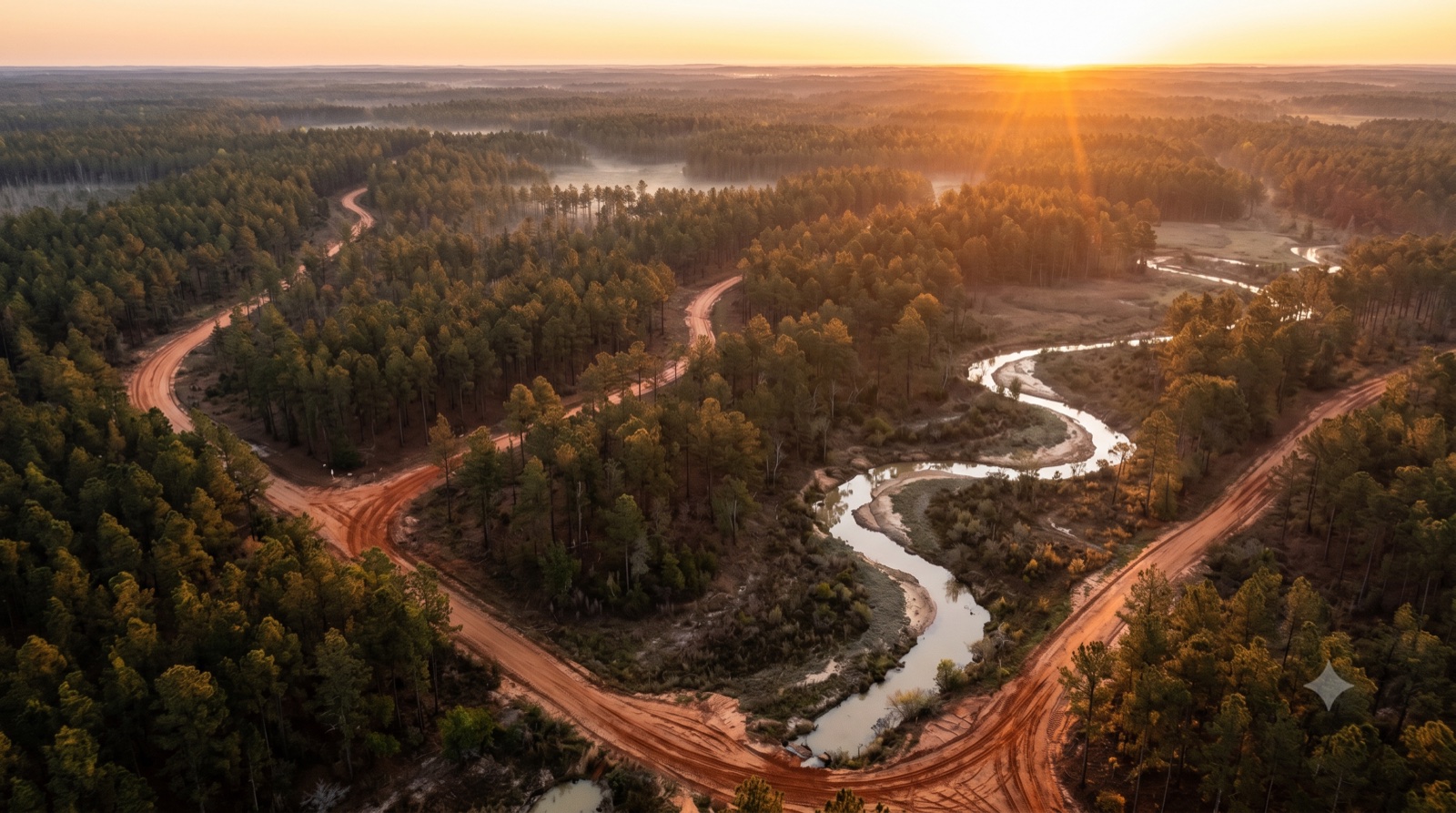
Selling land in Covington County means recording the deed through the Probate Office in Andalusia, paying Alabama's deed recording tax of $0.50 per $500 of value, and confronting a local reality most owners miss: the county's agricultural money is in poultry, and poultry buyers do not need your acreage. Covington County sits in the southeast Alabama Wiregrass on the Florida line, covering roughly 1,030 square miles of longleaf and loblolly pine broken by peanut, cotton, and hay ground, with the county seat of Andalusia anchoring a population that has been essentially flat for fifteen years.
That flatness is worth stating precisely, because it is often overstated in either direction. Covington County recorded 37,765 residents in the 2010 census and 37,570 in 2020 — a change of less than 1% across an entire decade — with recent estimates hovering near 37,600 to 37,700. This is not a collapsing county. It is a plateaued one, which has a different and less obvious effect on a land seller: there is no steady inflow of new households bidding for rural parcels, but there is also no distress-driven flood of inventory. The buyer pool is simply small and stable.
This guide covers Alabama's property classification system and the current-use election that governs your annual tax bill, the closing and recording process in Covington County, how the county compares with its Wiregrass neighbors, and the practical options for selling. For the statewide process, start with how to sell land in Alabama. For more guides across the region, browse the blog.
What Are the Tax Costs of Holding Land in Covington County?
The single largest variable in your Covington County tax bill is not the millage rate — it is which class your land falls into. Alabama sorts property into classes with different assessment ratios, and vacant rural land can land in either of two of them depending on a filing you may never have made. Class III property, which includes agricultural, forest, residential, and historic property, is assessed at 10% of value. Class II — the catch-all for most other property — is assessed at 20%, according to Code of Alabama § 40-8-1.
The practical consequence: two identical wooded tracts side by side can carry assessed values that differ by a factor of two, purely because one owner filed a current-use application and the other did not. The Alabama Department of Revenue specifies that the application is filed with the county assessing official during a window that runs from October 1 to January 1. Miss the window and you wait a year.
What Current Use Actually Values Your Land At
Alabama does not leave current-use values to local guesswork. The Department of Revenue's Property Tax Division issues an annual directive setting current-use values per acre statewide by land type and productivity rating, which county officials then apply to qualifying parcels. Division Directive CU-2026, issued October 1, 2025 and signed by Property Tax Division Director Amanda Wolfe, sets these current-use values for the tax year beginning October 1, 2025:
- Timberland: $837 per acre for good productivity, $638 per acre for average, and $364 per acre for poor.
- Rowcrop and pastureland: $532 per acre for good, $443 for average, $310 for poor, and $110 per acre for non-productive ground.
These are tax-assessment values, not market values, and the distinction matters enormously. A current-use figure is what the state says your land is worth for the purpose of computing a property tax bill on land kept in timber or agriculture. It is not an appraisal, not a sale price, and not a number any buyer is obligated to respect. It is, however, the number that drives what you pay every year while the land sits — and on a timbered tract in Covington County, the gap between a current-use assessment and a full market assessment is the difference between a carrying cost you barely notice and one that compounds. If you want a fuller picture of what holding land costs while you try to sell it, see do I pay property tax while trying to sell land.
One caution specific to current use: the election is tied to how the land is actually used, and converting the property to a non-qualifying use can trigger back-tax consequences. Confirm your parcel's current classification and any conversion exposure with the Covington County Revenue Commission before you list or sign anything.
What Zoning and Closing Rules Apply to Covington County Land?
Alabama conveys real property by recorded deed through the county Probate Office, and Covington County's is in Andalusia at 1 North Court Square. Most rural acreage in Alabama outside municipal limits carries little or no county zoning, which is generally good news for a seller — a buyer's intended use is less likely to be blocked — but it also means you cannot point to a zoning classification as evidence of what the land can support. Access, soils, and utilities do that work instead.
Recording, Deed Tax, and the Alabama Closing Process
Alabama's deed recordation tax is $0.50 per $500 of value, or fraction thereof, which works out to $1.00 per $1,000 conveyed — among the lower transfer-tax burdens in the Southeast, per the Alabama Department of Revenue. On a $100,000 conveyance that is roughly $100.
A typical Covington County land closing runs in this order:
- Confirm the legal description and current tax status with the Revenue Commission, and pull the prior deed from the Probate Office.
- Resolve title issues early — unreleased mortgages, heirs who never probated an estate, and unrecorded access agreements are the three that most often stall rural Alabama closings.
- Order a title examination. Alabama closings are commonly handled by an attorney, and a title examination is where boundary and heirship problems surface.
- Verify current-use status. If the parcel is enrolled, establish what happens to that election on transfer.
- Execute and record the deed at the Probate Office, paying the recordation tax at recording.
If back taxes are part of your situation, read sell land with back taxes before you approach a buyer — unpaid taxes are far easier to handle when disclosed up front than when a title examiner finds them.
How Does Covington County Compare to Neighboring Alabama Counties?
Covington County holds more woodland inside its farm base than any of its immediate neighbors, and it sits between a growing county to the northeast and two declining ones to the west and north. The comparison below uses 2022 USDA Census of Agriculture figures, which are the most reliable county-level land-use data available and are directly comparable across counties.
| Factor | Covington County | Coffee County | Escambia County | Butler County |
|---|---|---|---|---|
| Population (2025 est.) | ~37,600 | ~57,000 | ~36,400 | ~18,100 |
| Population trend | Flat, slightly declining | Growing | Declining | Declining |
| County seat | Andalusia | Elba | Brewton | Greenville |
| Woodland in farms (2022) | 76,642 acres | 45,461 acres | 35,792 acres | 50,896 acres |
| Farm sales mix | 86% livestock/poultry | 93% livestock/poultry | 91% crops | 99% livestock/poultry |
| Class III assessment ratio | 10% | 10% | 10% | 10% |
| Distinguishing pattern | Most woodland acreage in the group | Sales value up 97% since 2017 | Farm count down 25%; largest average farm | Woodland exceeds cropland and pasture combined |
Why a Booming Farm Economy Does Not Mean Buyers for Your Tract
This is the part of Covington County that misleads sellers, and it is worth being blunt about. On paper the county's agriculture looks strong and getting stronger: $196.4 million in products sold in 2022, up 55% in five years, with average market value per farm up 74%. A landowner reading those numbers reasonably concludes there must be money chasing ground.
But 86% of those sales are livestock and poultry, and poultry and eggs alone account for $155.6 million of the total. The county reported 4.4 million broilers and other meat-type chickens in inventory. Poultry income of that kind is generated inside built chicken houses under contract with an integrator — it is a capital-and-contract business, not an acreage business. An operator expanding poultry production needs houses, permits, and a contract, not another eighty wooded acres eight miles out.
Meanwhile the underlying farm structure is consolidating: farm count fell 11% between 2017 and 2022 while land in farms rose 2% and average farm size rose 15% to 204 acres. Fewer operators are working slightly more ground. Consolidation of that kind thins a buyer pool rather than deepening it, because the remaining buyers are expanding operators who want land adjoining what they already farm — not a standalone parcel across the county.
Add the age structure. Of 1,327 producers in Covington County, 661 are 65 or older — roughly half. That points toward succession-driven turnover in the years ahead, which means more inventory reaching the market, not less.
None of that makes Covington County land unsellable. It means the realistic buyer for an ordinary wooded or pasture tract here is a recreational or timber buyer, an adjoining owner, or a direct cash buyer — not the poultry economy the headline numbers describe. If your tract is timbered, how to sell timberland covers what a cruise does and does not do for you, and sell a cutover or recently logged timber tract covers the post-harvest case. If it is idle pasture, see sell pasture or grazing land no longer farmed.
A note on federal land: Conecuh National Forest occupies a portion of Covington and Escambia counties, which reduces the private land base available in that part of the county. We are not publishing an acreage figure for it — the U.S. Forest Service land-area report we attempted to verify against was unavailable, and the acreage splits circulating on third-party sites could not be confirmed. If the federal boundary is near your parcel, confirm it against the Forest Service directly rather than relying on a listing site.
What Are Your Options for Selling Land in Covington County?
You have three realistic paths in Covington County: list with a land broker, sell privately to a neighbor or local operator, or take a direct cash offer. Which one fits depends almost entirely on your timeline and how clean your title is.
Before you choose, gather the facts that every path requires. The Covington County Revenue Commission, led by Revenue Commissioner George L. Patterson Jr., is at 1 North Court Square, Andalusia, AL 36420, and can be reached at 334-428-2540, open Monday through Friday, 8:00 a.m. to 5:00 p.m. They hold your parcel's assessed value, classification, and current-use status. The Covington County Probate Office, under Probate Judge Stacy B. Brooks, is at the same address, 1 North Court Square, Andalusia, AL 36420; its recording line for deeds is 334-428-2518 or 334-428-2519. That office holds your recorded deed and chain of title.
A word on tax rates: several private websites publish an "effective property tax rate" for Covington County, and they do not agree with one another. We are not repeating any of those figures here, because none of them traces to the county or the Alabama Department of Revenue. Ask the Revenue Commission for the current millage applicable to your parcel — that is the only number that will actually appear on your bill.
Listing makes the most sense for a clean, accessible tract with merchantable timber or road frontage, where a broker can reach recreational and timber buyers. Expect months, not weeks; how long does it take to sell land sets realistic expectations. A private sale to an adjoining owner is often the fastest route in a consolidating farm county — the adjoining operator is frequently the only buyer with a specific reason to want your exact parcel.
A direct cash sale fits when the timeline matters more than the marketing period: an estate that needs settling, back taxes accruing, an unreleased lien, heirs in different states, or simply an owner who does not want to carry another year of taxes on land nobody is farming. Request a no-obligation cash offer on your Covington County land — we buy timbered, cutover, pasture, and idle acreage, we price each parcel individually rather than by formula, and we cover closing costs. If you are still weighing whether to sell at all, should I sell my land or keep it works through the carrying-cost side of that decision.
Frequently Asked Questions
I inherited timberland in Covington County and live out of state — can I sell without coming to Alabama?
Yes. Alabama conveys land by recorded deed, and the deed can be signed and notarized where you live and then recorded at the Covington County Probate Office in Andalusia. The complication is usually not distance — it is whether the estate was ever probated. If the land is still titled in a deceased relative's name, no one has authority to convey it until an estate is opened or an alternative Alabama procedure establishes who the heirs are. Confirm the current record owner with the Probate Office at 334-428-2518 before you plan a sale timeline.
My Covington County land isn't farmed or logged — am I paying more property tax than my neighbor?
Possibly, and by a wide margin. Alabama assesses agricultural, forest, and residential property as Class III at a 10% assessment ratio, while most other property is Class II at 20%, per Code of Alabama § 40-8-1. If your neighbor filed a current-use application and you did not, an identical parcel can be assessed at twice yours. The application is filed with the county assessing official and, per the Alabama Department of Revenue, the window runs only from October 1 to January 1 each year. Call the Covington County Revenue Commission at 334-428-2540 to find out which class your parcel is actually in.
We're three siblings who inherited a wooded tract near Andalusia and can't agree — what happens now?
Nothing can be conveyed until all owners of record sign the deed, so one holdout stops a sale outright. The practical options are a buyout of the reluctant sibling's interest, a sale of your own undivided interest to a third party, or a partition action in Alabama court — the last being slow and expensive enough that it is usually a lever rather than a plan. Because all three of you likely hold an undivided interest rather than a specific piece of ground, start by pulling the deed at the Probate Office to confirm exactly how title is held before negotiating.
What does it cost to record a deed in Covington County?
Alabama charges a deed recordation tax of $0.50 per $500 of value, or fraction thereof — about $1.00 per $1,000 conveyed, or roughly $100 on a $100,000 transaction, according to the Alabama Department of Revenue. Two-thirds of the collection goes to the State General Fund and one-third to the county of record. Ordinary recording fees are charged separately by the Probate Office, so ask for the total when you call 334-428-2518.
Is Covington County's population growing or declining?
It is essentially flat, with a slight recent downward tilt. Covington County recorded 37,765 residents in the 2010 census and 37,570 in 2020 — a change of under 1% over the decade — with recent estimates in the 37,600 to 37,700 range. That is materially different from neighboring Coffee County, which has grown to roughly 57,000, and from Escambia and Butler counties, both of which are declining. For a land seller the flat trend means a small, stable local buyer pool rather than either a growth market or a distressed one.
Why is my land not selling when Covington County agriculture is doing so well?
Because the county's agricultural money is in poultry, and poultry does not buy acreage. Covington County sold $196.4 million in agricultural products in 2022, up 55% in five years, but 86% of that was livestock and poultry, with poultry and eggs alone at $155.6 million, according to the 2022 USDA Census of Agriculture. That income is produced inside built chicken houses under integrator contracts — capital and contracts, not open ground. At the same time farm count fell 11% while average farm size rose 15%, meaning fewer, larger operators who mainly want land adjoining what they already work. Your realistic buyer is a recreational or timber buyer, an adjoining owner, or a direct cash buyer.
Disclaimer: This article is for informational purposes only and does not constitute legal, financial, or tax advice. Laws, tax rates, assessment classifications, and current-use valuation figures change over time and vary by parcel. Current-use values published by the Alabama Department of Revenue are tax-assessment figures, not market values or appraisals. Always confirm your parcel's classification and tax status with the Covington County Revenue Commission and consult a licensed Alabama attorney before making land sale decisions. Jerez Land is not responsible for actions taken based on this information.