
Sell My Land in Walker County AL - What Landowners Need to Know
Key Takeaways
- Walker County's population has softened since the 2020 census count of 65,342: The county fell from 67,023 residents in 2010 to 65,342 in 2020, and recent estimates put it at roughly 64,800 to 65,260 today — a continuation, not a reversal, of the long-run decline, according to Wikipedia's Census-sourced profile, Census Reporter, and Data USA
- Woodland is the single largest use of Walker County farmland, and poultry drives farm sales: Of the county's 65,359 acres in farms, 31,945 acres are woodland, and poultry and eggs account for $59.34 million of the county's $65.95 million in total 2022 agricultural sales, according to the USDA Census of Agriculture
- Walker County sits on the Warrior Coal Field and touches two major public-land features: the county ranked second only to Jefferson County in Alabama coal production by 1900, and it also contains part of the William B. Bankhead National Forest and a stretch of Lewis Smith Lake shoreline, according to the Encyclopedia of Alabama and Wikipedia
How Can You Sell Land in Walker County Alabama?
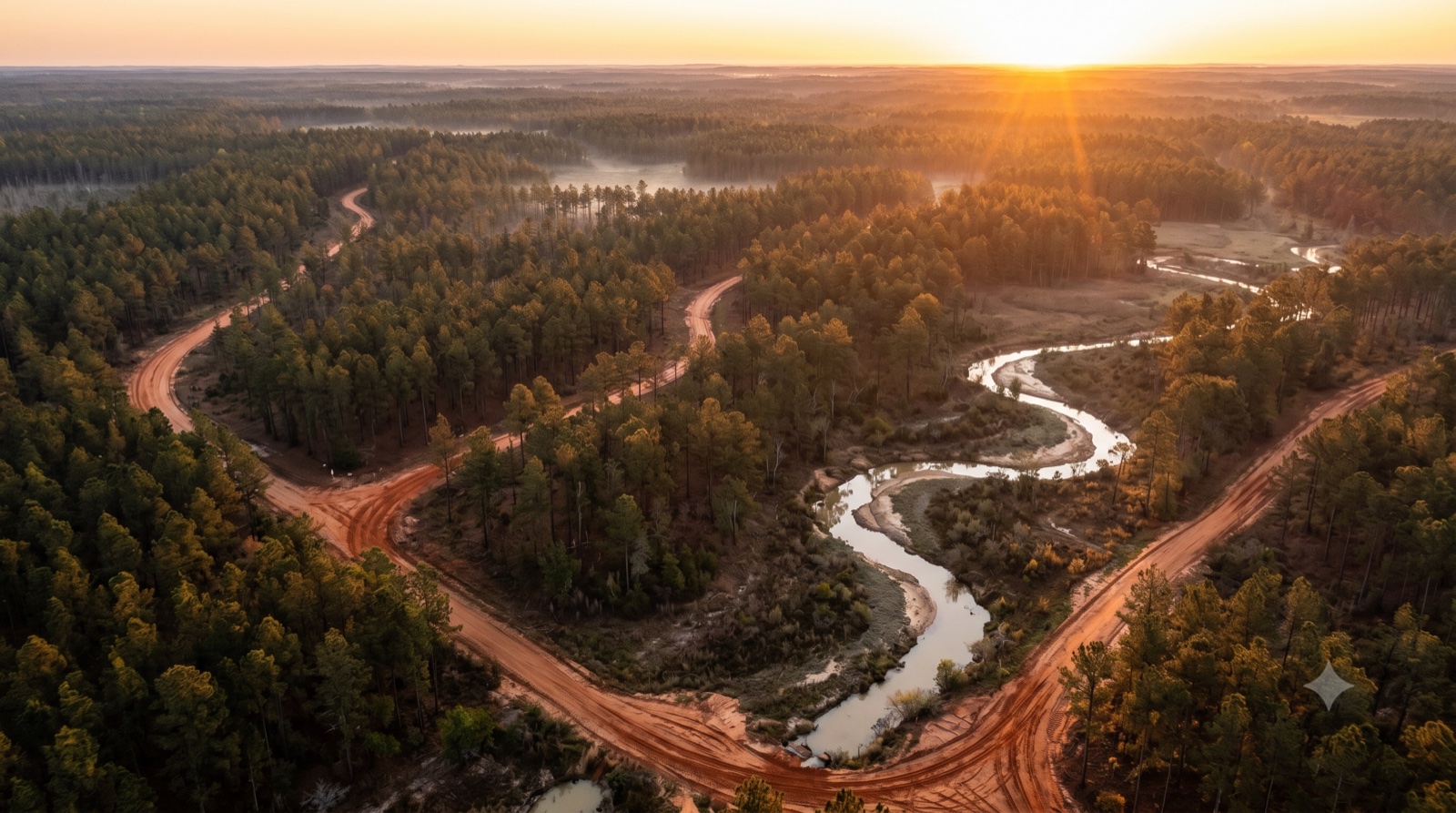
You can sell land in Walker County, Alabama through a closing prepared by a licensed Alabama attorney, with the deed recorded at the Walker County Probate Office and a $0.50-per-$500 deed recording tax due at recording — and the market itself is shaped by a Warrior Coal Field mining legacy, oak-and-pine timber ground, and shoreline tracts near Lewis Smith Lake and the Bankhead National Forest. Walker County covers 791 square miles of Cumberland Plateau terrain in north-central Alabama — narrow valleys and broad plateaus that the Encyclopedia of Alabama describes as covered with oak and pine forests — with Jasper as the county seat and largest city.
What makes this county different from most of rural Alabama is that its land history runs through coal as much as through timber or farming. Walker County was, by 1900, the second-largest coal-producing county in the state, and the underground and strip-mined ground left behind by more than a century of extraction is still part of the title and marketability picture for many parcels today. At the same time, the county borders public recreational land on two sides: a portion of the William B. Bankhead National Forest reaches into northwestern Walker County near Eldridge, and Lewis Smith Lake — one of the cleanest reservoirs in the Southeast, spanning Cullman, Walker, and Winston counties — has shoreline acreage on the Jasper side of the lake.
This guide covers how Alabama's property tax classification system applies to Walker County landowners, the county's zoning and closing framework, how the local market compares to neighboring counties, and the practical steps for selling — including what the county's coal-mining legacy means for a title search. For a complete overview of the statewide process, start with our guide on how to sell land in Alabama. For more land articles across the region, explore our blog.
What Are the Tax Costs of Holding Land in Walker County?
Alabama taxes vacant land differently depending on its classification, and that classification determines your annual bill. Under Alabama Code § 40-8-1, vacant land with no qualifying use is assessed as Class II property at 20% of fair market value, according to the Alabama Department of Revenue. Land enrolled in the state's Current Use program — agricultural, pasture, or timberland — is instead classified as Class III property and assessed at just 10% of current use value, a meaningful difference for owners of large, undeveloped tracts.
Walker County's median effective property tax rate is approximately 0.31% of fair market value, with a typical annual bill around $316 on a median home value of $103,400, according to Ownwell. That places the county well below the national median effective rate of roughly 1.02%, and among the lower-taxed counties in the country.
How Property Tax Bills Add Up for Vacant Land
A vacant parcel assessed as Class II with no Current Use designation is taxed on 20% of its appraised market value — every $100,000 of value produces a $20,000 assessed value before millage is applied. The resulting bill is modest by national standards, but a wooded or reclaimed-mine tract carried for years with no income still accumulates a bill alongside insurance, boundary upkeep, and the opportunity cost of an illiquid asset.
Alabama's Current Use program, in place since 1978 and administered by the Alabama Department of Revenue, lets owners of five or more acres of farmland, pastureland, or timberland apply for the reduced Class III valuation. For tax-assessment purposes, the Department of Revenue values Alabama timberland at $360 to $827 per acre depending on productive capacity — a state assessment figure tied to timber yield ratings, used to calculate the tax bill, not a market price for the land itself. Current Use approval carries forward with the parcel, but a new owner after a sale must reapply, and a rollback tax covering up to three prior years applies if the land converts to a non-qualifying use within two years of sale.
Beyond the ordinary tax bill, Walker County landowners holding ground with a mining history face a different kind of carrying cost: liability exposure around old shafts, portals, or highwalls, and the practical difficulty of getting a clear read on what's underneath a parcel before you can price or sell it confidently. The Alabama Department of Labor's Abandoned Mine Land Reclamation program addresses hazards from pre-1977 coal mining statewide — including mine subsidence, dangerous highwalls, and open shafts — and maintains the Alabama Mine Map Repository for underground coal workings, but it notes that many additional sites remain undocumented. If your land carries a coal-mining history, our guide on selling land over a former underground coal mine covers what can actually be verified and disclosed, and if the minerals under your surface were sold or reserved separately at some point, see selling land with severed mineral or oil and gas rights.
If your parcel carries delinquent taxes, our guide on selling land with back taxes explains how that process works and what buyers typically expect.
What Zoning and Closing Rules Apply to Walker County Land?
Unincorporated Walker County has no county-wide zoning ordinance, no building regulations, and does not require building permits or issue a certificate of occupancy — with the single exception of the area around the Walker County Airport at Bevill Field, according to the county's own Engineering Department. Zoning applies only inside the county's incorporated municipalities, which include Jasper (the county seat), Sumiton, Dora, Carbon Hill, Cordova, Parrish, Oakman, Sipsey, Nauvoo, Kansas, and Eldridge. Outside those boundaries, land use is governed primarily by deed restrictions, Walker County Health Department septic requirements, and — for tracts inside the national forest boundary — U.S. Forest Service management rules. Buyers considering development should confirm current requirements directly with the Walker County Commission or the relevant municipality before any purchase.
Alabama's Attorney-Required Closing Process
Alabama is an attorney-closing state. Under Alabama Code § 34-3-6(c), a licensed Alabama attorney must prepare and review all legal documents in a real estate transaction — including the deed, title opinion, and closing statement, according to the Alabama Closing Process Guide published by Freedom Residential. Unlike states where title companies handle closings independently, Alabama's attorney requirement applies to every real property conveyance.
A typical Alabama land closing proceeds as follows:
- Title search: An abstractor searches public land records through the Walker County Probate Office to verify clear title, identify liens or easements, and confirm chain of ownership
- Title opinion: The closing attorney issues a written opinion certifying marketability of title — on a Walker County parcel with a mining history, this is also where a prior severance of coal or mineral rights would typically surface
- Title insurance: The buyer may purchase an owner's title insurance policy to cover defects not caught in the standard search
- Closing and deed preparation: The attorney prepares the warranty deed and settlement statement, and all parties execute at closing
- Recording: The attorney records the deed with the Walker County Probate Office (Walker County Courthouse Annex II, 1900 Third Avenue South, Jasper, AL 35501; P.O. Box 502, Jasper, AL 35502; recording line 205-384-7281)
Alabama's deed recording tax is $0.50 per $500 of property value (or fraction thereof) — equivalent to 0.10% of the sale price, according to ListWithClever. On a $50,000 land sale, the recording tax totals $50. The buyer typically pays this cost, though it's negotiable between parties. Seller closing costs excluding agent commissions run approximately 3% of sale price.
For a complete checklist of what's needed at closing, see our guide to paperwork needed to sell land.
How Does Walker County Compare to Neighboring Alabama Counties?
Walker County's population has slipped from 67,023 in 2010 to 65,342 in 2020, and now sits at an estimated 64,800 to 65,260 — a continued, if modest, decline in the years since the 2020 count, according to Census Reporter and Data USA. The county's 2024 median household income is roughly $56,509 and its poverty rate stands at 18.5%, according to Data USA — figures consistent with a former coal county that has been transitioning toward timber, poultry, and lake-recreation land uses for decades.
| Factor | Walker County | Winston County | Marion County | Fayette County |
|---|---|---|---|---|
| Population (2024–26 est.) | ~64,800–65,260 | ~23,682–23,788 | ~28,800–29,200 | ~16,053 |
| Population trend | Declining since 2020 | Declined ~2.6% since 2010 | Declined ~5% since 2010 | Declined ~8% since 2010 |
| Effective tax rate | ~0.31% | ~0.28% | ~0.31% | ~0.31% |
| Dominant land use | Coal legacy, oak/pine timber, poultry, Smith Lake shoreline | Bankhead NF timber, poultry, cattle | Timber, poultry, cattle | Timber, poultry, cattle |
| County seat | Jasper | Double Springs | Hamilton | Fayette |
| Key selling challenge | Mining-history title questions on some tracts; largest local buyer pool of the four | Federal forest land limits private acreage; thin rural buyer pool | Smaller market, steady depopulation | Smallest market, steepest depopulation |
Coal Legacy, National Forest Edge, and the Smith Lake Effect on Walker County's Market
Walker County is the outlier among its northwest Alabama neighbors because it is the only one of the four with a genuine industrial mining history layered underneath its timber and farm economy. The county overlies the Warrior Coal Field — described in Alabama history sources as the southernmost large-scale coal-producing area in North America — and by 1900 ranked second in the state only to Jefferson County in coal output, a legacy that local officials still describe as central to the county's economic identity. For a land seller, that history matters at the title-search stage: severed coal and mineral rights, legacy underground workings, and reclaimed strip-mine ground are real considerations here in a way they simply aren't in Winston, Marion, or Fayette counties, none of which shared Walker's coal-mining scale.
At the same time, Walker County has more genuine lake and forest-adjacent recreational acreage than its neighbors. A portion of the William B. Bankhead National Forest — whose bulk lies in Winston, Lawrence, and Franklin counties to the north — extends into northwestern Walker County near Eldridge, and Lewis Smith Lake, a 21,000-plus-acre, roughly 500-mile-shoreline reservoir Alabama Power built in 1961, spans Cullman, Walker, and Winston counties, with a meaningful stretch of shoreline on the Jasper side. That combination of forest-edge and lake-adjacent tracts gives Walker County a recreational and second-home buyer segment that thinner-population Winston, Marion, and Fayette counties don't have at the same scale — but it also means a buyer for a wooded interior tract will still weigh timber stocking, road access, and proximity to the lake or forest boundary just as carefully as a buyer in any of the three smaller counties would.
On the farm side, the 2022 USDA Census of Agriculture counted 437 farms in Walker County averaging 150 acres each, working 65,359 total acres — down 13% in farm count since 2017 even as total farm acreage ticked up 1%. Livestock and poultry accounted for 94% of the county's $65.95 million in agricultural product sales, with poultry and eggs alone contributing $59.34 million. Of land held in farms, woodland is the single largest category at 31,945 acres, nearly half the total, ahead of cropland (15,174 acres) and pastureland (13,257 acres) — a landscape where working timber ground outweighs both row crops and pasture combined.
If your property is a recreational or working timber tract, our guides on selling hunting land and selling timberland cover what buyers in a market like this look for. And for a full look at how rural Alabama land values get established, see our guide on how much your land is worth.
What Are Your Options for Selling Land in Walker County?
Walker County landowners fall into a few common situations: inherited acreage with an unclear mining history, a wooded tract carried for years with no income, or shoreline-adjacent ground near Smith Lake or the Bankhead National Forest edge that's harder to price than a straightforward farm parcel. In every case, the county's population decline since 2020 and the added title complexity that coal history can bring mean a listed parcel can sit on the market longer than a comparable tract in a county without that mining legacy.
Before selling, verify your property's legal description and ownership through the Walker County Probate Office (Walker County Courthouse Annex II, 1900 Third Avenue South, Jasper, AL 35501; P.O. Box 502, Jasper, AL 35502; recording line 205-384-7281; Judge of Probate A. Lee Tucker). Confirm your tax status and parcel records through the Walker County Revenue Commissioner (Jerry Davis, Walker County Courthouse, 1803 3rd Avenue, Suite 102, Jasper, AL 35501; 205-384-7267). If your land carries merchantable timber, a timber cruise from a licensed forester will establish standing wood value before you negotiate with any buyer, and if the parcel sits over historic workings, ask your closing attorney to check the Alabama Mine Map Repository during the title search. If the parcel is owned by an out-of-area heir, our guide to selling inherited land covers the logistics of closing when the owner isn't local.
Walker County landowners have a few paths to a sale. Listing with a real estate agent who specializes in northwest Alabama timber, recreational, and lake-adjacent tracts provides the broadest exposure to out-of-area buyers, but commission costs of roughly 5% to 6% plus closing costs reduce net proceeds, and tracts with any mining-history complexity can carry long marketing periods while buyers and lenders sort out title questions. Whether you need an agent at all depends on your parcel and timeline; our guide on whether you need a realtor to sell land walks through the trade-offs. Online platforms like LandWatch, Land And Farm, and National Land Realty offer direct exposure to land buyers browsing by county. For landowners who want to avoid extended marketing timelines, title-history complications, and ongoing carrying costs, companies like Jerez Land make direct cash offers priced individually to the parcel — no commissions, no listing fees, and a firm written number. The buyer absorbs the carrying costs, marketing expenses, and resale risk that come with a mining-legacy rural market. Request a cash offer to see what your parcel qualifies for.
Frequently Asked Questions
I inherited 40 acres of old strip-mined ground near Jasper and I live in Texas — is it even sellable?
Yes. Old strip-mined or reclaimed ground in Walker County can be sold, but the process usually takes a bit more diligence than a typical timber tract because the closing attorney's title search needs to confirm whether coal or mineral rights were ever severed from the surface and check the Alabama Mine Map Repository for documented underground workings nearby. Start by verifying the property's legal description at the Walker County Probate Office and confirming there are no delinquent taxes with the Revenue Commissioner. Because Alabama requires a licensed attorney to handle the closing, you don't need to travel to Alabama — documents can typically be signed remotely and notarized where you live, and a direct cash-offer buyer can manage the entire transaction without an in-person visit.
What is the property tax rate for vacant land in Walker County AL?
Walker County's median effective property tax rate is approximately 0.31% of fair market value, with a typical annual bill around $316 on a median home value of $103,400, well below the national median of roughly 1.02%, according to Ownwell. Vacant land not enrolled in Alabama's Current Use program is assessed as Class II property at 20% of market value. Qualifying agricultural land, pasture, and timberland can instead receive Class III treatment at 10% of current use value, substantially reducing annual taxes on large rural tracts.
Does Alabama charge a transfer tax on land sales?
Yes. Alabama imposes a deed recording tax of $0.50 per $500 of property value (or fraction thereof), equivalent to 0.10% of the sale price, according to ListWithClever. On a $50,000 land parcel, the recording tax is $50. The buyer typically pays this cost, though it's negotiable. Alabama also charges a mortgage tax of $0.15 per $100 on financed amounts, which applies only when the transaction involves financing.
My family's land near the Bankhead National Forest edge has old underground coal workings under part of it — do I have to disclose that when I sell?
You should disclose any known mining history, and your closing attorney will typically uncover it anyway during the title search and a check of the Alabama Mine Map Repository, which the Alabama Department of Labor maintains for documented underground coal workings statewide. Known hazards like mine subsidence risk, open shafts, or dangerous highwalls fall under the state's Abandoned Mine Land Reclamation program, though that program itself notes many historic sites remain undocumented — so a buyer's own due diligence matters as much as your disclosure. Being upfront about what you know, and what you don't, is the more defensible position either way.
I own a wooded tract along Lewis Smith Lake that's been in the family for decades and nobody uses it — what are my options?
Your practical options are listing with an agent who specializes in Smith Lake and northwest Alabama recreational tracts, marketing it yourself through an online land platform, or selling directly to a land buyer for a firm cash number. Start by confirming your legal description and tax status through the Walker County Probate Office and Revenue Commissioner, and note that Smith Lake shoreline on the Jasper side has its own local access and use characteristics worth understanding before you market the parcel. If the land is still titled in a deceased relative's name, the estate will need to be resolved before clear title can pass, and your closing attorney can identify the right route.
Is Walker County Alabama's population growing or shrinking?
Walker County's population has declined overall since 2010, falling from 67,023 residents that year to 65,342 in 2020, and recent estimates put it at roughly 64,800 to 65,260 today — meaning the decline has continued, not reversed, in the years since the 2020 census count, according to Census Reporter and Data USA. The pattern reflects the long-term economic transition of a former coal county that hasn't fully replaced that lost industrial base with comparable population growth.
Disclaimer: This article is for informational purposes only and does not constitute legal, financial, or professional advice. Laws and regulations vary by jurisdiction and change over time. Always consult with qualified professionals before making land purchase decisions. Jerez Land is not responsible for actions taken based on this information.