
Sell My Land in Lincoln County TN - What Landowners Need to Know
Key Takeaways
- Lincoln County is Tennessee's top-ranked county for cattle and calves sales: The 2022 USDA Census of Agriculture reports $49.4 million in cattle and calves sales, ranking Lincoln first among the 95 Tennessee counties that produce them, alongside 69,050 head of cattle. Note that poultry and eggs actually generate more revenue in raw dollars — $87.7 million — so cattle is the county's top statewide ranking, not its largest revenue line.
- Roughly three-quarters of the county is working farmland: Lincoln County reports 270,934 acres in farms across a county of about 570 square miles, per the 2022 Ag Census. This is not a thin, marginal land market — but farm count fell 12% while acreage held flat, meaning fewer, larger operators are working the same ground.
- Greenbelt enrollment carries a rollback tax that surfaces at sale: Tennessee's Agricultural, Forest and Open Space Land Act allows qualifying land to be assessed at use value, but disqualification recaptures the difference for the preceding three years on agricultural and forest land, and five years on open space land, according to the Tennessee Comptroller and UT's County Technical Assistance Service.
How Can You Sell Land in Lincoln County Tennessee?
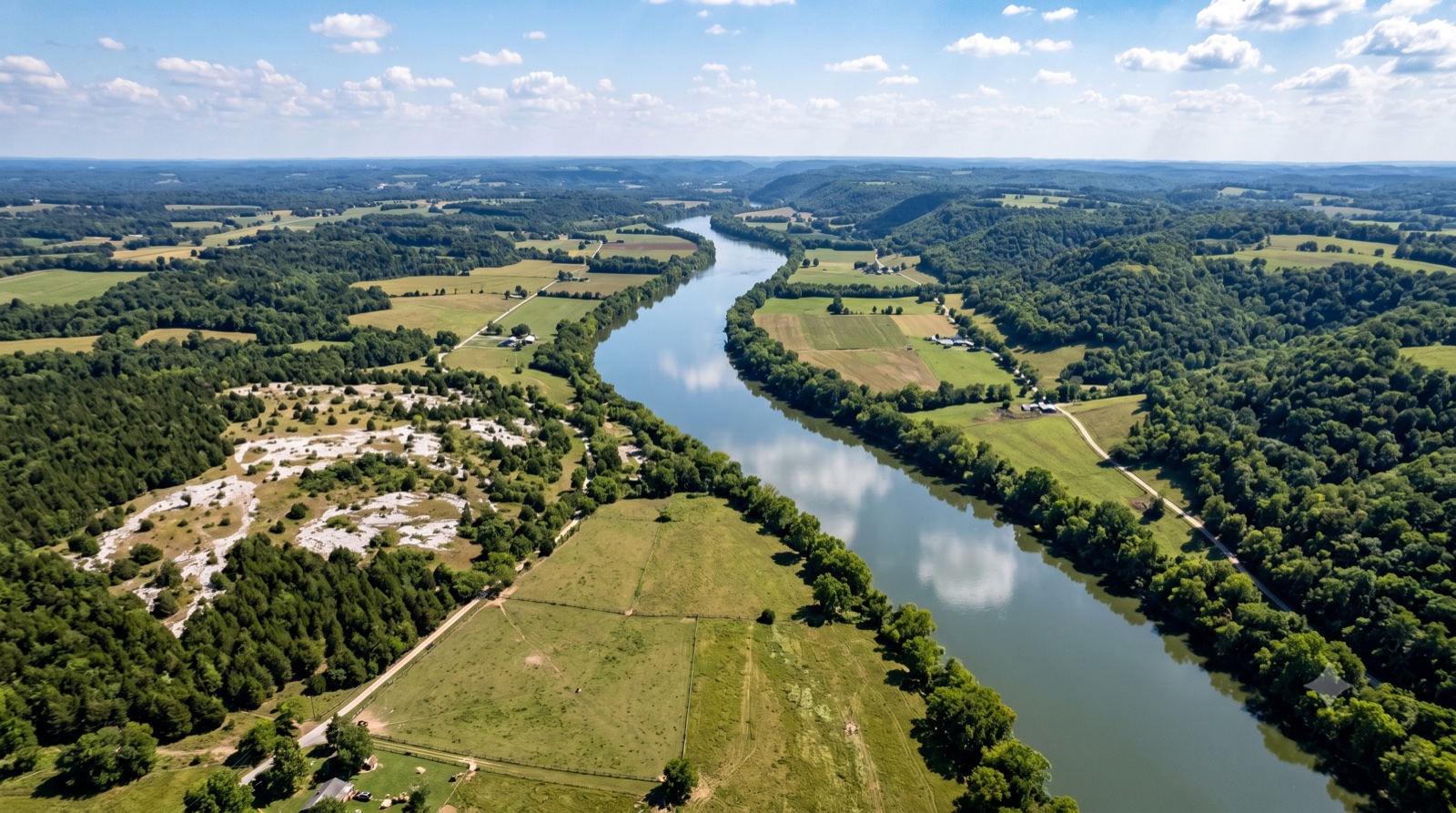
Selling land in Lincoln County means recording your deed with the Register of Deeds in Fayetteville, paying Tennessee's realty transfer tax, and understanding a market that is growing rather than shrinking — the county has gone from 31,340 residents in 2000 to 33,361 in 2010, 35,319 in 2020, and roughly 36,800 in recent estimates. Lincoln County sits on the Alabama line in south-central Tennessee, roughly 570 square miles of rolling pasture, hay ground, and row crop drained by the Elk River, with the county seat at Fayetteville.
That growth trend is worth stating plainly because it contradicts what most sellers assume about a rural Tennessee county. Lincoln is not depopulating. It is one of Tennessee's most productive agricultural counties — ranked fourth in the state for total agricultural sales — and it sits inside the Huntsville–Decatur–Albertville combined statistical area, close enough to north Alabama's defense and aerospace economy that the county's own development board is actively courting it.
What that means for you as a seller is more nuanced than "growing market, easy sale." Demand here is concentrated: working cattle and row-crop ground has real competition among expanding operators, and land along the industrial corridor toward the Alabama line has its own buyers. A wooded back tract with marginal access competes in a slower, thinner pool that looks nothing like the headline numbers.
This guide covers Tennessee's assessment and Greenbelt rules, the closing and recording process in Lincoln County, how the county compares with its Tennessee neighbors, and your realistic options. For the statewide process, see how to sell land in Tennessee. For more guides, browse the blog.
What Are the Tax Costs of Holding Land in Lincoln County?
Tennessee assesses farm and residential property at 25% of appraised value, commercial and industrial property at 40%, and public utility property at 55%, according to the Tennessee Comptroller of the Treasury and Tennessee Code Annotated § 67-5-801. Your annual bill is the county tax rate applied to that assessed portion, not to the full appraised value — a distinction that trips up owners comparing Tennessee bills to other states.
We are not publishing an "effective property tax rate" for Lincoln County. The private websites that publish one disagree with each other, and none traces to the county trustee or the state. For the rate that will actually appear on your bill, call the Lincoln County Trustee at (931) 433-1371, or the Assessor of Property at (931) 433-5409 for your parcel's appraised and assessed values.
Greenbelt and the Rollback Tax That Surfaces at Closing
Tennessee's Agricultural, Forest and Open Space Land Act of 1976 — universally called Greenbelt — lets qualifying land be assessed on its use value rather than market value. Qualification requires a minimum tract size of 15 acres for agricultural land, 15 acres for forest land, and 3 acres for open space land, and no owner may enroll more than 3,000 acres within a single taxing jurisdiction, per the Tennessee Comptroller.
The rollback is where sellers get hurt. When land is disqualified from Greenbelt — because it is converted to a non-qualifying use, subdivided below the threshold, or otherwise stops meeting the requirements — the owner owes rollback taxes recapturing the difference between the use-value assessment and the market-value assessment. That recapture reaches back three years for agricultural and forest land, and five years for open space land, according to the Comptroller and UT's County Technical Assistance Service.
This becomes a closing-table problem in a predictable way: a seller has enjoyed years of reduced assessment, a buyer intends a use that disqualifies the land, and nobody discussed who pays the recapture until it appeared on the settlement statement. Settle it in the purchase agreement. If your parcel is enrolled, get the enrollment date and classification from the Assessor of Property before you market it, and see how property tax reassessment affects selling land for the broader mechanics.
What Zoning and Closing Rules Apply to Lincoln County Land?
Tennessee conveys real property by deed recorded with the county Register of Deeds, and Lincoln County's office is at 112 Main Avenue South, Room 104, in Fayetteville. Tennessee imposes a realty transfer tax of $0.37 per $100 of consideration or property value, whichever is greater, under Tennessee Code Annotated § 67-4-409, per the Tennessee Department of Revenue. A separate recordation tax of $0.115 per $100 applies to indebtedness, less the first $2,000, which matters when the sale is financed rather than cash.
Tennessee does not require an attorney at closing the way Georgia and Alabama effectively do, and many rural land sales here close through a title company. That flexibility is real, but on a farm tract with an old description, a Greenbelt covenant, and possible heirship gaps, an attorney review is usually money well spent.
A Typical Lincoln County Land Closing
- Pull the deed and confirm the legal description at the Register of Deeds, (931) 433-5366.
- Confirm the appraised value, assessment class, and Greenbelt status with the Assessor of Property, (931) 433-5409.
- Verify taxes are current with the Trustee, (931) 433-1371.
- Resolve title problems early — unprobated estates, undocumented farm access, and old unreleased liens are the recurring three on rural Tennessee tracts.
- Allocate the Greenbelt rollback in the purchase agreement if the buyer's use will disqualify the land.
- Close and record, paying the transfer tax at recording.
If back taxes are part of your picture, read sell land with back taxes before approaching buyers.
How Does Lincoln County Compare to Neighboring Tennessee Counties?
Lincoln County has the largest cattle economy of any county in Tennessee and one of the largest farm land bases in its immediate neighborhood, and every one of its Tennessee neighbors is also growing. The comparison below uses 2022 USDA Census of Agriculture figures, which are directly comparable across counties.
| Factor | Lincoln County | Moore County | Franklin County | Giles County |
|---|---|---|---|---|
| Population (recent est.) | ~36,800 | ~7,000 | ~46,000 | ~31,400 |
| Population trend | Growing | Growing slowly | Growing | Growing modestly |
| County seat | Fayetteville | Lynchburg | Winchester | Pulaski |
| Land in farms (2022) | 270,934 acres | 63,825 acres | 115,142 acres | 241,228 acres |
| Largest land-in-farms use | Cropland (97,864 ac) | Woodland (29,522 ac) | Cropland (71,055 ac) | Pastureland (80,128 ac) |
| Farm sales mix | 71% livestock/poultry | 89% livestock/poultry | 51% livestock/poultry | 72% livestock/poultry |
| Statewide standout | #1 in cattle and calves sales | Jack Daniel Distillery is the county's largest employer | #6 in poultry and eggs; #4 in nursery and sod | #4 in cattle and calves sales |
Why "Tennessee's Top Cattle County" Does Not Mean Every Tract Sells
Lincoln County's agricultural strength is real and worth stating accurately, because the accurate version and the flattering version are different. The county sold $196 million in agricultural products in 2022, up 57% in five years, and ranks fourth in Tennessee for total agricultural sales. It is first in the state in cattle and calves sales at $49.4 million, with 69,050 head. Net cash farm income rose 87%.
But the largest single revenue line in the county is poultry and eggs at $87.7 million — nearly double the cattle figure — ranking third statewide, with 3.67 million broilers in inventory. Lincoln is Tennessee's number-one ranked cattle county while poultry quietly out-earns cattle inside its own borders. Any page telling you cattle is Lincoln County's biggest agricultural revenue source has the fact wrong, and the distinction matters to a seller because the two commodities buy completely different things. Cattle operations need pasture and hay ground — actual acreage. Poultry income is generated inside built houses under integrator contracts and creates almost no demand for open land.
The structural signal underneath is consolidation. Farm count fell 12% between 2017 and 2022 while land in farms stayed essentially flat and average farm size rose 14% to 187 acres. Fewer operators are working the same total acreage. For a seller, consolidation means your most likely buyer is an expanding operator who wants ground adjoining what they already farm — which is excellent news if your tract adjoins working pasture and considerably less helpful if it does not.
The Huntsville question, stated honestly. Lincoln County sits inside the Huntsville–Decatur–Albertville combined statistical area, and the Fayetteville-Lincoln County Industrial Development Board reports that its Horizon Industrial Park lies 1.5 miles north of the Alabama state line, a 25.5-mile, roughly 34-minute drive from Redstone Arsenal's Gate 9. U.S. Space Command's headquarters is relocating to Redstone Arsenal, bringing approximately 1,400 military and civilian personnel over five years. Lincoln County's own manufacturing sector has added more than 1,000 jobs in five years, per the same source.
What we will not claim is that Huntsville commuters are already driving Lincoln County land demand. No commuting-flow data was examined, and the county's own officials describe this as opportunity to be captured rather than growth already banked — the development board's chairman frames the Space Command move as providing "significant new business opportunities for Huntsville and the surrounding communities," and a county commissioner has publicly flagged the need to expand housing and infrastructure to capture it. The honest read is that Lincoln County is positioning itself for north Alabama spillover, that its population is genuinely rising, and that proximity is a real asset for land near the corridor — not that every rural tract in the county has a Huntsville buyer waiting.
If your tract is pasture that has gone idle, see sell pasture or grazing land no longer farmed. If it is working farmland, should I sell my farmland weighs the lease-income-versus-sale decision. Neighboring Moore County offers a useful contrast — the same cattle-and-hay economy on a far smaller land base.
What Are Your Options for Selling Land in Lincoln County?
You have three realistic paths in Lincoln County: list with a broker who works middle Tennessee farm ground, sell privately to an adjoining operator, or take a direct cash offer. In a consolidating agricultural county, the second option deserves more consideration than sellers usually give it.
Gather your facts first, all from offices at 112 Main Avenue South in Fayetteville. The Lincoln County Register of Deeds is in Room 104, phone (931) 433-5366 — that office holds your recorded deed and chain of title. The Assessor of Property is in Room 105, phone (931) 433-5409 — appraised value, assessment classification, and Greenbelt status. The Lincoln County Trustee is in Room 103, phone (931) 433-1371 — current tax status and the applicable rate.
Listing makes sense for productive pasture, hay, or row-crop ground with good access, where a broker can reach the expanding operators who are actively buying in a consolidating market. Expect a real marketing period; how long does it take to sell land sets expectations. A private sale to the adjoining farmer is frequently the fastest and cleanest route here, because in a consolidating county the neighbor often has both the motive and the financing already in place.
A direct cash sale fits when the timeline or the complications matter more than the marketing period — an estate to settle, a Greenbelt rollback you would rather not negotiate over, heirs in different states, a tract with poor access that brokers have passed on, or an owner who simply does not want another year of taxes on land nobody is working. Request a no-obligation cash offer on your Lincoln County land. We buy pasture, cropland, wooded, and landlocked tracts, we price each parcel on its own characteristics rather than by formula, and we cover closing costs.
Frequently Asked Questions
I inherited farmland near Fayetteville and live out of state — can I sell it without coming to Tennessee?
Yes. Tennessee conveys land by deed recorded with the county Register of Deeds, and your deed can be signed and notarized where you live, then recorded in Fayetteville. Tennessee does not require an attorney at closing, and many rural sales close through a title company, so the logistics are manageable remotely. The usual obstacle is probate: if the land is still titled in a deceased relative's name, no one can convey it until an estate is opened or the heirs are established of record. Confirm the current record owner with the Lincoln County Register of Deeds at (931) 433-5366 before setting a timeline.
My Lincoln County land is in Greenbelt and I'm selling — will I owe rollback taxes?
Only if the land is disqualified from Greenbelt, which a sale does not automatically cause. If the buyer keeps the property in a qualifying agricultural or forest use and it still meets the acreage minimums, the enrollment can generally continue and no rollback is triggered. If the buyer's intended use disqualifies it, the recapture covers the preceding three years for agricultural and forest land, or five years for open space land, per the Tennessee Comptroller. Because that bill can be substantial and lands at closing, your purchase agreement should state explicitly who pays it. Get your enrollment date and classification from the Assessor of Property at (931) 433-5409 first.
We're siblings who inherited a Lincoln County farm and one of us won't sell — what are our options?
Nothing conveys until every owner of record signs the deed, so a single holdout stops a sale outright. The practical options are buying out the reluctant sibling's interest, selling your own undivided interest to a third party, or filing a partition action in Tennessee court — the last being slow and costly enough that it usually functions as leverage rather than a real plan. Because co-heirs typically hold undivided interests in the whole farm rather than specific fields, start by pulling the deed at the Register of Deeds to confirm exactly how title is held before negotiating.
What does Tennessee charge in transfer tax when I sell land?
Tennessee imposes a realty transfer tax of $0.37 per $100 of consideration or the property's value, whichever is greater, under Tennessee Code Annotated § 67-4-409, according to the Tennessee Department of Revenue. A separate recordation tax of $0.115 per $100 applies to indebtedness, less the first $2,000, which is relevant when the buyer finances the purchase rather than paying cash. Ordinary recording fees are charged separately by the Register of Deeds, so ask for a total when you call.
Is Lincoln County's population growing or declining?
Growing, and steadily. Lincoln County went from 31,340 residents in 2000 to 33,361 in 2010 and 35,319 in 2020, with recent estimates near 36,800 — gains of roughly 11% and 6% across the two decades, with growth continuing. All of its immediate Tennessee neighbors are growing as well. The county also sits inside the Huntsville–Decatur–Albertville combined statistical area, and its development board is actively positioning for spillover from Redstone Arsenal, where U.S. Space Command is relocating roughly 1,400 personnel over five years.
Is Lincoln County really Tennessee's top cattle county, and does that help me sell pasture?
It is first in Tennessee for cattle and calves sales at $49.4 million with 69,050 head, per the 2022 USDA Census of Agriculture — but read that carefully. Poultry and eggs actually generate more revenue inside the county, $87.7 million, so cattle leads the statewide ranking while poultry leads the local economy. The distinction matters because poultry income comes from built houses under contract and creates almost no demand for open acreage, while cattle operations genuinely need pasture and hay ground. Good, accessible pasture adjoining a working operation has real buyers here. An isolated wooded tract does not benefit from the cattle ranking at all.
Disclaimer: This article is for informational purposes only and does not constitute legal, financial, or tax advice. Laws, tax rates, assessment ratios, and Greenbelt rules change over time and vary by parcel. Always confirm your parcel's assessment, Greenbelt status, and tax standing with the Lincoln County Assessor of Property and Trustee, and consult a licensed Tennessee attorney before making land sale decisions. Jerez Land is not responsible for actions taken based on this information.