
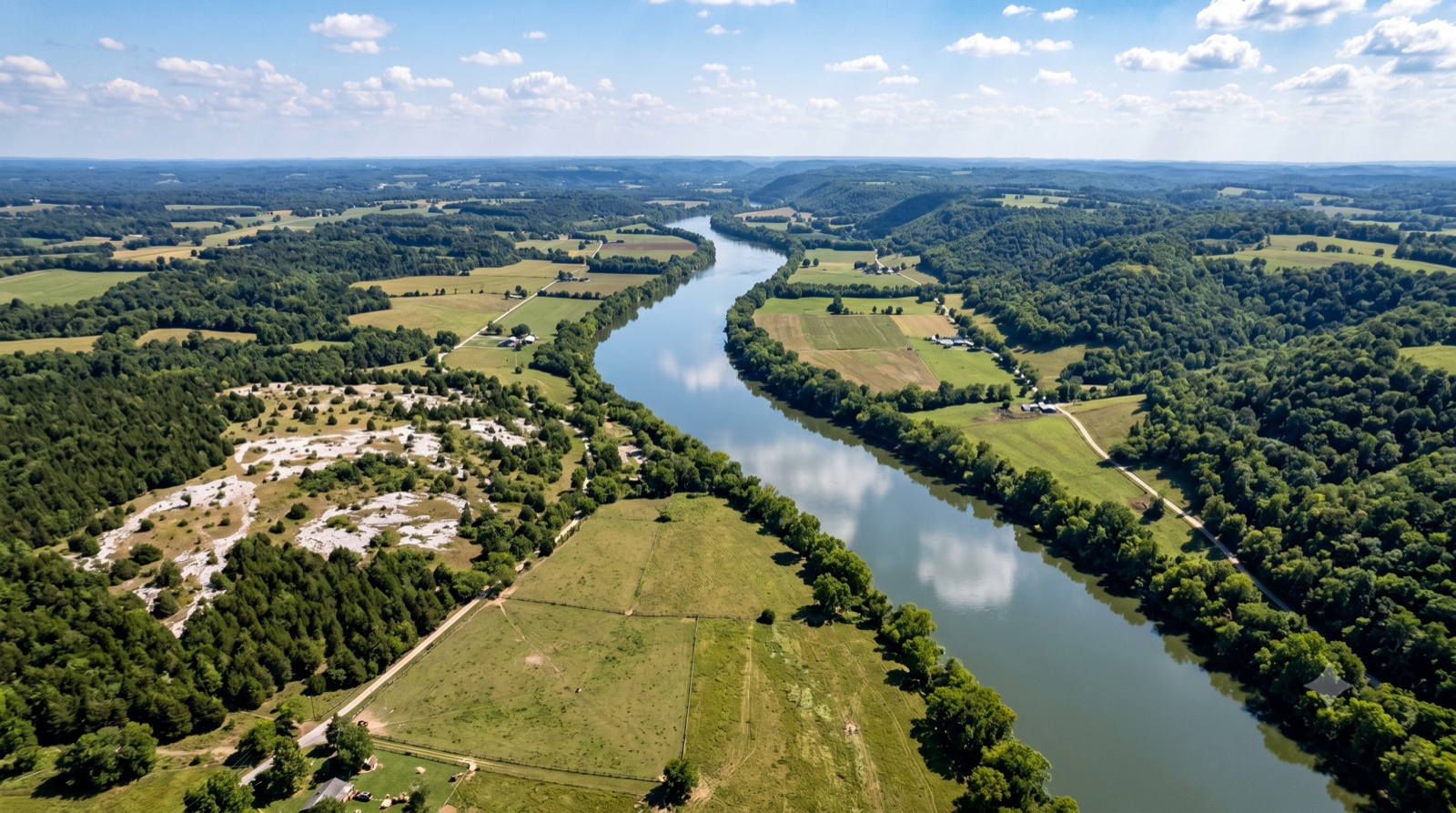
Sell My Land in Moore County TN - What Landowners Need to Know
Key Takeaways
- Moore County is Tennessee's second-smallest county by area, not its smallest: The county covers 130 square miles (129 land, 1.2 water). Trousdale County is smaller at 117 square miles total, and Trousdale — not Moore — holds the "smallest county in Tennessee" title. Moore is, however, among the state's least populous counties
- The population is growing, not declining: Moore County rose from 6,362 residents in the 2010 Census to 6,461 in 2020, with recent estimates ranging from 6,674 (ACS five-year) to roughly 6,900–7,018 depending on the estimate vintage. Any assumption that this is a depopulating rural county is wrong — the thin-market reality here comes from the county's small absolute size, not from population loss
- Cattle drive the farm economy, and 77% of the county is farmland: Cattle and calves generated $12,275,000 of Moore County's $17,078,000 in 2022 agricultural sales — about 72% — ranking 17th among Tennessee's 95 counties, according to the USDA 2022 Census of Agriculture. Land in farms totals 63,825 acres against roughly 82,560 acres of county land
How Can You Sell Land in Moore County Tennessee?
You can sell land in Moore County by listing with an agent, selling by owner, or requesting a direct cash offer, and Tennessee does not legally require an attorney at closing — title and escrow companies can close, though attorneys handle many rural transactions by custom. Start by verifying your legal description at the Register of Deeds and confirming whether your parcel is enrolled in Greenbelt, because rollback taxes on agricultural and forest land reach back three years.
Moore County is unusual in a way that simplifies your paperwork. In 1988, Lynchburg and Moore County merged into the Metropolitan Government of Lynchburg, Moore County — one of only three metro governments in Tennessee. Practically, that means one Register of Deeds office and one Property Assessor for the entire county, with no separate city layer of land records or assessment to reconcile.
The county spans both the Highland Rim and the Nashville Basin, sits in the Tullahoma–Manchester micropolitan area rather than the Nashville metro, and is best known as the home of the Jack Daniel Distillery. This guide covers Moore County's property tax and Greenbelt mechanics, Tennessee's recordation taxes and closing practice, how the county compares to its neighbors, and your practical options. For the statewide picture, start with how to sell land in Tennessee, and explore our blog for more.
What Are the Tax Costs of Holding Land in Moore County?
Moore County's countywide property tax rate is $1.7412 per $100 of assessed value for 2025–26, with a proposed increase to $1.7612 (plus a $0.0068 urban-services add-on) under discussion for 2026–27, according to local reporting on the county budget. Tennessee assesses residential and farm property at 25% of appraised value, commercial and industrial real property at 40%, and public utility property at 55%, so the assessed base on rural land is a quarter of its appraised value before the rate applies.
A separate aggregator figure from Tax-Rates.org puts the effective rate near 0.52%, based on a median annual bill of about $710 against a $135,500 median home value. That number and the official $1.7412 per $100 rate measure different things — an effective-rate-on-value estimate versus a nominal rate on assessed value — and should not be blended into a single figure.
The Greenbelt Program: Lower Taxes, Deferred Liability
Tennessee's Agricultural, Forest and Open Space Land Act of 1976 — the Greenbelt program — assesses qualifying land on use value rather than market value, and the Tennessee Comptroller's 2024 Greenbelt Manual sets out its terms precisely. Agricultural land and forest land each require a minimum of 15 acres, either as a single tract or as two noncontiguous tracts in the same county under specific pairing rules. Open space land requires a minimum of 3 acres and must be designated by a county or municipal planning commission. No owner may enroll more than 3,000 acres in a single taxing jurisdiction.
The rollback provision is where sellers get caught, and the lookback differs by category. Quoting the Comptroller's manual directly: "For agricultural and forest land, rollback taxes are calculated each year for the preceding three years. For open space land, they are calculated each year for the preceding five years." So agricultural and forest enrollment carries a three-year rollback, while open space carries five. If your land is enrolled and the buyer's intended use will not qualify, that recapture reduces your net proceeds — confirm your classification before you agree to terms.
Greenbelt applications are filed with the Property Assessor at 196 Main Street, Lynchburg, TN 37352, (931) 759-7044, with a March 15 deadline for first-time applications. Beyond taxes, vacant landowners carry liability exposure, fence and boundary maintenance, and the cost of holding an illiquid asset. If you are behind on payments, see selling land with back taxes; if the parcel came through an estate, see how to sell inherited land.
What Closing Requirements and Zoning Rules Apply in Moore County?
Tennessee does not legally require an attorney to close a real estate transaction — title and escrow companies can conduct closings — though attorneys handle many rural and more complex transactions by custom rather than by statute. Deeds are recorded with the Register of Deeds, an office that continues to exist under the consolidated metro government structure.
Tennessee's Recordation Taxes
Tennessee's recordation tax has two parts, and only one applies to a straightforward cash land sale. The realty transfer tax is $0.37 per $100 of consideration, and the mortgage or indebtedness tax is $0.115 per $100 of indebtedness, with the first $2,000 exempt, according to the Tennessee Department of Revenue's REC-1 guidance. On a cash purchase with no financing, only the transfer tax applies.
Which party customarily pays the transfer tax is genuinely disputed across sources — some describe it as seller-customary, others as buyer-customary or simply negotiable. Treat it as a negotiated contract term rather than a fixed obligation, and confirm the allocation in writing. For the full document checklist, see paperwork needed to sell land.
Zoning and Land Use
Land-use regulation in a consolidated metro government runs through a single governing body rather than separate city and county authorities, which removes a common source of confusion about which office has jurisdiction over a given parcel. Confirm current requirements with the metro government before marketing land as buildable or subdividable, particularly for any parcel you intend to represent as splittable.
For current deed information, legal descriptions, and recorded easements, contact the Moore County Register of Deeds — Pam Wells, P.O. Box 206, Lynchburg, TN 37352, (931) 759-7913.
How Does Moore County Compare to Neighboring Tennessee Counties?
Moore County is far smaller than any of its neighbors in both area and population, which is the single most important fact about its land market. With roughly 6,500 to 7,000 residents across 130 square miles, the local buyer pool for any given tract is small in absolute terms — not because people are leaving, but because there were never many to begin with.
| Factor | Moore County | Bedford County | Franklin County | Lincoln County |
|---|---|---|---|---|
| Population | 6,461 (2020); ~6,674–7,018 recent est. | ~52,200 (2024) | 44,654 | Not verified — gap |
| Population trend | Growing modestly | Growing | Stable | Not verified — gap |
| Property tax | $1.7412/$100 assessed (2025–26) | ~0.58% effective; $2.3252/$100 nominal | $1.7185/$100 county; $1.9953/$100 outside city | ~0.51% effective |
| Defining land character | Cattle and hay; Jack Daniel Distillery | Tennessee Walking Horse industry around Shelbyville | Largest, most diversified ag base; most of Tims Ford Lake | Top cattle producer; closest profile to Moore |
We could not verify a current population figure for Lincoln County, so that cell is an honest gap rather than an estimate. Note also that the effective-rate and nominal-rate figures above come from different source types and are not directly comparable across columns. Coffee County, Moore's fourth neighbor, is omitted because its economy is anchored by Arnold Air Force Base and manufacturing rather than agriculture, making it a poor land-use comparison.
Cattle, Hay, and a Consolidating Farm Base
The 2022 Census of Agriculture shows a livestock county with a shrinking number of operators. Cattle and calves led at $12,275,000 — 71.9% of the county's $17,078,000 in total agricultural sales — followed by poultry and eggs at $2,735,000 and other crops and hay at $799,000. Livestock, poultry, and products made up 89% of sales against 11% for crops. The county held 20,482 cattle and calves at the end of 2022, and forage for hay and haylage was by far the dominant crop at 9,273 acres.
The structural shift matters more than the totals. Moore County recorded 281 farms in 2022, down 25% from 2017, while land in farms rose 9% to 63,825 acres and average farm size jumped 46% to 227 acres. That is consolidation in its clearest form: a quarter of the county's farm operators disappeared while the remaining ones absorbed their ground. Fewer operators means fewer natural local buyers for a mid-sized tract, even as total farmland held steady.
Within farms, woodland covers 29,522 acres against 13,063 acres of cropland and 19,494 of pasture — so nearly half the farmland is timbered. We found no county-specific total forest-cover percentage or species breakdown and will not estimate one. If your tract carries merchantable hardwood, see selling timberland; for pasture no longer being worked, see selling pasture or grazing land.
Tims Ford Lake — a 10,700-acre TVA reservoir with roughly 250 miles of shoreline — and the Jack Daniel Distillery's visitor traffic are real regional draws, but we found no published data quantifying their effect on land buyer-pool depth or absentee ownership in Moore County. Treat any claim that tourism thickens the local land market as reasonable inference rather than established fact. Likewise, we found no land-specific days-on-market figure for the county and will not invent one.
What Are Your Options for Selling Land in Moore County?
Your options are an agent listing, a for-sale-by-owner effort, or a direct cash sale, and the deciding factor here is usually the size of the local buyer pool rather than anything about your parcel. In a county of roughly 6,500 people, a tract that would draw a dozen showings in a larger market may draw one or two.
Before pursuing any path, verify your legal description and recorded easements through the Register of Deeds (Pam Wells, P.O. Box 206, Lynchburg, TN 37352, (931) 759-7913). Confirm assessment and Greenbelt status with the Property Assessor (Shaun Sherrill, 196 Main Street, Lynchburg, (931) 759-7044), and check tax status with the Trustee (Lynn Harrison, P.O. Box 206, Lynchburg, (931) 759-7912).
Listing with a local agent who works middle Tennessee farm and pasture ground gives you the widest exposure, and cattle ground with road frontage and water is the most marketable land in the county. Commissions of roughly 5–6% plus closing costs reduce net proceeds, and small-county listings can carry long marketing periods simply because fewer buyers come through. Our guide on whether you need a realtor to sell land weighs the tradeoffs.
Selling by owner avoids commission but puts marketing, disclosure, buyer screening, and closing coordination on you. Online land platforms extend reach beyond the local pool, which matters more here than in a larger county — though parcels with access problems remain hard to move; see selling landlocked land. For what actually drives value on rural parcels, start with how much is my land worth.
For landowners who want to avoid extended timelines and ongoing carrying costs, companies like Jerez Land make direct cash offers priced individually to the parcel — a firm written number, not a range or a formula. We absorb the carrying costs, marketing expense, and resale risk, and we work with the closing agent or attorney handling your Tennessee transaction. Request a cash offer to see what your parcel is worth to a direct buyer.
Frequently Asked Questions
I own vacant land in Moore County TN and want to sell — where do I start?
Start by verifying your legal description and any recorded easements with the Moore County Register of Deeds, P.O. Box 206, Lynchburg, TN 37352, (931) 759-7913, then confirm your assessment and Greenbelt status with the Property Assessor at (931) 759-7044. Tennessee does not legally require an attorney at closing — title and escrow companies can close, though attorneys handle many rural transactions by custom. You can list with an agent, sell by owner, or request a direct cash offer.
I've been holding pasture ground in Moore County — what are my annual property tax obligations?
Moore County's countywide rate is $1.7412 per $100 of assessed value for 2025–26, with an increase to $1.7612 proposed for 2026–27. Tennessee assesses farm and residential property at 25% of appraised value, so the assessed base on rural land is a quarter of appraised value before the rate applies. A separate Tax-Rates.org estimate puts the effective rate near 0.52%, but that measures something different from the nominal rate and should not be combined with it.
My Moore County land is enrolled in Greenbelt — what happens when I sell?
Rollback taxes apply if the land stops qualifying, and the lookback depends on the category. Per the Tennessee Comptroller's 2024 Greenbelt Manual, agricultural and forest land carry a three-year rollback, while open space land carries five years. Enrollment requires at least 15 acres for agricultural or forest land and 3 acres for open space, with a 3,000-acre cap per owner per taxing jurisdiction. Confirm your parcel's classification with the Property Assessor before agreeing to a sale price.
I'm closing on a land sale in Tennessee — how much will the transfer tax be?
Tennessee's realty transfer tax is $0.37 per $100 of consideration, according to the Tennessee Department of Revenue. A separate mortgage or indebtedness tax of $0.115 per $100 applies only where financing is involved, with the first $2,000 of indebtedness exempt — so on an all-cash purchase, only the transfer tax applies. Which party pays is disputed across sources and is best treated as a negotiated term confirmed in writing.
Is Moore County really the smallest county in Tennessee?
No — it is the second-smallest by area. Moore County covers 130 square miles total (129 land, 1.2 water), while Trousdale County covers 117 square miles and holds the title of Tennessee's smallest county. Moore County is, however, among the state's least populous, which is what actually shapes its land market: a small absolute buyer pool rather than a shrinking one.
Is Moore County Tennessee's population growing or declining?
Growing modestly. The county rose from 6,362 residents in the 2010 Census to 6,461 in 2020, and recent estimates range from 6,674 on the ACS five-year figure to roughly 6,900–7,018 depending on the estimate vintage. Moore County sits in the Tullahoma–Manchester micropolitan area rather than the Nashville metro, and we found no sourced evidence that it functions as a Nashville commuter community.
Disclaimer: This article is for informational purposes only and does not constitute legal, financial, or professional advice. Laws and regulations vary by jurisdiction and change over time. Always consult with qualified professionals before making land purchase decisions. Jerez Land is not responsible for actions taken based on this information.