
Sell My Land in Schuylkill County PA - What Landowners Need to Know
Key Takeaways
- Schuylkill County's population has held roughly flat since 2020 but remains down from 2010: the county fell from 148,289 residents in the 2010 Census to 143,049 in the 2020 Census, with the U.S. Census Bureau's most recent estimate near 143,800 — a net loss of roughly 4,500–5,000 residents since 2010, even as the last few years have been closer to stable
- The county's assessment system just reset: Schuylkill County's new countywide assessed values took effect January 1, 2026 — its first reassessment since 1996, ordered after a 2018 lawsuit found the old assessments unfairly inconsistent — and the Department of Revenue cut the county's Common Level Ratio factor from 5.30 to 1.00 effective January 1, 2026 as a result — an adjustment its factor list footnotes as reflecting "an assessment base change effective January 1, 2026"
- Schuylkill sits in the heart of Pennsylvania's historic anthracite coal region, where coal mining shaped the local economy from the 1790s discovery of anthracite near Pottsville through peak production in 1917 and the closure of underground mining in the 1950s–60s (Wikipedia), and where the county's 710 farms work 103,511 acres of mostly cropland and pasture alongside hardwood woodlots (USDA 2022 Census of Agriculture)
How Can You Sell Land in Schuylkill County Pennsylvania?
Yes—you can sell land in Schuylkill County through a title company closing (Pennsylvania's standard method), by listing with a local real estate agent, or by requesting a direct cash offer from a buyer. The process requires a title search to confirm exactly what you own — surface only, or surface plus coal, oil, and gas rights — plus Pennsylvania's realty transfer tax, and it now intersects with the county's first property reassessment in nearly 30 years.
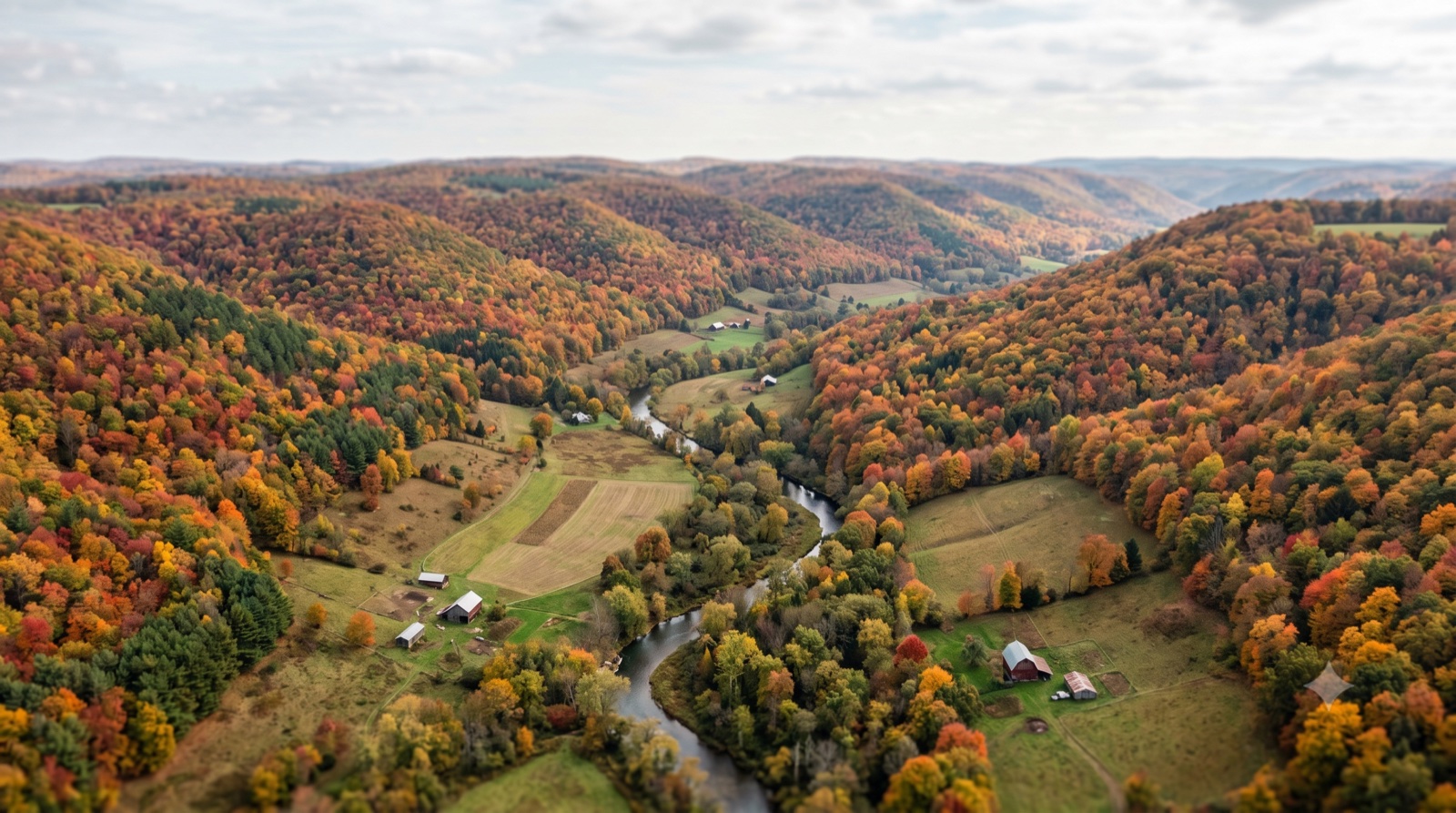
Selling land in Schuylkill County, Pennsylvania means navigating a rural market shaped by a long coal-and-farming history, a population that has leveled off after a decade of decline, and a title company-centered closing process that just absorbed a major shift in how the county values property. Schuylkill County covers roughly 779 square miles in east-central Pennsylvania, anchored by the county seat of Pottsville. Anthracite coal was first discovered near Pottsville in 1790, and the coal industry — moved to market for over a century by the Schuylkill Navigation Company and later the region's railroads — defined the county's economy through the early 20th century, with production peaking in 1917 before underground mining wound down in the 1950s and 60s in favor of surface mining, according to Wikipedia. Alongside that coal legacy, Schuylkill remains a working agricultural county: the 2022 USDA Census of Agriculture counted 710 farms averaging 146 acres apiece, working 103,511 acres — most of it cropland, with a smaller share in pasture and woodland — and generating a market value of products sold that rose 65% between 2017 and 2022.
Understanding how Pennsylvania's property tax and reassessment system, realty transfer tax, and title closing requirements interact — and how the county's coal history factors into a mineral-rights title search — will help you set realistic expectations, whether you plan to list on the open market, sell by owner, or request a no-obligation cash offer from a direct buyer. For a statewide overview, start with our guide on how to sell land in Pennsylvania.
This guide covers Schuylkill County's tax and reassessment mechanics, the Pennsylvania closing process and realty transfer tax, how Schuylkill compares to neighboring counties, and the practical options available to landowners ready to sell. For the full range of topics affecting Pennsylvania sellers, browse our blog.
What Are the Tax Costs of Holding Land in Schuylkill County?
Schuylkill County's effective property tax rate runs around 1.57% of a property's fair market value, according to Tax-Rates.org — above the national average near 1.08% — and the county's underlying assessment system changed substantially at the start of 2026. The median property tax bill on the county's median home value of $88,400 has run about $1,387 a year under the prior system; total effective rates vary by municipality and school district, since each taxing authority sets its own millage on top of the county rate.
Pennsylvania counties do not reassess property on a fixed schedule, so most counties — like Schuylkill until recently — collect taxes on assessed values pegged to a decades-old base year, corrected each year by a Common Level Ratio (CLR) published by the State Tax Equalization Board. The Pennsylvania Department of Revenue's own factor list shows Schuylkill County's CLR factor was 4.88 for documents accepted July 1, 2024 through June 30, 2025 and 5.30 from July 1, 2025 through December 31, 2025 — meaning assessed values averaged only about 19% of current market value in that final stretch under the old 1996 base year. Vacant land carrying a low, outdated assessment can look artificially cheap to hold on paper, right up until a reassessment catches up.
Schuylkill County's 2026 Property Reassessment — What Changed
Schuylkill County's assessed values had not been updated countywide since 1996. A 2018 lawsuit challenged the resulting assessments as inconsistent and in violation of Pennsylvania's constitutional Uniformity Clause, and an independent expert retained in the case found the county could not refute the claim, according to the county's own reassessment page. The county sent property owners their new assessed values on or before July 1, 2025, with an appeal window through the Board of Assessment Appeals, and the new values took effect January 1, 2026 using a new Computer-Assisted Mass Appraisal (CAMA) system. As a direct result, the Department of Revenue's Common Level Ratio factor for Schuylkill County dropped to 1.00 effective January 1, 2026, and it remains 1.00 for documents accepted July 1, 2026 through June 30, 2027 — meaning, by design, the new assessed values are meant to track current market value far more closely than the old 1996 base year did. If you're holding vacant land in the county, your assessment — and the tax bill built on it — may look meaningfully different than it did a year ago; confirming your parcel's current assessed value with the county is the first step before pricing a sale.
Delinquent Pennsylvania property taxes are collected at the county level under the state's Real Estate Tax Sale Law. Contact the Schuylkill County Tax Assessment Office (Schuylkill County Courthouse, 401 North Second Street, Pottsville, PA 17901, 570-628-1025) to confirm your parcel's current assessed value, or the county's Tax Claim office to confirm whether any delinquent balance exists before you list or accept an offer. If you're behind on payments, our guide on selling land with back taxes explains your options before a tax sale is scheduled. If you've inherited land and aren't sure of its tax or title status, how to sell inherited land walks through the process.
Clean and Green Act 319 Preferential Assessment
Landowners with at least 10 acres devoted to agricultural use, open space, or forest reserve can apply for Pennsylvania's Clean and Green program (Act 319), which taxes enrolled land at use value rather than fair market value, according to the Pennsylvania Department of Agriculture. Given how much of Schuylkill County's rural acreage is farmed or wooded, this program is directly relevant to many sellers here. Withdrawing enrolled land from Clean and Green triggers a rollback tax — seven years of the difference between market-value taxes and use-value taxes, plus 6% annual interest — so if your parcel is enrolled, factor that rollback exposure into your net proceeds before agreeing to a sale.
What Zoning and Closing Rules Apply to Schuylkill County Land?
Schuylkill County is largely unzoned outside its boroughs and the city of Pottsville; land use is governed at the township level, so requirements vary depending on which municipality your parcel sits in. For zoning and permitting questions, contact the relevant township supervisors, or start with the county offices at the Schuylkill County Courthouse (401 North Second Street, Pottsville, PA 17901).
For deed history, legal descriptions, and recorded easements, contact the Schuylkill County Recorder of Deeds (Schuylkill County Courthouse, 401 North Second Street, Pottsville, PA 17901, 570-628-1480, Monday–Friday). The office records all documents relating to real estate, along with UCC filings, military discharges, and notary commissions.
A Note on the Anthracite Coal Legacy, Mineral Rights, and Mine Subsidence
Schuylkill County sits at the center of Pennsylvania's historic anthracite coal region, where coal was mined commercially from the early 1800s through the mid-20th century, with underground operations largely closing in the 1950s and 60s in favor of surface mining, per Wikipedia. As is common practice across Pennsylvania's coal counties, coal, oil, and gas rights beneath a surface tract were frequently sold or reserved separately from the surface, sometimes generations ago — a title search through the Recorder of Deeds is the only reliable way to confirm whether your deed conveys those rights or only the surface. This guide does not, and cannot, tell you whether any specific parcel sits over old mine workings or quantify subsidence risk — that determination requires checking the parcel directly.
To check, Pennsylvania's Department of Environmental Protection maintains the MSI Risk mapping tool at gis.dep.pa.gov/msiRisk, searchable by address or coordinates, and a site-specific mine-map request form through its Office of Active and Abandoned Mine Operations for a more detailed report. The DEP also administers a Mine Subsidence Insurance program covering buildings and structures (not vacant land) against collapse of underground coal or clay mines — coverage that homeowner's policies typically exclude — at a published rate of roughly 27 cents per $1,000 of coverage. That program is relevant if you or a future buyer plan to build; it is not a substitute for a site-specific mine-map check on raw land. If your title search turns up severed coal, oil, or gas rights, our guides on selling mineral rights vs. surface rights and selling land with severed mineral or oil-and-gas rights explain how split estates affect a sale.
Pennsylvania's Title Company Closing Process
Pennsylvania does not require a licensed attorney to conduct real estate closings. Most land transactions are handled by a title company or settlement agent, which runs the title search, prepares closing documents, disburses funds, and records the deed with the county recorder. Attorneys are often involved but are not legally required for the closing itself.
The closing process for land in Schuylkill County typically works as follows:
- Title search: The title company searches public land records through the Schuylkill County Recorder of Deeds to verify clear title — no outstanding liens, unpaid taxes, or unresolved encumbrances — and to identify any severed coal, oil, or gas interests
- Title insurance: A lender's or owner's title insurance policy protects against defects not caught in the standard search
- Closing: Buyer, seller, and any agents execute the deed and settlement statement, typically overseen by the title company or settlement agent
- Recording: After closing, the deed is recorded with the Schuylkill County Recorder of Deeds, making the transfer part of the public record
For the full documentation checklist, see our guide on paperwork needed to sell land.
Pennsylvania Realty Transfer Tax
Pennsylvania imposes a 1% state realty transfer tax on all real property transfers, according to the Pennsylvania Department of Revenue. A local realty transfer tax also applies — commonly around 1% statewide, split between the municipality and school district — but the exact local rate is set independently by each of Schuylkill County's municipalities and school districts, so it can vary by township; confirm the specific rate for your parcel's municipality with the settlement agent handling your closing rather than assuming a countywide figure.
By custom, the tax is typically split equally between buyer and seller, though the allocation can be negotiated. Cash buyers who advertise no closing costs to the seller typically absorb both sides of the transfer tax as part of their offer terms. The deed must be recorded with the Recorder of Deeds in the county where the property is located.
How Does Schuylkill County Compare to Neighboring Pennsylvania Counties?
Schuylkill County's population of 143,049 (2020 Census) is down from 148,289 in 2010, though the U.S. Census Bureau's more recent estimates put the count near 143,800 — suggesting the decline has leveled off in the last few years even though the county remains well below its 2010 level. Schuylkill borders eight counties: Berks and Lebanon to the south, Dauphin and Northumberland to the west, Columbia and Luzerne to the north, and Carbon and Lehigh to the east, per Wikipedia.
| Factor | Schuylkill County | Luzerne County | Carbon County | Northumberland County |
|---|---|---|---|---|
| County seat | Pottsville | Wilkes-Barre | Jim Thorpe | Sunbury |
| Population (2020 Census) | 143,049 | 325,594 | 64,749 | 91,647 |
| Effective property tax rate | ~1.57% | ~1.40% | ~1.56% | ~1.13% |
| Regional character | Anthracite coal heritage, mixed farmland and hardwood ridges | Larger anthracite-region metro anchored by Wilkes-Barre | Lehigh Gorge and former anthracite mining towns | Susquehanna River valley, coal and farming mix |
Effective property tax rates per Tax-Rates.org; figures are county averages and vary by municipality and school district within each county.
Schuylkill's Place in the Anthracite Region
Schuylkill, Luzerne, Carbon, and Northumberland all sit within Pennsylvania's historic anthracite coal fields, and each carries some version of the same legacy: former mine lands, mixed timber-and-farm rural acreage away from the built-up river towns, and the potential for severed mineral rights on older parcels. Schuylkill's own land base splits between the agricultural acreage tracked in the 2022 USDA Census of Agriculture — 710 farms averaging 146 acres, with cropland (77,496 acres) making up the largest share of farmed land, followed by woodland (16,980 acres) and pasture (2,918 acres) — and additional unfarmed hardwood ridgeline and reclaimed mine-land acreage that doesn't show up in farm statistics at all. Poultry and livestock accounted for 65% of the county's $236 million in 2022 agricultural sales, with poultry and eggs alone contributing roughly $112 million, according to the USDA. If your land is timber or hunting acreage rather than working farmland, our guides on selling timberland and selling hunting land cover what drives value for recreational parcels; if it's cropland or pasture, selling farmland covers the basics for working ag land.
What Are Your Options for Selling Land in Schuylkill County?
With a population that has only recently stabilized after a decade-plus decline, an effective tax rate near 1.57% that's now anchored to freshly reassessed 2026 values, and — for many older parcels — coal, oil, or gas rights that may have been severed from the surface generations ago, Schuylkill County landowners face a straightforward carrying-cost equation: taxes, insurance, and maintenance accumulate every year a parcel sits unsold, and an unclear mineral-rights or reassessment picture can slow down a sale further. Understanding what your land is actually worth — and exactly what you own — is the logical first step. Our guide on how much is my land worth explains the factors that drive valuation for rural parcels.
Before pursuing any sale path, verify your property's legal description and mineral-rights status through the Schuylkill County Recorder of Deeds (570-628-1480, 401 North Second Street, Pottsville, PA 17901), and confirm your current assessed value and tax status with the Schuylkill County Tax Assessment Office (570-628-1025, same address) given the county's 2026 reassessment. If your parcel is enrolled in Clean and Green, understand the rollback tax exposure before agreeing to a sale price. Out-of-state owners can find more on remote selling in our guide on selling land as an out-of-state owner.
Schuylkill County landowners have several selling paths:
Listing with a local real estate agent familiar with the county's farm and recreational-land buyers offers market exposure, but agent commissions of approximately 5–6%, combined with Pennsylvania's transfer tax and title company fees, reduce net proceeds — and in a market recovering from years of population decline, carrying costs continue accumulating through a listing period that can stretch for months. Our guide on whether you need a realtor to sell land weighs the tradeoffs.
Selling by owner (FSBO) eliminates agent commissions but puts the burden of marketing, disclosures, mineral-rights research, and coordinating a title company on you. Raw or access-limited parcels — including former mine land or landlocked tracts — can be especially difficult to move this way; see our guide on selling raw, undeveloped land if that describes your tract.
For landowners who want to avoid extended timelines, ongoing tax exposure under the new assessments, and the uncertainty of a thin rural market, companies like Jerez Land provide direct cash offers priced individually to the parcel — a firm written number, not a range or a formula. We absorb the carrying costs, marketing risk, and resale uncertainty, and we close in weeks rather than months. There are no agent commissions, and the same title company closing process applies. Request a cash offer to see what your parcel is worth to a direct buyer.
Frequently Asked Questions
I own a former strip-mine or reclaimed coal parcel in Schuylkill County — how do I find out if it's undermined before I sell?
Check Pennsylvania DEP's MSI Risk mapping tool at gis.dep.pa.gov/msiRisk by entering your address or coordinates, or submit a site-specific mine-map request through the DEP's Office of Active and Abandoned Mine Operations. This tells you whether historic mine workings are mapped beneath your parcel — it does not, by itself, determine subsidence risk, which requires a site-specific engineering evaluation.
I inherited land in Schuylkill County and I'm not sure I own the coal, oil, or gas rights underneath it — how do I check?
A title search through the Schuylkill County Recorder of Deeds (401 North Second Street, Pottsville, PA 17901, 570-628-1480) will show whether a prior owner sold or reserved the mineral estate separately from the surface, a common practice across Pennsylvania's anthracite counties dating back generations. Until you confirm this, you can't know for certain what you actually own or what a buyer is purchasing.
I live out of state and inherited farmland or timber acreage in Schuylkill County — can I sell without traveling there?
Yes. Pennsylvania land sales close through a title company or settlement agent rather than requiring an attorney or an in-person courthouse visit, and closing documents can typically be signed remotely or through a mobile notary. You can request a title search, receive a cash offer, and complete the entire closing by mail or electronically; our guide on selling land as an out-of-state owner covers the remote process in detail.
I've held vacant land in Schuylkill County for years — what should I know about the county's 2026 property reassessment?
Schuylkill County's new assessed values took effect January 1, 2026 — the county's first countywide reassessment since 1996, ordered after a 2018 lawsuit found the prior assessments inconsistent. The State Tax Equalization Board's Common Level Ratio factor for the county, previously 5.30, dropped to 1.00 for the post-reassessment period, meaning your parcel's new assessed value is designed to track current market value more closely than it did under the old 1996 base year — worth confirming with the county Tax Assessment Office before you price a sale.
Does Pennsylvania charge a transfer tax when you sell land in Schuylkill County?
Yes. Pennsylvania imposes a 1% state realty transfer tax on all property transfers, plus a local realty transfer tax that commonly runs around 1% but is set separately by each municipality and school district, so the combined rate can vary by township within the county. By custom the tax is split evenly between buyer and seller, each paying roughly half, though the split can be negotiated.
Is a title company required to close a land sale in Schuylkill County PA?
Pennsylvania does not legally require a licensed attorney to close a real estate transaction. Most land sales in Schuylkill County are handled by a title company or settlement agent, which runs the title search through the Recorder of Deeds, prepares the deed and settlement statement, and records the transfer after closing. An attorney may be involved but is optional under state law.
Disclaimer: This article is for informational purposes only and does not constitute legal, financial, or professional advice. Laws and regulations vary by jurisdiction and change over time. Always consult with qualified professionals before making land purchase decisions. Jerez Land is not responsible for actions taken based on this information.