
Sell My Land in Vance County NC - What Landowners Need to Know
Key Takeaways
- Vance County's population fell 6.3% from 2010 to 2020 but has since leveled off: The county dropped from 45,422 residents in 2010 to 42,578 in 2020, according to U.S. Census Bureau decennial counts, but Census Bureau population estimates put the county at roughly 42,600–42,700 through 2025 — essentially flat, not a continuing decline
- Farms shrank sharply even as tobacco stayed the top crop by value: Vance County had 170 farms working 38,231 acres in 2022, down 42% in total farmed acreage since 2017, with cropland covering roughly half that acreage (18,523 acres) and woodland about a third (12,515 acres); tobacco alone generated $4.58 million of the county's $12.86 million in total agricultural sales — more than any other single crop — despite covering far fewer acres than soybeans, according to the 2022 USDA Census of Agriculture
- Kerr Lake's shoreline is federally owned, which limits — rather than fuels — private lakefront demand: The John H. Kerr Reservoir spans Vance, Granville, and Warren counties in North Carolina with roughly 850 miles of shoreline, but the U.S. Army Corps of Engineers owns and manages most of the surrounding land, so a Vance County parcel simply being "near Kerr Lake" doesn't automatically translate into private, developable lake frontage
How Can You Sell Land in Vance County North Carolina?
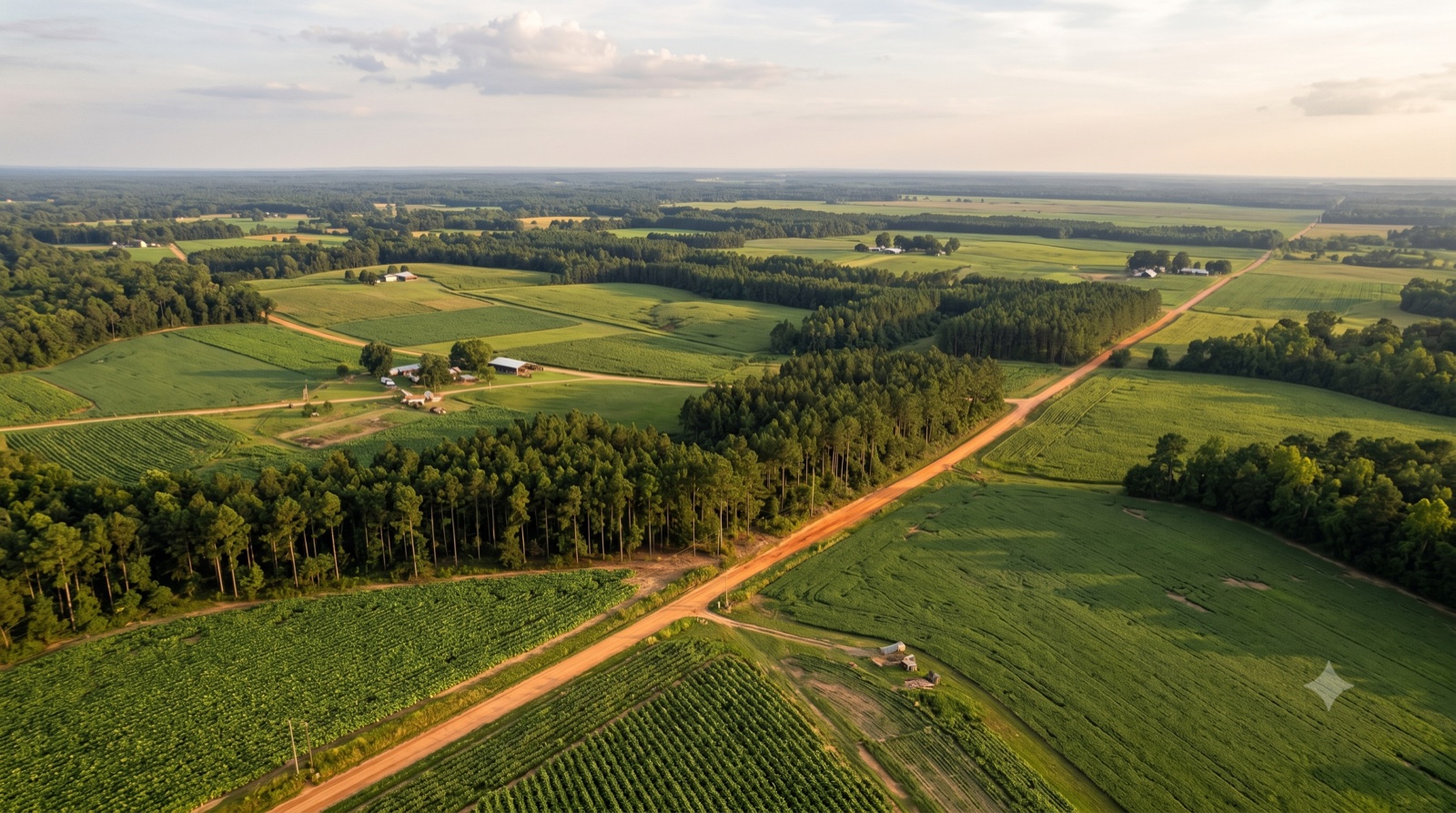
To sell land in Vance County, North Carolina, you need a licensed North Carolina attorney to close the transaction, must pay the state's $2-per-$1,000 excise tax to the Register of Deeds, and are selling into a mid-sized rural market where population loss has leveled off since 2020 — cash sales can close in two to four weeks once any inherited or tobacco-era title issues are cleared. Vance County sits in the north-central Piedmont on the Virginia line, anchored by the county seat of Henderson and bordered by the John H. Kerr Reservoir (Kerr Lake) to the north and east. It's a county with a mixed identity: former tobacco farms and pasture stretch across its interior, pine and hardwood timber tracts run along its creeks and the lakeshore, and Henderson itself carries the scars of a textile industry that largely collapsed in the early 2000s, when Harriet & Henderson Yarns — once one of the county's largest employers — closed its last mill in 2003.
This guide covers North Carolina's property tax system and the Present-Use Value deferral program for agricultural and forested land, the state's attorney-closing requirement and what it means for your timeline, how Vance County compares to neighboring Warren, Franklin, and Granville counties, and the practical steps for completing a land sale — including what the county's actual population trend does and doesn't tell you about buyer demand. For a broader overview of the process across the state, visit our guide on how to sell land in North Carolina.
What Are the Property Tax and Carrying Costs of Holding Land in Vance County?
Vance County's property tax rate is $0.7129 per $100 of assessed value for 2025-26, according to the North Carolina Department of Revenue's county tax rate schedule, set following the county's 2024 revaluation. North Carolina assesses all real property — including vacant land — at 100% of fair market value, so that rate applies directly against your parcel's assessed value. On a parcel assessed at $40,000, county tax alone runs approximately $285 per year before any municipal or fire-district overlays.
For comparison, the North Carolina statewide average effective rate is approximately 0.77%. Vance County's rate sits modestly below that average — a smaller carrying-cost burden than in many neighboring counties, though still a real annual cost on acreage that isn't producing income while you wait for a buyer.
How the Present-Use Value (PUV) Program Can Reduce Your Tax Bill
North Carolina's Present-Use Value program, authorized under N.C. Gen. Stat. §§ 105-277.2 through 105-277.7, allows qualifying agricultural, horticultural, and forestland to be assessed on its income-producing value rather than market value. According to the NC Forest Service, this program can reduce property taxes by up to 90% for eligible parcels. NCDOR's use-value guidance caps agricultural land PUV rates at no more than $1,200 per acre for the best classification tier, and forestland is capitalized at a fixed 9% rate set by statute.
To qualify, a parcel must meet minimum acreage thresholds — 10 acres for field crops or pasture, 5 acres for horticultural use, and 20 acres under a qualified timber management plan — and agricultural or horticultural land must generate at least $1,000 in gross annual income. Applications are due by January 31 each year with the county Tax Assessor. If ownership changes or the land is converted to a non-qualifying use, deferred taxes from the current year plus the three prior years become immediately due with interest.
Given that roughly half of Vance County's farmed acreage is cropland and close to a third is woodland, both agricultural-use and forestland PUV enrollment show up regularly on county parcels — and the rollback is a real cost a seller needs to account for before closing. For landowners carrying back taxes on a Vance County parcel, resolving delinquency before listing matters because a tax lien will surface in any title search and must be satisfied at closing.
Vance County Tax Administration Contact
Vance County Tax Administration (V.C. Tax Office) | 122 Young Street, Suite E, Henderson, NC 27536 | Phone: (252) 738-2040 | Website: vancecounty.org/departments/tax-overview
What Closing and Zoning Requirements Apply in Vance County?
North Carolina is an attorney-close state. Under established North Carolina case law and State Bar opinions, a licensed North Carolina attorney must conduct or supervise every real estate closing — including reviewing title, preparing the deed, coordinating payoffs, and recording the deed with the Register of Deeds. A title company can issue title insurance but cannot replace the attorney's legal role.
The closing sequence for a Vance County land sale typically works as follows: the attorney orders a title search through the county's deed records, resolves any clouds on title, prepares a warranty deed, and schedules the closing. The seller conventionally pays the excise tax — $1 per $500 of the sale price, or $2 per $1,000 — directly to the Register of Deeds when the deed is recorded, according to HomeLight's transfer tax analysis. For a parcel selling at $50,000, that works out to a $100 excise tax obligation. Our guide on who pays closing costs when selling land covers how these costs are typically allocated between buyer and seller.
In Vance County, as in most rural North Carolina counties, title work — not the closing appointment itself — is usually the longest part of the process, particularly on tracts that have passed through generations of a family without formal probate. If you need to understand what documents are required, see our overview of the paperwork needed to sell land.
Zoning and Permitting in Vance County
Vance County handles planning, zoning, and permitting through its county offices in Henderson, with land-use districts governing residential, agricultural, and commercial uses across the county's unincorporated areas. Parcels along the Kerr Lake shoreline face additional considerations: because the U.S. Army Corps of Engineers owns and manages most of the reservoir's surrounding land, private parcels near the water may be subject to floodplain regulations, easements, or limited direct lake access, and any proposed development near the shoreline should be checked against both county zoning and Corps property lines before a sale is priced or marketed.
Vance County Register of Deeds (Cassandra D. Neal) | 122 Young Street, Suite F, Henderson, NC 27536 | Phone: (252) 738-2110 | Website: vancecounty.org/departments/register-of-deeds
How Does Vance County Compare to Neighboring Counties?
Vance County's population of roughly 42,600 makes it a mid-sized North Carolina county — larger than Warren County to its east but smaller than the fast-growing counties closer to Raleigh and Durham. The county lost population through the 2010s, falling 6.3% from 45,422 residents in 2010 to 42,578 in 2020, a decline that tracks closely with the collapse of Henderson's textile industry, including the 2003 closure of Harriet & Henderson Yarns. Since 2020, however, Census Bureau population estimates show the county holding essentially steady in the low 42,000s — not the continued freefall the manufacturing-decline narrative alone would suggest.
| Factor | Vance County | Warren County | Franklin County | Granville County |
|---|---|---|---|---|
| Population (est.) | ~42,600 | ~18,000 | ~82,000 | ~62,700 |
| Population trend | Declined 2010s (−6.3%), roughly flat since 2020 | Declining | Growing fast (+20%+ since 2020) | Growing modestly (+3% since 2020) |
| County tax rate (per $100) | $0.7129 | $0.5796 | $0.5050 | $0.6310 |
| Top industry | Manufacturing / retail / healthcare | Public admin / agribusiness | Bedroom community / Raleigh commuters | Bedroom community / Durham-Butner commuters |
| Key selling challenge | No longer shrinking, but no metro-growth pull either | Tiny, declining market; heirs' land | Growth concentrated in the southern corridor, not rural interior | Growth concentrated near Durham, not rural interior |
Vance County borders Warren County to the east, Franklin County to the south, Granville County to the west, and crosses the state line into Mecklenburg County, Virginia to the north across Kerr Lake. Franklin and Granville are both growing as spillover from the Raleigh-Durham metro reaches outward, but that growth concentrates near their southern edges and commuter corridors — not evenly across their rural interiors, so it doesn't reliably lift demand for Vance County's farm and timber tracts. Vance County is itself part of the Henderson Micropolitan Statistical Area, which the Census Bureau includes within the broader Raleigh-Durham-Cary Combined Statistical Area, giving it a nominal metro connection that hasn't yet translated into strong rural land demand.
Vance County's median household income runs approximately $50,465 and its poverty rate sits near 19.8%, according to Data USA's 2024 estimates — figures that reflect a community still working through the aftermath of its manufacturing decline, even as the population itself has stopped shrinking. For context on land valuation, see our guide on how much is my land worth.
Motivated-Seller Signals in Vance County
Several patterns concentrate motivated sellers in Vance County. The clearest is inherited farmland: with the county's 170 remaining farms down 29% in number and 42% in total acreage since 2017, families that once worked tobacco and row-crop ground have increasingly stepped away from active farming, often leaving land to heirs who live elsewhere and have no interest in continuing to farm or manage timber. The 2003 closure of Harriet & Henderson Yarns and the broader retreat of textile manufacturing pushed a generation of working-age residents out of the county for jobs, which is a common driver of the absentee ownership showing up on tax and deed records today.
A second pattern involves Kerr Lake-adjacent parcels. Because the Army Corps of Engineers controls much of the shoreline, owners of land near — but not directly on — the lake sometimes hold acreage they assumed would carry lake-view or lake-access value, only to find development options constrained by federal property lines and floodplain rules. That gap between expectation and what a parcel can actually support is a real source of seller motivation. Delinquent tax rolls and periodic tax foreclosure listings are handled through the Vance County Tax Administration's office.
For more county-level land analysis across North Carolina and the Southeast, explore our blog.
What Are Your Options for Selling Land in Vance County?
With a population that has stopped shrinking but still isn't drawing the kind of growth pressure reaching Franklin and Granville counties, vacant land in Vance County tends to move at a moderate, unhurried pace, and comparable sales on farm and timber tracts can be thin. Inherited and undivided tracts, tobacco-era family land, and parcels near the federally managed Kerr Lake shoreline all add layers of complexity. Understanding your options helps you choose the path that fits your timeline and your situation.
Listing with a real estate agent gives your parcel the broadest market exposure through the MLS and land-specific platforms. Agents familiar with the Henderson-area and Kerr Lake land market can reach hunting, timber, and recreational buyers as well as local farm operators. Agent commissions typically run 5–6% of the sale price, plus the state excise tax and other closing costs. If you own the land with multiple heirs, all owners must agree before a listing can proceed.
For Sale By Owner (FSBO) and online platforms like Land.com, LandWatch, and LandAndFarm let you list directly. These platforms have active audiences of land buyers, but marketing a rural farm or timber parcel effectively — with boundary surveys, timber data, and access documentation — takes time and knowledge of what buyers in this market actually look for.
Working with a direct cash buyer like Jerez Land means skipping the listing period, agent commissions, and the uncertainty of buyer financing. We make parcel-specific, firm written offers based on a full review of your property — location, access, encumbrances, timber, and condition — and we absorb the carrying costs, marketing expense, and resale risk. Our offers are not formulas; they reflect what we can actually do with your specific land. If you have inherited land, are managing a timbered tract, or are trying to sell farmland you no longer work, we're experienced working through those situations.
Request a cash offer to get a specific number on your Vance County parcel, or read our full guide on whether you need a realtor to sell land before deciding.
Frequently Asked Questions
I inherited 40 acres of old tobacco land outside Henderson and I live out of state — can I sell it without traveling to North Carolina?
Yes. North Carolina's attorney-closing requirement doesn't require you to be physically present — your closing attorney can prepare documents for remote or mail-away signing, often with a notary in your home state, and coordinate the entire transaction, including title search and payoff of any liens, without you visiting Vance County. Confirm early with the Vance County Register of Deeds and Tax Administration that title is clear and taxes are current, since resolving any inherited or tobacco-era title gaps is usually the longest step, not the closing itself.
My family has held pastureland near Kerr Lake for generations and we don't all agree on selling — what are our options?
When land is inherited by multiple heirs without a will or formal probate, every co-owner generally must agree before a sale or listing can proceed, and disagreement is one of the most common reasons family land near Vance County's Kerr Lake shoreline sits unsold for years. Options include a partition action through the courts if heirs truly cannot agree, or a negotiated buyout where one heir or a direct buyer purchases the interests of willing sellers. A real estate attorney experienced in heirs' property can walk through which path fits your family's situation.
How fast can I sell land in Vance County North Carolina?
The fastest path to closing on a Vance County parcel is working with a direct cash buyer who doesn't require mortgage financing, which can close in two to four weeks once title is confirmed clear. Listing with an agent or on FSBO platforms typically takes considerably longer given the county's moderate, non-metro land market, and the biggest variable in either path is usually how quickly title issues — liens, unresolved heirs, or PUV deferred-tax questions — can be resolved rather than the closing process itself.
I have a parcel enrolled in North Carolina's Present-Use Value program and I'm not sure what selling it will cost me — what should I expect?
North Carolina's PUV program lets qualifying agricultural, horticultural, and forestland be taxed on its income-producing value rather than market value, which can cut property taxes by up to 90% according to the NC Forest Service. If you sell PUV-enrolled land or convert it to a non-qualifying use, deferred taxes from the current tax year plus the three prior years become due immediately at closing, with interest. Because roughly half of Vance County's farmed acreage is active cropland and close to a third is woodland, this deferred-tax exposure is common here and should be confirmed with the Tax Administration office before you price the land.
What closing costs will I have to pay when I sell land in North Carolina?
In North Carolina, the seller conventionally pays the excise tax (revenue stamps) at $1 per $500 of the sale price, equal to $2 per $1,000. Attorney fees and title search costs are typically negotiated between the parties or paid by the buyer, since state law sets no fixed rule beyond the excise tax obligation. The purchase contract governs how these costs are ultimately split.
Does my Vance County land near Kerr Lake come with any special restrictions I should know about before selling?
Possibly. Because the U.S. Army Corps of Engineers owns and manages most of the roughly 850 miles of shoreline around Kerr Lake, including the stretch bordering Vance County, private parcels near the water can be affected by floodplain rules, Corps property-line easements, or limited direct lake access, even if the listing describes the land as "near the lake." Before pricing or marketing a shoreline-adjacent parcel, it's worth confirming the exact boundary between your deeded property and federally managed land with a survey, since that boundary materially affects what a buyer can actually do with the tract.
Disclaimer: This article is for informational purposes only and does not constitute legal, financial, or professional advice. Laws and regulations vary by jurisdiction and change over time. Always consult with qualified professionals before making land purchase decisions. Jerez Land is not responsible for actions taken based on this information.