
Sell My Land in Franklin County TN - What Landowners Need to Know
Key Takeaways
- If your parcel touches a TVA reservoir, the shoreline is federally permitted rather than freely developable: TVA's published shoreline-construction guidance requires a Section 26a permit before constructing facilities, clearing vegetation, or maintaining an access corridor on adjacent TVA-owned land, and treats docks, piers, boathouses, ramps, fills, bridges, culverts, pipelines, shoreline stabilization, and channel excavation as regulated obstructions. Confirm your parcel's status with TVA directly before you market it as buildable waterfront.
- Franklin County has the largest cropland base among its Tennessee neighbors, and it is growing: The 2022 USDA Census of Agriculture reports 71,055 acres of cropland within 115,142 acres in farms, and the county's population has risen from 40,960 in 2010 to 42,774 in 2020 and roughly 46,000 in recent estimates.
- Greenbelt disqualification recaptures three years of tax savings on agricultural and forest land: Tennessee's Agricultural, Forest and Open Space Land Act allows use-value assessment, but a rollback covers the preceding three years for agricultural and forest land and five years for open space land, according to the Tennessee Comptroller and UT's County Technical Assistance Service.
How Can You Sell Land in Franklin County Tennessee?
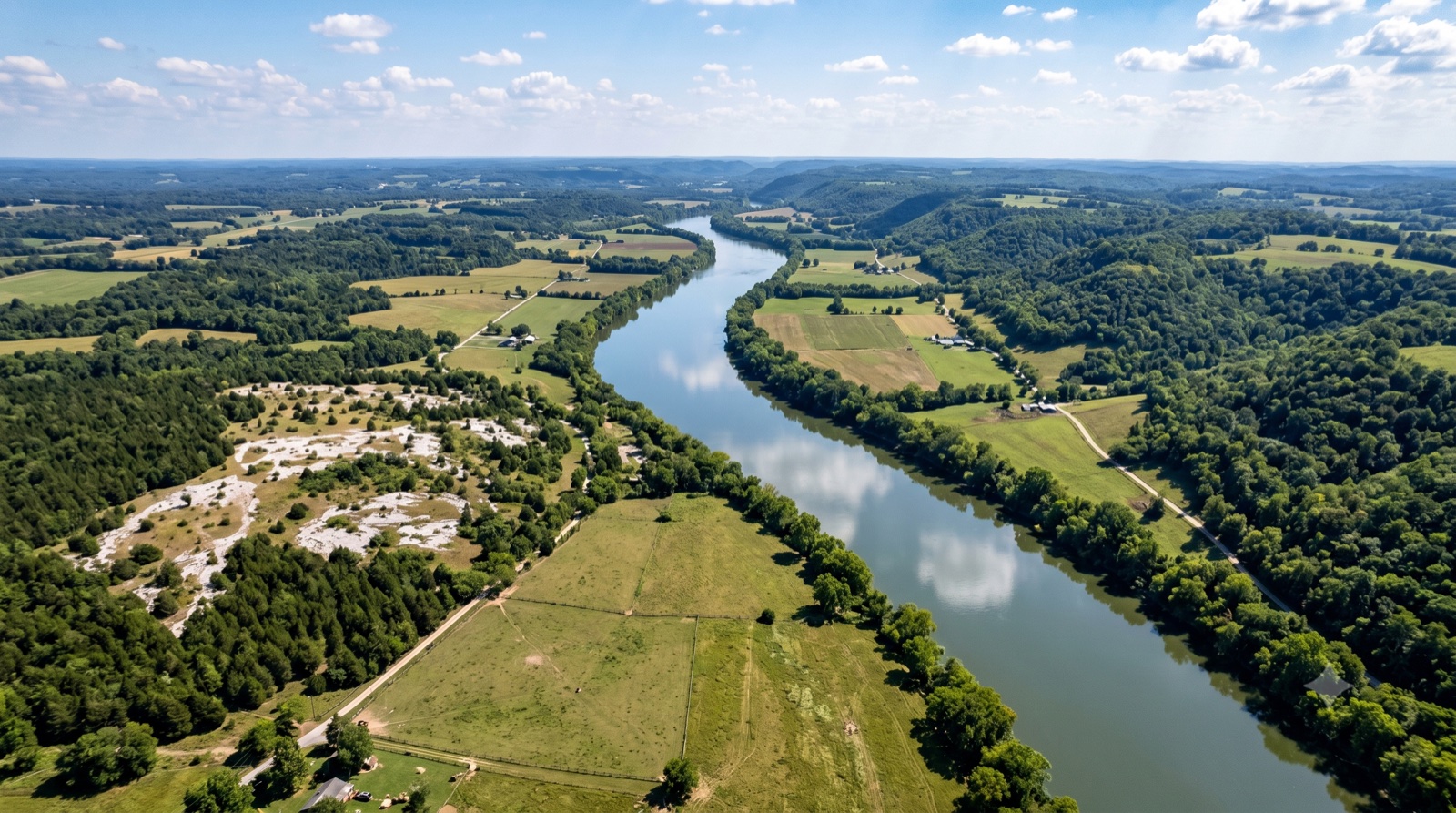
Selling land in Franklin County means recording your deed with the Register of Deeds in Winchester, paying Tennessee's realty transfer tax, and — if your land touches Tims Ford Lake — understanding that the shoreline carries a federal permitting layer most sellers do not know exists. Franklin County occupies roughly 555 square miles in south-central Tennessee on the Alabama line, where flat, productive row-crop bottoms give way to the wooded escarpment of the Cumberland Plateau, with the county seat at Winchester.
Franklin is a growing county with a genuinely strong farm base, and it is unusual among the rural Tennessee counties in this region for having two distinct land markets rather than one. There is the agricultural county — 71,055 acres of cropland, the largest cropland base among its neighbors, producing soybeans, corn, and a poultry sector that ranks sixth statewide. And there is the reservoir county, where parcels near Tims Ford Lake draw recreation-driven demand that back acreage five miles inland does not see.
Sellers get into trouble when they assume the second market's demand applies to the first market's land. It does not, and being honest about which one your parcel sits in is the single most useful thing you can do before pricing it.
This guide covers Tennessee's assessment and Greenbelt rules, the TVA shoreline question, the closing process in Franklin County, how the county compares with its neighbors, and your realistic options. For the statewide process, see how to sell land in Tennessee. For more guides, browse the blog.
What Are the Tax Costs of Holding Land in Franklin County?
Tennessee assesses farm and residential property at 25% of appraised value, commercial and industrial property at 40%, and public utility property at 55%, according to the Tennessee Comptroller of the Treasury and Tennessee Code Annotated § 67-5-801. Your bill applies the county rate to that assessed portion, not to full appraised value.
We are not publishing an "effective property tax rate" for Franklin County. The private sites that publish one disagree with each other and with the arithmetic implied by the county's own certified rate, and none of them is the county. For the figure that will appear on your bill, contact the Franklin County Property Assessor at (931) 967-3869 for your appraised and assessed values, and the Franklin County Trustee for the current rate and payment status.
Greenbelt and the Rollback That Lands at Closing
Tennessee's Agricultural, Forest and Open Space Land Act of 1976 — Greenbelt — lets qualifying land be assessed on use value instead of market value. Minimum tract size is 15 acres for agricultural land, 15 acres for forest land, and 3 acres for open space, and no owner may enroll more than 3,000 acres in one taxing jurisdiction, per the Tennessee Comptroller.
When land is disqualified — converted to a non-qualifying use, subdivided below the threshold, or otherwise failing to meet requirements — rollback taxes recapture the difference between use-value and market-value assessment for the preceding three years on agricultural and forest land, and five years on open space land, according to the Comptroller and UT's County Technical Assistance Service.
Franklin County is exactly the kind of place this bites. A cropland tract near the lake or near Winchester is a plausible development or recreation target, and a buyer's intended use is precisely what disqualifies Greenbelt. If your parcel is enrolled and your likely buyer is not going to keep farming it, the rollback is a real number that belongs in the purchase agreement rather than on the settlement statement as a surprise. Get your enrollment date and classification from the Property Assessor first, and see how property tax reassessment affects selling land for the broader mechanics.
What Do TVA Shoreline Rules Mean If My Land Touches the Lake?
If your parcel adjoins a TVA reservoir, you cannot assume the shoreline is yours to develop — a federal permit governs work there, and it is granted by TVA rather than by the county. TVA's published shoreline-construction guidance states that individual residential landowners wishing to construct facilities, clear vegetation, or maintain an access corridor on adjacent TVA-owned land must apply for and obtain a Section 26a permit before doing any of it.
The regulated category is broad. TVA's materials list boat docks, piers, boathouses, buoys, floats, boat launching ramps, fills, water intakes, effluent-discharge devices, bridges, aerial cables, culverts, pipelines, fish attractors, shoreline stabilization projects, channel excavations, and floating cabins among the "obstructions" that require approval. TVA defines an obstruction, in substance, as any man-made physical condition that after completion impounds, checks, hinders, restricts, retards, diverts, or otherwise interferes with the movement of water or of objects on or in the water.
There is an important narrowing that cuts the other way, and sellers should know it because it is frequently overstated in listing copy: vegetation removal or modification on privately owned shoreland that is merely subject to a TVA flowage easement generally does not require TVA approval, unless the work creates an actual obstruction or deposits material on TVA easement land. The permit requirement attaches to obstructions and to work on TVA-owned land — not to every activity near the water.
A disclosure about our sourcing here: TVA's website blocks automated access, so we were unable to load these pages directly and are relying on TVA's own published wording as indexed. The substance is TVA's, but before you represent anything about your shoreline to a buyer — or before you build a dock — confirm it with TVA directly and get your parcel's specific jurisdictional status in writing. We are also deliberately not publishing a surface-acreage or shoreline-mileage figure for Tims Ford Lake: the numbers circulating on real-estate and tourism sites could not be confirmed against a TVA or Tennessee State Parks source, so we are leaving them out rather than repeating them.
For a seller, the practical consequence is simple. Waterfront proximity is an asset, but a buyer who plans a dock is buying a permitting process, not a guarantee. Sellers who find out their parcel's status early can answer that question confidently; sellers who do not tend to lose the buyer at diligence.
What Closing and Recording Rules Apply in Franklin County?
Tennessee conveys real property by deed recorded with the county Register of Deeds, and Franklin County's office is at 1 South Jefferson Street in Winchester, reachable at (931) 967-2840. Tennessee imposes a realty transfer tax of $0.37 per $100 of consideration or property value, whichever is greater, under Tennessee Code Annotated § 67-4-409, per the Tennessee Department of Revenue, plus a separate recordation tax of $0.115 per $100 of indebtedness, less the first $2,000, when the purchase is financed.
Tennessee does not require an attorney at closing, and many rural land sales close through a title company. On a Greenbelt-enrolled farm tract, a parcel with lake frontage, or land with an unprobated estate behind it, an attorney review is generally worth the cost.
A typical Franklin County closing runs:
- Pull the deed and legal description at the Register of Deeds, (931) 967-2840.
- Confirm appraised value, assessment class, and Greenbelt status with the Property Assessor, (931) 967-3869.
- Verify taxes are current with the Trustee.
- Establish TVA jurisdictional status if any boundary touches the reservoir.
- Resolve title defects — unprobated estates, undocumented farm access, and old unreleased liens are the recurring three here.
- Allocate the Greenbelt rollback in the purchase agreement if the buyer's use will disqualify the land.
- Close and record, paying the transfer tax at recording.
If back taxes are involved, sell land with back taxes covers how to handle them before a title examiner finds them.
How Does Franklin County Compare to Neighboring Tennessee Counties?
Franklin County has the most cropland-weighted farm base among its Tennessee neighbors and is the only one of the four whose agricultural land base is expanding rather than holding flat or shrinking. All figures below are from the 2022 USDA Census of Agriculture and are directly comparable.
| Factor | Franklin County | Moore County | Lincoln County | Grundy County |
|---|---|---|---|---|
| Population (recent est.) | ~46,000 | ~7,000 | ~36,800 | ~14,100 |
| Population trend | Growing | Growing slowly | Growing | Roughly flat |
| County seat | Winchester | Lynchburg | Fayetteville | Altamont |
| Land in farms (2022) | 115,142 acres | 63,825 acres | 270,934 acres | 29,669 acres |
| Change in land in farms | +2% | — | Flat | −12% |
| Largest land-in-farms use | Cropland (71,055 ac) | Woodland (29,522 ac) | Cropland (97,864 ac) | Woodland (11,605 ac) |
| Farm sales mix | 51% livestock/poultry | 89% livestock/poultry | 71% livestock/poultry | 61% livestock/poultry |
| Statewide standout | #6 in poultry and eggs; #4 in nursery and sod | Jack Daniel Distillery is the county's largest employer | #1 in cattle and calves sales | Smallest and fastest-contracting farm base of the four |
What the Numbers Say About Who Will Actually Buy Your Tract
Franklin County's agriculture is doing well, and doing well in a specific way. The county sold $133.5 million in agricultural products in 2022, up 84% in five years, with sales split almost evenly between crops at 49% and livestock and poultry at 51%. Poultry and eggs at $61.1 million rank sixth in Tennessee. Less obviously, nursery, greenhouse, floriculture, and sod at $20.4 million rank fourth statewide — an unusual specialty that depends on good bottomland soils and irrigation, and one that gives Franklin a genuine buyer class most rural counties lack.
Cattle, by contrast, is minor here at $5.9 million, ranked 46th. If you own pasture in Franklin County expecting to sell into a cattle market, the demand you are counting on is mostly in Lincoln County next door.
Underneath the growth, the same consolidation shows up: farm count fell 16% between 2017 and 2022 while land in farms rose 2% and average farm size rose 22% to 168 acres. Fewer, larger operations. That pattern points your most likely agricultural buyer toward ground adjoining what they already farm.
So the realistic buyer map in Franklin County looks like this. Productive cropland with irrigation potential competes for row-crop and nursery-sod operators and has genuine competition. Lake-adjacent parcels draw recreation buyers, subject to the TVA question above. Wooded escarpment ground away from both is the slowest of the three and behaves much more like neighboring Grundy County, where the farm base is actively contracting. Knowing which of the three you own is worth more than any marketing tactic.
If your parcel is farmland you no longer work, should I sell my farmland weighs lease income against a sale. If it floods or sits low along the river bottoms, see sell swamp or bottomland that floods. Neighboring Lincoln and Moore counties round out the regional picture.
What Are Your Options for Selling Land in Franklin County?
You have three realistic paths: list with a broker experienced in middle Tennessee farm and lake property, sell privately to an adjoining operator, or take a direct cash offer. Franklin County's two-market structure makes the choice more consequential here than in a uniform rural county — a broker who knows the lake market may not be the right one for irrigated bottomland, and vice versa.
Gather your facts first. The Franklin County Register of Deeds, Denise Ingle Marshall, is at 1 South Jefferson Street, Winchester, TN 37398, phone (931) 967-2840 — deeds and chain of title. The Franklin County Property Assessor, Monica Jeffers, is at No. 1 South Jefferson Street, Room 101, Winchester, TN 37398, phone (931) 967-3869 — appraised value, assessment class, and Greenbelt status. The Franklin County Trustee handles tax collection and current rates through the county's trustee portal.
Listing works well for productive cropland or a clean lake-adjacent parcel where a broker can reach the right buyer class. Expect a real marketing period; how long does it take to sell land sets expectations. A private sale to an adjoining operator is often the cleanest outcome for farm ground in a consolidating county.
A direct cash sale fits when the complications outweigh the marketing upside — an estate to settle, a Greenbelt rollback nobody wants to negotiate, unresolved TVA shoreline questions, heirs in different states, a wooded tract on the escarpment that brokers have passed on, or an owner who does not want to carry another year of taxes. Request a no-obligation cash offer on your Franklin County land. We buy cropland, pasture, wooded, and hard-to-access tracts, we price each parcel on its own characteristics rather than by formula, and we cover closing costs.
Frequently Asked Questions
My land touches Tims Ford Lake — can I tell buyers they can build a dock?
Not without checking first. TVA's published shoreline-construction guidance requires a Section 26a permit before constructing facilities, clearing vegetation, or maintaining an access corridor on adjacent TVA-owned land, and it treats docks, piers, boathouses, ramps, fills, and shoreline stabilization as regulated obstructions. A buyer who plans a dock is buying a permitting process, not a guarantee. There is a narrowing worth knowing: vegetation work on privately owned shoreland merely subject to a TVA flowage easement generally does not need TVA approval unless it creates an obstruction or deposits material on easement land. Get your parcel's jurisdictional status from TVA in writing before you market it as buildable waterfront.
I inherited farmland near Winchester and live out of state — can I sell without traveling to Tennessee?
Yes. Tennessee conveys land by deed recorded with the county Register of Deeds, and your deed can be signed and notarized where you live, then recorded in Winchester. Tennessee does not require an attorney at closing and many rural sales close through a title company, so remote handling is routine. The usual obstacle is probate: if the land is still titled in a deceased relative's name, nobody can convey it until an estate is opened or the heirs are established of record. Confirm the current record owner with the Franklin County Register of Deeds at (931) 967-2840 before setting a timeline.
My Franklin County farm is in Greenbelt and the buyer wants to develop it — who pays the rollback?
Whoever your purchase agreement says pays it, which is exactly why it needs to be addressed in the contract. A sale alone does not trigger the rollback; disqualification does. If the buyer converts the land to a non-qualifying use, Tennessee recaptures the difference between use-value and market-value assessment for the preceding three years on agricultural and forest land, or five years on open space land, per the Tennessee Comptroller. That amount can be substantial on a tract that has been enrolled for years. Get the enrollment date and classification from the Property Assessor at (931) 967-3869 before you negotiate, so you are pricing a known number rather than an unknown one.
What does Tennessee charge in transfer tax when I sell land?
Tennessee imposes a realty transfer tax of $0.37 per $100 of consideration or the property's value, whichever is greater, under Tennessee Code Annotated § 67-4-409, according to the Tennessee Department of Revenue. If the buyer finances the purchase, a separate recordation tax of $0.115 per $100 of indebtedness applies, less the first $2,000. Ordinary recording fees are charged separately by the Register of Deeds, so ask for a combined total when you call (931) 967-2840.
Is Franklin County's population growing or declining?
Growing. Franklin County recorded 40,960 residents in the 2010 census and 42,774 in 2020, with recent estimates near 46,000. Its Tennessee neighbors Moore and Lincoln counties are also growing, while Grundy County to the north is roughly flat. For a land seller, growth means a real and expanding local buyer pool — but that demand concentrates around Winchester, the lake, and the productive bottomland, not evenly across every acre of the county.
Why does my wooded tract on the plateau move so much slower than lake property in the same county?
Because they are two different markets that happen to share a county line. Lake-adjacent land in Franklin County draws recreation buyers from well outside the area, while wooded escarpment ground competes in a much thinner pool that behaves like neighboring Grundy County, where the farm base contracted 12% and farm count fell 23% between 2017 and 2022. Franklin's agricultural strength is concentrated in cropland — 71,055 of its 115,142 farm acres — and in poultry and nursery-sod production, none of which creates demand for a wooded hillside. Your realistic buyers there are recreational buyers, adjoining owners, and direct cash buyers.
Disclaimer: This article is for informational purposes only and does not constitute legal, financial, or tax advice. Laws, tax rates, assessment ratios, Greenbelt rules, and TVA shoreline regulations change over time and vary by parcel. TVA Section 26a information here reflects TVA's published guidance and is not a substitute for a jurisdictional determination from TVA. Always confirm your parcel's assessment, Greenbelt status, and shoreline status with the Franklin County Property Assessor and TVA, and consult a licensed Tennessee attorney before making land sale decisions. Jerez Land is not responsible for actions taken based on this information.