Sell My Land in Hyde County NC - What Landowners Need to Know
Key Takeaways
- North Carolina charges a $2-per-$1,000 excise tax on deeds: Sellers pay $1 per $500 of the conveyed property value (equivalent to $2 per $1,000) to the Register of Deeds at closing, per N.C. Gen. Stat. § 105-228.30, according to HomeLight's North Carolina transfer tax guide
- Hyde County holds the lowest population density of any county in North Carolina: With 4,589 residents recorded in the 2020 Census across 612 square miles of land — a density of 7.49 people per square mile — Hyde County is the most sparsely populated county in the state, and its population fell by roughly 21.7% between 2010 and 2020, according to U.S. Census Bureau data
- Over half of Hyde County's total area is water: The county covers approximately 1,459 square miles in total, of which about 847 square miles is water — including the 40,000-acre Lake Mattamuskeet, the largest naturally occurring lake in North Carolina, which sits entirely within Mattamuskeet National Wildlife Refuge, according to the U.S. Fish & Wildlife Service
How Can You Sell Land in Hyde County North Carolina?
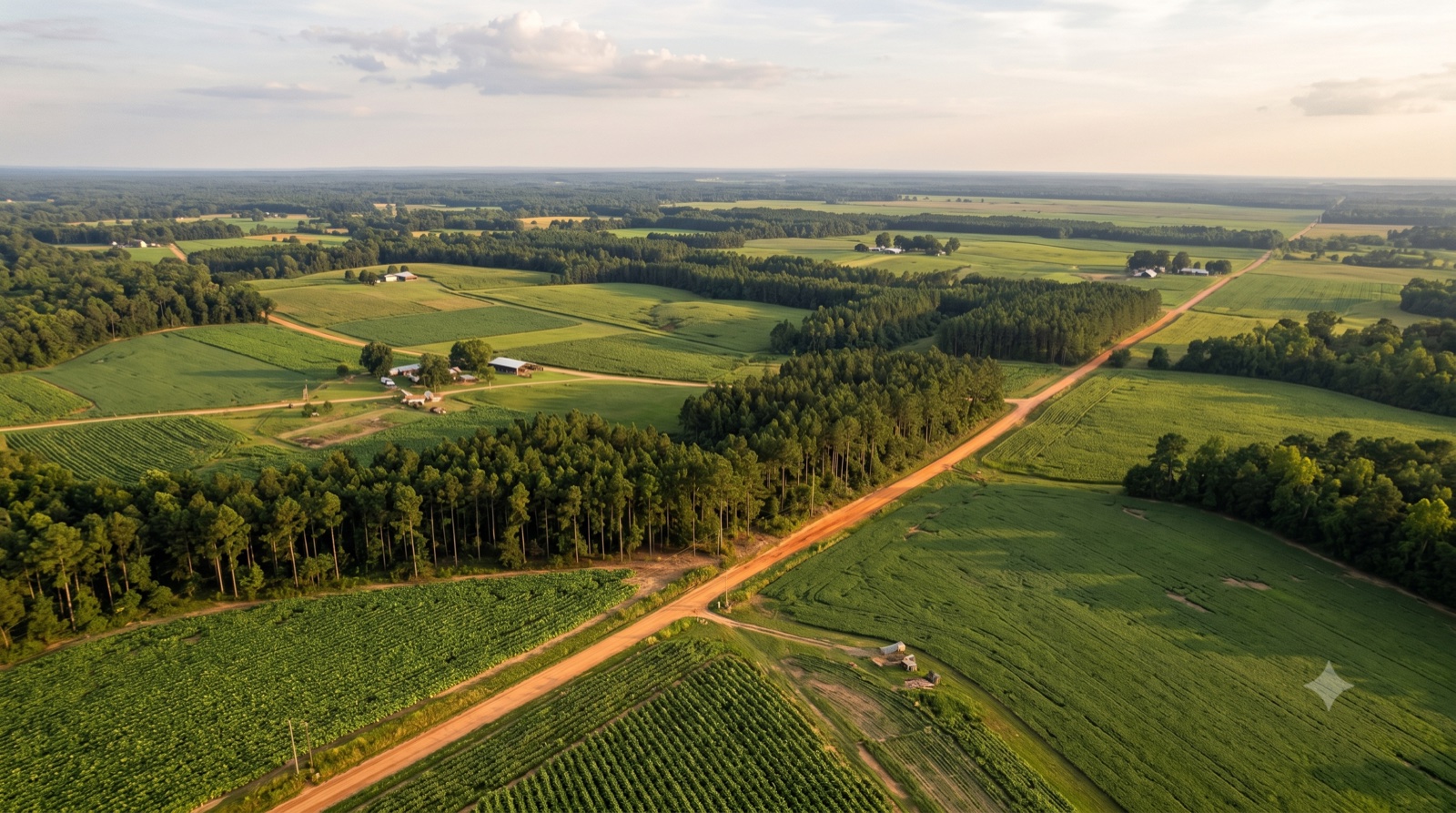
You can sell land in Hyde County through a licensed North Carolina attorney, who is required by state law to supervise the closing, examine title, prepare the deed, and record it with the Register of Deeds. As the seller, you pay a $2-per-$1,000 excise tax to the Register of Deeds at closing and must verify Present-Use Value enrollment status to understand any tax-deferral rollback exposure. Selling land in Hyde County, North Carolina means selling into one of the most distinctive and ecologically complex land markets in the entire state. Hyde County occupies the Outer Banks and mainland coastal plain south of Dare County, separated from the Outer Banks barrier islands by Pamlico Sound. Its geography is shaped by water — Lake Mattamuskeet's 40,000 acres, the brackish marsh of the Swanquarter National Wildlife Refuge, miles of pocosin peat-soil wetlands, and flat tidal farmland that has been drained and cultivated for generations. Ocracoke Island, one of the most isolated and celebrated communities in North Carolina, is the county's most recognizable landmass despite being accessible only by ferry.
With just 4,589 residents in the 2020 Census and a population density of 7.49 people per square mile, Hyde County is North Carolina's least densely populated county — a fact that shapes the land market in every direction. The natural buyer pool for any given parcel is extraordinarily thin. Large federal refuges and state conservation lands lock up vast acreage from private transaction. The agricultural tracts that remain in private hands are subject to flood risk, soil drainage limitations, and the PUV-deferral tax exposure common to eastern NC farmland. Understanding these dynamics before you sell is not optional — it is the difference between a realistic price expectation and months of frustration.
This guide covers North Carolina's property tax system and the Present-Use Value deferral program that applies to qualifying farmland and forestland in Hyde County, the state's attorney-closing requirement and what it means for your timeline, how Hyde County compares to neighboring Beaufort, Dare, and Tyrrell counties, and the practical steps for completing a land sale. For a broader overview of the process across the state, visit our guide on how to sell land in North Carolina.
What Are the Property Tax and Carrying Costs of Holding Land in Hyde County?
North Carolina assesses all real property — including vacant land — at 100% of fair market value, unlike states that apply fractional assessment ratios. The county then applies its published rate per $100 of that assessed value. According to the North Carolina Department of Revenue's 2025-2026 county tax rate schedule, Hyde County's rate is $0.9200 per $100 of assessed value — among the higher rates in the eastern part of the state. The county's next scheduled reappraisal is 2030, meaning current assessed values reflect market conditions as of the last revaluation cycle rather than any current uptick or softness in land pricing.
For context, the North Carolina statewide average effective property tax rate runs approximately 0.77%, and the national average sits around 1.02%. Hyde County's published rate of $0.92 per $100 puts the nominal rate well above the state average, though individual effective rates depend on what a parcel assessed to — and on whether it is enrolled in the Present-Use Value deferral program.
For landowners carrying back taxes on a Hyde County parcel, resolving delinquency before listing is essential. Tax liens appear in every title search and must be satisfied at closing. Hyde County's online bill search at bcpwa.ncptscloud.com/hydetax allows property owners to look up outstanding balances before initiating a sale.
How the Present-Use Value (PUV) Program Can Reduce Your Tax Bill
North Carolina's Present-Use Value program, authorized under N.C. Gen. Stat. §§ 105-277.2 through 105-277.7, allows qualifying agricultural, horticultural, and forestland to be assessed on its income-producing value rather than market value. According to the NC Forest Service, this program can reduce property taxes by up to 90% for eligible parcels. In Hyde County — where working farmland, timber tracts, and drainage-dependent row-crop fields make up the bulk of private acreage outside the federal refuges — a meaningful share of the county's privately held land is enrolled in PUV.
To qualify, a parcel must meet minimum acreage thresholds: 10 acres for field crops or pasture, 5 acres for horticultural use, and 20 acres under a qualified timber management plan. It must also generate at least $1,000 in gross annual income for crop and horticultural land. Applications are due by January 31 each year with the county Tax Assessor. If ownership changes or the land is converted to a non-qualifying use, deferred taxes from the current year plus the three prior years become immediately due with interest — a "rollback" that can be a meaningful, often overlooked cost when an enrolled tract changes hands.
For out-of-state owners who may have inherited a Hyde County parcel and are unfamiliar with PUV enrollment, our guide on selling land as an out-of-state owner covers how to confirm enrollment status and estimate rollback exposure before accepting any offer.
Hyde County Tax Department Contact
Hyde County Tax Department | 30 Oyster Creek Rd, PO Box 188, Swan Quarter, NC 27885 | Tax Administrator: Donnie Shumate, (252) 926-4474 | Tax Assessor / Land Records: Tommy Taylor, (252) 926-4187 | Tax Collector: Ryan Bishop, (252) 926-4190 | Fax: (252) 926-3709 | Website: hydecountync.gov/departments/tax_dept.php
What Closing and Zoning Requirements Apply in Hyde County?
North Carolina is an attorney-close state. Under established North Carolina case law and State Bar opinions, a licensed North Carolina attorney must conduct or supervise every real estate closing — including reviewing title, preparing the deed, coordinating payoffs, and recording the deed with the Register of Deeds. A title company can issue title insurance but cannot replace the attorney's legal role in a North Carolina transaction.
The closing sequence for a Hyde County land sale typically works as follows: the buyer's (or seller's, if agreed) attorney orders a title search through Hyde County's deed records, resolves any clouds on title, prepares a warranty deed, and schedules the closing. The seller pays the excise tax — $1 per $500 of the sale price, or $2 per $1,000 — directly to the Register of Deeds when the deed is recorded. This tax is conventionally a seller cost in North Carolina transactions, according to HomeLight's transfer tax analysis. Our guide on how to sell land in North Carolina walks through the full attorney-supervised closing process step by step.
Zoning, Flood Risk, and Federal Overlay in Hyde County
Hyde County is one of the most heavily overlaid counties in North Carolina from a land-use restriction standpoint. Landowners and buyers face several layers of regulatory consideration beyond standard county zoning:
Federal refuge adjacency. The Mattamuskeet National Wildlife Refuge (50,173 acres) and the Swanquarter National Wildlife Refuge (16,411 acres) together place a large footprint of restricted land in the county. Private tracts adjacent to refuge boundaries may face buffer expectations from conservation buyers but can also attract hunting and wildlife-oriented purchasers who value the proximity.
Flood and wetland designations. Much of Hyde County's privately held land — particularly on the mainland — sits in FEMA flood zones and contains jurisdictional wetlands under Army Corps of Engineers Section 404 authority. Development of any kind on wetlands requires a federal permit, a multi-month process that strongly limits the development potential of a given tract.
Drainage district assessments. Agricultural land in Hyde County is often within drainage districts that levy annual assessments to maintain canal and ditch systems essential to farmland productivity. These assessments run with the land, appear as a separate charge on tax bills, and must be disclosed to buyers.
Pocosin soils. Tracts with deep peat-soil pocosin conditions are essentially undevelopable without significant engineering. Their value lies in timber, hunting, or conservation acquisition — and buyers for those uses move slowly and make low offers relative to what owners often expect.
Hyde County Register of Deeds | 30 Oyster Creek Rd, Room 112, PO Box 294, Swan Quarter, NC 27885 | Register of Deeds: E. Merita Lewis-Spencer | Phone: (252) 926-4182 | Fax: (252) 926-3710 | Email: mspencer@hydecountync.gov | Assistant: Rhonda Wheeler, (252) 926-4183
How Does Hyde County Compare to Neighboring North Carolina Counties?
Hyde County's population fell from 5,812 in the 2010 Census to 4,589 in 2020 — a decline of roughly 21.7%, which is among the steeper declines of any county in North Carolina during that decade. The county lost its only hospital in 2014 and has no incorporated municipalities. Its median household income of approximately $47,338 (2023 ACS estimate) and a poverty rate approaching 22% — well above the national average of about 12.5% — reflect the depth of economic distress in a county where agriculture, fishing, and tourism are the primary economic pillars. These dynamics produce a steady stream of landowners who need to sell but face a drastically limited local buyer pool.
| Factor | Hyde County | Beaufort County | Dare County | Tyrrell County |
|---|---|---|---|---|
| Population (2024 est.) | ~4,400 | ~44,600 | ~29,761 | ~3,500 |
| Population trend | Declining (−21.7% 2010–2020) | Stable / modest decline | Stable | Slowly growing |
| County tax rate (per $100) | $0.9200 | $0.4450 | $0.2632 | $0.8700 |
| Primary land character | Marsh, refuge, coastal farmland | River-bottom farmland, timber | Outer Banks / beach | Pocosin, swamp timber |
| Key selling challenge | Extreme buyer scarcity; flood/wetland overlays | Moderate rural market | Tourism inflates land price expectations | Similar to Hyde; even fewer buyers |
The contrast with Dare County is instructive: Dare's Outer Banks geography and the Hatteras Island and Nags Head tourism economy push land price expectations far above what rural coastal landowners typically achieve, while Dare's tax rate ($0.2632 per $100) is roughly a quarter of Hyde's. Beaufort County — the county seat of Washington sits at the confluence of the Tar and Pamlico rivers — has a more developed inland land market and a meaningfully larger population base. Tyrrell County, Hyde's neighbor to the north, shares many of the same challenges: deep pocosins, thin buyer pool, and a very small tax base.
Motivated-Seller Patterns in Hyde County
Several patterns concentrate motivated sellers in Hyde County. The county's extraordinary population decline — it has lost nearly half its peak population of 9,278 (recorded in 1900) — means that family land holdings from earlier agricultural generations now pass to heirs who have relocated elsewhere in North Carolina or out of state entirely. Absentee ownership is pervasive. Inherited parcels of coastal farmland, drainage-district wetlands, and cut-over timber tracts frequently sit idle for years, accumulating taxes and drainage assessments, because the heirs have no connection to the local land market and no clear path to a sale. For guidance on that specific situation, see our guides on how to sell inherited land and selling wetlands.
For hunting land and refuge-adjacent tracts with waterfowl, deer, or bear hunting value, the buyer pool — while not large — is motivated and willing to pay for access to the kind of undisturbed marsh habitat that Hyde County offers. Understanding which category your parcel falls into shapes every decision about how to price and market it.
For more county-level land analysis across North Carolina and the Southeast, explore our blog.
What Are Your Options for Selling Land in Hyde County?
In a county with fewer than 4,400 residents, no incorporated towns, and some of the most complex land-use overlays in the state, the practical options for selling land narrow quickly. The natural buyer pool — working farmers, hunting lessees, conservation organizations, and very occasional developers — is small and moves on its own timeline.
Listing with a real estate agent gives your parcel the broadest exposure through the MLS and land-specific platforms such as Land.com and LandWatch. Finding an agent with genuine knowledge of eastern North Carolina land — one who understands FEMA flood zones, drainage district assessments, and refuge-adjacency dynamics — is harder in Hyde County than in more populated areas. Commissions typically run 5–6% of the sale price, and rural coastal parcels in a thin market can sit listed for well over a year. For farmland tracts with active agricultural leases or working drainage infrastructure, an agent experienced with eastern NC agricultural properties matters significantly.
For Sale By Owner (FSBO) and online platforms like Land.com and LandAndFarm reach buyers nationally — which matters in a county where the local buyer pool is so thin that most realistic purchasers will come from outside the county. Marketing a Hyde County parcel effectively requires clear documentation of flood zone status, wetland jurisdictional status, drainage district assessments, PUV enrollment, and any conservation easement or refuge boundary notes. Buyers unfamiliar with the county will not take the time to research these issues on their own.
Working with a direct cash buyer like Jerez Land means skipping the listing period, agent commissions, and the uncertainty of buyer financing. We make parcel-specific, firm written offers based on a full review of your property — location, access, flood designation, wetland coverage, encumbrances, soil and use designations, drainage district status, and condition — and we absorb the carrying costs, marketing expense, and resale risk. Our offers are not formulas; they reflect what we can actually do with your specific land. If you have inherited land, are dealing with title complications from absentee ownership, or face PUV rollback exposure, we are experienced in working through those situations in North Carolina attorney-closing states.
To reach the Hyde County Register of Deeds for deed history or parcel information before initiating a sale, contact E. Merita Lewis-Spencer at (252) 926-4182. For tax records and PUV status, contact the Tax Department at (252) 926-4474.
Request a cash offer to get a specific number on your Hyde County parcel, or read our full guide on how much your land is worth before deciding.
Frequently Asked Questions
How do I sell my land in Hyde County fast?
The fastest path to closing on a Hyde County parcel is working with a direct cash buyer who does not require mortgage financing. Cash closings eliminate lender timelines and can often close in two to four weeks once title is clear. Before any sale, confirm your property's legal description with the Hyde County Register of Deeds at (252) 926-4182, verify there are no delinquent taxes or unpaid drainage district assessments through the Tax Department at (252) 926-4474, and check whether the land is enrolled in the Present-Use Value program, since deferred-tax rollback may come due at closing.
When I'm selling land in North Carolina, who pays the closing costs?
In North Carolina, the seller conventionally pays the excise tax (revenue stamps) at $1 per $500 of sale price, which equals $2 per $1,000. Attorney fees and title search costs are typically split by negotiation or paid by the buyer. There is no fixed statewide rule beyond the excise tax obligation, so closing cost allocation is addressed in the purchase contract.
Do I need an attorney to sell land in North Carolina?
Yes. North Carolina requires a licensed attorney to supervise every real estate closing — this is not optional or waivable by the parties. The attorney conducts the title examination, prepares the deed, coordinates the disbursement of funds, and records the deed with the county Register of Deeds. Closing cannot be completed by a title company alone.
What property tax rate will I pay on my Hyde County land?
Hyde County's rate is $0.9200 per $100 of assessed value for fiscal year 2025-2026, according to the North Carolina Department of Revenue. The next scheduled reappraisal for Hyde County is 2030. Land enrolled in the Present-Use Value program is taxed on income-producing capacity rather than market value, which can significantly reduce the annual tax obligation on qualifying agricultural, horticultural, or forestland parcels.
What is the Present-Use Value program and how does it affect my land sale?
North Carolina's PUV program allows qualifying agricultural, horticultural, and forest land to be taxed on its income-producing value rather than market value — potentially reducing taxes by up to 90%, according to the NC Forest Service. If you sell PUV-enrolled land, deferred taxes from the current year and the three prior years can become due immediately at closing. This rollback obligation is a real cost that affects your net proceeds and should be confirmed with the Hyde County Tax Assessor at (252) 926-4187 before you accept any offer.
I own a small parcel or wetland tract in Hyde County — how hard is it to sell?
Yes, for most parcel types, it is quite difficult. Hyde County has the lowest population density of any county in North Carolina, which means the local buyer pool is extremely thin. Wetland-heavy parcels, pocosin tracts, and drainage-district farmland with flood zone designations face the most difficulty, because buyers must perform substantial environmental due diligence before committing. Hunting and refuge-adjacent tracts with documented wildlife value attract a more motivated national buyer pool. Many owners of idle or inherited Hyde County land ultimately find that a direct cash sale is the only practical path to closing within a reasonable timeframe.
Disclaimer: This article is for informational purposes only and does not constitute legal, financial, or professional advice. Laws and regulations vary by jurisdiction and change over time. Always consult with qualified professionals before making land purchase decisions. Jerez Land is not responsible for actions taken based on this information.