
Sell My Land in Macon County AL - What Landowners Need to Know
Key Takeaways
- Macon County sits in the heart of Alabama's Black Belt and produced more than $26 million in agricultural sales in 2022: According to the USDA 2022 Census of Agriculture, the county's 322 farms span 115,773 acres — with market value of products sold up 34% since 2017, driven 91% by crops on the region's famously fertile dark soils
- Population has declined roughly 15% since 2010: Macon County's population fell from 21,452 in 2010 to 19,532 in 2020 and an estimated 18,159 in 2024, a loss of about 3,293 residents over 14 years, according to U.S. Census Bureau data
- Alabama's deed recording tax is $0.50 per $500 of property value: The state imposes one of the lowest deed transfer tax rates in the Southeast, totaling approximately $100 per $100,000 of sale price, according to ListWithClever
How Can You Sell Land in Macon County Alabama?
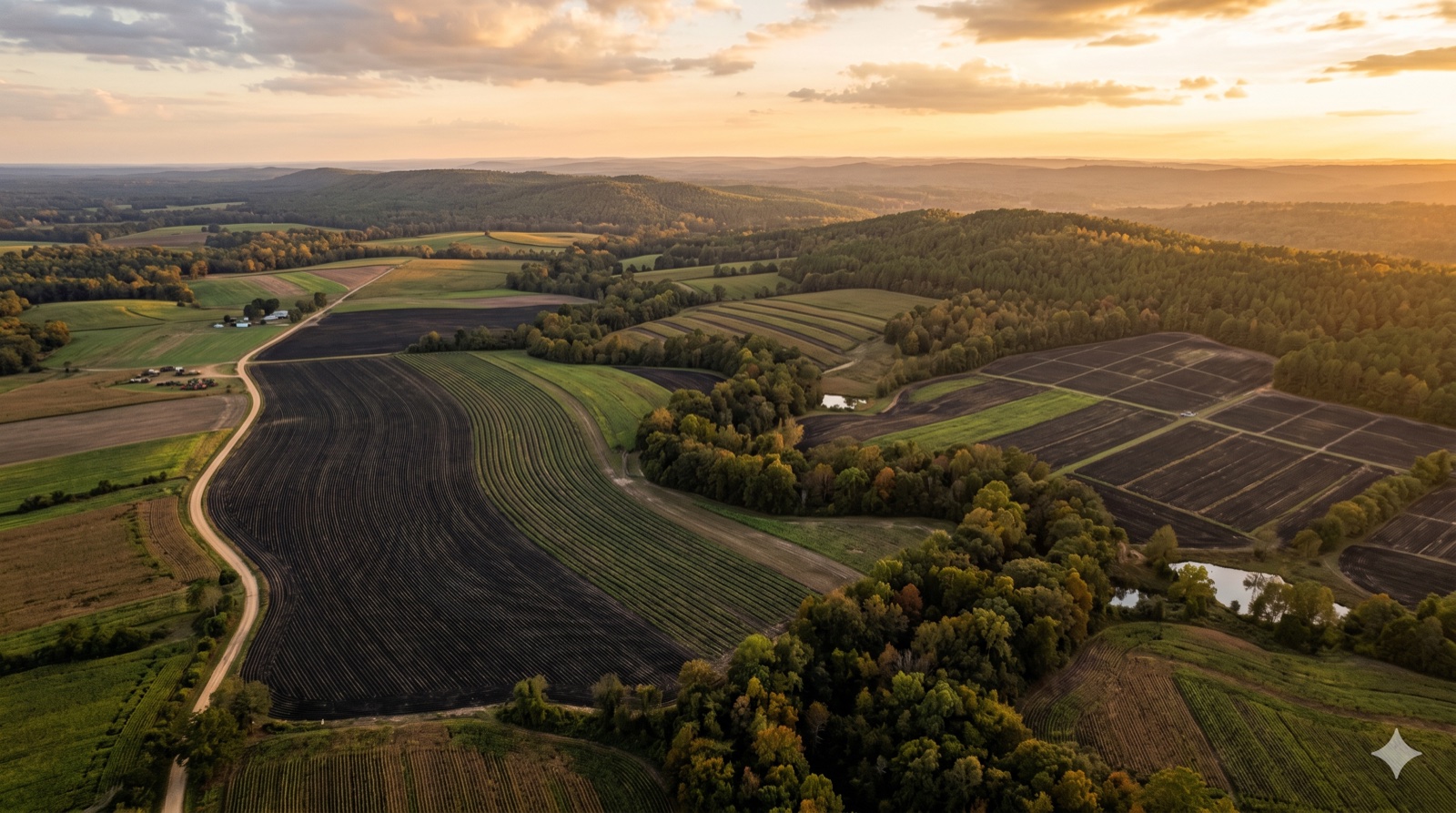
To sell land in Macon County, you can list with an agent, use online platforms, or seek a direct cash offer — all involve navigating Alabama's attorney-managed closing process and a $0.50 per $500 deed recording tax. Selling land in Macon County, Alabama involves a process shaped by the state's attorney-required closing rules, a low deed recording tax of $0.50 per $500 of value, and a rural market anchored by Black Belt row-crop agriculture, hardwood creek bottoms, and a strong trophy-whitetail hunting culture. The county covers roughly 610 square miles of fertile prairie soils, pine ridges, and creek-bottom hardwoods surrounding Tuskegee, the county seat and home to historic Tuskegee University.
This guide covers Alabama's property tax classification system and how it affects Macon County landowners, the county's land use framework, how the local market compares to neighboring counties, and practical steps for selling your land — including what to expect from the attorney-managed closing process. For a broader look at selling acreage statewide, start with our guide on how to sell land in Alabama, and explore more articles on our blog.
What Are the Tax Costs of Holding Land in Macon County?
Alabama uses a four-class property tax system, and the class your land falls into determines how much you pay each year. Under Alabama Code § 40-8-1, vacant land that is not otherwise classified is assessed as Class II property at 20% of fair market value, according to the Alabama Department of Revenue. Agricultural land and forestland that qualifies for the state's Current Use program, however, is reclassified as Class III property and assessed at just 10% of current use value — a significant difference for rural landowners.
Macon County's median effective property tax rate is approximately 0.49%, with a median annual tax bill of about $468, according to PropertyTaxRates. That places the county well below the national median effective rate of roughly 1.02%, though slightly above the Alabama state average. The county's real property millage is applied against assessed value, which is itself a fraction of market value under the class system.
How Property Tax Bills Add Up for Vacant Land
For a vacant parcel assessed as Class II (no Current Use designation), every $100,000 of appraised market value produces a $20,000 assessed value. At a combined millage rate that varies by taxing district but typically encompasses county, school, and state levies, the annual bill on a bare land parcel is modest compared to most states — but it is a recurring cost on land that may produce no income.
Alabama's Current Use program, established in 1978 and administered by the Alabama Department of Revenue, allows owners of five or more acres of farmland, pastureland, or timberland to apply for Class III valuation based on actual use rather than market value. The Department of Revenue values Alabama timberland at $360 to $827 per acre depending on productive capacity, using weighted average pulpwood stumpage prices from the Alabama Forestry Commission. Once approved, reapplication is not required each year — but new owners after a sale must reapply, or the property reverts to market value assessment. A rollback tax covering up to three prior years applies if the land is converted to non-qualifying use within two years of sale.
Beyond property taxes, vacant landowners face liability exposure, potential maintenance costs on fenced or cleared parcels, and in heavily timbered areas, the risk of storm or pine beetle damage to standing timber. If you are carrying land with ongoing costs and no near-term plan, it may be worth requesting a no-obligation cash offer to understand your exit options before another tax bill arrives.
If you are weighing whether to handle a sale yourself or hire a broker, our guide on whether you need a realtor to sell land breaks down the trade-offs for rural parcels.
What Zoning and Closing Rules Apply to Macon County Land?
Much of Macon County's rural acreage sits outside any municipal zoning jurisdiction. Alabama does not have a mandatory statewide zoning framework, and many rural Alabama counties operate without comprehensive county-wide zoning ordinances. Within the county's incorporated municipalities — including Tuskegee (the county seat) and Notasulga — municipal zoning districts apply. Outside those boundaries, land use is governed primarily by deed restrictions, health department requirements for septic systems, and floodplain regulations along the county's creek and river corridors. Buyers considering development should verify current local requirements directly with the Macon County Commission before any purchase.
Alabama's Attorney-Required Closing Process
Alabama is an attorney-closing state. Under Alabama Code § 34-3-6(c), a licensed Alabama attorney must prepare and review all legal documents in a real estate transaction — including the deed, title opinion, and closing statement, according to the Alabama Closing Process Guide published by Freedom Residential. Unlike some states where title companies handle closings independently, Alabama's attorney requirement applies to all real property conveyances.
The typical Alabama land closing process works as follows:
- Title search: An abstractor searches public land records through the Macon County Probate Office to verify clear title, identify any liens, encumbrances, or easements, and confirm chain of ownership
- Title opinion: The closing attorney issues a written title opinion certifying marketability of title
- Title insurance: The buyer may purchase an owner's title insurance policy to protect against defects not discovered in the standard search
- Closing and deed preparation: The attorney prepares the warranty deed, settlement statement, and other required documents; all parties execute at closing
- Recording: The attorney records the deed and any other instruments with the Macon County Probate Office (Judge James Cooper, Judge of Probate, 101 E. Rosa Parks Avenue, Suite 101, Tuskegee, AL 36083; 334-724-2552)
Alabama's deed recording tax is $0.50 per $500 of property value (or fraction thereof), equivalent to 0.10% of the sale price, according to ListWithClever. On a $50,000 land sale, the recording tax totals $50. The buyer typically pays this cost, though responsibility is negotiable. Alabama also charges a mortgage tax of $0.15 per $100 on financed amounts, which applies only to financed transactions.
For an out-of-state owner managing an Alabama parcel remotely, our guide on selling land as an out-of-state owner covers how to coordinate an attorney closing without traveling to the county.
How Does Macon County Compare to Neighboring Alabama Counties?
Macon County's population of an estimated 18,159 has declined steadily — down from 21,452 in 2010 to 19,532 in 2020 to the current estimate — a loss of roughly 3,293 residents, or about 235 per year on average, according to U.S. Census Bureau data. The decline reflects long-term agricultural restructuring, limited industrial diversification, and out-migration of working-age residents common across the rural Black Belt. The county's median household income of approximately $43,700 sits below the Alabama and national medians, and the poverty rate of roughly 24% is among the higher rates in the state, according to DataUSA.
| Factor | Macon County | Lee County | Montgomery County | Bullock County |
|---|---|---|---|---|
| Population (2024 est.) | ~18,159 | ~181,000 | ~226,700 | ~10,300 |
| Population trend | Declining (−7% since 2020) | Growing strongly | Slowly declining | Declining |
| Effective tax rate | ~0.49% | ~0.52% | ~0.48% | Higher rural rate |
| County seat | Tuskegee | Opelika | Montgomery | Union Springs |
| Key selling challenge | Sustained depopulation, high absentee ownership | Auburn/Opelika prices skew comps | State-capital metro skews comps | Very small, thin market |
Macon County's economy is anchored by education, healthcare, and public administration. Tuskegee University, the historic land-grant institution founded by Booker T. Washington, is the county's largest employer and the dominant economic engine in the county seat. The Tuskegee VA Medical Center, the John A. Andrew Health Care complex, and local government round out the major employment base. Beyond town, the land economy is rooted in Black Belt row-crop farming, cattle, and an increasingly valuable recreational-hunting sector. Macon County is well known across the Southeast for exceptional deer, turkey, and waterfowl hunting, and its creek-bottom hardwoods and managed pine stands draw recreational buyers from out of state.
Timber and Agricultural Land Programs
Macon County's agricultural profile reflects its Black Belt geography. According to the USDA 2022 Census of Agriculture, the county's 322 farms cover 115,773 acres, with land split among 35,489 acres of cropland, 52,087 acres of woodland, and 15,421 acres of pastureland. Crops account for 91% of the county's $26.25 million in agricultural sales — a reminder that the prairie's fertile dark soils remain the economic backbone, even as many tracts transition from row crop to timber and managed hunting ground. The average farm size of 360 acres rose 12% since 2017, consistent with consolidation and absentee ownership patterns across the region.
Alabama's Current Use program is particularly valuable for Macon County timberland and farmland owners. Qualifying land is assessed at 10% of current use value (rather than 20% of market value for Class II property), substantially reducing the annual tax burden on non-income-producing tracts. Additionally, Alabama imposes a special timber tax of $0.10 per acre annually on timberland, according to the National Timber Tax website. Standing timber is not subject to ad valorem tax until it is harvested, at which point a severance tax applies. Federal deductions of up to $10,000 per year in reforestation expenses are also available, with amounts exceeding $10,000 amortizable over 84 months.
For a full analysis of how land values are established in rural Alabama markets, see our guide on how much your land is worth. Owners of working ground may also find our guides to selling farmland and selling timberland useful.
What Are Your Options for Selling Land in Macon County?
With population declining at roughly 235 residents per year, a high rate of absentee ownership, and a thin local buyer pool, Macon County landowners holding non-productive parcels often face ongoing carrying costs and uncertain timelines. The strongest demand is for hunting and recreational tracts — which means the market can move for well-located creek-bottom and managed-timber ground, but slowly and unevenly for everything else.
Before selling, verify your property's legal description through the Macon County Probate Office (101 E. Rosa Parks Avenue, Suite 101, Tuskegee, AL 36083; 334-724-2552). Confirm your tax status through the Macon County Revenue Commission (Courthouse Annex, 210 N. Elm Street, Tuskegee, AL 36083; mailing P.O. Box 830420, Tuskegee, AL 36083). If your land carries merchantable timber, a timber cruise from a licensed forester will establish standing wood value. If the parcel has been in a family for generations — common across the Black Belt, where heirs' property is widespread — expect the closing attorney to confirm clear title among all heirs before a sale can proceed.
Macon County landowners have several paths to a sale. Listing with a real estate agent familiar with central Alabama hunting and timber properties provides market exposure — agents routinely market these parcels to out-of-state recreational buyers — but commission costs of approximately 5% to 6% plus closing costs reduce net proceeds. Online platforms like LandWatch (which shows roughly 52 active Macon County listings) and Land And Farm provide direct exposure to land buyers. For landowners who want to avoid extended marketing timelines and ongoing carrying costs, companies like Jerez Land provide direct cash offers priced individually to the parcel — no commissions, no listing fees, and a firm written number. The buyer absorbs the carrying costs, marketing expenses, and resale risk. Recreational and hunting tracts in particular can be a fit; see our guide on selling hunting land for what buyers look for. Request a cash offer to see what your parcel qualifies for.
Frequently Asked Questions
I want to sell vacant land in Macon County — what are my options?
Start by verifying your property's legal description and ownership through the Macon County Probate Office and confirming there are no delinquent taxes through the Macon County Revenue Commission. Alabama requires a licensed attorney to handle the closing, including the title search, deed preparation, and recording. You can list with an agent, use online land platforms, or request a direct cash offer from a land buyer.
I inherited land in Macon County — what should I expect to pay in property taxes?
Macon County's median effective property tax rate is approximately 0.49%, with a median annual tax bill of about $468, according to PropertyTaxRates. Vacant land not enrolled in Alabama's Current Use program is assessed as Class II property at 20% of market value. Qualifying agricultural and timberland can receive Class III treatment at 10% of current use value, significantly reducing annual taxes.
How much will I owe in transfer taxes when I sell my land in Macon County?
Yes. Alabama imposes a deed recording tax of $0.50 per $500 of property value (or fraction thereof), equivalent to 0.10% of the sale price, according to ListWithClever. On a $50,000 land parcel, the recording tax is $50. The buyer typically pays this cost, though it is negotiable. Alabama also charges a mortgage tax of $0.15 per $100 on financed amounts, which applies only to financed transactions.
Do I need an attorney to close my Macon County land sale?
Yes. Under Alabama Code § 34-3-6(c), a licensed Alabama attorney must prepare all legal documents — including the deed, title opinion, and closing statement. The attorney also certifies title and oversees disbursement of funds at closing. Deeds are recorded with the Probate Office in the county where the property is located, which is the Macon County Probate Office for properties in this county.
I'm carrying timberland in Macon County and taxes are eating into my returns — what's the Current Use program?
Alabama's Current Use program, established in 1978 and administered by the Alabama Department of Revenue, allows owners of five or more acres of qualifying agricultural or forest land to be assessed at 10% of current use value rather than 20% of market value. The Department values Alabama timberland at $360 to $827 per acre depending on productive capacity. Owners must apply through their county assessing official between October 1 and January 1. New owners after a sale must reapply or the land reverts to standard market value assessment.
Is Macon County Alabama population growing or declining?
Macon County's population has declined steadily, from 21,452 in 2010 to 19,532 in 2020 to an estimated 18,159 in 2024, a loss of roughly 3,293 residents over 14 years, according to U.S. Census Bureau data. The county has shed about 15% of its population since 2010, reflecting long-term out-migration and natural population decrease across the rural Black Belt region.
Disclaimer: This article is for informational purposes only and does not constitute legal, financial, or professional advice. Laws and regulations vary by jurisdiction and change over time. Always consult with qualified professionals before making land purchase decisions. Jerez Land is not responsible for actions taken based on this information.