
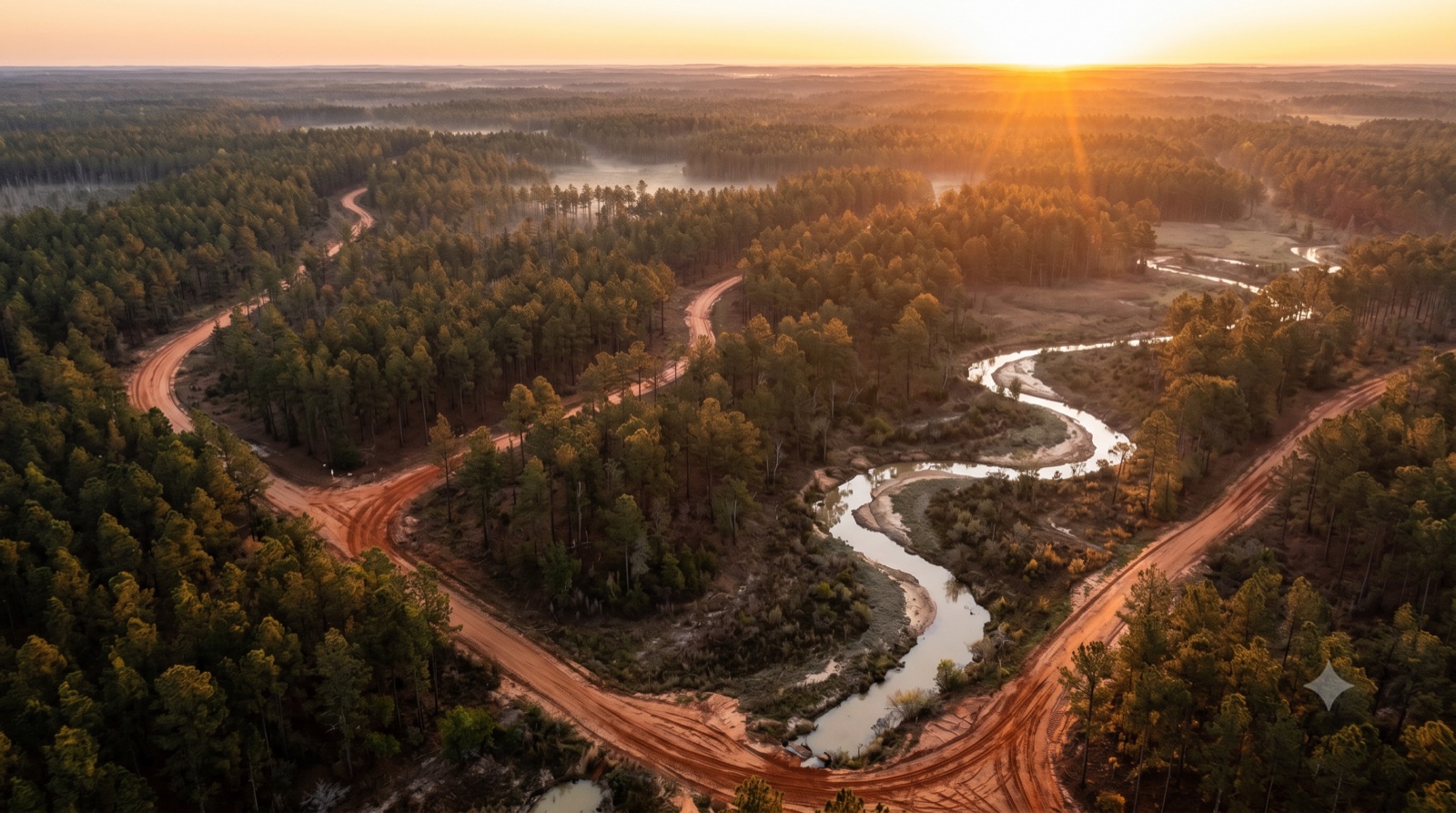
Sell My Land in Coffee County AL - What Landowners Need to Know
Key Takeaways
- Coffee County is growing, not shrinking: The county rose from 49,948 residents in the 2010 Census to 53,465 in 2020 — a 7.0% gain — with U.S. Census Bureau data putting the count near 56,358 by 2024. That makes it an outlier among the rural Southern counties where vacant land typically sits unsold, and the growth is concentrated in and around Enterprise rather than spread evenly across the county
- This is poultry country, not peanut country: Poultry and eggs alone accounted for $353,401,000 of Coffee County's $393,123,000 in total 2022 agricultural sales — roughly 90% of everything the county sells — ranking 4th among Alabama's 67 counties, according to the USDA 2022 Census of Agriculture. Cotton and cottonseed brought $9,769,000, and peanuts do not appear as a named dollar line item at all
- Alabama's carrying costs are among the nation's lowest: Coffee County's effective property tax rate is reported between roughly 0.36% and 0.43% depending on the source and methodology, and the state deed recording tax is $0.50 per $500 of consideration under Alabama Department of Revenue rules — a materially cheaper place to hold and transfer land than most states
How Can You Sell Land in Coffee County Alabama?
You can sell land in Coffee County by listing with a local agent, selling by owner, or requesting a direct cash offer — but every path closes through a licensed Alabama attorney, because Alabama Code § 34-3-6 restricts title examination and deed preparation to attorneys. Before you start, verify your legal description at the Coffee County Probate Office and confirm your tax and Current Use status with the Revenue Commissioner. Coffee County covers roughly 680 square miles of the southeast Alabama Wiregrass, and it is unusual among the rural markets we work in: its population is rising, not falling.
That growth story comes with a catch worth understanding before you set expectations. The county's population gain is anchored by Enterprise — which straddles the Coffee–Dale county line and sits adjacent to Fort Rucker, the Army's aviation post — while the rural western reaches around Elba, Kinston, and New Brockton remain thinly populated farm and timber country. A buildable lot near Enterprise and a 60-acre cutover tract outside Elba are not the same market, even though they share a county courthouse and a tax rate.
This guide covers Coffee County's property tax mechanics and the Current Use rollback, the two-courthouse recording system and Alabama's attorney-required closing, how the county compares to its neighbors, and the practical options available to landowners ready to sell. For the statewide picture, start with our guide on how to sell land in Alabama, and for land articles across the region, explore our blog.
What Are the Tax Costs of Holding Land in Coffee County?
Vacant, non-owner-occupied land in Alabama is Class II property, assessed at 20% of fair market value, while agricultural and forest land enrolled in Current Use drops to Class III at 10% — a difference that roughly halves the assessed base on qualifying rural acreage. Alabama's overall property tax burden is among the lowest in the country, so the annual bill on a vacant Coffee County parcel is usually modest in absolute terms. It is still a recurring cost against an asset producing no income.
Published effective rates for Coffee County vary by source and methodology, and they are not reconcilable into a single number. Tax-Rates.org reports an average effective rate near 0.36%, based on a median annual bill of about $415 against a median home value near $116,700. Ownwell reports a median effective rate of about 0.43%, working from a median bill near $710 and a median home value of $158,400. PropertyTaxPeek lands between them at roughly 0.41%. All three agree on the direction: well below the national median.
How Property Tax Bills Add Up for Vacant Land
Your actual bill depends on which millage district the parcel sits in. Coffee County publishes its rates directly: unincorporated county land is levied at 34 mills, while Elba is 38 mills, New Brockton 39, Kinston 41, and Enterprise 43.5. Those totals build from a state levy of 6.5 mills plus a county levy of 10.5 mills, with school and municipal levies stacked on top. A parcel just outside a town line and one just inside it can carry meaningfully different annual costs.
Beyond taxes, vacant landowners face liability exposure, boundary and fence-line maintenance, and the carrying cost of an illiquid asset. If you have fallen behind, our guide on selling land with back taxes explains the options before the county schedules a sale. If the parcel came to you through an estate, how to sell inherited land walks through the sequence.
Current Use Valuation and the Three-Year Rollback
Alabama's Current Use program under Code of Ala. § 40-7-25.1 lets qualifying agricultural and forest land be assessed on its use value rather than its market value, which is why so much Coffee County acreage carries a small tax bill. Applications are filed with the county assessing official between October 1 and January 1, and once approved the classification carries forward without annual reapplication unless ownership changes.
The part that matters at closing is the rollback. When property converts out of Current Use qualification — including conversion within two years of a sale — the assessing official recaptures three years of back taxes, computed on the higher of the sale price or fair market value for the three years preceding the October 1 following conversion. If your land is enrolled and the buyer intends a non-qualifying use, that recapture is a real line item. Ask the Revenue Commissioner's office how your parcel is currently classified before you agree to terms, and see how property tax reassessment affects selling land for the broader mechanics.
What Zoning and Closing Rules Apply to Coffee County Land?
Land-use control in Coffee County is municipal, so requirements depend on whether your parcel sits inside a city limit or in the unincorporated county. Enterprise, Elba, New Brockton, and Kinston each administer their own ordinances; unincorporated rural acreage is generally far less restricted. Confirm the specifics with the municipality your land falls within before marketing it as buildable or subdividable.
Alabama's Attorney-Required Closing Process
Under Alabama Code § 34-3-6, examining title, preparing deeds, and certifying clear title are the practice of law and must be handled by a licensed Alabama attorney. Title companies commonly perform search and administrative work alongside the closing attorney, but the legal document work is not optional. A typical Coffee County land sale runs:
- Purchase agreement: Buyer and seller execute a contract covering price, earnest money, contingency periods, and closing date. For raw land, address access, mineral rights, and any timber or hunting lease explicitly
- Title examination: An attorney or abstractor traces the chain of title through Probate Court records
- Deed preparation: The closing attorney drafts the warranty, special warranty, or quitclaim deed and supporting documents
- Deed recording tax: Alabama imposes $0.50 per $500 of consideration, or fraction thereof, collected at recording — $100 on a $100,000 sale, per the Alabama Department of Revenue. The mortgage recording tax, where financing is involved, is $0.15 per $100 of indebtedness
- Recording: The deed is recorded with the Coffee County Probate Office, making the transfer public record
Alabama statute does not assign the recordation tax to buyer or seller, so who pays is a matter of local custom and negotiation rather than law. For the full document checklist, see paperwork needed to sell land.
Two Courthouses: Where Your Deed Gets Recorded
Coffee County is one of Alabama's split-courthouse counties. Created in 1841 from Dale County, it maintains two full courthouses — Elba, the county seat in the west, and Enterprise, the larger city in the east — both operating under the same Probate Judge. The Probate Office publishes locations at 230-P North Court Street, Elba, AL 36323, (334) 897-2211, and 101 South Edwards Street, Enterprise, AL 36330, (334) 347-2688. Jodee R. Thompson serves as Probate Judge, per the Alabama Secretary of State's county officials listing and the county's own directory.
Assessment and tax collection run through the Revenue Commissioner, Ronald L. Burns, whose office publishes an Elba location at 230 R Court Street, Elba, AL 36323, (334) 897-2475 and an Enterprise location at 99 S. Edwards Street, Enterprise, AL 36331, (334) 347-8734, with mapping and appraisal at 1085 E. McKinnon Street in New Brockton. One caution worth knowing: the county's general directory page lists a different Enterprise address and phone for the Revenue Commissioner than the office's own website does. Use the numbers published by the Revenue Commissioner's office itself, and call before mailing anything.
How Does Coffee County Compare to Neighboring Alabama Counties?
Coffee County stands out from its neighbors on population direction: it is growing while much of the surrounding Wiregrass is flat or declining. Covington County to the west, for example, sits near 37,635 with a slightly negative recent trend. That difference traces largely to the Enterprise–Fort Rucker corridor rather than to anything happening on rural farmland.
| Factor | Coffee County | Dale County | Geneva County | Covington County |
|---|---|---|---|---|
| Population | 53,465 (2020); ~56,358 (2024 est.) | 49,326 (2020) | 26,383 (2020); ~27,259 recent est. | ~37,635 (2025 est.) |
| Population trend | Growing (+7.0% 2010–2020) | Roughly flat | Roughly flat | Slightly declining |
| Effective tax rate | ~0.36%–0.43% (source-dependent) | ~0.32%–0.42% | ~0.29%–0.35% | ~0.31%–0.33% |
| Defining land character | Broiler poultry, cotton, hay; two courthouses | Hosts the main Fort Rucker post; military-driven | Balanced peanut, cotton, cattle and poultry mix | Notable timberland acreage |
A note on Fort Rucker, because the naming has changed twice recently and it affects how people search: the installation was renamed Fort Novosel in 2023, then redesignated Fort Rucker on June 11, 2025, now honoring World War I aviator Captain Edward W. Rucker. Just as importantly, the main post sits primarily in Dale County, not Coffee — roughly 64,500 acres of government land spreads into Coffee, Geneva, and Houston counties, but Coffee County's relationship to the base is proximity through Enterprise, not hosting it.
Why a Growing County Can Still Have a Slow Rural Land Market
The 2022 USDA Census of Agriculture shows what Coffee County's rural acreage actually does, and it is not what most people assume. Livestock, poultry, and products generated $365,370,000 of the county's $393,123,000 in total agricultural sales — 93% — with poultry and eggs alone at $353,401,000. The county held 11,899,483 broilers and other meat-type chickens at the end of 2022, against 22,928 cattle. Crops contributed just $27,753,000, or 7%. By acreage the picture is more familiar — cotton at 12,825 acres, hay at 12,054, peanuts at 8,844 — but by dollars, peanuts do not register as a named line item.
That concentration matters to a seller. A poultry operation's value sits in its houses and its grower contract, not in bare dirt, so the buyer pool for an unimproved tract is narrower than the county's headline farm-sales figure suggests. Meanwhile the farm base itself is consolidating: Coffee County recorded 666 farms in 2022, down 15% from 2017, on 133,040 acres of farmland, down 25% — about 31% of the county's land area. Average farm size fell to 200 acres. Fewer, and fewer buyers among them.
We found no published days-on-market or absentee-ownership data separating the Enterprise submarket from the rural western county, so treat that split as a reasonable reading of the population and agricultural data rather than a measured market statistic. If your tract carries merchantable pine — woodland inside county farms totaled 45,461 acres — our guides on selling timberland and selling hunting land cover what drives value for those parcels.
What Are Your Options for Selling Land in Coffee County?
Your realistic options are an agent listing, a for-sale-by-owner effort, or a direct cash sale — and which fits depends far more on where your parcel sits and what shape it is in than on the county's growth rate. Rising population helps parcels near Enterprise with road frontage and utilities. It does very little for a landlocked 40 acres outside Kinston.
Before pursuing any path, verify your legal description and recorded easements through the Coffee County Probate Office (Elba, (334) 897-2211; Enterprise, (334) 347-2688), and confirm your tax status and Current Use classification with the Revenue Commissioner (Elba, (334) 897-2475; Enterprise, (334) 347-8734). If the land came to you as an out-of-area heir, our guide to selling land as an out-of-state owner covers closing remotely in an attorney state.
Listing with a local agent who knows Wiregrass farm and recreational property gives you the widest exposure, particularly for parcels with road frontage near Enterprise. Commissions of roughly 5–6%, plus closing costs, reduce net proceeds, and rural tracts can carry long marketing periods even in a growing county. Our guide on whether you need a realtor to sell land weighs the tradeoffs.
Selling by owner avoids commission but puts marketing, disclosures, buyer screening, and attorney coordination on you. Online land platforms reach out-of-state buyers, though parcels with access problems remain difficult — see selling landlocked land if that describes your tract. To understand what actually drives value here, start with how much is my land worth.
For landowners who want to avoid extended timelines and ongoing carrying costs, companies like Jerez Land make direct cash offers priced individually to the parcel — a firm written number, not a range or a formula. We absorb the carrying costs, marketing expense, and resale risk, and we coordinate with the Alabama closing attorney. Request a cash offer to see what your parcel is worth to a direct buyer.
Frequently Asked Questions
I own vacant land in Coffee County AL and want to sell — where do I start?
Start by verifying your legal description and any recorded easements at the Coffee County Probate Office, which has locations in Elba at 230-P North Court Street, (334) 897-2211, and Enterprise at 101 South Edwards Street, (334) 347-2688. Then confirm your tax status and whether the parcel is enrolled in Current Use with the Revenue Commissioner. Alabama requires a licensed attorney for title work and deed preparation, so line that up before you market the land.
I've been holding rural land near Elba for years — what am I actually paying in property taxes?
Vacant non-owner-occupied land is Class II property assessed at 20% of fair market value, dropping to Class III at 10% if enrolled in Current Use. Coffee County's effective rate is reported between about 0.36% and 0.43% depending on the source. Your bill depends on millage district: unincorporated county land is levied at 34 mills, Elba at 38, New Brockton at 39, Kinston at 41, and Enterprise at 43.5.
My Coffee County land is enrolled in Current Use — what happens to that when I sell?
If the property converts out of Current Use qualification, including conversion within two years of a sale, Alabama recaptures three years of back taxes under Code of Ala. § 40-7-25.1. The recapture is computed on the higher of the sale price or fair market value for the three years preceding the October 1 following conversion. Ask the Coffee County Revenue Commissioner how your parcel is classified before agreeing to terms, because that rollback comes out of your net proceeds.
I inherited land in Coffee County but live out of state — can I sell without traveling to Alabama?
Yes. Alabama closings are handled by a licensed attorney who can coordinate title examination, deed preparation, and funding remotely, and documents can generally be signed before a notary where you live and returned for recording. You will need the legal description and tax status verified through the Coffee County Probate Office and Revenue Commissioner, both of which maintain offices in Elba and Enterprise.
Is an attorney required to close a land sale in Alabama?
Yes. Alabama Code § 34-3-6 restricts examining title, preparing deeds, and certifying clear title to licensed Alabama attorneys. Title companies commonly handle search and administrative work alongside the closing attorney, but the legal document work cannot be done by a non-attorney. Budget for attorney involvement on every Alabama land sale, including cash transactions.
Is Coffee County's population growing or declining?
Growing. Coffee County rose from 49,948 residents in the 2010 Census to 53,465 in 2020 — a 7.0% increase — with U.S. Census Bureau data putting the count near 56,358 by 2024. That growth is concentrated in and around Enterprise, adjacent to Fort Rucker, rather than distributed across the rural western portion of the county around Elba, Kinston, and New Brockton.
Disclaimer: This article is for informational purposes only and does not constitute legal, financial, or professional advice. Laws and regulations vary by jurisdiction and change over time. Always consult with qualified professionals before making land purchase decisions. Jerez Land is not responsible for actions taken based on this information.