
Sell My Land in Washington County NC - What Landowners Need to Know
Key Takeaways
- North Carolina charges a $2-per-$1,000 excise tax on deeds: Sellers pay $1 per $500 of the conveyed property value (equivalent to $2 per $1,000) to the Register of Deeds at closing, per N.C. Gen. Stat. § 105-228.30, according to HomeLight's North Carolina transfer tax guide
- Washington County is one of North Carolina's fastest-shrinking counties: Its population fell roughly 16.3% from 2010 to 2020, dropping from 13,228 residents to 11,003, according to U.S. Census Bureau data — one of the steepest percentage declines of any county in the state
- The county is a mix of working farmland, pocosin timberland, and water: Spanning roughly 424 square miles along the Albemarle Sound and Roanoke River, Washington County pairs flat coastal-plain crop fields with extensive pocosin peat wetlands and managed timber tracts, per NCpedia and the 2022 USDA Census of Agriculture — a landscape where most acreage is farm, forest, or swamp rather than house lots
How Can You Sell Land in Washington County North Carolina?
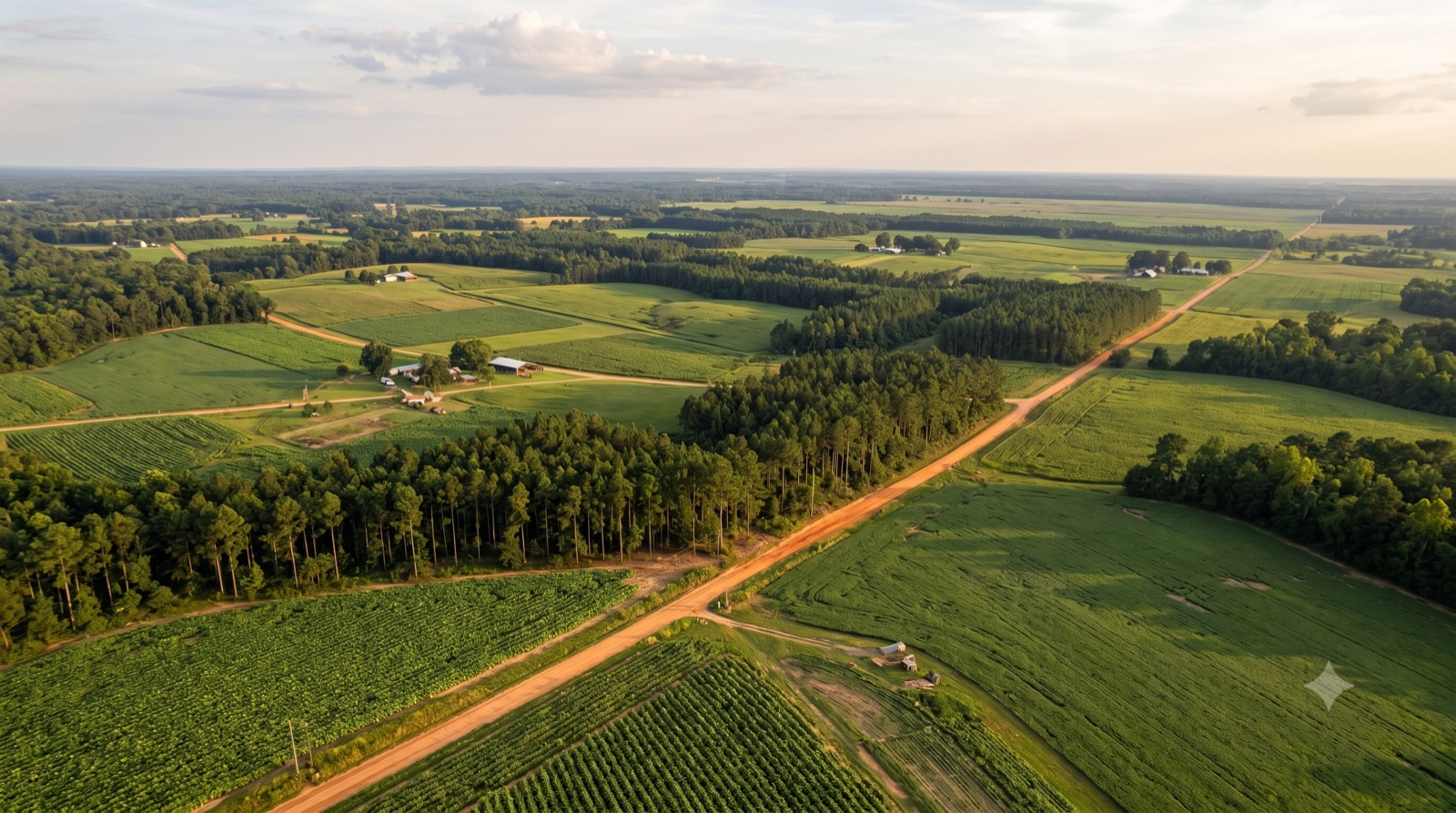
You can sell land in Washington County, North Carolina through three main paths: listing with a real estate agent for broad MLS exposure, selling FSBO through online land platforms, or working with a direct cash buyer to avoid a long holding period. Closings are supervised by a North Carolina attorney, the seller pays a $2-per-$1,000 excise tax, and if your land is enrolled in the Present-Use Value program, deferred taxes may become due at closing. Selling land in Washington County, North Carolina means selling into a thin, sparsely populated market on the southern shore of the Albemarle Sound. With roughly 11,003 residents across about 424 square miles, Washington County is one of the least populated and fastest-shrinking counties in the state. The land itself is a patchwork of flat coastal-plain farm fields, hardwood and pine bottomland along the Roanoke River, and vast pocosin peat wetlands — including a share of the 110,000-acre Pocosin Lakes National Wildlife Refuge and 16,000-acre Lake Phelps inside Pettigrew State Park, according to NCpedia. For landowners, that geography shapes everything: who the likely buyers are, how parcels are valued, and how a closing is handled under North Carolina's attorney-supervised system.
Understanding Washington County's attorney-closing requirement, property tax system, and Present-Use Value deferred-tax rollback is essential before you list or make a sale. This guide explains North Carolina's property tax system and the PUV program that shelters most working farm and forestland here, covers the state's attorney-closing requirement and how it affects your timeline, compares Washington County to neighboring Tyrrell, Martin, and Beaufort counties, and walks through the practical steps to closing. For a broader overview of the process across the state, visit our guide on how to sell land in North Carolina.
What Are the Property Tax and Carrying Costs of Holding Land in Washington County?
North Carolina assesses all real property — including vacant land — at 100% of fair market value, unlike states that apply fractional assessment ratios. The county then applies its rate per $100 of that assessed value. According to the North Carolina Department of Revenue's 2025-2026 county tax rate schedule, Washington County's rate is $0.8500 per $100 of assessed value, with the county's most recent reappraisal in 2021 and the next scheduled for 2029. Because assessed values are set to true market value, that rate applies to the full appraised value of a parcel — not a discounted fraction of it.
For comparison, PropertyTax101 reports a median effective property tax rate of roughly 0.97% of property value in Washington County, against a national median closer to 1.0%. With a relatively low median tax bill in absolute dollars — reflecting modest property values in this rural, agricultural tax base — carrying costs on idle land are usually small in dollar terms but persist year after year on a parcel that may take a long time to sell.
How the Present-Use Value (PUV) Program Can Reduce Your Tax Bill
North Carolina's Present-Use Value program, authorized under N.C. Gen. Stat. §§ 105-277.2 through 105-277.7, allows qualifying agricultural, horticultural, and forestland to be assessed on its income-producing value rather than market value. According to the NC Forest Service, this program can reduce property taxes by up to 90% for eligible parcels. The NCDOR's Use-Value Manual caps agricultural land use-value rates at no more than $1,200 per acre for the best classification tier — a tax use-value figure, not a market price — and forestland is capitalized at a fixed 9% rate set by statute. In a county dominated by crop farms and managed timber, a large share of Washington County's rural acreage sits under PUV enrollment.
To qualify, a parcel must meet minimum acreage thresholds — 10 acres for field crops or pasture, 5 acres for horticultural use, and 20 acres under a qualified timber management plan — and agricultural and horticultural land must generate at least $1,000 in gross annual income. Applications are due by January 31 each year with the county Tax Office. If ownership changes or the land is converted to a non-qualifying use, deferred taxes from the current year plus the three prior years become immediately due with interest — a "rollback" that can be a meaningful, often overlooked cost when an enrolled farm or timber tract changes hands.
For landowners carrying back taxes on a Washington County parcel, resolving delinquency before listing is important because a tax lien will appear in any title search and must be satisfied at closing.
Washington County Tax Office Contact
Washington County Tax Office | Washington Co. Courthouse, 120 Adams St., P.O. Box 1007, Plymouth, NC 27962 | Phone: (252) 793-1176 | Tax Administrator: Sherri Wilkins | Website: washconc.org/tax-office
What Closing and Zoning Requirements Apply in Washington County?
North Carolina is an attorney-close state. Under established North Carolina case law and State Bar opinions, a licensed North Carolina attorney must conduct or supervise every real estate closing — including reviewing title, preparing the deed, coordinating payoffs, and recording the deed with the Register of Deeds. A title company can issue title insurance but cannot replace the attorney's legal role.
The closing sequence for a Washington County land sale typically works as follows: the buyer's (or seller's, if agreed) attorney orders a title search through Washington County's deed records, resolves any clouds on title, prepares a warranty deed, and schedules the closing. The seller pays the excise tax — $1 per $500 of the sale price, or $2 per $1,000 — directly to the Register of Deeds when the deed is recorded. This tax is conventionally a seller cost in North Carolina transactions, according to HomeLight's transfer tax analysis. For a parcel selling at $50,000, the excise tax obligation would be $100. Our guide on the paperwork needed to sell land covers the documents you'll want ready before closing.
Zoning, Wetlands, and Permitting in Washington County
Washington County administers planning and land-use through its county offices, with most unincorporated acreage carrying rural or agricultural designations. The defining wrinkle here is water and wetlands: much of the county is low, flat pocosin and bottomland, and a significant portion drains through managed canals or sits inside or beside protected refuge land. A buyer evaluating a tract has to know what is uplands, what is jurisdictional wetland, and what can actually be built on or farmed. Parcels with substantial wetlands may face federal and state permitting limits on filling or development, and timber tracts are subject to forestry best-management practices. For any proposed land-use change — subdividing, placing a manufactured home, or constructing a building — confirm permitting requirements with the county and verify wetland status before assuming a parcel is buildable.
Washington County Register of Deeds | 120 Adams St., P.O. Box 1007, Plymouth, NC 27962 | Phone: (252) 793-2325 | Register of Deeds: Timothy J. Esolen
How Does Washington County Compare to Neighboring North Carolina Counties?
Washington County's population fell from 13,228 in the 2010 Census to 11,003 in 2020 — a decline of roughly 16.3%, one of the steepest percentage drops of any county in the state — and the trend has continued in the years since, according to U.S. Census Bureau data. The decline reflects a long pattern of out-migration as younger residents leave for larger metros and the local farm and timber economy supports fewer jobs than it once did. Its three rural neighbors face many of the same pressures.
| Factor | Washington County | Tyrrell County | Martin County | Beaufort County |
|---|---|---|---|---|
| Population (2020 Census) | ~11,003 | ~3,245 | ~22,440 | ~44,900 |
| Population trend | Declining (−16.3% 2010–2020) | Declining | Declining | Roughly stable |
| County tax rate (per $100) | $0.8500 | $0.8700 | ~$0.8500 | $0.4450 (post-2025 reappraisal) |
| Land character | Coastal-plain farm, pocosin, timber | Pocosin & swamp, very sparse | Coastal-plain farm & timber | Farm, river & sound frontage |
| Key selling challenge | Thin market; population loss; wetlands | Tiny buyer pool | Rural ag market, slow turnover | Larger but uneven demand |
The largest sectors of the Washington County economy are tied to agriculture, food and forest-products manufacturing, public administration, and health care, according to Data USA. Much of the private employment base is connected to the land — row-crop farming, timber, and the processing that supports them — which means the pool of local buyers for a random vacant or wooded parcel is small and shrinks further each year as the population declines.
Washington County's modest median household income and elevated poverty rate, relative to state and national figures reported by Data USA, reflect the economic pressures that make it difficult for many local landowners — particularly retiring or aging family-farm and timber owners — to keep non-productive or marginal acreage on the books long-term. For context on land valuation, see our guide on how much is my land worth.
Motivated-Seller Signals in Washington County
Several patterns concentrate motivated sellers in Washington County. With a shrinking, aging population and a land base that is mostly farm, forest, and wetland, a steady stream of rural parcels passes to heirs each year. Many of those heirs have moved away — a back field, a cutover timber tract, or a low pocosin parcel with limited access is something they have no intention of farming or managing. As farm operations consolidate and timber owners age out, those leftover and hard-to-reach tracts — too wet to build on, too small to log economically, or burdened with PUV rollback exposure — are exactly the parcels that sit idle. The county's delinquent tax rolls and periodic tax foreclosure proceedings are administered through the Washington County Tax Office.
For more county-level land analysis across North Carolina and the Southeast, explore our blog.
What Are Your Options for Selling Land in Washington County?
In a county this small and this rural — losing population year after year, with a land base dominated by farm fields, pocosin, and timber — a vacant or wooded parcel can be genuinely hard to sell. The natural local buyers are farmers, timber operators, and hunters, and they want acreage that fits a specific use, not a low, wet remnant or a cutover tract with poor access. Understanding your options helps you choose the path that fits your timeline and financial goals.
Listing with a real estate agent gives your parcel the broadest market exposure through the MLS and land-specific platforms. Agents who know the Albemarle and inner-coastal-plain land market can reach farmers, hunters, and recreational buyers. Agent commissions typically run 5–6% of the sale price, plus the state excise tax and other closing costs, and rural tracts in a thin market can sit listed for many months — or longer. If you own farmland, timberland, or hunting land, an agent with genuine land experience matters far more than a general residential broker.
For Sale By Owner (FSBO) and online platforms like Land.com, LandWatch, and LandAndFarm let you list directly. These platforms have active audiences of land buyers, but marketing a rural parcel effectively — with boundary surveys, wetland delineation, PUV status, timber-stand information, and access documentation — requires time and knowledge of what coastal-plain buyers look for. If you live elsewhere, our guide for the out-of-state owner covers the extra logistics.
Working with a direct cash buyer like Jerez Land means skipping the listing period, agent commissions, and the uncertainty of buyer financing. We make parcel-specific, firm written offers based on a full review of your property — location, access, encumbrances, soil and use designations, wetland status, and condition — and we absorb the carrying costs, marketing expense, and resale risk. Our offers are not formulas; they reflect what we can actually do with your specific land. If you have inherited land or face PUV rollback exposure on a Washington County parcel, we are experienced working through those situations.
Request a cash offer to get a specific number on your Washington County parcel, or read our full guide on whether you need a realtor to sell land before deciding.
Frequently Asked Questions
How do I sell my land in Washington County fast?
The fastest path to closing on a Washington County parcel is working with a direct cash buyer who does not require mortgage financing. Cash closings eliminate lender timelines and can often close in two to four weeks once title is clear. Before any sale, confirm your property's legal description with the Washington County Register of Deeds, verify there are no delinquent taxes, and check whether the land is enrolled in Present-Use Value, since deferred-tax rollback may come due at closing.
I'm selling land in North Carolina — who pays the closing costs?
In North Carolina, the seller conventionally pays the excise tax (revenue stamps) at $1 per $500 of sale price, which equals $2 per $1,000. Attorney fees and title search costs are typically split by negotiation or paid by the buyer. There is no fixed statewide rule beyond the excise tax obligation, so closing cost allocation is addressed in the purchase contract.
Do I have to use an attorney to close my land sale in North Carolina?
Yes. North Carolina requires a licensed attorney to supervise every real estate closing — this is not optional or waivable by the parties. The attorney conducts the title examination, prepares the deed, coordinates the disbursement of funds, and records the deed with the county Register of Deeds. Closing cannot be completed by a title company alone.
What will my annual property tax bill be on a Washington County parcel?
Washington County's rate is $0.8500 per $100 of assessed value for fiscal year 2025-26, according to the North Carolina Department of Revenue, with the county's most recent reappraisal in 2021 and the next scheduled for 2029. Because North Carolina assesses property at 100% of market value, that rate applies to the full appraised value. Land enrolled in the Present-Use Value program may be taxed at significantly lower amounts based on income-producing capacity rather than market value.
I have land in a PUV program in Washington County — what are the tax consequences if I sell?
North Carolina's PUV program allows qualifying agricultural, horticultural, and forestland to be taxed on its income-producing value rather than market value — potentially reducing taxes by up to 90%, according to the NC Forest Service. Much of the working farm and timberland in Washington County is enrolled. If you sell PUV-enrolled land, deferred taxes from the current year and the three prior years can become due immediately at closing. This rollback obligation is a real cost that affects your net proceeds and should be factored into any offer evaluation.
I have a wet or wooded parcel in Washington County — is it hard to sell?
It can be. Washington County's land base is heavily pocosin, bottomland, and timber, and the local population is small and declining, so low, wet, or hard-to-access parcels have a limited natural buyer pool. Wetland status can restrict building and development, and these tracts often sit on the market for long periods, which is why many owners of marginal coastal-plain parcels choose a direct cash sale over an extended listing.
Disclaimer: This article is for informational purposes only and does not constitute legal, financial, or professional advice. Laws and regulations vary by jurisdiction and change over time. Always consult with qualified professionals before making land purchase decisions. Jerez Land is not responsible for actions taken based on this information.